1691: "The Silence Beyond Redshift"
Interesting Things with JC #1691: "The Silence Beyond Redshift" – A spacecraft continues receiving messages from Earth while the signals arrive slower, weaker, and increasingly redshifted. Earth never stops transmitting, but the shared conversation keeps stretching across time until the messages can no longer preserve a common present.
Curriculum - Episode Anchor
Episode Title: The Silence Beyond Redshift
Episode Number: 1691
Host: JC
Audience: Grades 9–12, Introductory College, Homeschool Learners, Lifelong Learners
Subject Area: Physics, Astronomy, Information Theory, Relativity, Scientific Philosophy
Lesson Overview
Objectives:
Explain how redshift affects communication between distant observers.
Describe how relativistic motion changes the timing and frequency of signals.
Analyze the concept of an information horizon as a communication boundary.
Evaluate the relationship between shared time, observation, and reality.
Essential Question: How does the ability to exchange information shape our understanding of distance, time, and shared reality?
Success Criteria:
Define redshift and information horizon accurately.
Explain why communication becomes increasingly difficult at relativistic speeds.
Analyze the podcast's central argument using evidence from physics.
Connect scientific concepts to human experiences of communication and separation.
Student Relevance Statement: Students rely on communication technologies daily. This lesson explores the physical limits of communication and how scientific principles affect the sharing of information across space and time.
Real-World Connection: Deep-space communication, satellite systems, interplanetary exploration, and future spacecraft missions all face signal delays and information-transfer limitations.
Workforce Reality: Aerospace engineers, physicists, communication specialists, computer scientists, and mission planners must account for signal delay, frequency shifts, and information loss when designing systems.
Key Vocabulary
Redshift (RED-shift) — The stretching of light or radio waves toward longer wavelengths and lower frequencies.
Relativity (rel-uh-TIV-uh-tee) — Einstein's description of how space, time, and motion interact.
Photon (FOH-ton) — A particle of light that carries electromagnetic energy.
Information Horizon (in-fer-MAY-shun huh-RYE-zun) — A boundary beyond which meaningful information can no longer be effectively exchanged.
Frequency (FREE-kwen-see) — The number of wave cycles occurring per second.
Electromagnetic Wave (ee-lek-troh-mag-NET-ik wave) — A traveling disturbance that includes radio waves, light, and other radiation.
Signal Degradation (SIG-nuhl deg-ruh-DAY-shun) — The loss of quality or recoverability in transmitted information.
Observer (ob-ZUR-ver) — A person or system measuring events from a particular frame of reference.
Frame of Reference (frame of REF-er-ens) — The perspective from which motion and events are measured.
Shared Present (shared PREZ-ent) — The concept of experiencing the same moment in time.
Narrative Core
Open: Imagine a spacecraft moving away from Earth so fast that the difference between its speed and the speed of light barely matters. Earth continues sending messages, but something unexpected begins happening.
Info: As distance and relativistic effects increase, radio signals become stretched. Frequencies drop, transmission rates slow, and messages require more time to arrive.
Details: Earth never stops transmitting. Photons continue traveling through space. Yet signals become increasingly redshifted and difficult to decode. Information arrives more slowly and with less usable content. From both perspectives, communication appears to fade even though transmission continues.
Reflection: The episode proposes a shift in perspective. Instead of measuring separation only by distance, we can consider separation as a reduction in shared information. Two observers may remain connected by photons while losing the ability to share a common present.
Closing: These are interesting things, with JC.
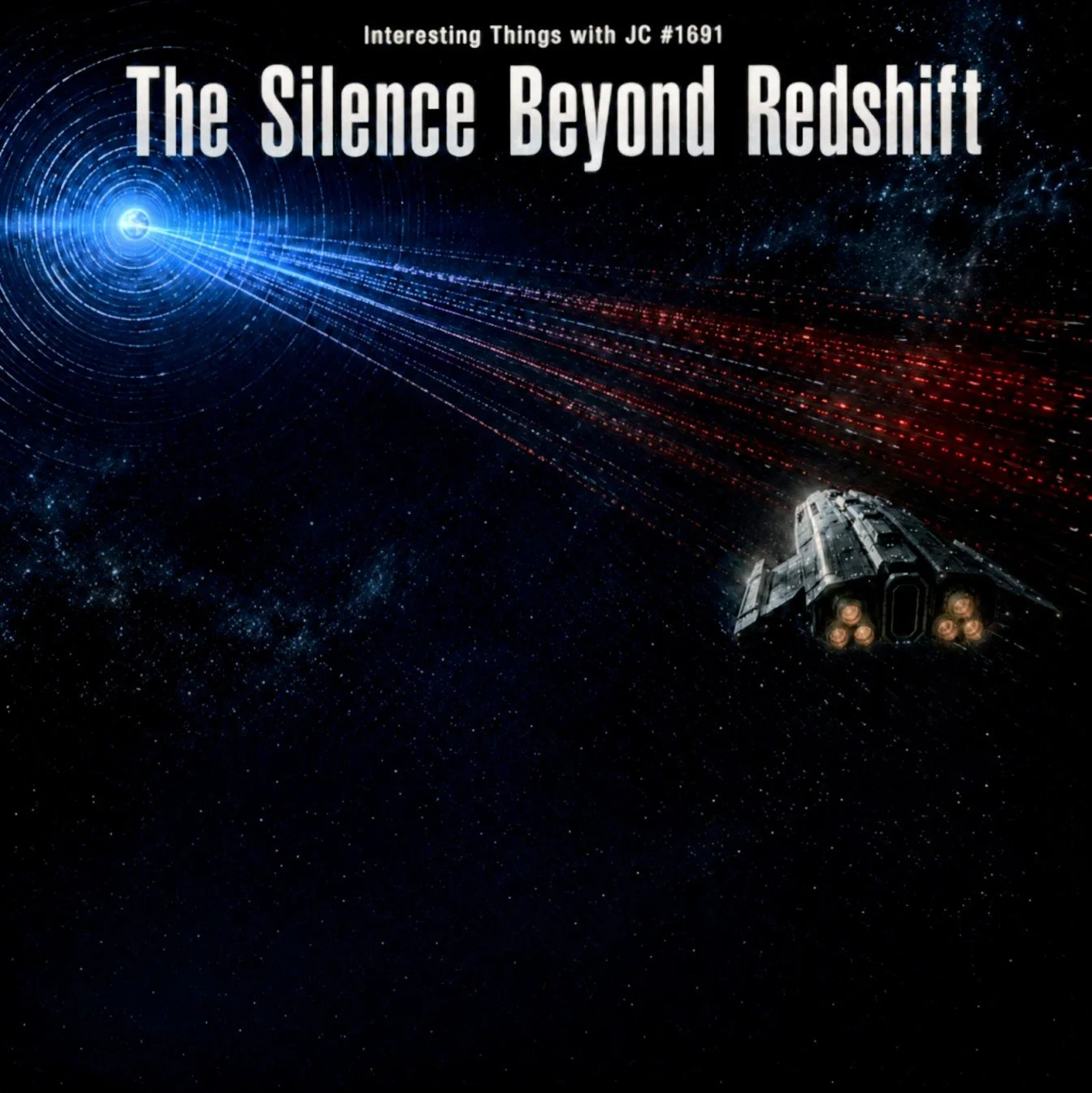
Promotional artwork for Interesting Things with JC #1691: "The Silence Beyond Redshift." Against a dark star-filled backdrop, a lone spacecraft drifts through deep space on the right side of the image. Far in the upper left, Earth appears as a small glowing blue-white point surrounded by concentric rings representing outgoing communications. Bright blue signal streams stretch across space toward the spacecraft, gradually shifting into dim red wavelengths to illustrate relativistic redshift and the fading exchange of information over vast distances. The lower third of the image is intentionally left dark and uncluttered. The overall mood is quiet, contemplative, and emphasizes cosmic isolation, distance, and the concept of an information horizon.
Transcript
Interesting Things with JC #1691:
"The Silence Beyond Redshift"
A spacecraft is heading away from Earth at a speed so close to the speed of light that the difference hardly matters.
Back home, life continues. Mission control sends updates. Families leave messages. A mother records a birthday greeting. A brother talks about a game he watched. Someone says, "Call when you can," even though everyone knows that isn't really possible anymore.
Earth hasn't gone silent.
But aboard the ship, something strange begins to happen.
The messages arrive slower and slower. Radio waves stretch as they travel. Frequencies drop. Data that once arrived in seconds now takes longer and longer to unfold as distance grows and the signals become increasingly redshifted. Eventually the transmissions stretch so far across time that the ship's computers may struggle to recognize them as meaningful messages at all.
From Earth, communication is still happening. From Earth's perspective, the ship is fading too—its messages arriving later, slower, and more distorted.
Or perhaps distance isn't the whole story.
Suppose the journey is defined not by how far apart two places become, but by how much information they can still share.
The observable facts don't change. Earth's signals continue to arrive weaker, slower, and more redshifted. Redshift is nature's version of a lowering pitch. Just as a passing siren sounds deeper as it moves away, light from distant galaxies becomes stretched and redder as they move away from us. By measuring that change, scientists can estimate their speed and distance.
What changes is the picture.
The crew isn't losing contact because Earth stopped transmitting. They're losing contact because Earth is slipping beyond an information horizon.
The photons still arrive, even when the message becomes impossible to recover. The channel remains open while the shared reality begins to fade.
In that sense, the blackout isn't really a communication failure.
It's the gradual loss of a common present.
Earth is still speaking. The crew is still listening. But eventually the conversation stretches so far across time that neither side can truly inhabit the same moment anymore.
And perhaps the deepest separation in the universe isn't measured by distance at all, but by the moment two observers can no longer share the same now.
These are interesting things, with JC.
Student Worksheet
Comprehension Questions
What happens to radio signals as the spacecraft moves farther away at relativistic speeds?
Why do messages take longer to arrive aboard the spacecraft?
What is meant by the term "information horizon" in the episode?
Does Earth stop transmitting messages? Explain.
What is the episode's definition of the deepest separation between observers?
Analysis Questions
How does the concept of an information horizon differ from a physical boundary?
Explain how redshift affects the ability to recover information from a signal.
Evaluate the statement: "The blackout isn't really a communication failure."
Reflection Prompt
Describe a situation where communication continued but shared understanding was lost. Compare it to the episode's discussion of a common present.
Difficulty Scaling
Foundational: Complete comprehension questions.
Intermediate: Answer analysis questions with evidence from the transcript.
Advanced: Write a one-page explanation connecting relativity, information theory, and human communication.
Student Output
Written responses using complete sentences.
Evidence cited from the transcript.
Clear scientific reasoning.
Academic Integrity Guidance
Use your own words.
Support conclusions with evidence.
Distinguish between observations from the episode and personal interpretations.
Teacher Guide
Quick Start: Play the podcast first. Have students record one idea about communication they found surprising.
Pacing Guide (Audio-First):
Bell Ringer (5 min)
Podcast Listening (5 min)
Vocabulary Review (10 min)
Worksheet Activities (15 min)
Discussion (10 min)
Assessment and Exit Ticket (5 min)
Bell Ringer: Ask students: "Is distance the only thing that separates people?"
Audio Guidance: Encourage students to identify scientific concepts and metaphorical ideas while listening.
Audio Fallback: Read the transcript aloud and pause after major sections for discussion.
Time-on-Task: Approximately 50 minutes.
Materials:
Podcast audio or transcript
Student worksheet
Writing materials
Vocabulary Prep: Review redshift, frequency, observer, and information horizon before listening.
Misconceptions:
Redshift does not mean signals disappear instantly.
Information can arrive while becoming increasingly difficult to decode.
Communication delay is not necessarily communication failure.
Discussion Prompts:
Can information define separation better than distance?
What does it mean to share a common present?
How might future interstellar missions handle communication challenges?
Formative Checkpoints:
Vocabulary understanding
Accurate explanation of redshift
Identification of the episode's central claim
Differentiation:
Provide vocabulary supports for emerging learners.
Allow verbal responses when appropriate.
Offer extension writing for advanced learners.
Assessment Differentiation:
Written, oral, or visual explanation options.
Extended time if needed.
Time Flexibility:
Condensed 30-minute version focuses on listening and discussion.
Extended 75-minute version adds research activities.
Substitute Readiness: Lesson can be completed using only the transcript and worksheet.
Engagement Strategy: Ask students to imagine sending messages to a spacecraft traveling for generations.
Extensions:
Research relativistic Doppler shift.
Investigate communication delays with Mars missions.
Compare information horizons with event horizons around black holes.
Cross-Curricular Connections:
Physics
Astronomy
Philosophy
Communication Studies
SEL Connection: Explore how communication influences relationships and understanding.
Skill Emphasis:
Critical thinking
Scientific reasoning
Evidence evaluation
Communication
Answer Key:
Signals become stretched and redshifted.
Increasing distance and relativistic effects slow information arrival.
A boundary where meaningful information exchange becomes impractical.
No; Earth continues transmitting.
The inability to share the same present moment.
6–8. Responses should reference information loss, redshift, and shared reality concepts.
Quiz
Which physical effect causes frequencies to become lower as signals stretch?
A. Reflection
B. Redshift
C. Refraction
D. PolarizationAccording to the episode, Earth:
A. Stops transmitting
B. Loses power
C. Continues sending messages
D. Changes locationAn information horizon refers to:
A. A mountain range
B. A physical wall
C. A spacecraft shield
D. A limit to meaningful information exchangeWhat continues to arrive even after messages become difficult to recover?
A. Asteroids
B. Gravitational waves
C. Photons
D. SatellitesThe episode suggests the deepest separation occurs when:
A. Distance reaches a maximum
B. Fuel runs out
C. Gravity disappears
D. Observers can no longer share the same now
Assessment
Open-Ended Questions
Explain how redshift affects communication between Earth and a near-light-speed spacecraft.
Analyze the idea that separation can be measured by shared information rather than physical distance.
Rubric (3–2–1)
3 – Proficient
Accurate scientific explanation
Strong use of evidence
Clear reasoning
2 – Developing
Mostly accurate explanation
Some supporting evidence
Partial reasoning
1 – Beginning
Limited accuracy
Minimal evidence
Incomplete reasoning
Exit Ticket
In one or two sentences, explain why Earth and the spacecraft eventually lose their shared present despite continued communication.
Standards Alignment
NGSS HS-PS4-1: Wave Properties
Students analyze how electromagnetic waves carry information.
Measurable Skill: Explain how redshift alters signal frequency.
Alignment: Vocabulary, worksheet analysis, and assessment tasks.
NGSS Science and Engineering Practice: Analyzing and Interpreting Data
Students evaluate communication changes over distance and time.
Measurable Skill: Interpret evidence from the transcript.
Alignment: Analysis questions and discussion.
CCSS.ELA-LITERACY.RST.11-12.2
Determine central ideas of scientific texts.
Measurable Skill: Identify and summarize the episode's primary argument.
Alignment: Worksheet and assessment.
CCSS.ELA-LITERACY.RST.11-12.4
Determine meaning of scientific terminology.
Measurable Skill: Apply vocabulary accurately.
Alignment: Vocabulary and quiz.
CCSS.ELA-LITERACY.WHST.11-12.1
Write arguments supported by evidence.
Measurable Skill: Defend interpretations of information horizons.
Alignment: Reflection and assessment.
CCSS.ELA-LITERACY.SL.11-12.1
Participate in collaborative discussions.
Measurable Skill: Engage in evidence-based discussion.
Alignment: Discussion prompts.
C3 Framework D2.Sci.3.9-12
Evaluate evidence and explanations.
Measurable Skill: Compare competing interpretations of separation.
Alignment: Analysis activities.
ISTE Standard 1.3 Knowledge Constructor
Critically evaluate information sources.
Measurable Skill: Connect scientific concepts to evidence.
Alignment: Extension activities.
Career Readiness: Analytical Thinking
Measurable Skill: Evaluate complex systems and information flow.
Justification: Mirrors scientific and engineering decision-making.
Career Readiness: Communication
Measurable Skill: Explain technical concepts clearly.
Justification: Essential across STEM careers.
Career Readiness: Problem Solving
Measurable Skill: Analyze communication limitations.
Justification: Supports engineering design thinking.
Career Readiness: Adaptability
Measurable Skill: Consider alternative interpretations and solutions.
Justification: Reflects real-world scientific inquiry.
Career Readiness: Professional Judgment
Measurable Skill: Evaluate evidence before reaching conclusions.
Justification: Central to scientific practice.
Homeschool / Lifelong Learning Alignment
Independent learning through transcript analysis.
Information literacy through evidence evaluation.
Real-world application through communication technologies.
Self-directed inquiry through extension research.
Transferable life skills through critical thinking and reasoning.
Show Notes
This episode explores the scientific and philosophical consequences of communication across immense distances. Using the example of a near-light-speed spacecraft, learners examine redshift, information transfer, and the concept of an information horizon. The lesson encourages students to think beyond physical distance and consider how shared information shapes reality, making it valuable for physics, astronomy, communication studies, and critical thinking instruction.
References
Einstein, A. (1905). On the electrodynamics of moving bodies. https://www.fourmilab.ch/etexts/einstein/specrel/www/
National Aeronautics and Space Administration. (2024). Deep Space Network overview. https://www.nasa.gov/communicating-with-missions/dsn/
Encyclopaedia Britannica. (2025). Doppler effect. https://www.britannica.com/science/Doppler-effect
Encyclopaedia Britannica. (2025). Redshift. https://www.britannica.com/science/red-shift
OpenStax. (2024). Astronomy 2e: Relativity. https://openstax.org/details/books/astronomy-2e