1692: "Frank Gardiner Wisner"
Interesting Things with JC #1692: "Frank Gardiner Wisner" – Frank Wisner watched Soviet influence replace German influence in Romania while World War II was still being fought, and the institutions he later helped build were designed to compete in the same kind of political struggle through covert influence, organizations, media, and intelligence networks long after armies stopped moving.
Curriculum - Episode Anchor
Episode Title: Frank Gardiner Wisner
Episode Number: 1692
Host: JC
Audience: Grades 9–12, Introductory College, Homeschool, Lifelong Learners
Subject Area: History, Intelligence Studies, Cold War History, Political Science
Lesson Overview
Objectives:
Analyze Frank Wisner's role in the development of early American intelligence institutions.
Explain how World War II experiences influenced Cold War policy decisions.
Evaluate the relationship between intelligence gathering and influence operations.
Assess the long-term impact of covert action on international affairs.
Essential Question: How did Frank Wisner help shape modern American intelligence, and why did his experiences during World War II influence Cold War strategy?
Success Criteria:
Identify key events in Wisner's career.
Explain the purpose of the Office of Policy Coordination.
Describe the concept of the "Mighty Wurlitzer."
Evaluate differing historical perspectives on covert action.
Student Relevance Statement: Modern information campaigns, media influence, and international competition continue to shape global events. Understanding Wisner's work helps students recognize how governments use information and influence in addition to military power.
Real-World Connection: Intelligence agencies, diplomatic institutions, media organizations, and policy analysts continue to study the challenges Wisner confronted regarding influence, information, and national security.
Workforce Reality: Careers in intelligence, foreign service, journalism, law, military affairs, public policy, and international relations require critical thinking, ethical decision-making, and evidence evaluation.
Key Vocabulary
Office of Strategic Services (OSS)(AW-fiss uv struh-TEE-jik SUR-vuh-siz) — America's primary wartime intelligence agency during World War II.
Intelligence(in-TEL-uh-jens) — Information gathered and analyzed to support national security decisions.
Covert Action(KOH-vurt AK-shun) — Activities conducted secretly to influence events without publicly revealing sponsorship.
Cold War(KOHLD WOR) — The geopolitical competition between the United States and the Soviet Union after World War II.
Propaganda(prop-uh-GAN-duh) — Information used to influence opinions or actions.
Office of Policy Coordination (OPC)(OFF-iss uv POL-uh-see koh-or-duh-NAY-shun) — Early U.S. organization responsible for covert political operations.
Influence Operations(IN-floo-ens op-uh-RAY-shuns) — Efforts designed to shape opinions, behaviors, or political outcomes.
Clandestine Service(klan-DES-tin SUR-vis) — Secret intelligence and operational activities.
Bipolar Disorder(bye-POH-lar dis-OR-der) — A mental health condition involving significant mood changes.
Mighty Wurlitzer(MY-tee WER-lit-ser) — A metaphor describing networks used to influence public opinion and political outcomes.
Narrative Core
Open: In 1944, Frank Wisner stood in Romania and watched political power change rapidly as Nazi influence collapsed and Soviet influence expanded.
Info: His wartime experiences convinced him that future conflicts might be fought through information, alliances, and influence rather than direct military confrontation.
Details: After serving in the OSS, Wisner became a leading architect of American covert political operations. He led the Office of Policy Coordination and later helped build the CIA's clandestine service. His work supported resistance movements, media efforts, labor organizations, and intelligence networks designed to influence global events during the Cold War.
Reflection: Wisner's career raises important questions about the role of intelligence agencies, the limits of covert action, and the balance between national security and transparency. His personal struggles also remind us that public achievements can coexist with private challenges.
Closing: These are interesting things, with JC.
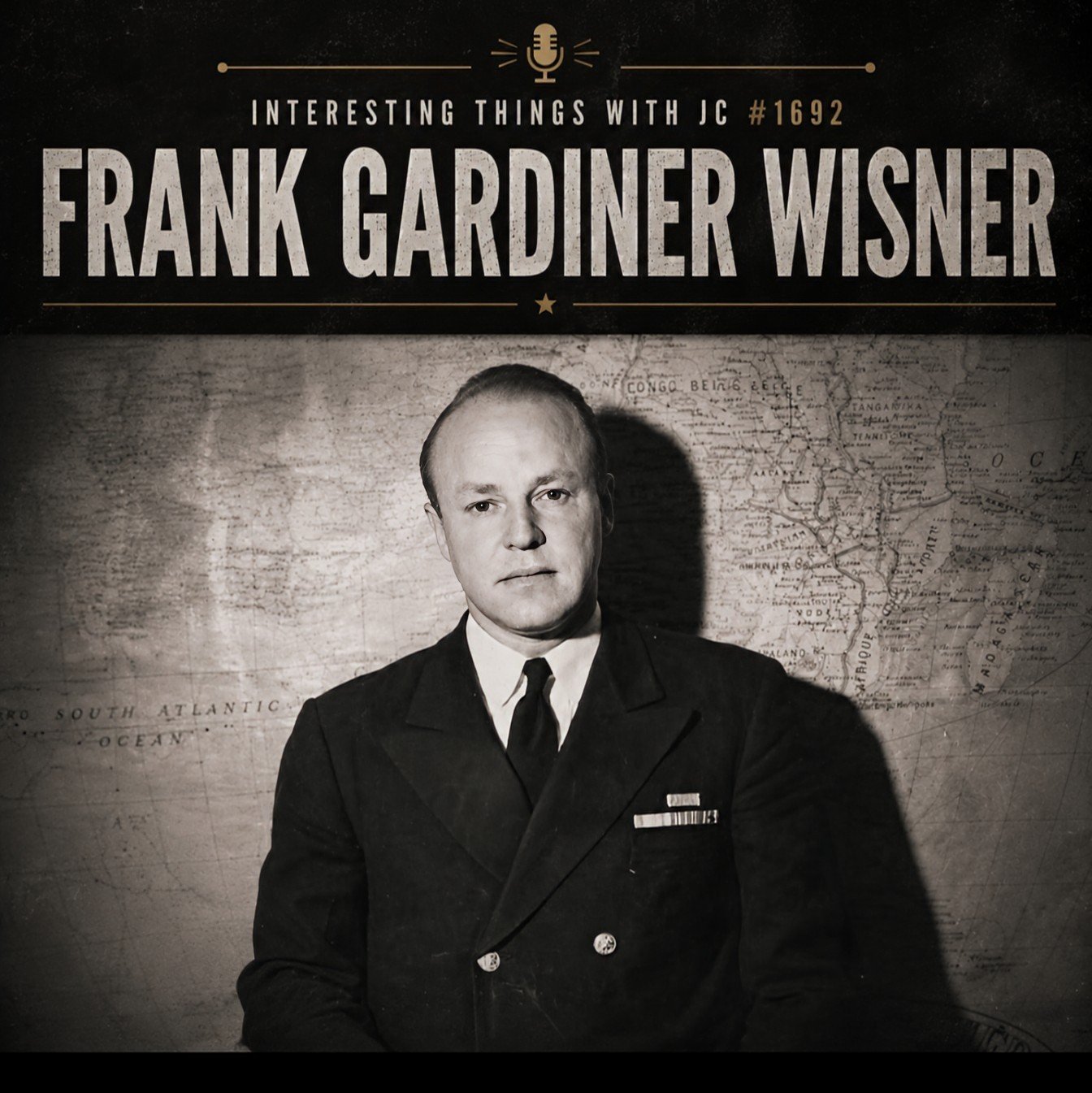
Promotional cover image for Interesting Things with JC #1692. Large text at the top reads “Frank Gardiner Wisner.” Below the title is a black-and-white portrait of a middle-aged man wearing a dark suit and tie, seated in front of a large world map. The image has a vintage, historical style with muted tones and a textured background, emphasizing the subject’s connection to international affairs and intelligence history.
Transcript
Interesting Things with JC #1692:
Frank Gardiner Wisner
In the summer of 1944, Frank Wisner found himself in a part of Europe where governments were changing faster than maps could be printed.
Romania had abandoned its alliance with Nazi Germany. Soviet forces were moving west. German influence was collapsing. Soviet influence was arriving. The war was still being fought, but power was already changing hands, and Wisner watched it happen from close enough to see how quickly one reality could replace another.
He would spend the rest of his life trying to respond to what he saw there.
Frank Gardiner Wisner was born in Laurel, Mississippi, on June 23, 1909. He graduated from the University of Virginia, built a successful career as a Wall Street lawyer, and appeared headed toward a future that looked nothing like intelligence work. Then World War II intervened.
Wisner joined the Office of Strategic Services, the OSS, America's wartime intelligence organization. During the war he was assigned to southeastern Europe, where he helped coordinate the evacuation of more than a thousand American airmen stranded in Romania after bombing missions against the Ploiești oil fields. The rescue itself was remarkable, but it was the political landscape around it that left the deeper impression.
In Eastern Europe, Wisner had watched governments fall without armies necessarily conquering them. He had watched influence operate behind official events and seen intelligence networks, propaganda, alliances, and political pressure shape outcomes before most people even realized a contest was underway. Where many Americans saw a war that had ended, Wisner increasingly saw a conflict that had simply changed form.
Today it's easy to assume the CIA was inevitable. In the late 1940s it was anything but. The United States had long been wary of permanent intelligence organizations, preferring to build wartime capabilities and then reduce them when peace returned. But Wisner belonged to a generation that believed the postwar world was becoming something new, a place where influence could matter as much as armies and where the next major struggle might be fought without a formal declaration of war.
Across Eastern Europe, Soviet influence continued to expand. Political parties, labor organizations, newspapers, radio broadcasts, and cultural institutions were becoming arenas of competition. Wisner became convinced that gathering information and negotiating agreements would no longer be enough. The world he thought he saw emerging would require institutions capable of competing for influence itself.
What made Wisner particularly effective was that he was more than an intelligence officer. Friends and colleagues described a man who could persuade, recruit, connect people, and inspire commitment. He moved comfortably through elite circles, but he also understood the power of organizations, movements, and ideas. Intelligence work attracted analysts, administrators, and specialists. Wisner was something closer to a political operator. He understood that information mattered because people mattered, and people could be influenced.
In 1948 he was chosen to lead the newly created Office of Policy Coordination. The name sounded harmless. The mission was covert political warfare.
Under Wisner, the office supported resistance movements, anti-communist organizations, publications, broadcasters, labor groups, and intelligence networks around the world. The objective was not merely to understand events but to affect them. Many intelligence officers focused on collecting information. Wisner focused on shaping outcomes.
That mindset became associated with one of the most famous phrases connected to his career: the "Mighty Wurlitzer."
The comparison came from the giant theater organs of the era. Press a key, and sound emerged from somewhere else in the building. To both admirers and critics, it became a useful metaphor for a network of publications, broadcasters, cultural organizations, and other voices that could advance American objectives without always revealing who stood behind them. Whether that represented innovative statecraft or something more troubling remains debated, but it reflected how Wisner understood the Cold War. He wasn't helping build an intelligence service whose purpose was simply to gather facts. He was helping build one designed to compete for influence.
By 1951, Wisner became Deputy Director for Plans. A year later, he oversaw the consolidation that formed the CIA's modern clandestine service. Some of the methods he championed would later appear in operations that helped shape political outcomes in places such as Iran and Guatemala, actions that supporters viewed as necessary Cold War measures and critics later cited as examples of American overreach. Many of the assumptions that guided American covert operations throughout the Cold War passed through structures he helped create.
The same qualities that made him effective also carried a cost. The Cold War demanded patience, secrecy, and constant vigilance. Successes often remained classified. Failures often remained hidden. The pressure accumulated quietly and rarely disappeared.
By 1958, Wisner suffered a severe mental health collapse. Historians generally believe he was battling bipolar disorder at a time when understanding and treatment remained limited. Though he eventually returned to government service in a reduced role, including a period as CIA station chief in London, many who knew him felt they were seeing only part of the man who had once helped drive the agency's early growth.
He retired in 1962.
Three years later, on October 29, 1965, Frank Wisner took his own life. He was 56 years old.
By then, the energetic lawyer who had entered the OSS during World War II and the driven architect of early Cold War covert action were both part of the past. Yet the institutions he helped build, the methods he championed, and the assumptions he carried home from Eastern Europe continued to shape American intelligence long after he was gone.
Today, his name is largely unknown outside intelligence circles. Yet many of the assumptions that shaped modern American intelligence can still be traced to the generation that emerged from World War II convinced the next great contest would not look like the last.
Frank Wisner was one of them.
Standing in Romania in 1944, he watched one form of power recede while another moved in to take its place. The institutions he later helped build grew from that observation. Long after his name faded from public memory, the world he believed was emerging continued to unfold.
These are interesting things, with JC.
Student Worksheet
Comprehension Questions
Where was Frank Wisner stationed during World War II?
What was the OSS?
What was the purpose of the Office of Policy Coordination?
What did the phrase "Mighty Wurlitzer" represent?
What major historical conflict shaped Wisner's worldview?
Analysis Questions
How did Wisner's experiences in Romania influence his understanding of power and influence?
Why might governments use covert action instead of military force?
What are potential benefits and risks of influence operations?
How did the Cold War differ from traditional warfare?
Reflection Prompt
Should governments attempt to influence events in other countries to protect national interests? Explain your reasoning using evidence from the lesson.
Difficulty Scaling
Foundational: Complete comprehension questions.
Intermediate: Complete comprehension and analysis questions.
Advanced: Complete all sections and write a one-page evidence-based reflection.
Student Output
Written responses using complete sentences.
Evidence from the transcript.
Reflection paragraph or essay.
Academic Integrity Guidance
Use evidence from the lesson.
Cite specific examples.
Write responses in your own words.
Distinguish facts from personal opinions.
Teacher Guide
Quick Start: Play the podcast episode, distribute the worksheet, facilitate discussion, and conclude with assessment activities.
Pacing Guide (Audio-First):
Bell Ringer (5 minutes)
Vocabulary Preview (5 minutes)
Podcast Listening (10–15 minutes)
Guided Discussion (10 minutes)
Worksheet Completion (15–20 minutes)
Assessment and Exit Ticket (10 minutes)
Bell Ringer: Ask students: "Can influence be as powerful as military force? Why or why not?"
Audio Guidance: Students should listen for examples of how power can change through influence rather than direct conflict.
Audio Fallback: If audio is unavailable, use the transcript as the primary text source.
Time-on-Task: 55–70 minutes.
Materials:
Podcast audio or transcript
Student worksheet
Writing materials
Projector or whiteboard
Vocabulary Prep: Review intelligence, covert action, propaganda, and influence operations before listening.
Misconceptions:
Intelligence agencies only gather information.
The Cold War involved constant direct military combat.
Covert operations are identical to military operations.
Discussion Prompts:
What did Wisner observe in Romania?
How can information shape political outcomes?
What responsibilities accompany secret government operations?
How should historians evaluate covert actions?
Formative Checkpoints:
Vocabulary understanding
Participation in discussion
Completion of worksheet responses
Differentiation:
Provide vocabulary supports for emerging readers.
Allow verbal responses when appropriate.
Offer guided notes for students needing additional support.
Assessment Differentiation:
Oral presentation option.
Graphic organizer option.
Extended essay option.
Time Flexibility:
Single class period lesson.
Can expand to two-day inquiry lesson.
Substitute Readiness: Transcript and worksheet allow independent implementation.
Engagement Strategy: Debate whether influence operations can be justified during periods of international competition.
Extensions:
Research the early CIA.
Compare Cold War intelligence agencies.
Examine the role of media during international conflicts.
Cross-Curricular Connections:
History
Government
Media Studies
Psychology
SEL Connection: Discuss stress, resilience, leadership pressures, and mental health awareness.
Skill Emphasis:
Critical thinking
Source analysis
Evidence evaluation
Historical reasoning
Communication
Answer Key:
Comprehension 1: Romania
Comprehension 2: America's wartime intelligence organization
Comprehension 3: Conduct covert political operations
Comprehension 4: A metaphor for influence networks
Comprehension 5: The Cold War
Analysis answers will vary but should reference evidence from the transcript.
Quiz
Which wartime organization did Frank Wisner join?
A. FBI
B. OSS
C. NSA
D. State DepartmentIn what country did Wisner observe major political changes during 1944?
A. France
B. Italy
C. Romania
D. SpainWhat was the primary mission of the Office of Policy Coordination?
A. Tax collection
B. Military training
C. Covert political warfare
D. Infrastructure planningThe phrase "Mighty Wurlitzer" referred to:
A. A military aircraft
B. A communications satellite
C. An armored vehicle
D. A network of influence operationsWhat challenge affected Wisner later in life?
A. Financial collapse
B. Political exile
C. Severe mental health struggles
D. Imprisonment
Assessment
Open-Ended Questions
Explain how Wisner's experiences during World War II influenced his approach to intelligence and covert action during the Cold War.
Evaluate the advantages and disadvantages of influence operations as described in the lesson.
Rubric (3–2–1)
3: Thorough explanation, strong evidence, clear reasoning.
2: Adequate explanation, some evidence, generally clear reasoning.
1: Limited explanation, minimal evidence, unclear reasoning.
Exit Ticket
What is one idea from today's lesson that changed your understanding of intelligence work?
What question do you still have about Frank Wisner or the Cold War?
Standards Alignment
NGSS Science and Engineering Practice: Analyzing and Interpreting Data
Students evaluate historical evidence and intelligence-related information.
Measurable Outcome: Analyze multiple forms of evidence to support conclusions.
CCSS.ELA-LITERACY.RH.11-12.1
Cite specific textual evidence to support analysis of historical sources.
Measurable Outcome: Use transcript evidence in worksheet and assessment responses.
CCSS.ELA-LITERACY.RH.11-12.6
Evaluate differing viewpoints on historical events.
Measurable Outcome: Assess supporter and critic perspectives regarding covert action.
CCSS.ELA-LITERACY.WHST.11-12.1
Write arguments focused on discipline-specific content.
Measurable Outcome: Construct evidence-based responses in assessment activities.
CCSS.ELA-LITERACY.SL.11-12.1
Participate in collaborative discussions.
Measurable Outcome: Engage in structured classroom dialogue about intelligence and influence.
C3 Framework D2.His.1.9-12
Evaluate historical sources and evidence.
Measurable Outcome: Analyze how World War II experiences shaped Cold War decisions.
C3 Framework D2.His.14.9-12
Analyze multiple and complex causes and effects.
Measurable Outcome: Connect wartime observations to institutional development.
ISTE 1.3 Knowledge Constructor
Critically curate information from diverse resources.
Measurable Outcome: Evaluate evidence presented in transcript and discussion.
ISTE 1.7 Global Collaborator
Understand issues from multiple perspectives.
Measurable Outcome: Examine competing interpretations of intelligence operations.
Career Readiness – Analytical Thinking
Evaluate information and identify patterns.
Measurable Outcome: Assess strategic decisions and outcomes.
Career Readiness – Communication
Present evidence-based arguments.
Measurable Outcome: Participate effectively in discussion and written assessments.
Career Readiness – Problem Solving
Examine complex geopolitical challenges.
Measurable Outcome: Analyze strategic responses to emerging threats.
Career Readiness – Adaptability
Understand changing international conditions.
Measurable Outcome: Explain how leaders respond to evolving circumstances.
Career Readiness – Professional Judgment
Consider ethical and strategic implications of decisions.
Measurable Outcome: Evaluate covert action from multiple perspectives.
Homeschool / Lifelong Learning Alignment
Independent learning through transcript analysis.
Information literacy through evidence evaluation.
Real-world application through intelligence and policy discussions.
Self-directed inquiry through extension research.
Transferable life skills including critical thinking and decision-making.
Show Notes
This lesson explores the life and legacy of Frank Wisner, a key figure in the creation of America's early Cold War intelligence infrastructure. Students examine how wartime experiences shaped strategic thinking, how influence became a tool of international competition, and how intelligence institutions evolved during a period of rapid global change. The lesson encourages critical evaluation of historical decisions while developing skills in evidence analysis, communication, and historical reasoning.
References
Central Intelligence Agency. (n.d.). Frank G. Wisner. https://www.cia.gov/readingroom/document/cia-rdp75-00001r000200520015-3
National WWII Museum. (n.d.). The Office of Strategic Services. https://www.cia.gov/legacy/museum/exhibit/the-office-of-strategic-services-n-americas-first-intelligence-agency/
Douglas Waller. (2025). The determined spy: The turbulent life and times of CIA pioneer Frank Wisner. Harper. https://www.cia.gov/resources/csi/static/Review-The-Determined-Spy-June-2025.pdf
Maior, G. C. (n.d.). America’s first spy: The tragic heroism of Frank Wisner. Academica Press. https://www.academicapress.com/node/318
University of Virginia Law School. (2024, May 31). Our history: Featured alumni/ae: Wisner, Frank G., 1934. https://libguides.law.virginia.edu/c.php?g=39996&p=254196
Spartacus Educational. (n.d.). Frank Wisner. https://spartacus-educational.com/JFKwisner.htm
U.S. Department of State, Office of the Historian. (n.d.). Foreign relations of the United States, 1952–1954, Guatemala. https://history.state.gov/historicaldocuments/frus1952-54Guat/d133 (Includes Wisner memorandum.)
National Security Archive. (2013, August 19). CIA confirms role in 1953 Iran coup. https://nsarchive2.gwu.edu/NSAEBB/NSAEBB435/
The Guardian. (2025, April 12). The determined spy: Frank Wisner, the CIA and a covert life. https://www.theguardian.com/books/2025/apr/12/determined-spy-cia-frank-wisner
The Washington Post. (2025, April 27). ‘The determined spy’ charts a CIA legend’s rapid rise and descent. https://www.washingtonpost.com/books/2025/04/27/determined-spy-frank-wisner-book/