Interesting Things with JC #1693: "HAL5 and the Space Settlement Movement" – Engineers and space enthusiasts in Huntsville kept meeting to discuss permanent human settlements in space after the Space Age had largely faded from public attention, and decades later many of the same ideas are returning through commercial stations, lunar development, and reusable rockets.
Curriculum - Episode Anchor
Episode Title: HAL5 and the Space Settlement Movement
Episode Number: 1693
Host: JC
Audience: Grades 9–12, Introductory College, Homeschool Learners, Lifelong Learners
Subject Area: Space History, Aerospace Engineering, Future Studies, Science and Technology History
Lesson Overview
Objectives:
Explain the origins and goals of the L5 space settlement movement.
Describe the role of HAL5 in preserving interest in space settlement concepts.
Analyze how public priorities and government programs influence scientific ambitions.
Evaluate the challenges involved in establishing permanent human communities beyond Earth.
Essential Question: How do visionary ideas survive during periods when public attention and funding decline?
Success Criteria:
Students can identify the purpose of the L5 movement.
Students can explain why HAL5 was founded.
Students can connect historical space advocacy efforts to current space development initiatives.
Students can discuss requirements for long-term human settlement beyond Earth.
Student Relevance Statement: Students encounter emerging technologies and ambitious future projects every day. Understanding how ideas persist over time helps them recognize the importance of long-term thinking and innovation.
Real-World Connection: Modern discussions about commercial space stations, lunar bases, reusable rockets, and future settlements draw upon concepts explored decades earlier by organizations such as HAL5.
Workforce Reality: Aerospace engineers, physicists, systems designers, project managers, policymakers, and commercial space entrepreneurs all contribute to the planning and development of future human space habitats.
Key Vocabulary
Lagrange Point(luh-GRAHNJ point) — A location in space where gravitational forces create a stable position for an object.
L5(ell-five) — One of the five Lagrange points proposed as a location for large space habitats.
Space Settlement(space SET-ul-ment) — A permanent human community located beyond Earth.
Habitat(HAB-ih-tat) — A structure designed to support human life.
Gerard O'Neill(juh-RARD oh-NEEL) — Princeton physicist who proposed large space habitats.
HAL5(hal-five) — Huntsville Alabama L5 Society, founded in 1983.
Project HALO(PROJECT HAY-loh) — HAL5's high-altitude balloon program.
Orbital Community(OR-bih-tuhl kuh-MYOO-nuh-tee) — A population living in a space-based habitat.
Reusable Rocket(ree-YOO-zuh-bul ROK-it) — A launch vehicle designed for multiple flights.
Space Advocacy(space AD-vuh-kuh-see) — Efforts promoting space exploration and development.
Narrative Core
Open: In 1983, a group of people in Huntsville, Alabama continued discussing a future many believed had slipped away: permanent human communities in space.
Info: The organization became known as HAL5, the Huntsville Alabama L5 Society. Its inspiration came from physicist Gerard O'Neill's proposals for giant space habitats located at stable gravitational positions called Lagrange points.
Details: During the years following Apollo, public attention shifted away from large-scale space expansion. Despite declining visibility, HAL5 members continued meeting, hosting speakers, discussing exploration concepts, and examining future possibilities. In the 1990s, Project HALO demonstrated continued hands-on interest through high-altitude balloon launches reaching approximately 36 miles above Earth.
Reflection: The story of HAL5 illustrates how scientific ideas often survive through dedicated communities. While expectations for rapid space settlement did not materialize, the underlying questions remained relevant and eventually returned to public discussion as commercial spaceflight expanded.
Closing: These are interesting things, with JC.
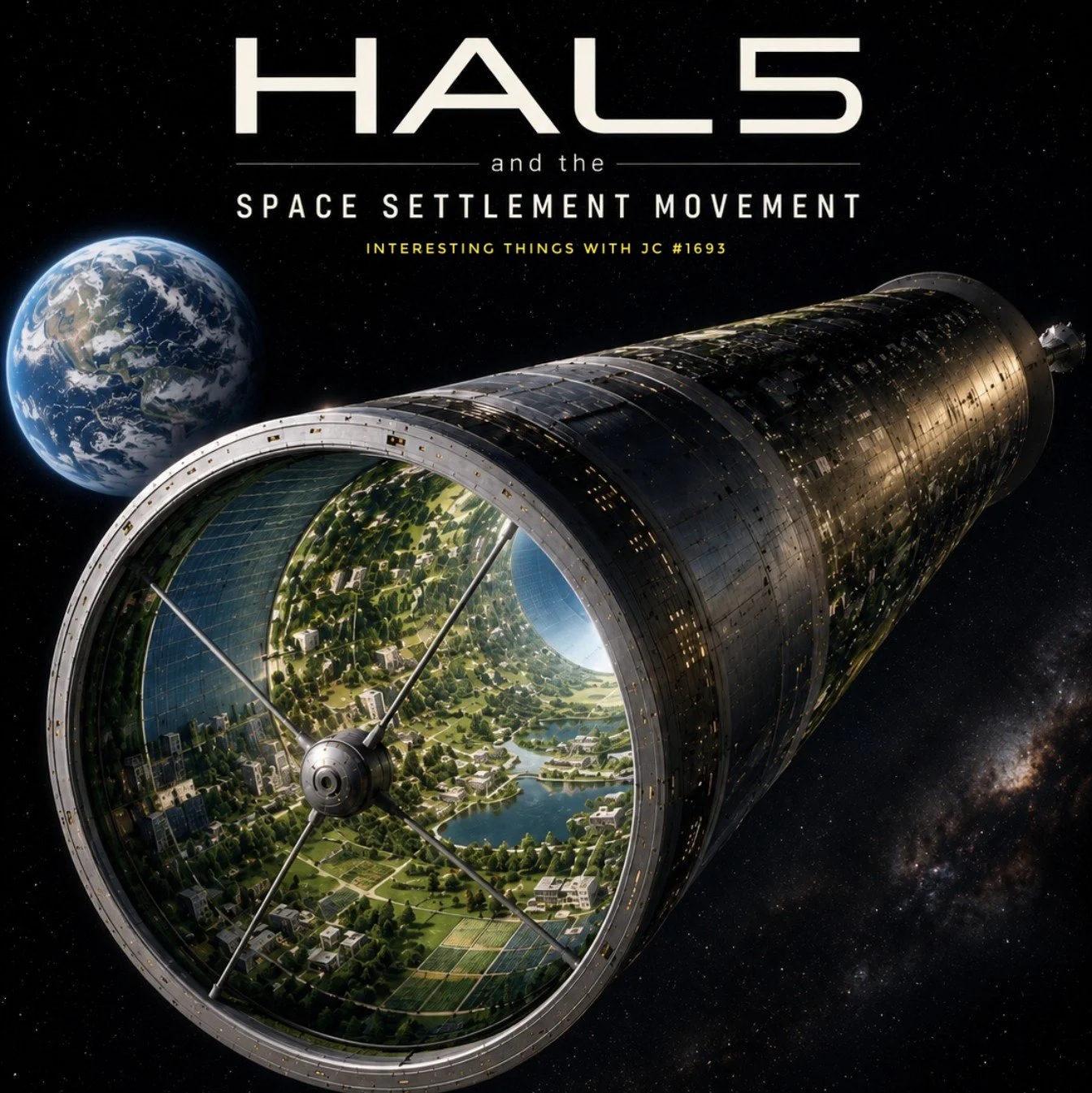
Poster style illustration of a large cylindrical space habitat orbiting near Earth. The open end reveals a lush interior landscape with forests, lakes, farmland, and cities curving along the inside surface. The title "HAL5 and the Space Settlement Movement" appears above the habitat against a star filled background.
Transcript
Interesting Things with JC #1693:
"HAL5 and the Space Settlement Movement"
In 1983, a group of people in Huntsville, Alabama organized themselves around an idea that had already begun to fade from public view.
The organization became known as the Huntsville Alabama L5 Society, or HAL5. Its roots reached back to the 1970s, when Princeton physicist Gerard O'Neill proposed that humanity might someday live in enormous habitats built in space. Rather than settling planets, he imagined entire communities located at stable gravitational points known as Lagrange points. One of them was called L5.
By the early 1980s, Apollo was over. Budgets tightened. The grand expectations of the Space Age were no longer at the center of the national conversation.
In Huntsville, the conversation continued.
Home to Marshall Space Flight Center and generations of engineers who helped build America's rocket program, the city remained closely tied to spaceflight. Members of HAL5 gathered to hear speakers, discuss exploration and settlement concepts, and consider possibilities that seemed increasingly distant from the headlines of the day.
During the 1990s, volunteers launched high-altitude balloons through Project HALO, eventually reaching about 36 miles, or 58 kilometers, above Earth. It wasn't orbit. It wasn't one of O'Neill's settlements. But it showed the subject had not been set aside.
Many people who joined the original L5 movement expected large-scale space settlement to arrive much sooner than it has. Instead, they watched programs change, priorities shift, and decades pass.
Today, discussions about commercial space stations, lunar development, reusable rockets, and permanent human presence beyond Earth have returned. Long before those subjects reappeared in business plans and policy papers, groups like HAL5 were still meeting to talk about them.
The questions that drew people to the L5 movement never really went away. Where might people live beyond Earth? How would they get there? What would a permanent human presence in space require?
Those questions were being discussed in Huntsville in 1983.
They're still being discussed today.
These are interesting things, with JC.
Student Worksheet
Comprehension Questions
What does HAL5 stand for?
Who proposed large-scale space habitats during the 1970s?
What are Lagrange points?
Why was HAL5 founded during the early 1980s?
What was Project HALO?
Analysis Questions
Why do you think public interest in space settlement declined after Apollo?
How did HAL5 help preserve interest in space settlement concepts?
Compare the goals of the original L5 movement with current commercial space initiatives.
What technological developments might be necessary before large-scale space settlements become practical?
Reflection Prompt
If humans establish permanent settlements beyond Earth, where should they be located and why?
Difficulty Scaling
Emerging: Answer comprehension questions using evidence from the transcript.
Proficient: Complete comprehension and analysis questions.
Advanced: Write a one-page argument evaluating whether space settlements should be a major future goal.
Student Output
Written responses to all questions.
One paragraph reflection.
Optional one-page analytical response.
Academic Integrity Guidance
Use evidence from the episode.
Cite sources when using outside research.
Explain ideas in your own words.
Distinguish facts from personal opinions.
Teacher Guide
Quick Start: Play the episode audio first. Ask students to listen for examples of how ideas can survive despite declining public attention.
Pacing Guide (Audio-First):
Bell Ringer – 5 minutes
Vocabulary Preview – 5 minutes
Podcast Listening – 8 minutes
Discussion – 10 minutes
Worksheet – 15 minutes
Assessment and Exit Ticket – 7 minutes
Bell Ringer: Ask students: "What major technological goal today might take decades to achieve?"
Audio Guidance: Students should listen for the relationship between HAL5, O'Neill's ideas, and modern space development.
Audio Fallback: If audio is unavailable, use the transcript as a guided reading activity.
Time on Task: Approximately 50 minutes.
Materials:
Episode audio or transcript
Worksheet
Writing materials
Internet access for extension activities
Vocabulary Strategy: Review Lagrange Point, Space Settlement, Habitat, and Advocacy before listening.
Misconceptions:
Space settlements are not the same as planetary colonies.
Lagrange points are positions, not physical objects.
High-altitude balloons do not reach orbit.
Discussion Prompts:
Why do some scientific ideas take decades to develop?
What role do advocacy groups play in technological progress?
How should society prioritize long-term projects?
Formative Checkpoints:
Vocabulary understanding
Participation in discussion
Completion of worksheet responses
Differentiation:
Provide vocabulary supports for emerging learners.
Allow oral responses when appropriate.
Offer enrichment research opportunities for advanced students.
Assessment Differentiation:
Short-answer option for emerging learners.
Extended written analysis for advanced learners.
Time Flexibility:
Condense discussion for shorter periods.
Expand research activities for block scheduling.
Substitute Readiness: All materials can be delivered through transcript reading and worksheet completion.
Engagement Strategy: Have students design a future space habitat concept and justify its location.
Extensions:
Research O'Neill cylinders.
Investigate current commercial space station projects.
Compare lunar and orbital settlement proposals.
Cross-Curricular Connections:
Physics
Engineering
History
Economics
Public Policy
SEL Connection: Persistence, long-term goal setting, and resilience in the face of setbacks.
Skill Emphasis:
Critical thinking
Evidence evaluation
Communication
Systems thinking
Future planning
Answer Key:
Huntsville Alabama L5 Society.
Gerard O'Neill.
Stable gravitational positions created by the interaction of celestial bodies.
To continue discussing and promoting space settlement concepts.
A high-altitude balloon program operated by HAL5.
Analysis and reflection responses will vary but should be supported with evidence.
Quiz
Questions
What does the "L" in L5 refer to?
A. Launch Site
B. Lunar Zone
C. Lagrange Point
D. Low Orbit
Who proposed large-scale orbital habitats?
A. Wernher von Braun
B. Gerard O'Neill
C. Carl Sagan
D. Robert Goddard
HAL5 was founded in:
A. 1969
B. 1975
C. 1983
D. 1995
Project HALO primarily involved:
A. Rocket launches
B. Satellite manufacturing
C. Lunar mapping
D. High-altitude balloons
The main theme of the episode is:
A. Military spaceflight
B. Space tourism
C. Preservation of space settlement ideas
D. Planetary geology
Assessment
Open-Ended Questions
Explain how HAL5 helped preserve interest in space settlement concepts during a period when public attention had shifted elsewhere.
Evaluate whether the goals of the L5 movement appear more achievable today than they did in 1983.
Rubric (3–2–1)
3: Uses evidence, demonstrates analysis, and connects historical and modern developments.
2: Uses some evidence and demonstrates partial understanding.
1: Limited evidence and minimal understanding.
Exit Ticket
What is one challenge humanity must solve before permanent space settlements become practical?
What is one idea from today's lesson that surprised you?
Standards Alignment
NGSS
HS-ETS1-2 Engineering Design — Evaluate solutions to complex problems. Students assess possible approaches to long-term human habitation in space. Alignment supports analytical evaluation of technological systems.
HS-ETS1-3 Engineering Design — Analyze and compare solutions. Students compare orbital settlements, lunar bases, and other habitation concepts.
CCSS Reading
CCSS.ELA-LITERACY.RH.9-10.2 — Determine central ideas of a source. Students identify the main themes of the episode and transcript.
CCSS.ELA-LITERACY.RH.11-12.6 — Evaluate perspectives and interpretations. Students examine historical expectations and modern realities.
CCSS Writing
CCSS.ELA-LITERACY.WHST.9-10.1 — Write arguments supported by evidence. Students defend positions regarding future settlement efforts.
CCSS.ELA-LITERACY.WHST.11-12.7 — Conduct short research projects. Students investigate space settlement concepts.
CCSS Speaking & Listening
CCSS.ELA-LITERACY.SL.9-10.1 — Participate in collaborative discussions. Students engage in structured conversations regarding technological development.
C3 Framework
D2.His.1.9-12 — Evaluate historical events and developments. Students analyze how changing priorities influenced space programs.
D3.1.9-12 — Gather and evaluate sources. Students use episode content and additional research to support conclusions.
ISTE Standards
ISTE 1.3 Knowledge Constructor — Evaluate information from multiple sources. Students investigate scientific and historical claims related to space settlement.
Career Readiness Competencies
Analytical Thinking — Assess technological feasibility and long-term planning.
Communication — Present evidence-based arguments.
Problem Solving — Explore challenges of sustaining human life beyond Earth.
Adaptability — Understand changing priorities in scientific programs.
Professional Judgment — Evaluate realistic pathways toward future development.
Homeschool / Lifelong Learning Alignment
Independent Learning — Conduct self-directed research on aerospace topics.
Information Literacy — Evaluate historical and scientific information.
Real-World Application — Connect historical advocacy efforts to current industry developments.
Self-Directed Inquiry — Develop questions about future exploration.
Transferable Life Skills — Practice critical thinking and evidence-based reasoning.
Show Notes
This lesson explores the history of HAL5 and the broader L5 movement, demonstrating how ambitious scientific ideas can survive through dedicated communities even when public attention declines. Students examine the relationship between technological vision, public priorities, and long-term innovation while considering the future of human activity beyond Earth.
References
National Aeronautics and Space Administration. (n.d.). Lagrange points overview. https://science.nasa.gov/resource/what-is-a-lagrange-point/
National Aeronautics and Space Administration. (n.d.). Human exploration and operations. https://www.nasa.gov/humans-in-space/
O'Neill, G. K. (1977). The High Frontier: Human Colonies in Space. Princeton University Press. https://archive.org/details/highfrontierhuma0000onei_p0p1
HAL5 Official Organization History https://www.hal5.org/about-us.shtml