Interesting Things with JC #1694: "27 Distinct Emotional Categories" – Researchers analyzed 27,000 emotional responses and found that human emotions did not fit a few basic categories; instead, 27 distinct emotional states blended into one another across a continuous emotional landscape. This story was suggested by Dr. Igo
Curriculum - Episode Anchor
Episode Title: 27 Distinct Emotional Categories
Episode Number: 1694
Host: JC
Audience: Grades 9–12, Introductory College, Homeschool, Lifelong Learners
Subject Area: Psychology, Neuroscience, Cognitive Science, Statistics
Lesson Overview
Objectives:
Explain how researchers used large-scale data collection and statistical analysis to study human emotions.
Describe the 27 emotional categories identified by researchers and explain why they challenge earlier models of emotion.
Interpret the concept of emotional gradients and discuss how emotions transition rather than exist as isolated states.
Evaluate how neuroscience supports the understanding that emotions emerge from interacting brain networks.
Essential Question:
How does modern research change our understanding of the complexity of human emotions?
Success Criteria:
Identify the purpose and methodology of the Berkeley study.
Explain why emotional experiences are better represented as a continuum than as isolated categories.
Connect psychological research with findings from neuroscience.
Use evidence from the episode to support written and verbal explanations.
Student Relevance:
Every person experiences emotions daily. Understanding how emotions connect and overlap improves communication, self-awareness, decision-making, and empathy.
Real-World Connection:
Knowledge of emotional complexity is used in psychology, counseling, education, medicine, marketing, artificial intelligence, human-computer interaction, and conflict resolution.
Workforce Reality:
Professionals in healthcare, education, business leadership, customer service, emergency response, and technology rely on recognizing nuanced emotional states rather than assuming simple emotional categories.
Key Vocabulary
Emotion(ih-MOH-shun) — A psychological and physiological response to internal or external events.
Gradient(GRAY-dee-uhnt) — A gradual transition from one state to another without sharp boundaries.
Statistical Modeling(stuh-TIS-tih-kul MOD-uhl-ing) — Mathematical techniques used to analyze patterns within data.
Neuroscience(NOOR-oh-SY-ence) — The scientific study of the nervous system and the brain.
Amygdala(uh-MIG-duh-luh) — A brain structure involved in processing emotionally significant information.
Prefrontal Cortex(pree-FRUN-tuhl KOR-teks) — Brain region involved in planning, reasoning, and emotional regulation.
Anterior Cingulate Cortex(an-TEER-ee-er SING-gyuh-lit KOR-teks) — Region involved in attention, decision-making, and emotional processing.
Insula(IN-suh-luh) — Brain region associated with bodily awareness and emotional experience.
Continuum(kun-TIN-yoo-um) — A continuous range in which categories gradually merge into one another.
Empathic Pain(em-PATH-ik payn) — Emotional discomfort experienced in response to another person's suffering.
Narrative Core
Open:
People often describe emotions using simple words like happy, sad, angry, or afraid. But are those broad labels enough to describe the full range of human experience?
Info:
In 2017, researchers at the University of California, Berkeley conducted one of the largest studies ever performed on human emotional responses. Thousands of participants viewed thousands of carefully selected video clips while researchers recorded nearly 27,000 emotional reactions.
Details:
Instead of discovering that emotions fit neatly into a handful of basic categories, researchers identified 27 distinct emotional states. More importantly, they found that these emotions blended together through gradual transitions. Admiration could become awe. Interest could evolve into surprise. Nostalgia often combined happiness and sadness simultaneously. Rather than existing as separate boxes, emotions formed an interconnected landscape.
The findings also aligned with neuroscience. Emotional experiences arise from communication among multiple brain regions—including the amygdala, insula, prefrontal cortex, anterior cingulate cortex, and other neural networks. These systems continuously interact, allowing emotional experiences to shift rapidly depending on context.
Reflection:
The study did not invent new emotions. Instead, it demonstrated that emotional life is richer, more measurable, and more interconnected than many earlier psychological theories suggested. Recognizing this complexity helps us better understand ourselves and others.
Closing:
These are interesting things, with JC.
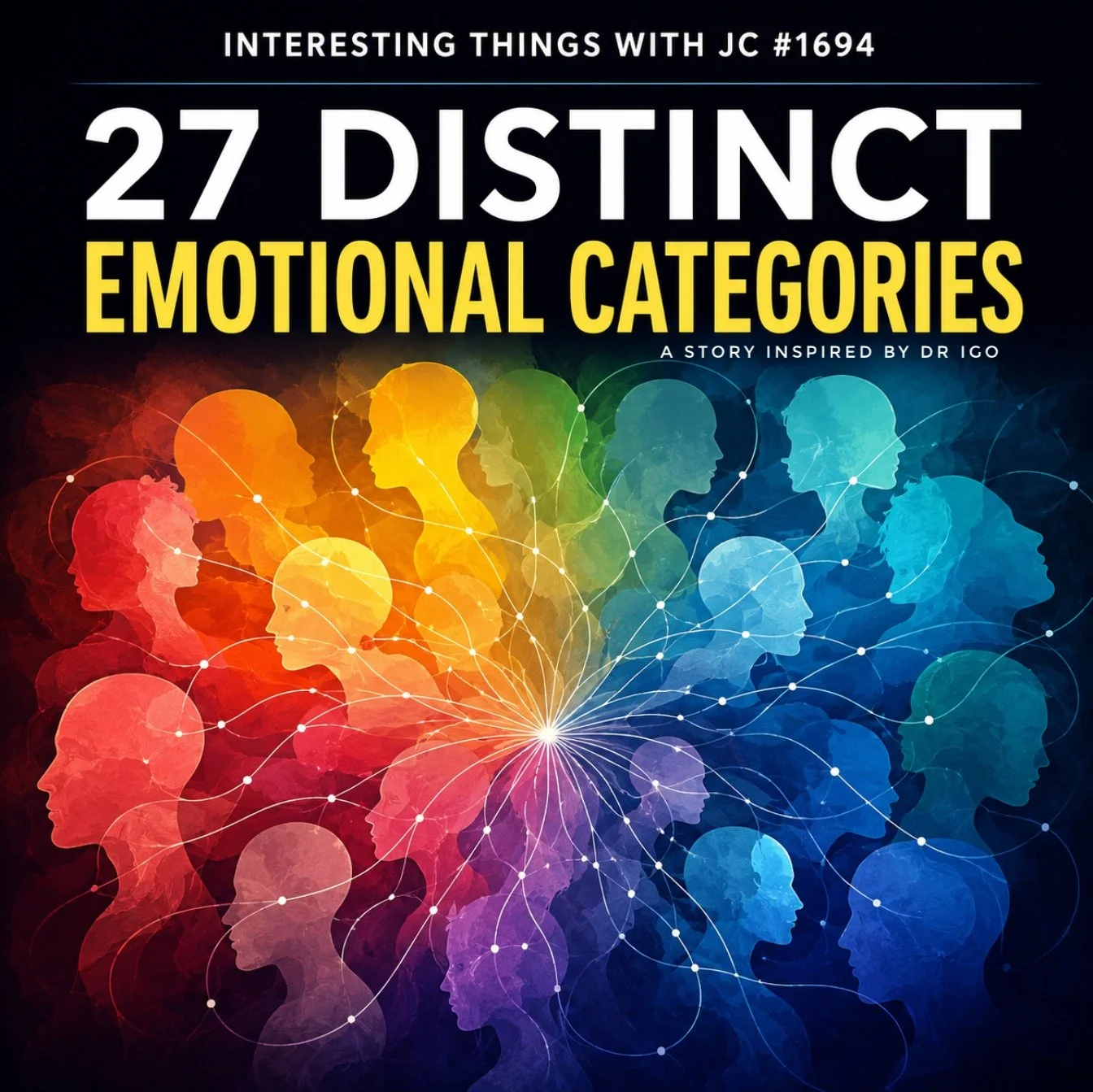
Podcast cover artwork titled "27 Distinct Emotional Categories." Across the top, small white text reads, "Interesting Things with JC #1694." Below, the main title appears in large bold lettering, with "27 Distinct" in white and "Emotional Categories" in yellow.
The artwork features approximately 27 semi transparent human head and shoulder silhouettes arranged in a circular composition. The figures transition through a rainbow spectrum from deep reds and oranges on the left, through yellow, green, teal, blue, and purple on the right. Thin white lines & small circular nodes connect the silhouettes into an intricate network that converges at a bright white point of light near the center, visually suggesting that emotions are interconnected rather than isolated. The background is dark with subtle gradients, making the colorful figures & network stand out prominently. A subtitle near the upper right reads "A Story Inspired by Dr Igo."
Transcript
Interesting Things with JC #1694:
27 Distinct Emotional Categories
In 2017, researchers at the University of California, Berkeley analyzed one of the largest collections of emotional responses ever assembled.
More than 2,000 participants watched over 2,000 video clips. The clips ranged from births and weddings to accidents, natural disasters, comedy routines, animal encounters, and acts of kindness. Researchers collected roughly 27,000 emotional responses and then used statistical modeling to see how those feelings related to one another.
What they found challenged a common assumption in psychology.
Human emotions did not organize themselves into a small number of basic categories.
Instead, the data revealed 27 distinct emotional states: admiration, adoration, aesthetic appreciation, amusement, anger, anxiety, awe, awkwardness, boredom, calmness, confusion, craving, disgust, empathic pain, entrancement, envy, excitement, fear, horror, interest, joy, nostalgia, relief, romance, sadness, surprise, and triumph.
The study also showed that these emotions were not isolated from one another.
Admiration flowed into awe. Interest flowed into surprise. Anxiety flowed into fear. Relief often existed alongside joy. Nostalgia frequently contained elements of both happiness and sadness.
Rather than finding sharp emotional boundaries, researchers found gradients.
Using those relationships, they constructed a multidimensional emotional map. The map showed emotional experiences connected by thousands of subtle transitions, creating a continuous landscape instead of separate emotional compartments.
That finding stood in contrast to earlier theories that emphasized a small set of core emotions from which all others were derived.
The Berkeley team argued that emotional experience is richer and more differentiated than those simplified models suggest.
The results also fit with modern neuroscience. Brain imaging studies have repeatedly shown that emotions are not generated by a single brain region. Networks involving the amygdala, prefrontal cortex, insula, anterior cingulate cortex, and other structures interact to produce emotional states that can overlap and change rapidly.
The study didn't discover emotions people had never felt before.
What it provided was evidence that human emotion is far more nuanced, interconnected, and measurable than many researchers once believed.
These are interesting things, with JC.
Student Worksheet
Purpose: Use the podcast episode as your primary source of information. Listen carefully or read the transcript before completing the activities.
Comprehension Questions
Approximately how many participants took part in the Berkeley study?
About how many emotional responses did researchers collect?
What common psychological assumption did the study challenge?
How many emotional categories did the researchers identify?
What did researchers mean by emotional "gradients"?
Name three of the 27 emotional categories discussed in the episode.
According to the episode, why is the emotional map considered multidimensional?
Which brain regions are mentioned as contributing to emotional experiences?
Analysis Questions
Why might researchers have chosen thousands of different video clips instead of only a few examples?
Explain how the idea of emotional gradients differs from thinking of emotions as separate boxes.
How does the neuroscience evidence strengthen the conclusions of the Berkeley study?
Give an example from your own experience in which two emotions occurred at the same time.
Why is recognizing emotional complexity valuable in professions such as education, healthcare, or business?
Reflection Prompt
Write one paragraph explaining how understanding that emotions often overlap might improve communication, empathy, or decision-making in everyday life.
Difficulty Scaling
Level 1
Define "emotion."
List five emotional categories from the episode.
Level 2
Explain emotional gradients using one example from the podcast.
Level 3
Compare the Berkeley model with earlier theories of basic emotions using evidence from the episode.
Student Output Expectations
Students should produce:
Complete written responses using evidence from the episode.
One analytical paragraph.
One reflective paragraph using real-life examples where appropriate.
Accurate vocabulary usage throughout.
Academic Integrity Guidance
Base all responses on the podcast and classroom discussion.
When adding outside information, cite reliable academic sources.
Explain ideas using your own words rather than copying text directly.
Teacher Guide
Quick Start: Begin by playing the podcast episode. Ask students to record every emotion they hear mentioned while listening.
Pacing Guide (Audio-First):
Bell Ringer – 5 minutes
Podcast Listening – 6–8 minutes
Vocabulary Review – 10 minutes
Worksheet Activities – 20 minutes
Discussion – 10 minutes
Assessment/Exit Ticket – 7 minutes
Bell Ringer
Ask students:
"Can you think of a time when you felt two different emotions at once? Describe the situation."
Allow volunteers to share examples before introducing the research.
Audio Guidance
Encourage students to:
Listen for evidence supporting scientific claims.
Notice transitions between emotional examples.
Record unfamiliar vocabulary.
Audio Fallback
If audio is unavailable:
Read the transcript aloud.
Assign paired reading with annotation.
Highlight transitions between emotional states.
Time on Task
Introduction: 5 minutes
Listening: 8 minutes
Vocabulary: 10 minutes
Worksheet: 20 minutes
Discussion: 10 minutes
Assessment: 7 minutes
Total: Approximately 60 minutes
Materials
Podcast or transcript
Student worksheet
Projector or display
Whiteboard
Highlighters or annotation tools
Vocabulary Preparation
Review:
Gradient
Statistical modeling
Continuum
Neuroscience
Amygdala
Empathic pain
Common Misconceptions
Emotions are always separate and distinct.
One brain region controls each emotion.
Scientific models are permanent and never change.
Complex emotions cannot be measured scientifically.
Discussion Prompts
Why might earlier psychologists have preferred simpler emotional models?
What advantages come from recognizing emotional complexity?
Can emotional experiences ever fit neatly into categories?
How might artificial intelligence benefit from understanding nuanced emotions?
Formative Checkpoints
Students should be able to:
Explain emotional gradients.
Describe the Berkeley research.
Identify multiple interacting brain regions.
Interpret evidence from scientific studies.
Differentiation
For emerging learners:
Provide vocabulary organizers.
Allow verbal responses.
Pair students for discussion.
For advanced learners:
Compare the Berkeley findings with other theories of emotion.
Research additional neuroscience evidence.
Assessment Differentiation
Students may demonstrate learning through:
Written responses
Oral presentations
Graphic organizers
Concept maps
Digital presentations
Time Flexibility
45-minute class: Focus on listening, worksheet, and exit ticket.
90-minute class: Include extended research and group discussion.
Substitute Readiness
All activities may be completed using only the transcript if audio equipment is unavailable.
Engagement Strategy
Have students arrange the 27 emotions on a classroom continuum, discussing where gradual transitions occur rather than placing emotions into isolated categories.
Extensions
Explore how emotional recognition is used in artificial intelligence.
Compare emotional theories from different psychological researchers.
Investigate how emotions influence memory and decision-making.
Cross-Curricular Connections
Psychology
Biology
Neuroscience
Statistics
Computer Science
Health Education
SEL Connection
Students develop:
Emotional awareness
Empathy
Perspective-taking
Communication skills
Self-reflection
Skill Emphasis
Critical thinking
Scientific reasoning
Evidence evaluation
Data interpretation
Communication
Analytical writing
Answer Key
Worksheet (Suggested Responses)
Comprehension:
Over 2,000 participants.
Approximately 27,000 responses.
That emotions fit into only a few basic categories.
Twenty-seven.
Emotions transition gradually rather than having sharp boundaries.
Answers vary.
Because emotions connect through many gradual transitions.
Amygdala, prefrontal cortex, insula, anterior cingulate cortex, and interacting neural networks.
Analysis:
Responses should reference evidence from the episode and demonstrate understanding of emotional complexity.
Reflection:
Responses should connect emotional gradients with communication, empathy, or personal experience.
Quiz
Multiple Choice
The Berkeley researchers primarily studied:
A. Memory formation
B. Emotional responses
C. Intelligence
D. Personality typesApproximately how many emotional categories were identified?
A. 6
B. 12
C. 18
D. 27The study concluded that emotions are best described as:
A. Completely separate
B. Fixed personality traits
C. Gradually connected experiences
D. Random reactionsWhich research method helped identify relationships among emotions?
A. DNA sequencing
B. Statistical modeling
C. Chemical analysis
D. Behavioral conditioningAccording to the episode, emotions involve:
A. One specialized brain region
B. Only the amygdala
C. Multiple interacting brain networks
D. The spinal cord alone
(Answers intentionally omitted in accordance with the curriculum framework.)
Assessment
Open-Ended Questions
Explain how the Berkeley study changed scientists' understanding of human emotions. Include evidence from both psychology and neuroscience.
Describe why emotional gradients may better represent human emotional experiences than traditional categories. Support your explanation with examples from the episode.
3–2–1 Rubric
3 — Proficient
Uses accurate scientific vocabulary.
Explains concepts with supporting evidence.
Demonstrates clear understanding of emotional gradients.
2 — Developing
Shows partial understanding.
Includes some evidence.
Uses vocabulary with minor errors.
1 — Beginning
Limited explanation.
Minimal evidence.
Significant misconceptions remain.
Exit Ticket
In two or three sentences, explain one new idea you learned about emotions and describe how it changed your understanding of human emotional experiences.
Standards Alignment
NGSS Science & Engineering Practices
SEP 4 – Analyzing and Interpreting Data
Connection: Students examine how researchers interpreted approximately 27,000 emotional responses using statistical modeling.
Measurable Outcome: Students explain how large datasets can reveal scientific patterns that are not obvious through individual observations.
Justification: The lesson centers on interpreting empirical psychological data to draw evidence-based conclusions.
SEP 7 – Engaging in Argument from Evidence
Connection: Students compare earlier theories of basic emotions with the Berkeley findings.
Measurable Outcome: Students support claims using evidence from the podcast and classroom discussion.
Justification: Students evaluate competing scientific explanations using documented research.
CCSS Reading
CCSS.ELA-LITERACY.RST.11-12.1 – Cite Specific Textual Evidence
Connection: Students answer worksheet and assessment questions using evidence from the transcript.
Measurable Outcome: Students accurately reference information presented in the episode.
Justification: Evidence-based reading strengthens scientific literacy.
CCSS.ELA-LITERACY.RST.11-12.2 – Determine Central Ideas
Connection: Students identify the central finding that emotions form a continuum rather than isolated categories.
Measurable Outcome: Students summarize the study using accurate scientific language.
Justification: Scientific communication requires identifying key concepts from informational texts.
CCSS Writing
CCSS.ELA-LITERACY.WHST.11-12.2 – Informative/Explanatory Writing
Connection: Students compose analytical and reflective responses explaining emotional gradients.
Measurable Outcome: Students organize evidence into clear scientific explanations.
Justification: Writing reinforces conceptual understanding and communication.
CCSS.ELA-LITERACY.WHST.11-12.9 – Draw Evidence from Informational Texts
Connection: Students support written responses using information presented in the episode.
Measurable Outcome: Students integrate evidence appropriately.
Justification: Academic writing depends on accurate use of supporting information.
CCSS Speaking & Listening
CCSS.ELA-LITERACY.SL.11-12.1 – Collaborative Discussions
Connection: Students discuss emotional complexity and compare interpretations.
Measurable Outcome: Students contribute evidence-based ideas while responding respectfully to classmates.
Justification: Scientific learning benefits from collaborative reasoning.
C3 Framework
D2.Sci.6.9-12 – Evaluate Scientific Explanations Using Evidence
Connection: Students evaluate how statistical analysis challenged previous psychological theories.
Measurable Outcome: Students explain why scientific understanding evolves as new evidence becomes available.
Justification: Inquiry-based reasoning is fundamental to scientific literacy.
ISTE Standards
ISTE 1.3 Knowledge Constructor
Connection: Students interpret scientific research and evaluate evidence supporting emotional classification.
Measurable Outcome: Students distinguish evidence-based conclusions from assumptions.
Justification: Modern learners must critically evaluate information from multiple sources.
Career Readiness Competencies
Analytical Thinking
Students interpret complex research findings and identify relationships among emotional categories.Communication
Students explain scientific concepts using accurate psychological vocabulary in written and oral formats.Problem Solving
Students evaluate competing theories and determine which is better supported by available evidence.Adaptability
Students recognize that scientific understanding changes when new research becomes available.Professional Judgment
Students practice drawing conclusions based on empirical evidence rather than personal opinion.
Homeschool / Lifelong Learning Alignment
Independent Learning
Students investigate scientific discoveries using podcasts, transcripts, and supplemental research.Information Literacy
Students distinguish peer-reviewed scientific evidence from unsupported claims.Real-World Application
Students apply knowledge of emotional complexity to communication, relationships, leadership, and decision-making.Self-Directed Inquiry
Students formulate additional questions about neuroscience and psychology for independent exploration.Transferable Life Skills
Students strengthen emotional awareness, critical thinking, evidence evaluation, and effective communication across academic and professional settings.
Show Notes
This lesson explores one of the largest studies ever conducted on human emotional experiences and demonstrates how modern psychology and neuroscience have expanded our understanding of emotion. Students learn that emotions are not isolated categories but interconnected experiences that transition gradually from one state to another. By combining psychology, neuroscience, statistics, and critical thinking, learners gain a deeper appreciation for how scientific research continually refines our understanding of human behavior and the brain.
References
Cowen, A. S., & Keltner, D. (2017). Self-report captures 27 distinct categories of emotion bridged by continuous gradients. Proceedings of the National Academy of Sciences, 114(38), E7900–E7909. https://www.pnas.org/doi/10.1073/pnas.1702247114
University of California, Berkeley. (2017). Researchers identify 27 distinct human emotions.https://news.berkeley.edu/2017/09/06/27-emotions/
National Institute of Mental Health. (2024). The Brain.https://www.nimh.nih.gov/health/topics/brain-health
Society for Neuroscience. (2023). Brain Facts.https://www.brainfacts.org/
American Psychological Association. (2023). Emotion.https://dictionary.apa.org/emotion