Interesting Things with JC #1695: "The Berlin Airlift - Keeping a City Alive" – Cargo planes keep landing in a city sealed off by every road, rail line, and canal as thousands of tons of coal, food, and medicine arrive through three air corridors, with flights continuing every few minutes despite weather, accidents, and an expanding blockade.
Curriculum - Episode Anchor
Episode Title: The Berlin Airlift
Episode Number: 1695
Host: JC
Audience: Grades 9–12, Introductory College, Homeschool, Lifelong Learners
Subject Area: Modern World History, Cold War History, Geography, Logistics, Aviation
Lesson Overview
Objectives:
Explain why the Berlin Blockade occurred following World War II.
Analyze how the Berlin Airlift became one of history's greatest logistical operations.
Evaluate the political and humanitarian significance of the airlift during the early Cold War.
Describe how innovation, cooperation, and planning prevented a humanitarian disaster.
Essential Question:
How did supplying an entire city by air change the course of the Cold War without firing a shot?
Success Criteria:
Students can identify the causes of the Berlin Blockade.
Students can explain why air transport was selected instead of military force.
Students can describe the operational challenges of the airlift.
Students can evaluate the historical impact of Operation Vittles and Operation Plainfare.
Student Relevance:
Modern supply chains, disaster relief, and humanitarian aid all rely on principles developed through large-scale logistics. The Berlin Airlift demonstrates how planning and coordination can solve enormous challenges peacefully.
Real-World Connection:
Military transport aircraft, emergency relief organizations, and international humanitarian missions continue to use logistical concepts refined during the Berlin Airlift.
Workforce Reality:
This lesson highlights careers in aviation, logistics, engineering, emergency management, diplomacy, public administration, and military planning.
Key Vocabulary
Blockade(blŏ-KAYD) — Preventing movement of people or supplies into an area.
Occupation Zone(ok-yuh-PAY-shun zohn) — Territory administered by a foreign military after war.
Airlift(AIR-lift) — Supplying people entirely by aircraft.
Logistics(loh-JIS-tiks) — Planning and coordinating transportation, supplies, and operations.
Corridor(KOR-ih-dor) — A designated route through controlled territory.
Rationing(RASH-un-ing) — Controlled distribution of limited supplies.
Cargo(KAR-go) — Goods transported by ship, truck, rail, or aircraft.
Infrastructure(IN-fruh-struk-cher) — Physical systems that support society.
Humanitarian(hyoo-man-ih-TAIR-ee-un) — Intended to improve human welfare.
Cold War(kohld wor) — The period of political and strategic rivalry between the United States and the Soviet Union after World War II.
Narrative Core
Open
Imagine living in a city where every road, railroad, and canal suddenly closes. Food cannot arrive. Coal cannot arrive. Medicine cannot arrive. More than two million people are trapped, surrounded by territory controlled by another nation.
Info
In June 1948, that became reality for West Berlin. Rather than risking another world war, the Western Allies chose an unprecedented solution: keep an entire city alive using airplanes alone.
Details
Every day thousands of tons of coal, flour, milk, machinery, fuel, and medicine crossed the skies of Germany. Pilots flew through dangerous weather around the clock while engineers built new airports and ground crews turned aircraft around in minutes. The operation demanded extraordinary precision because one delayed airplane could disrupt dozens more.
The Berlin Airlift became a demonstration that logistics, discipline, and international cooperation could overcome political pressure without direct military conflict.
Reflection
The success of the Berlin Airlift reminds us that history is often shaped not only by soldiers and battles, but also by pilots, mechanics, engineers, planners, and ordinary citizens working together toward a common goal.
Closing
These are interesting things, with JC.
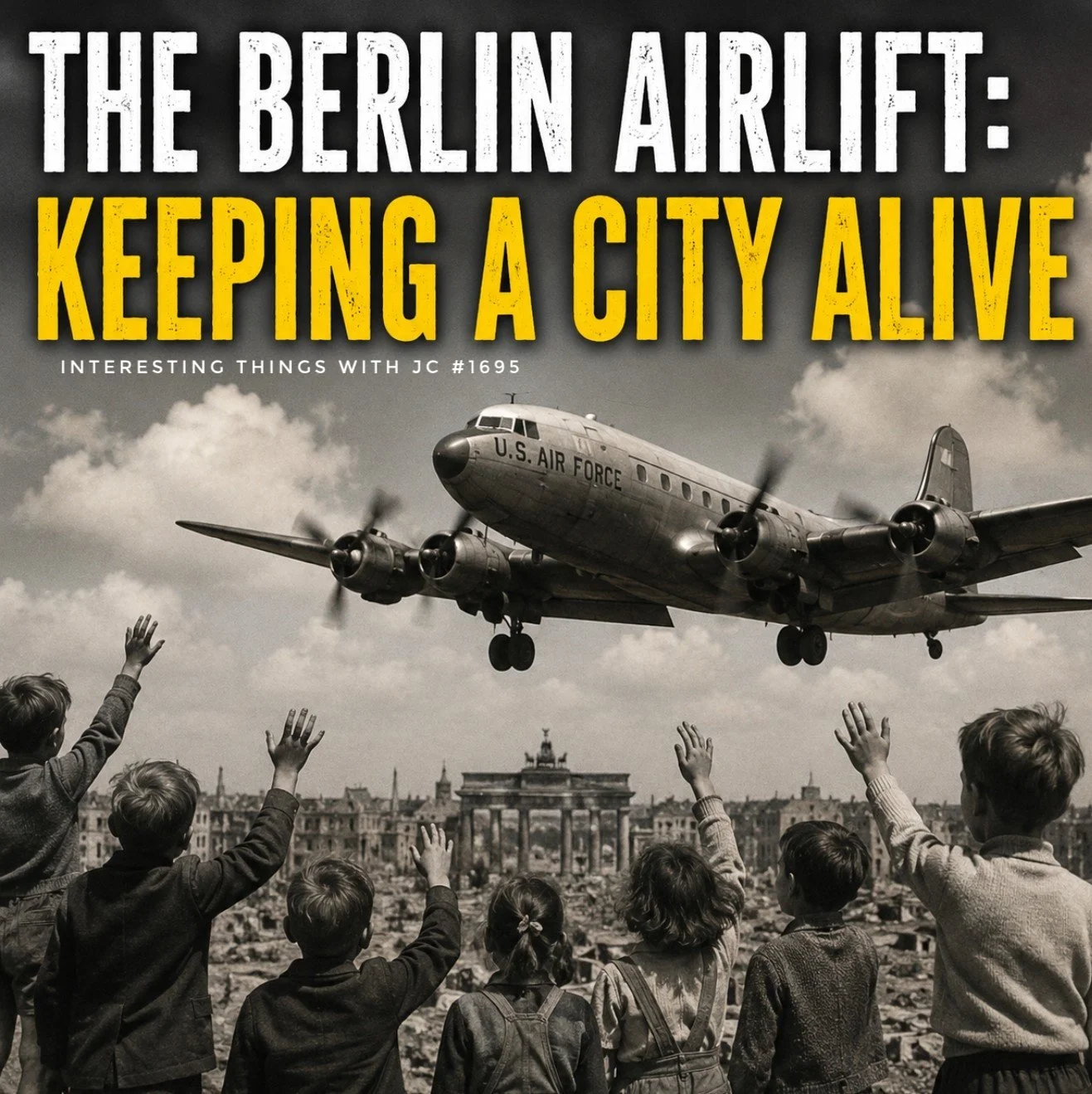
Promotional artwork for Interesting Things with JC Episode #1695, The Berlin Airlift: Keeping a City Alive. The cover depicts a U.S. Air Force cargo plane flying over the war-damaged city of Berlin while children wave below, illustrating the historic Allied airlift that sustained West Berlin during the Soviet blockade of 1948–1949.
Transcript
Interesting Things with JC #1695:
"The Berlin Airlift: Keeping a City Alive"
On June 26, 1948, the first cargo planes lifted off carrying flour, milk, coal, and medicine to a city cut off from the outside world.
Two days earlier, the Soviet Union had blocked every road, railroad, and canal into West Berlin. More than two million people were stranded nearly 100 miles (160 kilometers) inside Soviet-controlled territory. The blockade was meant to force the Western Allies to abandon the city without risking open war.
After World War II, Germany was divided into occupation zones, and Berlin, though surrounded by Soviet territory, was divided among the four Allied powers. When the Western powers introduced a new currency to stabilize their economy, Joseph Stalin responded by sealing every land route into West Berlin.
Berlin needed about 4,500 short tons, roughly 4,100 metric tons, of supplies every day. Coal was the greatest challenge, heating homes, powering hospitals, generating electricity, and keeping factories running. No one had ever sustained a city this large entirely by air.
President Harry Truman refused to abandon Berlin or send troops through the blockade. Instead, the Allies relied on three air corridors guaranteed by postwar agreements.
The Americans called the effort Operation Vittles. The British called theirs Operation Plainfare. Under Lieutenant General William H. Tunner, the airlift became a masterpiece of logistics. Aircraft flew fixed routes, altitudes, and schedules. If they missed an approach, they didn't circle. They returned to West Germany because one delay affected dozens of flights.
Ground crews unloaded, refueled, inspected, and relaunched aircraft in minutes as larger Douglas C-54 transports replaced smaller planes. Soon, aircraft landed every few minutes, day and night.
Winter brought fog, snow, freezing rain, and ice. Flying grew even more hazardous, and more than one hundred Allied personnel lost their lives keeping the airlift moving. Berlin endured rationing, limited electricity, and bitter cold, but the airplanes kept arriving.
Pilot Gail Halvorsen noticed children watching aircraft at Tempelhof Airport. On his next approach, he wiggled his wings and dropped candy tied to tiny handkerchief parachutes. Other crews joined him, and Operation Little Vittles eventually delivered more than 23 short tons, about 21 metric tons, of candy to Berlin's children.
Even as flights continued, the Allies expanded the operation. French engineers and thousands of Berlin civilians built Tegel Airport in just 90 days, increasing Berlin's capacity to receive cargo.
On April 16, 1949, the outcome was no longer in doubt. During the Easter Parade, Allied aircraft delivered more than 12,900 short tons, about 11,700 metric tons, of supplies in a single day, more than Berlin required to survive.
The blockade ended on May 12, 1949, though flights continued into September to rebuild reserves. By then, Allied crews had completed more than 277,000 flights and delivered over 2.3 million short tons, roughly 2.1 million metric tons, of cargo.
These are interesting things, with JC.
Student Worksheet
Instructions: Listen to the podcast episode first. If audio is unavailable, read the transcript carefully before completing the activities. Answer in complete sentences using evidence from the episode.
Comprehension Questions
Why did the Soviet Union establish the Berlin Blockade?
Why was West Berlin especially vulnerable to a blockade?
Approximately how many tons of supplies were needed each day?
Why was coal considered the most important cargo?
What were Operation Vittles and Operation Plainfare?
Who was Lieutenant General William H. Tunner?
Why did aircraft return to West Germany instead of circling after a missed approach?
What was Operation Little Vittles?
Why was Tegel Airport constructed?
When did the Berlin Blockade officially end?
Analysis Questions
Why do you think President Truman chose an airlift instead of sending military forces through the blockade?
How did logistics become just as important as aviation during the Berlin Airlift?
What risks did Allied aircrews accept during the operation?
How did the Easter Parade demonstrate that the Allies had succeeded?
What does the Berlin Airlift teach about solving international conflicts without direct military action?
Reflection Prompt
Imagine you are a resident of West Berlin during the winter of 1948. Write one page describing what daily life might have been like while depending entirely on aircraft for survival. Include how the arrival of each airplane may have affected morale.
Difficulty Scaling
Level 1
Identify important dates and people.
Level 2
Explain causes and effects using evidence.
Level 3
Evaluate why historians consider the Berlin Airlift one of history's greatest logistical achievements.
Student Output Expectations
Students should produce:
Complete written responses.
Evidence from the episode.
Logical historical reasoning.
Proper grammar and organization.
Academic Integrity Guidance
Use only your own words. Support answers with evidence from the episode or additional reliable historical sources cited appropriately.
Teacher Guide
Quick Start: Begin class by playing the podcast. Ask students to listen specifically for how the Allies solved a problem without using military force.
Pacing Guide (Audio-First)
Bell Ringer – 5 minutes
Vocabulary Preview – 5 minutes
Podcast Listening – 8–10 minutes
Guided Discussion – 10 minutes
Student Worksheet – 20 minutes
Review – 5 minutes
Exit Ticket – 2 minutes
Bell Ringer
Display the question:
"If every highway, railroad, and shipping route into your city suddenly closed, how would people survive?"
Students write a brief response before listening.
Audio Guidance
Encourage students to listen for:
Causes of the blockade.
Daily supply requirements.
Innovations that made the airlift successful.
Human stories illustrating the operation.
Audio Fallback
If audio cannot be played:
Read the transcript aloud.
Divide students into small groups to analyze different sections.
Conduct a whole-class discussion.
Time on Task
Vocabulary: 5 minutes
Listening: 10 minutes
Discussion: 10 minutes
Worksheet: 20 minutes
Assessment: 10 minutes
Materials
Podcast or transcript
World map of postwar Germany
Student worksheet
Writing materials
Projector (optional)
Vocabulary Strategy
Introduce vocabulary before listening. Encourage students to identify each term as it appears in the episode.
Common Misconceptions
Berlin was not located in West Germany.
The blockade did not begin another shooting war.
Aircraft carried far more than food; coal was the most critical cargo.
The airlift lasted more than a year.
Success depended on planning as much as flying skill.
Discussion Prompts
Why was Berlin politically important to both sides?
Could an operation like the Berlin Airlift succeed today?
What role did engineering play in the operation?
How did Operation Little Vittles influence public morale?
Why do historians consider the airlift a strategic victory?
Formative Checks
Think-Pair-Share after listening.
Vocabulary matching.
Timeline activity.
Exit question after discussion.
Differentiation
Support
Guided notes.
Vocabulary sheet.
Timeline organizer.
Extension
Research another Cold War crisis.
Compare humanitarian airlifts from different eras.
Create a logistics flowchart illustrating aircraft movement.
Assessment Differentiation
Students may demonstrate learning through:
Written essay.
Oral presentation.
Digital timeline.
Illustrated logistics diagram.
Time Flexibility
45-minute class: Podcast, discussion, worksheet.
60-minute class: Add map analysis.
90-minute block: Include logistics simulation and reflection writing.
Substitute Readiness
The lesson is fully self-contained using the transcript and worksheet if audio is unavailable.
Engagement Strategy
Have students estimate how many flights would be required each day before revealing the historical figures. Discuss why their estimates differ from reality.
Extensions
Research Tempelhof Airport.
Compare Operation Vittles with modern humanitarian airlifts.
Investigate the engineering challenges of building Tegel Airport in 90 days.
Cross-Curricular Connections
Geography: Postwar Europe and occupation zones.
Mathematics: Cargo calculations and flight scheduling.
Engineering: Airport construction and logistics.
Economics: Currency reform and supply chains.
Government: Diplomacy during the Cold War.
SEL Connection
Students examine perseverance, cooperation, resilience, and responsible decision-making during periods of international crisis.
Skill Emphasis
Historical reasoning
Evidence evaluation
Geographic literacy
Systems thinking
Communication
Problem solving
Collaboration
Answer Key
Comprehension
To pressure the Western Allies to abandon West Berlin.
It was surrounded by Soviet-controlled territory.
About 4,500 short tons (4,100 metric tons).
It powered heating, electricity, hospitals, and industry.
American and British names for the airlift.
He organized the highly efficient flight system.
To prevent delays from disrupting the tightly scheduled airlift.
Candy drops for Berlin's children.
To increase cargo-handling capacity.
May 12, 1949.
Analysis (Sample Responses)
An airlift avoided escalating into armed conflict.
Logistics ensured continuous, efficient delivery of essential supplies.
Dangerous weather, mechanical failures, and fatigue.
It proved the Allies could exceed Berlin's daily needs.
Careful planning and sustained cooperation can achieve strategic objectives without direct combat.
Quiz
Instructions: Select the best answer for each question. Choose only one answer. (Answers are intentionally not provided.)
Why did the Soviet Union begin the Berlin Blockade in June 1948?
A. To prepare for an invasion of Western Europe
B. To force the Western Allies to abandon West Berlin
C. To stop all air travel over Germany
D. To rebuild Berlin's transportation network
Which supply was considered the greatest challenge during the airlift?
A. Flour
B. Medicine
C. Coal
D. Clothing
What was one major innovation introduced under Lieutenant General William H. Tunner?
A. Aircraft flew without navigational aids.
B. Aircraft circled until landing clearance was available.
C. Aircraft followed fixed routes, altitudes, and schedules.
D. Cargo was delivered only during daylight.
What was Operation Little Vittles?
A. A military rescue mission
B. Construction of Tegel Airport
C. Candy drops for Berlin's children
D. A Soviet relief program
What demonstrated that the Allies had effectively overcome the blockade?
A. Berlin became self-sufficient.
B. The Easter Parade delivered more supplies than Berlin required in one day.
C. The Soviet Union abandoned East Berlin.
D. All Allied troops left Germany.
Assessment
Open-Ended Questions
Explain how the Berlin Airlift demonstrated that logistics and international cooperation could achieve strategic goals without direct military conflict. Support your answer with at least three examples from the episode.
Evaluate the long-term historical significance of the Berlin Airlift. How did it influence the early Cold War and later humanitarian airlift operations?
3–2–1 Rubric
3 – Exceeds Expectations
Demonstrates thorough historical understanding.
Uses multiple pieces of evidence accurately.
Explains historical significance with clear reasoning.
Writing is well organized and nearly free of errors.
2 – Meets Expectations
Demonstrates accurate understanding.
Uses supporting evidence.
Explains major ideas clearly.
Minor writing errors do not interfere with understanding.
1 – Developing
Demonstrates partial understanding.
Limited or inaccurate evidence.
Explanation lacks organization or depth.
Writing contains significant errors.
Exit Ticket
On an index card or digital form, answer:
What was one new fact you learned today?
What was the most impressive logistical achievement of the Berlin Airlift?
Why do you think historians continue to study this event?
Standards Alignment
NGSS Science & Engineering Practices
SEP 2 – Developing and Using Models
Students analyze the Berlin Airlift as a complex logistical system involving transportation, infrastructure, scheduling, and resource management. Measurable outcome: Students construct a systems explanation showing how coordinated air operations sustained West Berlin.SEP 4 – Analyzing and Interpreting Data
Students interpret supply quantities, flight frequency, and cargo statistics from the episode. Measurable outcome: Students explain how quantitative evidence supports historical conclusions.
CCSS Reading
CCSS.ELA-LITERACY.RH.9-10.2
Determine the central ideas of a primary or secondary historical source.
Connection: Students identify the major causes, events, and outcomes of the Berlin Airlift using evidence from the transcript.CCSS.ELA-LITERACY.RH.11-12.1
Cite specific textual evidence to support analysis of historical sources.
Connection: Students support worksheet and assessment responses with evidence from the transcript.
CCSS Writing
CCSS.ELA-LITERACY.WHST.9-10.2
Write informative texts to examine historical topics.
Connection: Students compose evidence-based responses explaining the significance of the airlift.
CCSS Speaking & Listening
CCSS.ELA-LITERACY.SL.9-10.1
Initiate and participate effectively in collaborative discussions.
Connection: Students discuss humanitarian decision-making, logistics, and Cold War strategy using historical evidence.
C3 Framework
D2.His.1.9-12
Evaluate how historical events were shaped by time, place, and context.
Connection: Students analyze why Berlin's geography made the blockade possible and the airlift necessary.D3.1.9-12
Gather and evaluate evidence from historical sources.
Connection: Students distinguish between factual evidence and historical interpretation while completing the worksheet and assessment.
ISTE Standards
ISTE 1.3 – Knowledge Constructor
Students evaluate historical information from multiple reliable sources to build evidence-based explanations about the Berlin Airlift.
Career Readiness Competencies
Analytical Thinking
Students evaluate logistical challenges and historical decision-making using quantitative and qualitative evidence.Communication
Students present historical conclusions clearly through written responses and classroom discussion.Problem Solving
Students analyze how Allied planners overcame transportation barriers through innovation and coordination.Adaptability
Students examine how pilots, engineers, and planners adjusted operations during severe weather and changing conditions.Professional Judgment
Students evaluate why diplomatic restraint and logistical planning proved more effective than military escalation.
Homeschool / Lifelong Learning Alignment
Independent Learning
Students investigate additional Cold War events using reliable historical resources.Information Literacy
Students distinguish credible historical sources from unsupported claims.Real-World Application
Students connect humanitarian airlift operations with modern disaster relief and emergency logistics.Self-Directed Inquiry
Students formulate questions about Cold War diplomacy and pursue further historical research.Transferable Life Skills
Students develop critical thinking, evidence evaluation, communication, and informed decision-making skills applicable beyond history classrooms.
Show Notes
The Berlin Airlift remains one of history's greatest examples of peaceful determination and logistical excellence. Faced with a blockade that threatened more than two million civilians, the Western Allies chose cooperation, engineering, aviation, and careful planning over military confrontation. This lesson helps students understand the origins of the Cold War while demonstrating how innovation, leadership, and humanitarian commitment can shape world history.
References
Air Mobility Command. (2008). Berlin Airlift lays foundation for today's air mobility. https://www.amc.af.mil/News/Features/Display/Article/150372/berlin-airlift-lays-foundation-for-todays-air-mobility
AlliiertenMuseum. (n.d.). The Berlin Airlift 1948/49. https://www.alliiertenmuseum.de/en/thema/the-berlin-airlift-1948-49/
Harrington, D. (2008). The Air Force can deliver anything: A history of the Berlin Airlift. Air Mobility Command. https://www.amc.af.mil/Portals/12/documents/The%20AF%20Can%20Deliver%20Anything,%20The%20Berlin%20Airlift%20(Harrington%202008).pdf
Miller, R. G. (n.d.). Global supply and maintenance for the Berlin Airlift, 1948–1949. Defense Technical Information Center. https://apps.dtic.mil/sti/pdfs/ADA369479.pdf
Truman Library Institute. (2024). The Berlin Airlift. https://www.trumanlibraryinstitute.org/berlin-airlift/
U.S. Air Force. (2022). Famed "Candy Bomber" Gail Halvorsen dies at 101. https://www.hill.af.mil/News/Article-Display/Article/2940783/famed-candy-bomber-gail-halvorsen-dies-at-101/
U.S. Air Force. (2023). Remembering the epic triumph of the Berlin Airlift. https://www.af.mil/News/Article-Display/Article/3439311/remembering-the-epic-triumph-of-the-berlin-airlift-secretary-kendall-airlift-pa/
U.S. Air Force. (n.d.). Gail Halvorsen – Veterans in Blue. https://www.veterans-in-blue.af.mil/Veterans/VetLib/Article/757638/gail-halvorsen/
U.S. Air Forces in Europe. (2024). Lessons from the Berlin Airlift, 75 years later. https://www.usafe.af.mil/News/Article-Display/Article/3920437/lessons-from-the-berlin-airlift-75-years-later/
U.S. Army. (2023). Engineering the world's most famous airlift in Berlin – 75 years later. https://www.army.mil/article/267744/engineering_the_worlds_most_famous_airlift_in_berlin_75_years_later
U.S. Department of State, Office of the Historian. (n.d.). The Berlin Airlift, 1948–1949. https://history.state.gov/milestones/1945-1952/berlin-airlift