1696: "David Clayton-Thomas"
Interesting Things with JC #1696: "David Clayton-Thomas" – David Clayton-Thomas replaced Blood, Sweat & Tears' original singer just as the band's future was uncertain, and his gritty rhythm-and-blues voice transformed a brass-heavy rock experiment into one of the biggest albums of its era. Long after lineup changes and shifting musical trends, the same voice remained inseparable from songs that continue to define the band's legacy.
Curriculum - Episode Anchor
Episode Title: David Clayton-Thomas
Episode Number: 1696
Host: Jim Connors (JC)
Audience: Grades 9–12, Introductory College, Homeschool, Lifelong Learners
Subject Area: Music History, Canadian History, Biography, Popular Culture
Lesson Overview
Objectives:
Explain how David Clayton-Thomas overcame adversity to build a successful music career.
Analyze the evolution of jazz-rock and brass-driven rock during the late 1960s.
Evaluate the relationship between perseverance, opportunity, and artistic achievement.
Connect historical events, musical innovation, and personal resilience through evidence from the episode.
Episode Summary
This episode chronicles the remarkable life of David Clayton-Thomas, beginning with his difficult childhood in England and Canada and following his transformation into one of rock music's most recognizable vocalists. It explores how discovering music during incarceration redirected his life, examines his rise through Toronto's rhythm-and-blues scene, details his career-defining years with Blood, Sweat & Tears, and concludes with his lasting legacy following his passing on June 24, 2026.
Essential Question:
How can personal adversity shape creativity and long-term success?
Success Criteria:
Students can summarize David Clayton-Thomas's life, identify his musical contributions, explain the significance of Blood, Sweat & Tears, and support conclusions with evidence.
Student Relevance:
Students explore how determination, lifelong learning, and developing unique skills can create opportunities regardless of difficult beginnings.
Real-World Connection:
Creative industries reward originality, discipline, adaptability, and continuous improvement.
Workforce Reality:
Successful careers rarely follow a straight path. Adaptability, resilience, collaboration, and professionalism remain valuable in every profession.
Key Vocabulary
Rhythm and Blues (R&B)(RITH-um and BLOOZ) — A musical style combining blues, jazz, and gospel influences.
Jazz-Rock Fusion(JAZ ROCK FYOO-zhun) — Music blending jazz improvisation with rock rhythms.
Brass Section(BRASS SEK-shun) — Trumpets, trombones, and other brass instruments performing together.
Reformatory(rih-FORM-uh-tor-ee) — An institution intended to rehabilitate young offenders.
Soul Music(SOHL MYOO-zik) — Emotionally expressive music rooted in gospel and rhythm and blues.
Grammy Award(GRAM-ee) — A prestigious award recognizing excellence in recorded music.
Autobiography(aw-toh-by-OG-ruh-fee) — A person's written account of their own life.
Perseverance(per-suh-VEER-uns) — Continuing despite obstacles or hardship.
Narrative Core
Open
Many legendary performers appear to have found success effortlessly, but David Clayton-Thomas's story reveals decades of hardship before worldwide recognition.
Info
Born David Henry Thomsett in Surrey, England, in 1941, he immigrated to Canada as a child. Difficult family circumstances, encounters with the juvenile justice system, and unstable living conditions marked his early years.
Details
While confined in a reformatory, he discovered an abandoned guitar and began teaching himself music. Influenced by Ray Charles, James Brown, and Bobby Bland, he developed a distinctive soulful voice unlike most Canadian performers of the era.
His talent attracted Ronnie Hawkins and later led him to replace Al Kooper as lead vocalist of Blood, Sweat & Tears in 1968. The band's second album became one of the defining recordings of its era, winning Album of the Year at the Grammy Awards and producing enduring hits including "Spinning Wheel," "You've Made Me So Very Happy," and "And When I Die."
Throughout decades of changing musical tastes and multiple departures from and returns to the band, Clayton-Thomas continued recording, touring, mentoring young musicians, and supporting organizations that assist at-risk youth.
Reflection
David Clayton-Thomas demonstrates that talent alone is rarely enough. Persistence, discipline, continuous learning, and the willingness to embrace opportunity often determine lasting success.
Closing
These are interesting things, with JC.
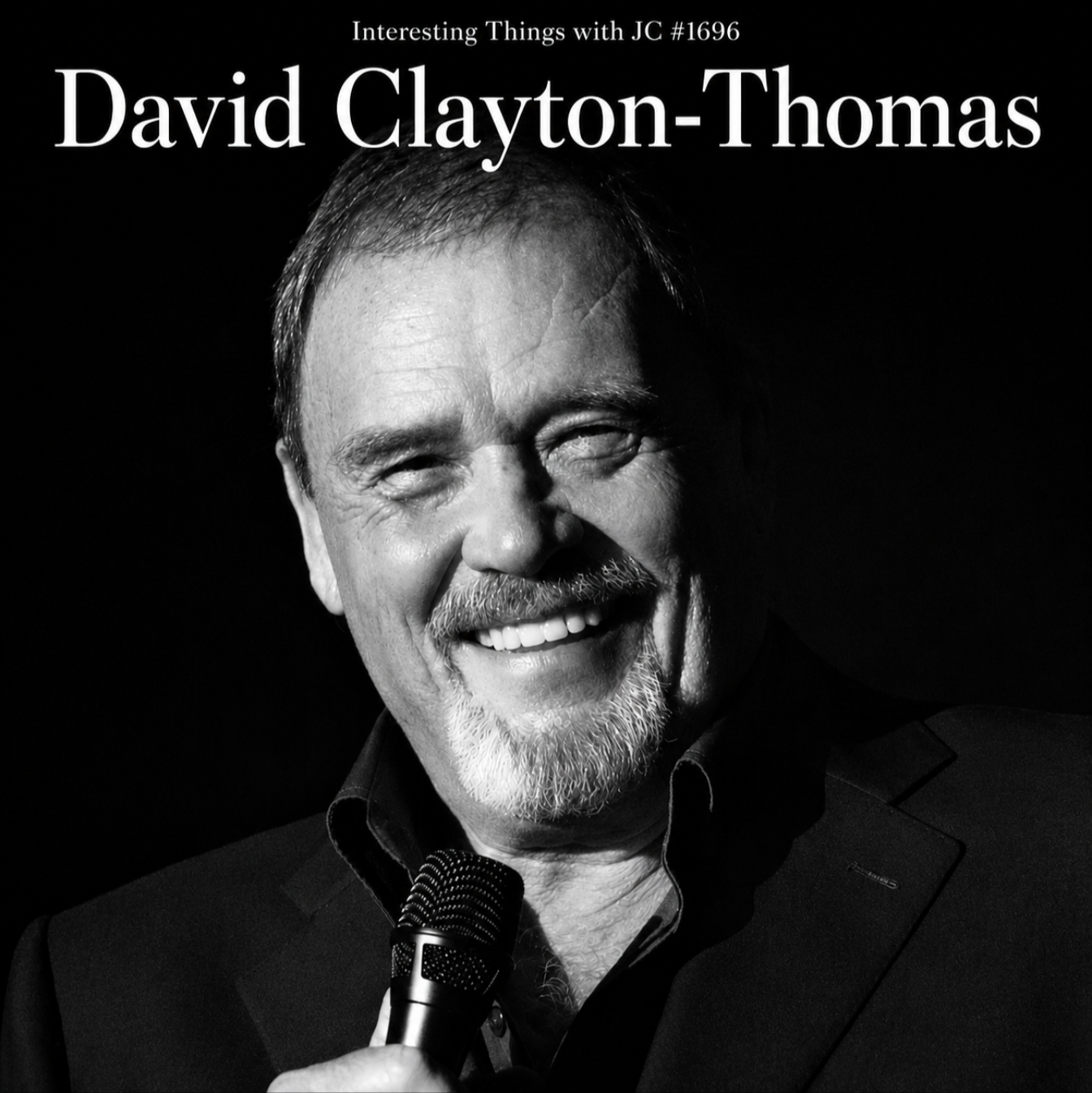
A high-contrast black-and-white portrait of singer David Clayton-Thomas fills the image. He is smiling warmly while holding a handheld microphone and wearing a dark jacket over a collared shirt. Dramatic lighting illuminates the left side of his face while the background remains completely black, drawing attention to his expression. At the top of the image, small white text reads "Interesting Things with JC #1696," with the much larger title "David Clayton-Thomas" displayed prominently beneath it in white lettering. The overall design has a clean, classic appearance that emphasizes the subject and the episode title.
Transcript
Interesting Things with JC #1696:
"David Clayton-Thomas"
David Clayton-Thomas wasn't supposed to become one of the defining voices of brass-driven rock. Before the sold-out concerts, the hit records, and the opening lines of "Spinning Wheel" that millions would recognize, he was a teenager sleeping wherever he could after leaving an abusive home. When his family immigrated from England to Canada in the early 1950s, the change in countries didn't change the turmoil at home, and his life seemed headed in a very different direction.
Born David Henry Thomsett on September 13, 1941, in Surrey, England, he endured years of instability, brushes with the law, and time in reformatories. It was in one of those institutions that an abandoned guitar changed his life. Teaching himself to play, he discovered that music offered something he hadn't found anywhere else: a future. He wasn't trying to sound like the British rock singers who dominated the charts. Instead, he immersed himself in the music of Ray Charles, James Brown, and Bobby Bland, developing the gritty, soulful style that would become his signature. By the time he reached Toronto's clubs, he already sounded unlike almost anyone else on the Canadian music scene. Ronnie Hawkins recognized that talent early and helped open doors for the young singer.
By the mid-1960s, he had become one of Canada's strongest rhythm-and-blues singers, earning a devoted following in Toronto clubs. Then, in 1968, came the opportunity that changed everything. Blood, Sweat & Tears had lost its original vocalist, Al Kooper, and needed someone who could bridge rock, blues, jazz, and soul. They weren't looking for another rock singer. They needed someone who could stand in front of a band that often sounded like a jazz orchestra without being overwhelmed by it. Clayton-Thomas had both the power and the musical instincts to do exactly that.
The gamble paid off almost immediately. The band's self-titled second album sold more than 10 million copies worldwide, spent 109 weeks on the Billboard chart, and earned five Grammy Awards, including Album of the Year. Clayton-Thomas became the unmistakable voice behind "You've Made Me So Very Happy," "And When I Die," and his own composition, "Spinning Wheel." Even today, those recordings reveal what made him different. He never seemed to compete with the horns. He sang through them, making the brass part of the song instead of something to overpower.
Blood, Sweat & Tears wasn't simply a rock band with horns. It fused jazz, blues, rock, and classical influences into something new, and Clayton-Thomas became the thread that held it together. Success didn't make life any simpler. He left and returned to the band more than once as musical tastes shifted and the lineup changed, but he never stopped performing. After returning to Toronto in 2004, he formed an all-star ten-piece band, continued recording and touring, and devoted time to organizations supporting at-risk youth.
The honors followed. He was inducted into the Canadian Music Hall of Fame, received a special Juno Award recognizing his outstanding contribution to Canadian music, earned a star on Canada's Walk of Fame, and saw "Spinning Wheel" inducted into the Canadian Songwriters Hall of Fame. Yet he always seemed proudest of simply being able to keep making music.
He later reflected on that remarkable journey in his autobiography, Blood, Sweat, and Tears. Looking back, it's hard to imagine that the young man searching for stability would become one of rock's most recognizable voices.
David Clayton-Thomas passed away peacefully at St. Michael's Hospital in Toronto on June 24, 2026, at the age of 84. He is survived by his daughters, Ashleigh Clayton-Thomas and Christine Graham. The voice that carried Blood, Sweat & Tears through its greatest success is now part of music history, but the recordings remain. They still sound every bit as powerful today as they did when they first came over the radio, reminding us that great singers don't simply perform songs. Sometimes they become inseparable from them.
These are interesting things, with JC.
Student Worksheet
Comprehension
Where was David Clayton-Thomas born?
What life event introduced him to playing guitar?
Which artists most influenced his vocal style?
Why was Blood, Sweat & Tears searching for a new vocalist in 1968?
Name three songs associated with David Clayton-Thomas.
Analysis
Why did Clayton-Thomas's soulful singing complement a horn-driven band?
How did adversity contribute to his development as an artist?
Compare perseverance in Clayton-Thomas's career with perseverance needed in another profession.
Reflection
Describe a challenge that ultimately helped you develop a valuable skill. How does your experience compare with David Clayton-Thomas's story?
Difficulty Scaling
Level 1: Recall factual information.
Level 2: Explain relationships between events.
Level 3: Analyze cause and effect.
Level 4: Apply lessons to modern careers and personal growth.
Student Output
Students will submit a one-page biography analysis citing evidence from the lesson.
Academic Integrity Guidance
Support all responses using lesson evidence and original thinking.
Teacher Guide
Quick Start: Begin by playing the podcast episode. Students should record examples of resilience, opportunity, and innovation while listening.
Pacing Guide (Audio-First):
Bell Ringer (5 minutes)
Podcast Listening (12–15 minutes)
Guided Discussion (10 minutes)
Worksheet (20 minutes)
Assessment and Exit Ticket (10 minutes)
Bell Ringer: Ask students to name a musician whose success followed significant personal hardship.
Audio Guidance: Encourage note-taking focused on turning points rather than memorizing dates.
Audio Fallback: Use the Narrative Core and Episode Summary if audio is unavailable.
Time on Task: Approximately 55–60 minutes.
Materials
Podcast audio
Student worksheet
Writing materials
Internet access for extension research
Vocabulary Strategy: Introduce key terms before listening and revisit them afterward using contextual examples.
Common Misconceptions
Success happens quickly.
Musical talent alone guarantees success.
Rock music developed independently from jazz and blues traditions.
Discussion Prompts
Why was Clayton-Thomas uniquely suited for Blood, Sweat & Tears?
How did musical diversity contribute to the band's success?
What role did perseverance play in his achievements?
Formative Checkpoints
Listening notes
Vocabulary review
Small-group discussion
Worksheet responses
Differentiation
Provide guided notes for emerging learners.
Allow verbal responses where appropriate.
Offer enrichment through independent artist research.
Assessment Differentiation
Written essay
Oral presentation
Multimedia timeline
Time Flexibility
Lesson may be condensed into one class or expanded into two sessions.
Substitute Readiness
All activities function independently using the Narrative Core and worksheet.
Engagement Strategy
Compare the sounds of traditional rock bands with brass-driven arrangements to identify musical differences.
Extensions
Research jazz-rock fusion.
Compare Blood, Sweat & Tears with Chicago.
Examine how musical genres evolve through collaboration.
Cross-Curricular Connections
History: Immigration and post-war Canada.
English: Biography and narrative writing.
Music: Instrumentation and vocal technique.
Sociology: Social mobility and resilience.
SEL Connection
Recognize perseverance, empathy, self-improvement, and positive decision-making.
Skill Emphasis
Critical thinking, evidence evaluation, communication, listening, historical reasoning, and reflection.
Answer Key
Comprehension:
Surrey, England.
Discovering an abandoned guitar while in a reformatory.
Ray Charles, James Brown, and Bobby Bland.
They needed a replacement for departing vocalist Al Kooper.
"Spinning Wheel," "You've Made Me So Very Happy," and "And When I Die."
Analysis and reflection responses will vary but should be supported with evidence.
Quiz
David Clayton-Thomas was originally born in:
A. Toronto
B. Liverpool
C. Surrey
D. GlasgowWhich instrument helped change the direction of his life?
A. Piano
B. Trumpet
C. Guitar
D. SaxophoneBlood, Sweat & Tears became famous for combining:
A. Country and bluegrass
B. Rock, jazz, blues, and brass arrangements
C. Classical opera
D. Electronic dance musicWhich song was written by David Clayton-Thomas?
A. Spinning Wheel
B. Imagine
C. Bridge Over Troubled Water
D. Hotel CaliforniaWhich characteristic best explains his long career?
A. Luck
B. Wealth
C. Perseverance
D. Fame
Assessment
Open-Ended Questions
Explain how David Clayton-Thomas's early experiences influenced both his musical style and career.
Why is Blood, Sweat & Tears considered innovative in music history?
3–2–1 Rubric
3: Thorough explanation supported with multiple accurate examples and clear reasoning.
2: Accurate explanation with some supporting evidence.
1: Limited understanding with minimal supporting detail.
Exit Ticket
Identify one challenge David Clayton-Thomas overcame and explain one lesson it offers for future careers or education.
Standards Alignment
NGSS Science & Engineering Practice: Analyzing and Interpreting Data
Students evaluate evidence from a historical biography and connect life events to outcomes.
Outcome: Construct evidence-based explanations about resilience and innovation.
CCSS.ELA-LITERACY.RI.11-12.1
Cite strong textual evidence supporting analysis.
Students support conclusions using evidence from the podcast summary and lesson activities.
CCSS.ELA-LITERACY.RI.11-12.2
Determine central ideas and analyze development.
Students identify themes of perseverance, opportunity, and artistic innovation.
CCSS.ELA-LITERACY.W.11-12.2
Write informative texts using relevant evidence.
Students produce a biography analysis demonstrating historical understanding.
CCSS.ELA-LITERACY.SL.11-12.1
Initiate and participate effectively in collaborative discussions.
Students evaluate historical and musical significance through discussion.
C3 Framework D2.His.1.9-12
Evaluate historical sources and chronology.
Students place Clayton-Thomas within the broader history of late-1960s popular music.
ISTE Standard 1.3 Knowledge Constructor
Evaluate information from multiple reliable sources.
Students distinguish between historical facts and interpretation.
Career Readiness Competencies
Analytical Thinking: Evaluate cause and effect in career development.
Communication: Present evidence-based conclusions.
Problem Solving: Examine obstacles and successful responses.
Adaptability: Recognize changing professional environments.
Professional Judgment: Connect perseverance with ethical career development.
Homeschool / Lifelong Learning Alignment
Encourages independent inquiry into music history.
Strengthens information literacy through source evaluation.
Demonstrates real-world applications of resilience and lifelong learning.
Promotes self-directed historical research.
Reinforces transferable skills including communication, analysis, and critical thinking.
Show Notes
David Clayton-Thomas's journey illustrates how determination, talent, and continual self-improvement can transform extraordinary hardship into lasting achievement. His story provides students with an engaging introduction to music history while emphasizing resilience, innovation, and the enduring influence of artists who bridge multiple musical traditions.
References
AllMusic. (n.d.). David Clayton-Thomas biography. https://www.allmusic.com/artist/david-clayton-thomas-mn0000636748
Blood, Sweat & Tears. (n.d.). Awards. Official website. https://bloodsweatandtears.com/awards
Canada's Walk of Fame. (n.d.). David Clayton-Thomas. https://www.canadaswalkoffame.com/inductee/david-clayton-thomas
Canadian Music Hall of Fame. (n.d.). David Clayton-Thomas. https://canadianmusichalloffame.ca/inductee/david-clayton-thomas/
Canadian Songwriters Hall of Fame. (n.d.). Spinning Wheel. https://www.cshf.ca/song/spinning-wheel/
Clayton-Thomas, D. (2010). Blood, sweat and tears. Penguin Canada. https://www.amazon.com/Blood-Sweat-Tears-David-Clayton-Thomas/dp/0143175998
David Clayton-Thomas. (n.d.). Official website. http://www.davidclaytonthomas.com/
Grammy.com. (n.d.). Grammy awards and nominations for Blood, Sweat and Tears. https://www.grammy.com/artists/blood-sweat-and-tears/7131/
Italie, H. (2026, June 25). David Clayton-Thomas, lead singer of Blood, Sweat & Tears, dies at 84. The Associated Press (via The Philadelphia Inquirer). https://www.inquirer.com/obituaries/david-clayton-thomas-blood-sweat-tears-singer-20260625.html
Pareles, J. (2026, June 25). David Clayton-Thomas, lead singer of Blood, Sweat & Tears, dies at 84. The New York Times. https://www.nytimes.com/2026/06/25/arts/music/david-clayton-thomas-dead.html
The Canadian Encyclopedia. (n.d.). David Clayton-Thomas. https://www.thecanadianencyclopedia.ca/en/article/david-clayton-thomas