1697: "Operation Popeye"
Interesting Things with JC #1697: "Operation Popeye" – American aircraft flew directly into monsoon clouds and released silver iodide to increase rainfall over the Ho Chi Minh Trail. The goal wasn't to destroy roads with bombs but to keep them buried in mud long enough to slow military supplies, and the secret program continued for years before becoming public.
Curriculum - Episode Anchor
Episode Title: Operation Popeye
Episode Number: 1697
Host: JC
Audience: Grades 9–12, Introductory College, Homeschool, Lifelong Learners
Subject Area: History, Military History, Earth Science, Meteorology, Environmental Science, Geography
Lesson Overview
Lesson Summary:
This lesson examines Operation Popeye, the secret United States weather-modification program conducted during the Vietnam War. Students explore the scientific principles behind cloud seeding, the military objectives of the operation, its effectiveness, ethical questions surrounding environmental warfare, and how the program ultimately influenced international law governing environmental modification.
Learning Objectives
Students will:
Explain why Operation Popeye was developed during the Vietnam War.
Describe the scientific process of cloud seeding and why it only works under specific atmospheric conditions.
Evaluate the military effectiveness of weather modification compared to conventional military operations.
Analyze how Operation Popeye contributed to international agreements regulating environmental warfare.
Essential Question
Can modifying the natural environment become an effective military strategy, and what limits should exist on its use?
Success Criteria
Students can:
Explain the purpose of the Ho Chi Minh Trail.
Describe how silver iodide cloud seeding works.
Evaluate historical evidence regarding Operation Popeye's effectiveness.
Explain why the ENMOD Convention was created.
Distinguish peaceful weather modification from military environmental warfare.
Student Relevance
Modern weather modification continues to support agriculture, water management, and hail suppression. Understanding Operation Popeye demonstrates how scientific discoveries may be applied for both peaceful and military purposes and why ethical standards are essential when technology advances.
Real-World Connection
Many western states in the United States, along with several other nations, continue limited cloud-seeding programs to improve snowpack and water supplies. Students will compare these peaceful applications with the prohibited military use of environmental modification.
Workforce Reality
Careers connected to this lesson include:
Meteorologist
Atmospheric Scientist
Environmental Engineer
Military Historian
Intelligence Analyst
Geographer
Civil Engineer
Emergency Management Specialist
International Law Specialist
Key Vocabulary
Cloud Seeding(klowd SEE-ding) — Introducing particles into suitable clouds to encourage precipitation under existing atmospheric conditions.
Silver Iodide(SIL-ver EYE-uh-dide) — A compound commonly used during cloud seeding because its crystal structure resembles natural ice.
Supercooled Water(soo-per-KOOLD WAW-ter) — Liquid water that remains below the normal freezing temperature until ice crystals begin forming.
Monsoon(mahn-SOON) — A seasonal wind pattern associated with prolonged periods of heavy rainfall.
Logistics(loh-JISS-tiks) — The planning and movement of personnel, equipment, fuel, and supplies.
Ho Chi Minh Trail(HOH CHEE MIN Trail) — An extensive transportation and supply network used by North Vietnam through Laos and Cambodia during the Vietnam War.
Environmental Modification(en-vy-run-MEN-tuhl mod-uh-fih-KAY-shun) — Deliberate alteration of natural environmental processes.
Sortie(SOR-tee) — A single operational military mission by an aircraft.
Reconnaissance(rih-KON-uh-suhns) — Military observation used to gather information.
ENMOD Convention(EN-mod) — The 1977 treaty prohibiting hostile environmental modification producing widespread, long-lasting, or severe effects.
Narrative Core
Open
For centuries, weather determined the outcome of military campaigns. Rain slowed armies, snow trapped soldiers, and floods altered battlefields. During the Vietnam War, military planners considered a different question: instead of waiting for the weather, could they change it?
Information
Operation Popeye emerged after years of bombing failed to stop the movement of troops and supplies along the Ho Chi Minh Trail. Rather than destroying roads, planners attempted to make those roads unusable by increasing rainfall during the annual monsoon season.
Details
Using aircraft equipped with silver iodide and lead iodide flares, Air Force crews seeded naturally developing clouds over portions of Laos, Cambodia, and Vietnam. The objective was not to create storms from clear skies but to enhance rainfall where favorable cloud conditions already existed. Between 1967 and 1972, thousands of operational missions attempted to extend the monsoon season, hoping to slow transportation through mud, flooding, landslides, and damaged crossings.
Although some classified assessments suggested measurable increases in rainfall and temporary transportation difficulties, historians continue to debate whether the operation significantly affected the overall course of the war. The Ho Chi Minh Trail remained operational through constant repairs, alternate routes, and remarkable logistical adaptability.
Reflection
Operation Popeye illustrates both the promise and the limitations of applying science to warfare. It also demonstrates how military innovation often produces ethical questions extending far beyond the battlefield. The international response eventually helped establish legal boundaries on the hostile use of environmental modification.
Closing
These are interesting things, with JC.
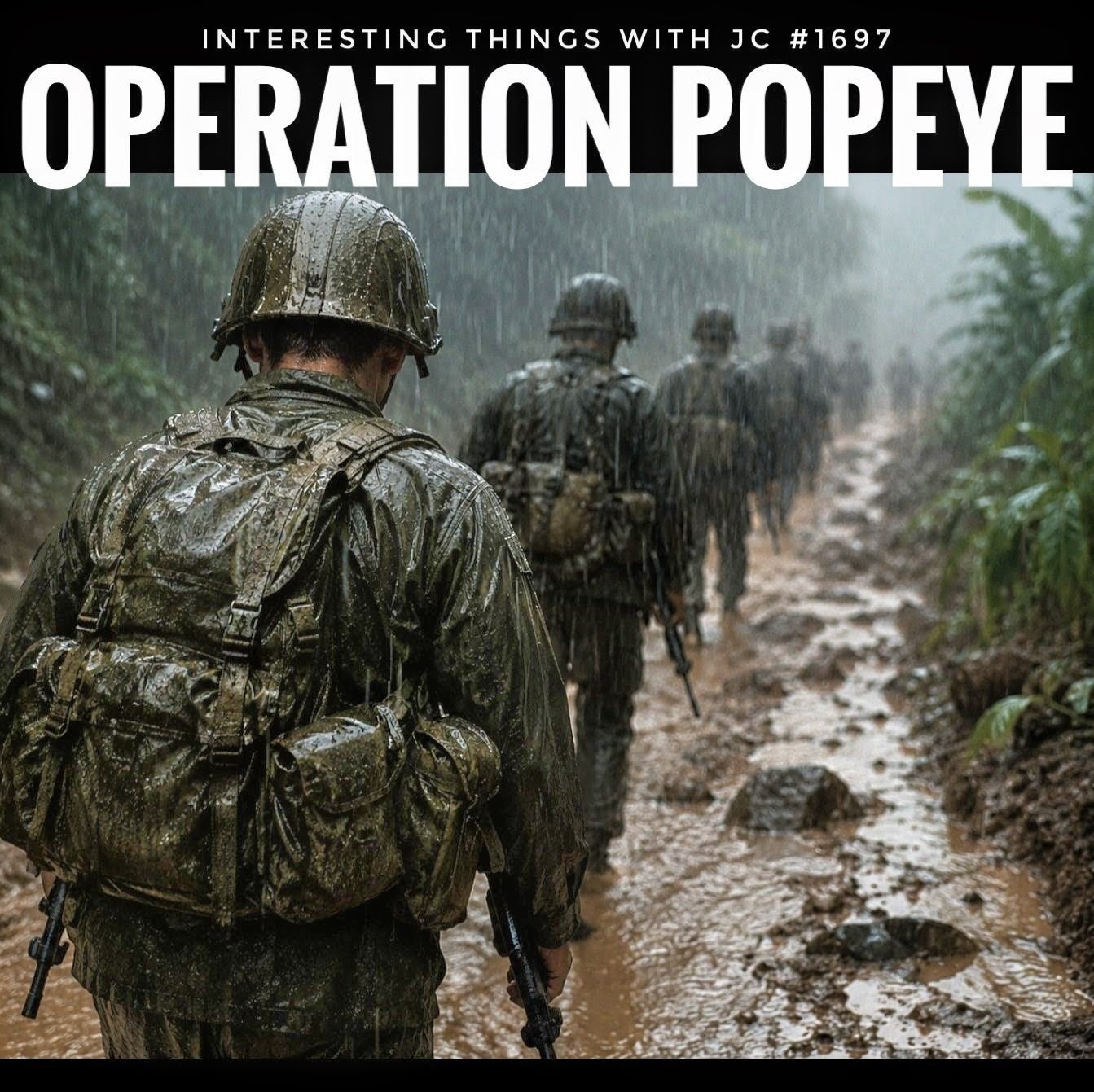
Square promotional image for Interesting Things with JC #1697: Operation Popeye. Across the top, large white text reads "INTERESTING THINGS WITH JC #1697" above the title "OPERATION POPEYE." The main image shows a line of soldiers walking away from the viewer along a deeply rutted, muddy jungle road during a heavy rainstorm. The nearest soldier wears a rain-soaked uniform, helmet, and large backpack, while additional soldiers fade into the rainy background. Dense tropical vegetation lines both sides of the road. The muddy conditions visually reinforce the episode's focus on Operation Popeye, the secret U.S. military cloud-seeding program during the Vietnam War that sought to increase rainfall and hinder movement along the Ho Chi Minh Trail.
Transcript
Interesting Things with JC #1697:
“Operation Popeye”
By 1966, American aircraft had dropped millions of pounds of bombs on the Ho Chi Minh Trail. Bridges were destroyed, roads were cratered, and supply depots were attacked, yet men and supplies kept moving south. The trail wasn't a single road. It was a logistical network stretching more than 10,000 miles, about 16,000 kilometers, through North Vietnam, Laos, and Cambodia. The network included truck parks, fuel pipelines, river crossings, bicycle trails, and jungle roads that were constantly repaired or rerouted. If one section disappeared under bombs, another opened through the forest.
Military planners began looking for something bombs couldn't do.
Their answer was the weather.
The project began as Project Popeye before becoming Operation Popeye. Later, to conceal its purpose, it received the classified designation Operation Intermediary-Compatriot. The mission was simple: increase rainfall over key sections of the Ho Chi Minh Trail long enough to slow the movement of troops, weapons, fuel, and supplies.
The idea wasn't new. In 1946, General Electric researcher Vincent Schaefer demonstrated that introducing particles into suitable clouds could stimulate the formation of ice crystals. His colleague, Bernard Vonnegut, later discovered that silver iodide worked especially well because its crystal structure closely resembles natural ice. Lead iodide was also used during Operation Popeye. Dispersed into moisture-rich clouds containing supercooled water droplets, these particles provided nuclei around which ice crystals formed. As the crystals grew, they fell as rain under the right atmospheric conditions. Cloud seeding couldn't make it rain from a clear sky. It only worked if the right kind of clouds were already there.
They summed up the entire operation in five words.
"Make mud, not war."
Beginning in March 1967, crews from the 54th Weather Reconnaissance Squadron flew repeated missions throughout each monsoon season. Most missions were flown by modified WC-130A Hercules aircraft, although F-4C Phantom II fighters also took part. Before each mission, Air Force meteorologists looked for developing clouds most likely to respond to seeding. After takeoff, crews entered those clouds and ignited pyrotechnic silver iodide and lead iodide flares beneath the wings, releasing microscopic particles as the aircraft made repeated passes through the cloud.
Over the next five years, the Air Force flew approximately 2,602 operational sorties, dispensing roughly 47,000 cloud-seeding cartridges over selected regions of Laos, Cambodia, and Vietnam.
They weren't trying to cause floods.
They were trying to make travel miserable.
Military planners hoped extended rainfall would soften dirt roads until trucks became mired in mud, wash away temporary bridges, swell streams beyond their banks, trigger landslides across mountain roads, and force North Vietnamese engineering units to spend more time rebuilding transportation routes than moving supplies. Slower convoys consumed more fuel, remained exposed longer to aerial reconnaissance, and delivered fewer supplies each day.
Classified Air Force assessments later concluded that cloud seeding increased rainfall in targeted areas and extended the monsoon season by approximately 30 to 45 days. Some reports described washed-out roads and increased maintenance demands along portions of the trail. Other analysts questioned whether those effects could be separated from naturally occurring weather or whether they made any real difference in the war. The Ho Chi Minh Trail continued operating throughout the conflict, adapting to heavier rainfall much as it had adapted to years of bombing by constructing bypasses, repairing damaged roads, and shifting traffic onto alternate routes.
Operation Popeye remained one of the most closely guarded programs of the Vietnam War. It operated under strict classification, and many members of Congress were unaware it even existed. That secrecy ended in 1971 when syndicated columnist Jack Anderson disclosed the operation. Seymour Hersh expanded the story the following year, revealing even more about the program and bringing it into public view.
The story reached far beyond Vietnam. Governments began asking whether the weather itself should ever become a weapon. Those debates helped shape the 1977 Environmental Modification Convention, known as ENMOD, which prohibits the hostile military use of environmental modification techniques that produce widespread, long-lasting, or severe effects. The treaty does not prohibit peaceful cloud-seeding projects, which continue today in several countries to increase mountain snowpack, supplement water supplies, reduce hail damage, and support agriculture.
Operation Popeye never became the future of warfare. No nation built weather squadrons. No campaigns were won by extending the rainy season. Instead, the operation helped draw a line. More than fifty years later, weather is still modified for peaceful purposes, but using it as a weapon is prohibited under international law.
These are interesting things, with JC.
Operation Popeye Curriculum
Student Worksheet
Lesson Title: Operation Popeye: Weather as a Weapon
Name: ________________________________
Date: _________________________________
Class: ________________________________
Directions: Listen to the podcast episode first. Take notes while listening. If audio is unavailable, read the transcript. Answer each question using complete sentences and evidence from the lesson.
Listening Notes
As you listen, record important information.
Military Problem
Scientific Solution
Results
Ethical Questions
Part A – Comprehension
Answer the following questions.
Why was the Ho Chi Minh Trail so difficult to destroy through bombing alone?
What was the primary objective of Operation Popeye?
Why can cloud seeding not produce rain from a completely clear sky?
What materials were released into the clouds during Operation Popeye?
What was meant by the phrase "Make mud, not war"?
Approximately how many operational sorties were flown during the program?
How did North Vietnamese forces respond to increased rainfall?
What treaty was influenced by the public disclosure of Operation Popeye?
Part B – Vocabulary in Context
Match each term with its correct definition.
TermDefinition Letter_____ LogisticsA. Artificially encouraging precipitation_____ Cloud SeedingB. Seasonal pattern of heavy rainfall_____ MonsoonC. Movement of personnel and supplies_____ ReconnaissanceD. Gathering military information_____ Environmental ModificationE. Deliberate alteration of natural processes
Part C – Cause and Effect
Complete the chart.
CauseEffectBombing failed to stop the Ho Chi Minh Trail.______________________________Cloud seeding increased rainfall.______________________________Roads became muddy.______________________________Operation Popeye became public.______________________________ENMOD Convention adopted.______________________________
Part D – Scientific Understanding
Explain the cloud-seeding process in your own words.
Why are supercooled water droplets important?
Why is silver iodide effective?
Why must suitable clouds already exist?
Part E – Historical Analysis
Use evidence from the lesson to answer.
What advantages did military planners hope to gain through weather modification?
Why do historians continue to debate the effectiveness of Operation Popeye?
Part F – Critical Thinking
Read the statement below.
"Science often creates opportunities that society must decide how to use responsibly."
Using Operation Popeye as evidence, explain whether you agree or disagree.
Support your response with at least three specific examples.
Part G – Modern Connections
Cloud seeding continues today for peaceful purposes.
Research one current application.
Examples include:
Increasing mountain snowpack
Supporting agriculture
Reducing hail damage
Improving water supplies
Application Studied
Purpose
Benefits
Potential Concerns
Part H – Timeline Activity
Place these events in chronological order.
____ ENMOD Convention adopted
____ Operation Popeye begins
____ Jack Anderson reveals the operation
____ Vincent Schaefer demonstrates cloud seeding
____ Seymour Hersh expands public reporting
Part I – Reflection
Respond thoughtfully.
Were military planners justified in attempting to change the weather during wartime?
Why or why not?
Should international law prohibit environmental warfare?
Explain your reasoning.
Difficulty Scaling
Level 1 – Foundations
Complete Parts A and B.
Level 2 – Proficient
Complete Parts A through F.
Level 3 – Advanced
Complete every section, including independent research in Part G.
Prepare a one-page written argument supported by historical evidence.
Present your findings in a short classroom discussion or presentation.
Student Product Expectations
By the end of this lesson, students should be able to produce:
A completed worksheet demonstrating factual understanding.
A cause-and-effect explanation of Operation Popeye.
A scientific explanation of cloud seeding.
An evidence-based historical analysis.
A reasoned ethical argument supported with historical evidence.
Academic Integrity Guidance
Listen carefully before answering.
Use your own words unless directly quoting the transcript.
Support conclusions with evidence from the lesson.
Clearly distinguish historical facts from personal opinions.
Properly cite any outside sources used for the research extension.
Teacher Guide
Lesson Title: Operation Popeye: Weather as a Weapon
Grade Band: Grades 9–12 | Introductory College | Homeschool | Lifelong Learning
Instructional Time: 55–75 minutes (expandable to 90 minutes)
Instructional Model: Audio-First Learning (Podcast → Discussion → Analysis → Reflection)
Instructional Purpose: This lesson uses Operation Popeye to demonstrate how scientific discovery, military necessity, geography, and ethics can intersect. Rather than presenting the operation as simply another Vietnam War story, students investigate how an atmospheric science experiment evolved into one of the most unusual military operations ever conducted and ultimately influenced international law.
Quick Start
Students should listen to the podcast before completing any written work. Encourage them to simply follow the story during the first listening rather than attempting to record every detail.
Distribute the worksheet only after the episode concludes. This allows students to experience the narrative naturally before shifting into historical analysis.
If audio is unavailable, students should read the transcript aloud in small groups, rotating readers every few paragraphs to preserve the conversational style of the original episode.
Learning Goals for the Instructor
By the conclusion of the lesson, students should understand that:
Operation Popeye was a logistics operation rather than a combat operation.
Cloud seeding enhances existing atmospheric conditions rather than creating weather.
The Ho Chi Minh Trail was an adaptable transportation network instead of a single roadway.
Scientific innovation can create ethical and legal questions beyond its original purpose.
The operation's greatest historical legacy may be its influence on international law rather than its military effectiveness.
Students should leave asking better questions, not simply remembering dates.
Before Playing the Episode
Many students picture the Ho Chi Minh Trail as one highway.
Begin by asking:
"When you hear the word trail, what image comes to mind?"
Allow several responses.
Then explain that the Ho Chi Minh Trail functioned more like a constantly evolving transportation system than a road. It included:
jungle roads
truck routes
bicycle paths
pipelines
river crossings
storage areas
engineering camps
alternate bypasses
Emphasize that destroying one section rarely stopped movement because another route quickly replaced it.
This context makes the military problem understandable before students hear the solution.
Audio-First Pacing Guide
Introduction (5 minutes)
Bell Ringer:
"Can changing nature ever become a military weapon?"
Students write a brief response without discussion.
Explain that today's lesson explores a real historical example.
Listening Phase (15–18 minutes)
Students listen without interruption.
Encourage them to identify:
the military problem
the scientific solution
whether the solution actually worked
Avoid pausing during the first listening unless absolutely necessary.
The episode is intentionally structured to reveal information gradually.
Guided Replay (Optional)
If time allows, replay selected portions and pause for discussion.
Pause One
After:
"Their answer was the weather."
Ask:
"What do you think they mean?"
Most students predict weather forecasting.
Allow predictions before revealing the actual operation.
Pause Two
After:
"Make mud, not war."
Ask:
"What is actually being attacked?"
Guide students toward recognizing that the target is transportation, not soldiers.
Introduce the military concept of logistics.
Pause Three
After the explanation of cloud seeding.
Ask:
"What scientific conditions must already exist before cloud seeding can work?"
Students should conclude that existing clouds containing supercooled water are required.
Clarify that cloud seeding cannot create rain from a clear sky.
Pause Four
After:
"They weren't trying to cause floods."
Ask:
"If the objective wasn't destruction, what was it?"
Expected discussion:
delay
inconvenience
increased maintenance
slower supply movement
higher transportation costs
Students begin recognizing that wars are often won—or lost—through logistics.
Pause Five
After discussion of ENMOD.
Ask:
"Why would governments decide this technology needed international limits?"
This transitions naturally into ethics and international law.
Teaching Notes
The Central Historical Idea
Operation Popeye illustrates an important principle of military history:
Sometimes the objective is not to destroy an enemy.
Sometimes the objective is to make accomplishing their mission slower, more expensive, and more difficult.
Students often associate warfare exclusively with combat.
This lesson expands their understanding by introducing logistics as a strategic target.
Integrating Science
Avoid presenting cloud seeding as mysterious.
Students should understand that:
water droplets already existed
clouds already existed
atmospheric conditions already existed
The aircraft attempted only to encourage precipitation within those naturally occurring systems.
This distinction is scientifically important and helps prevent misconceptions later.
Geography Matters
Display a regional map.
Have students identify:
North Vietnam
South Vietnam
Laos
Cambodia
Ask why the trail passed through neighboring countries rather than remaining inside Vietnam.
This discussion naturally introduces geography as a military factor.
Common Student Misconceptions
"They created storms."
Correction:
They enhanced rainfall within suitable clouds.
"Weather modification is illegal."
Correction:
Peaceful cloud seeding remains legal in many countries.
International law prohibits hostile environmental modification producing widespread, long-lasting, or severe effects.
"The operation failed because the war continued."
Correction:
Military historians distinguish between tactical effects and strategic outcomes.
Students should evaluate each separately.
"The Ho Chi Minh Trail was one road."
Correction:
It was an extensive transportation network with numerous alternate routes.
"Bombing and cloud seeding were competing strategies."
Correction:
Weather modification supplemented ongoing bombing campaigns rather than replacing them.
Guiding Inquiry
Observation
What logistical problem faced American planners?
Why was conventional bombing insufficient?
Analysis
Why might mud be more disruptive than destroyed bridges?
Why would extending the monsoon affect transportation?
Evaluation
How should historians determine whether Operation Popeye was successful?
What evidence supports competing interpretations?
Synthesis
How did scientific research conducted after World War II become a military tool?
How did one classified program influence international law?
Extension
Could modern satellite meteorology improve cloud seeding?
Should technological capability automatically justify military use?
Discussion Strategy
Encourage students to support every claim with evidence from the episode.
Instead of asking:
"Do you agree?"
Ask:
"What evidence supports that conclusion?"
This reinforces historical thinking over opinion.
Cross-Curricular Connections
History
Military logistics during the Vietnam War.
Earth Science
Cloud formation, precipitation, atmospheric physics.
Chemistry
Crystal nucleation and the role of silver iodide.
Geography
Terrain, climate, and transportation networks.
Government
International treaties and the regulation of warfare.
Environmental Science
Human interaction with natural systems.
Differentiation
Additional Support
Provide a vocabulary organizer before listening.
Allow transcript annotation.
Pair students for collaborative analysis.
Use a map during discussion to reinforce geographic concepts.
Advanced Learners
Investigate one of the following:
Project Stormfury
ENMOD negotiations
Modern cloud-seeding programs
Weather modification technologies
Logistics during the Vietnam War
Students should compare historical evidence from multiple sources rather than relying on a single account.
Extension Activities
Students may choose one:
Design a flowchart illustrating how cloud seeding works.
Create a timeline from scientific discovery (1946) to ENMOD (1977).
Debate whether environmental modification should ever be permitted during armed conflict.
Compare Operation Popeye with another military innovation that produced unintended legal or ethical consequences.
Write a short essay explaining why logistics often determine the success of military campaigns.
Formative Assessment Checkpoints
By the end of class, students should be able to explain:
Why bombing alone failed to stop the Ho Chi Minh Trail.
How cloud seeding functions scientifically.
Why the operation targeted transportation rather than combat.
Why historians debate its effectiveness.
How the operation influenced the creation of the ENMOD Convention.
If students can explain these concepts in their own words using evidence from the episode, they have met the lesson objectives.
Answer Key
Comprehension
The Ho Chi Minh Trail was an extensive, constantly changing logistics network with multiple alternate routes, making it difficult to destroy permanently.
The objective was to increase rainfall over portions of the trail to slow the movement of troops, weapons, fuel, and supplies.
Cloud seeding requires existing clouds containing supercooled water droplets; it cannot produce rain from a clear sky.
Silver iodide and lead iodide were dispersed into suitable clouds.
"Make mud, not war" summarized the strategy of disrupting transportation rather than relying solely on direct destruction.
Approximately 2,602 operational sorties were flown, dispersing about 47,000 cloud-seeding cartridges.
North Vietnamese engineers repaired roads, built bypasses, and shifted traffic to alternate routes, maintaining the flow of supplies.
Public disclosure contributed to international debate that helped lead to the 1977 Environmental Modification Convention (ENMOD).
Vocabulary
Logistics — Movement and management of personnel, equipment, and supplies.
Cloud Seeding — Introducing particles into suitable clouds to encourage precipitation.
Monsoon — Seasonal wind and rainfall pattern.
Reconnaissance — Gathering military information through observation.
Environmental Modification — Deliberate alteration of natural environmental processes.
Historical Analysis
High-quality responses should recognize that Operation Popeye sought to increase logistical difficulties rather than destroy enemy forces directly and should acknowledge that historians continue to debate whether its measurable meteorological effects translated into meaningful strategic gains.
This revised Teacher Guide is designed to function as an instructor's companion rather than a procedural checklist. It keeps the podcast narrative at the center of instruction, integrates science, history, geography, and ethics throughout the lesson, and provides educators with meaningful questions and teaching strategies that deepen analysis while remaining faithful to the instructional style.
Quiz
Instructions: Select the best answer for each question. Use evidence from the podcast episode and class discussion. Do not use notes unless directed by your instructor.
1. What military problem led to the development of Operation Popeye?
A. American aircraft lacked precision bombing capability.
B. The Ho Chi Minh Trail continued functioning despite years of bombing.
C. North Vietnam controlled American weather satellites.
D. Heavy snowfall prevented military operations.
2. Why was silver iodide used during Operation Popeye?
A. It produced electrical storms.
B. It absorbed atmospheric moisture.
C. Its crystal structure closely resembles natural ice, encouraging ice crystal formation.
D. It warmed clouds and increased evaporation.
3. What was the primary objective of increasing rainfall?
A. Destroy enemy cities.
B. Flood rice fields.
C. Slow the transportation of troops and supplies.
D. Eliminate enemy aircraft.
4. Which statement best describes the Ho Chi Minh Trail?
A. A single highway running through Vietnam.
B. A railroad connecting Hanoi and Saigon.
C. A large logistical network of roads, trails, rivers, pipelines, and support facilities.
D. An underground tunnel system.
5. Which international agreement was influenced in part by debates surrounding Operation Popeye?
A. Geneva Convention
B. Strategic Arms Limitation Treaty (SALT)
C. Environmental Modification Convention (ENMOD)
D. Antarctic Treaty
Challenge Question (Optional)
Military historians continue debating whether Operation Popeye was successful.
Which type of historical evidence would best help answer that question?
A. Personal opinions
B. Supply movement records before and after cloud-seeding operations
C. Newspaper headlines
D. Aircraft paint schemes
Assessment
Using evidence from the episode, explain how Operation Popeye demonstrates the relationship between science, military strategy, and international law.
Your response should include:
the military problem
the scientific principles involved
the intended military effect
the historical outcome
the legal legacy
Expected length: 2–3 well-developed paragraphs
Open-Ended Question 1
Operation Popeye attempted to solve a logistical problem rather than defeat enemy forces directly.
Explain why disrupting logistics can sometimes be as important as winning battles.
Support your answer with evidence from the episode.
Open-Ended Question 2
Scientific discoveries often have peaceful and military applications.
Using Operation Popeye as an example, discuss how societies should balance technological innovation with ethical responsibility.
Use historical evidence to support your position.
3–2–1 Reflection Rubric
3 Things I Learned
Students identify three significant facts or concepts they learned from the lesson.
Examples may include:
How cloud seeding works.
Why the Ho Chi Minh Trail remained operational.
The purpose of the ENMOD Convention.
2 Ideas That Changed My Thinking
Students explain two ideas that challenged previous assumptions.
Examples:
Weather can become part of military planning.
Logistics often determine strategic success more than combat alone.
1 Question I Still Have
Students write one thoughtful question for future investigation.
Examples:
Could modern technology make weather modification more effective?
How is cloud seeding monitored today?
Are there other military technologies that later became internationally restricted?
Exit Ticket
Before leaving class, answer the following in three complete sentences:
What do you believe is Operation Popeye's most important historical legacy, and why?
Students should support their answer with one specific example from the episode.
Standards Alignment
Lesson Title: Operation Popeye
This lesson aligns with secondary and introductory college expectations by integrating historical inquiry, scientific reasoning, geographical analysis, evidence evaluation, communication skills, and ethical decision-making. Alignment follows the requirements of the Interesting Things with JC™ Curriculum Framework for Grades 9–12, introductory college, homeschool, and lifelong learners.
NGSS — Next Generation Science Standards
HS-ESS2-5 — Plan and conduct an investigation of factors affecting Earth's systems.
Connection: Students examine how atmospheric conditions influence precipitation and why cloud seeding depends upon existing weather systems.
Student Outcome: Explain why cloud seeding enhances rather than creates rainfall.
Justification: Connects atmospheric science directly to the scientific explanation presented in the episode.
CCSS Reading
CCSS.ELA-LITERACY.RH.11-12.2
Determine the central ideas of primary and secondary historical sources.
Connection: Students identify the central historical argument presented in the podcast and transcript.
Student Outcome: Summarize Operation Popeye using supporting historical evidence.
CCSS.ELA-LITERACY.RH.11-12.7
Integrate information presented in diverse media.
Connection: Students synthesize information from the podcast, transcript, maps, and classroom discussion.
Student Outcome: Compare scientific, historical, and geographical evidence.
CCSS Writing
CCSS.ELA-LITERACY.WHST.11-12.1
Write arguments focused on discipline-specific content.
Connection: Students evaluate Operation Popeye's effectiveness and ethical implications.
Student Outcome: Construct an evidence-based historical argument.
CCSS.ELA-LITERACY.WHST.11-12.9
Draw evidence from informational texts.
Connection: Students support written responses using facts presented during the lesson.
Student Outcome: Cite historical evidence accurately.
CCSS Speaking & Listening
CCSS.ELA-LITERACY.SL.11-12.1
Initiate and participate effectively in collaborative discussions.
Connection: Students analyze competing historical interpretations during classroom discussion.
Student Outcome: Present claims supported by evidence while respectfully responding to peers.
C3 Framework for Social Studies
D2.His.16.9-12
Integrate evidence from multiple historical sources.
Connection: Students compare military objectives, scientific evidence, and international legal outcomes.
Student Outcome: Evaluate historical cause-and-effect relationships.
Justification: Encourages historical reasoning rather than simple memorization.
ISTE Standards for Students
1.3 Knowledge Constructor
Students critically evaluate information from multiple sources.
Connection: Learners distinguish historical evidence from assumptions regarding Operation Popeye's effectiveness.
Student Outcome: Develop informed conclusions supported by reliable evidence.
Career Readiness Competencies
Students develop transferable workplace skills including:
Analytical Thinking: Evaluating military and scientific evidence.
Communication: Explaining complex ideas clearly in discussion and writing.
Problem Solving: Examining why military planners pursued unconventional solutions.
Adaptability: Considering how changing conditions influence strategic decision-making.
Professional Judgment: Evaluating ethical implications of emerging technologies.
Homeschool / Lifelong Learning Alignment
Students practice:
Independent historical research.
Information literacy through evaluating multiple sources.
Scientific reasoning using real-world examples.
Ethical decision-making grounded in evidence.
Transferable critical-thinking skills applicable beyond the classroom.
Show Notes
Operation Popeye demonstrates that warfare is not limited to weapons and battles but also includes logistics, science, geography, and strategic decision-making. By examining one of the Vietnam War's most unusual classified programs, students explore how scientific discoveries can influence military planning, public policy, and international law. The lesson encourages learners to think critically about technological innovation, evidence, and the responsibilities that accompany scientific advancement while reinforcing the importance of historical inquiry over historical myth.
References
Keefer, E. C. (Ed.). (1998). Foreign Relations of the United States, 1964–1968, Volume XXVIII: Laos. Document 274: Weather modification in North Vietnam and Laos (Project Popeye). Office of the Historian, U.S. Department of State. https://history.state.gov/historicaldocuments/frus1964-68v28/d274
Pincus, R. (2017). To prostitute the elements: Weather control and weaponisation by the U.S. Department of Defense. War & Society, 36(1), 64–80. https://www.tandfonline.com/doi/abs/10.1080/07292473.2017.1295539
United Nations. (1977). Convention on the Prohibition of Military or Any Other Hostile Use of Environmental Modification Techniques (ENMOD). https://treaties.un.org/pages/ViewDetails.aspx?src=IND&mtdsg_no=XXVI-1&chapter=26&clang=_en
United Nations Office for Disarmament Affairs. (n.d.). Convention on the Prohibition of Military or Any Other Hostile Use of Environmental Modification Techniques. https://disarmament.unoda.org/en/our-work/weapons-mass-destruction/convention-prohibition-military-or-any-other-hostile-use-environmental-modification-techniques
U.S. Congress. Senate. Committee on Foreign Relations. Subcommittee on Oceans and International Environment. (1974). Weather modification: Hearing before the Subcommittee on Oceans and International Environment of the Committee on Foreign Relations, United States Senate, 93rd Congress. U.S. Government Printing Office. https://www.govinfo.gov/app/details/CHRG-93shrg29544O
House, T. J., Near, J. B., Shields, W. B., Celentano, R. J., Husband, D. M., & Mercer, A. J. (1996). Weather as a force multiplier: Owning the weather in 2025. Air University. https://ia601605.us.archive.org/35/items/WeatherAsAForceMultiplier/WeatherAsAForceMultiplier.pdf
Cabinet Magazine. (2001). We will bury you. In mud. https://www.cabinetmagazine.org/issues/3/brown.php
American Meteorological Society. (n.d.). Weather modification. https://www.ametsoc.org/ams/about-ams/ams-statements/archive-statements-of-the-ams/planned-weather-modification-through-cloud-seeding/
U.S. Department of State, Office of the Historian. (n.d.). The Vietnam War. https://history.state.gov/milestones/1961-1968/tet
U.S. Government Publishing Office. (1974). Weather Modification: Programs, Problems, Policy, and Potential. https://archive.org/stream/weatificat00unit/weatificat00unit_djvu.txt