1698: "Operation Mockingbird"
Interesting Things with JC #1698: "Operation Mockingbird" – The CIA built relationships with journalists, funded publications, and treated information as a Cold War weapon, but the famous name "Operation Mockingbird" may not have been the official program most people believe it was. The documented history is remarkable, while the legend grew even larger.
Curriculum - Episode Anchor
Episode Title: Operation Mockingbird
Episode Number: 1698
Host: JC
Audience: Grades 9–12, Introductory College, Homeschool, Lifelong Learners
Subject Area: United States History, Cold War History, Intelligence Studies, Media Studies, Civics, Information Literacy
Lesson Overview
Lesson Summary
This lesson examines the historical evidence surrounding the term Operation Mockingbird and explores how intelligence agencies viewed information as a strategic weapon during the early Cold War. Students investigate documented CIA relationships with journalists, newspapers, cultural organizations, and international broadcasting while distinguishing verified historical evidence from later myths and conspiracy narratives. Through primary and secondary historical interpretation, learners develop critical evaluation skills for assessing complex historical claims.
Learning Objectives
Students will:
Explain why information became a strategic asset during the Cold War.
Describe Frank Wisner's Office of Policy Coordination and the meaning of the "Mighty Wurlitzer."
Distinguish between documented CIA media influence programs and unsupported conspiracy claims.
Evaluate how historians analyze incomplete evidence and conflicting interpretations.
Analyze the importance of evidence-based historical reasoning when investigating controversial subjects.
Essential Question
How can historians distinguish documented covert government activities from myths and later interpretations?
Success Criteria
Students will be able to:
Describe the geopolitical context that produced CIA information operations.
Explain why intelligence agencies cultivated relationships with journalists and media organizations.
Identify historical evidence supporting documented CIA media influence.
Explain why the name Operation Mockingbird remains historically debated.
Evaluate multiple historical sources without relying on unsupported assumptions.
Student Relevance Statement
Students encounter information from countless media sources every day. Understanding how governments, organizations, and institutions attempt to influence public opinion helps develop media literacy, critical thinking, and informed citizenship.
Real-World Connection
Governments, corporations, advocacy groups, and media organizations continue to shape public opinion through strategic communication. Understanding historical information campaigns helps students better evaluate modern news, social media, and public messaging.
Workforce Reality
Professionals in journalism, intelligence analysis, public policy, communications, cybersecurity, law, political science, military service, and historical research all rely upon evidence evaluation, source verification, and analytical reasoning when assessing information.
Key Vocabulary
Cold War(kohld war)
A period of geopolitical rivalry between the United States and the Soviet Union characterized by ideological competition, proxy conflicts, espionage, and influence campaigns rather than direct large-scale military conflict.
Office of Policy Coordination (OPC)(OFF-iss uhv POL-uh-see kuh-or-duh-NAY-shun)
An early CIA organization responsible for covert political and psychological operations during the beginning of the Cold War.
Frank Wisner(Frank WIZ-ner)
The CIA official who directed the Office of Policy Coordination and envisioned coordinated influence efforts described as the "Mighty Wurlitzer."
Mighty Wurlitzer(MY-tee WURL-it-ser)
Wisner's metaphor describing a network of organizations capable of presenting coordinated messages through seemingly independent voices.
Propaganda(prop-uh-GAN-duh)
Information designed to influence public opinion, attitudes, or behavior, often emphasizing selected facts or perspectives.
Psychological Operations(SYE-kuh-LAH-jih-kul op-er-AY-shuns)
Activities intended to influence perceptions, attitudes, and behaviors of foreign audiences in support of strategic objectives.
Covert Operation(KOH-vert op-er-AY-shun)
A secret activity conducted so that the sponsor's involvement is concealed or plausibly denied.
Radio Free Europe(RAY-dee-oh Free YUR-up)
A U.S.-supported broadcasting organization that transmitted news and information into Eastern Europe during the Cold War.
Church Committee(Church Kuh-MIT-ee)
The 1975–1976 U.S. Senate investigation that examined intelligence agency activities, including CIA relationships with journalists.
Historical Evidence(his-TOR-ih-kul EV-ih-dents)
Documents, testimony, physical records, and verified sources that historians use to reconstruct past events.
Narrative Core
Open
The Cold War was fought with far more than soldiers, tanks, and nuclear weapons. It was also a struggle over ideas. Both the United States and the Soviet Union understood that influencing public opinion could shape governments, alliances, and international stability. In that environment, information itself became a strategic resource.
Information
American intelligence officials believed Soviet influence extended beyond military power into newspapers, universities, labor organizations, publishing houses, and cultural institutions. To counter that influence, the CIA developed covert methods to support anti-communist messaging around the world.
Frank Wisner, who directed the CIA's Office of Policy Coordination, famously compared this network to a "Mighty Wurlitzer," suggesting that many independent voices could collectively produce a coordinated message when national security required it.
Details
Over time, the CIA established relationships with journalists, financed publications, supported cultural organizations, and funded international broadcasting efforts such as Radio Free Europe and Radio Liberty. These activities were largely hidden from public view during the early Cold War.
Beginning in the late 1960s, investigative reporting and congressional inquiries revealed portions of these covert relationships. The Church Committee confirmed that the CIA had maintained relationships with numerous American journalists, although many names remained confidential.
Journalist Carl Bernstein later argued that the network of media relationships had been broader than previously understood, while historians continue debating the precise scope of those connections.
One of the greatest historical questions concerns the name "Operation Mockingbird." Although the phrase has become widely associated with CIA media influence programs, historians have found little evidence that it represented one centralized, officially documented operation. Instead, the label appears to have evolved as shorthand describing multiple related activities conducted over many years.
Ironically, one confirmed CIA use of the name "Project Mockingbird" referred to an entirely different 1963 wiretapping investigation involving syndicated columnists Robert Allen and Paul Scott, illustrating how historical terminology can evolve independently from official documentation.
Reflection
Operation Mockingbird demonstrates that history is often more complicated than popular narratives suggest. Governments sometimes conduct secret operations, but historical evidence rarely supports simple explanations for complex events.
Responsible historical inquiry requires balancing skepticism with evidence. Historians must avoid dismissing uncomfortable facts while also resisting unsupported conclusions. The strongest understanding emerges when documented evidence—not speculation—guides interpretation.
Closing
Frank Wisner imagined a "Mighty Wurlitzer" capable of playing many voices at once. Decades later, one of those voices became part of a larger historical debate about intelligence, journalism, secrecy, and public trust.
These are interesting things, with JC.
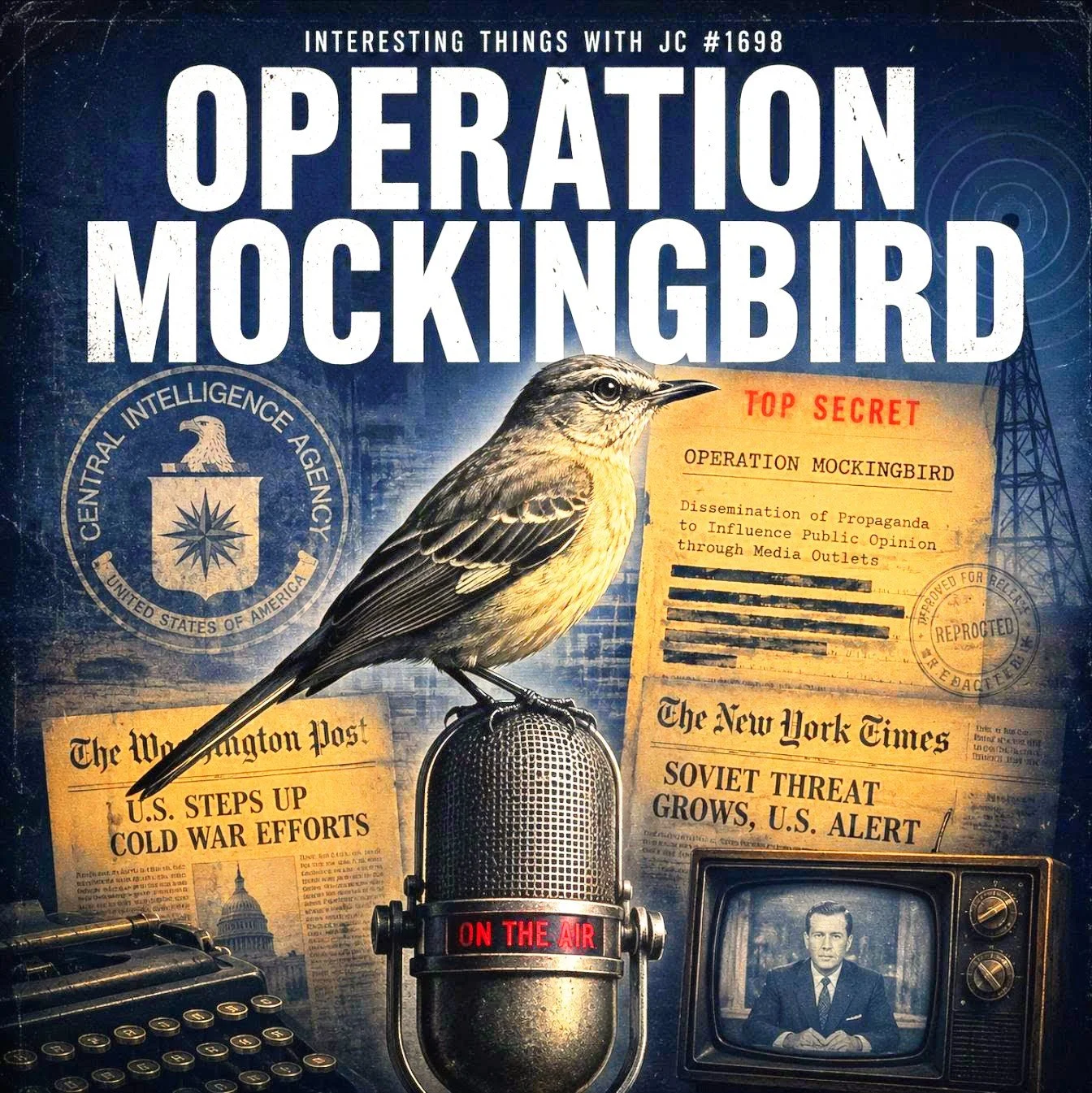
Promotional cover art for the podcast Interesting Things with JC #1698: Operation Mockingbird. Large white text reading "Operation Mockingbird" dominates the top of the image. A mockingbird is perched on a vintage broadcast microphone labeled "On the Air." Surrounding the bird are a faded CIA seal, vintage newspaper front pages, a redacted document stamped "Top Secret," a typewriter, a television displaying a 1960s-style news anchor, and radio transmission towers in the background. The overall design uses blue and sepia tones to evoke Cold War-era intelligence, journalism, and government secrecy.
Transcript
Interesting Things with JC #1698:
“Operation Mockingbird”
By 1948, the Cold War had already spread far beyond soldiers and spies.
American intelligence officers believed the Soviet Union wasn't simply competing for territory. It was competing for ideas. Newspapers, magazines, radio broadcasts, universities, labor unions, publishing houses, and cultural organizations had all become part of the battlefield. If public opinion could be influenced, information itself had become a strategic asset.
One of the men charged with fighting that battle was Frank Wisner, who led the CIA's Office of Policy Coordination. Wisner reportedly described the network of organizations available to American intelligence as the "Mighty Wurlitzer."
The comparison was instantly recognizable in its day. A Wurlitzer theater organ could fill an auditorium with what sounded like an entire orchestra, even though only one musician sat at the keyboard. Wisner imagined information working much the same way—a collection of independent voices that could, when necessary, advance a common strategic purpose against Soviet influence.
Decades later, much of that effort would become known to the public by another name.
Operation Mockingbird.
Few Cold War subjects generate as much disagreement. Some people use the term to describe documented CIA efforts to influence information. Others use it to describe an enormous conspiracy that secretly controls the news to this day. The historical record supports parts of the first claim. It does not support the second.
Understanding why means separating what historians can document from what later became attached to one memorable name.
The CIA quietly supported anti-communist newspapers and magazines overseas. It financed cultural organizations and intellectual journals. It backed Radio Free Europe and Radio Liberty, carrying Western news behind the Iron Curtain into countries where independent reporting often didn't exist.
It also developed relationships with journalists.
Today that sounds extraordinary. In the late 1940s and 1950s, many participants saw the world through the lens of an existential struggle with Soviet communism. Some reporters willingly shared observations gathered overseas because they believed they were serving their country. Others introduced intelligence officers to valuable contacts. In some cases, well-known correspondents maintained ongoing relationships with the agency, while others cooperated only occasionally or declined altogether. The relationships differed from person to person, making broad generalizations difficult.
By the late 1960s, those activities were beginning to emerge from the shadows.
Ramparts magazine revealed that the CIA had secretly financed the National Student Association, exposing covert relationships with respected private institutions. Congressional investigations followed. The Church Committee confirmed that the CIA had maintained relationships with dozens of American journalists over the years, although it chose not to publicly identify them.
In 1977, Carl Bernstein's investigation for Rolling Stone argued that the network had been considerably broader, involving reporters, editors, publishers, and media executives over several decades. His work remains one of the most influential examinations of the subject, even as historians continue debating the exact size and nature of those relationships.
Only after all of that do we arrive at the question most people assume has a simple answer.
Was this actually called Operation Mockingbird?
Official records don't provide a simple yes.
Many historians use the term as shorthand for the CIA's broader media influence efforts, particularly those associated with Frank Wisner's organization. Others argue the label was applied later to a collection of related activities rather than to one formally documented, centralized operation.
There's an irony here.
One of the few officially documented uses of the name appears in the CIA's declassified "Family Jewels" files, where "Project Mockingbird" referred to a 1963 wiretapping operation targeting syndicated columnists Robert Allen and Paul Scott during an investigation into classified leaks about the Soviet-American nuclear balance. It was real, but it wasn't the sweeping media program most people have in mind today.
Over time, congressional investigations, investigative journalism, declassified documents, biographies, and popular culture gradually merged into a single public narrative. "Operation Mockingbird" became the name attached to an entire era of covert media activity, even though the historical record describes numerous operations, relationships, and programs rather than one clearly documented master plan.
The documented history is already remarkable. Intelligence agencies cultivated journalists, funded publications, supported cultural organizations, and viewed information as an instrument of national security throughout the Cold War. Those facts don't require embellishment.
History also asks us to resist the temptation to make every complicated story simpler than the evidence allows.
Perhaps that's the lasting lesson of Operation Mockingbird. Not that every suspicion is true or every denial is sufficient, but that understanding history often requires holding two ideas at the same time: governments sometimes act in secret, and legends often grow larger than the records that inspired them.
Frank Wisner's "Mighty Wurlitzer" was designed to play many voices at once.
Decades later, one of those voices became a story of its own.
These are interesting things, with JC.
Student Worksheet
Lesson Title: Operation Mockingbird
Episode Number: 1698
Student Name: ____________________________
Date: ____________________________
Class Period: ____________________________
Estimated Completion Time: 35–45 minutes (following podcast listening)
Directions
Listen carefully to the podcast episode before completing this worksheet. If the audio is unavailable, read the transcript provided by your instructor. Answer all questions using evidence from the episode and your own historical reasoning. Write in complete sentences where appropriate.
Comprehension
Part A – Recall
Answer the following questions using information directly from the episode.
Why did American intelligence officials consider information to be a strategic asset during the Cold War?
Who was Frank Wisner, and what organization did he lead?
What did Wisner mean by the phrase "Mighty Wurlitzer"?
Name three types of organizations or institutions that the CIA supported or influenced during the Cold War.
Why were Radio Free Europe and Radio Liberty important?
How did some journalists cooperate with the CIA?
What role did Ramparts magazine play in revealing CIA activities?
What did the Church Committee investigate?
Why do historians debate the term "Operation Mockingbird"?
What was the documented "Project Mockingbird" described in the CIA's Family Jewels files?
Analysis
Use evidence from the episode to answer the following questions.
Why might intelligence agencies believe influencing information is as important as military strength?
Why is it important for historians to distinguish between documented evidence and popular belief?
How can incomplete historical records create myths or misunderstandings?
Explain why broad generalizations about journalists working with the CIA are historically inaccurate.
The episode argues that "history often requires holding two ideas at the same time." What does this mean in the context of Operation Mockingbird?
Source Evaluation Exercise
Below are four statements. Mark each as:
D = Supported by documented historical evidence
P = Plausible but debated
N = Not supported by the historical evidence discussed
_____ The CIA maintained relationships with some journalists.
_____ Every American news organization was secretly controlled by the CIA.
_____ Information became an important Cold War battleground.
_____ Historians continue debating exactly what "Operation Mockingbird" originally referred to.
Historical Thinking
Read each question carefully.
Why do you think governments sometimes conduct covert operations instead of acting publicly?
Should historians accept claims without documentary evidence? Explain.
What kinds of sources would historians want before accepting a controversial historical claim?
Timeline Activity
Place these events in chronological order by numbering them 1–6.
□ Carl Bernstein publishes his Rolling Stone investigation.
□ Frank Wisner leads the Office of Policy Coordination.
□ Ramparts magazine exposes CIA funding.
□ Cold War begins.
□ Church Committee investigation.
□ CIA Family Jewels describe Project Mockingbird.
Critical Thinking Scenario
Imagine you are a historian working in 2075.
A newly declassified government document appears to support one part of a long-debated historical claim.
Answer the following:
Would one document settle the debate? Why or why not?
What additional evidence would you seek?
Why is corroboration important in historical research?
Reflection
Write one well-developed paragraph (8–10 sentences).
Prompt:
What do you believe is the most important lesson this episode teaches about evaluating information? Support your answer with evidence from the podcast.
Challenge Activity (Advanced)
Research one additional Cold War information campaign (American or Soviet).
Include:
Name of the campaign
Country responsible
Primary objective
Methods used
Historical outcome
Two reliable historical sources
Write a one-page summary comparing it with the events described in this episode.
Difficulty Scaling
Level 1 (Developing)
Complete Parts A and Reflection.
Level 2 (Proficient)
Complete all worksheet sections.
Level 3 (Advanced)
Complete every section plus the Challenge Activity using outside scholarly research.
Student Output Expectations
By the end of this lesson, students should produce:
Accurate factual responses
Evidence-based historical analysis
A completed chronology
Source evaluation exercise
Reflective writing
Optional comparative research project
Academic Integrity Guidance
Base all responses on evidence from the episode, transcript, and approved historical sources.
Clearly distinguish documented facts from personal opinions.
Properly cite outside research if completing the Challenge Activity.
Do not use AI-generated summaries or online articles without verifying the original historical evidence.
Historical interpretation should always be supported by credible sources rather than assumptions or speculation.
Teacher Guide
Lesson Title: Operation Mockingbird
Episode Number: 1698
Recommended Grade Band: Grades 9–12, Introductory College, Homeschool, Lifelong Learning
Estimated Lesson Length: 60–75 minutes (Expandable to 90 minutes)
Instructional Model: Audio-First Inquiry Lesson
Quick Start
Purpose
This lesson uses the podcast episode as the primary instructional resource to examine the documented history surrounding CIA information operations during the Cold War while strengthening historical thinking and media literacy skills.
Students should first listen to the episode without interruption. The initial listening establishes the historical narrative before analysis begins.
After listening, students complete the worksheet individually before engaging in guided classroom discussion.
Lesson Sequence
0–5 Minutes
Bell Ringer
Introduce lesson objectives
Activate prior knowledge
5–18 Minutes
Listen to the podcast episode
Students should avoid taking extensive notes during the first listen.
Encourage students to focus on the overall narrative.
18–30 Minutes
Students complete the Comprehension section independently.
30–45 Minutes
Small-group discussion
Compare responses
Analyze evidence versus interpretation
45–60 Minutes
Whole-class discussion
Reflection activity
Exit Ticket
Extension (Optional)
Challenge Activity
Independent research project
Comparative Cold War information campaign investigation
Bell Ringer
Display the following question before class begins.
Can governments influence public opinion without using military force? Explain your reasoning and provide one historical or modern example if possible.
Allow students 3–5 minutes to write independently before discussion.
Learning Goals
By the conclusion of the lesson, students should understand:
Why information became a strategic resource during the Cold War.
The historical role of the CIA's Office of Policy Coordination.
The documented relationships between intelligence agencies and journalists.
Why historians continue debating the term Operation Mockingbird.
The importance of evidence when evaluating controversial historical claims.
Audio Guidance
The podcast should serve as the primary instructional source.
Encourage students to listen for:
Historical context
Chronological development
Cause-and-effect relationships
Differences between documented evidence and popular belief
Historical nuance
Students should identify major themes rather than attempting to transcribe details during the first listening.
Audio Fallback
If audio cannot be played:
Distribute the transcript.
Assign students to read silently.
Divide the class into small groups.
Have each group summarize one major section.
Reconstruct the narrative as a class discussion.
Learning objectives remain unchanged.
Time-on-Task Recommendations
ActivityTimeBell Ringer5 minPodcast Listening12–15 minWorksheet20 minDiscussion15 minReflection10 minExit Ticket5 min
Materials
Podcast episode
Transcript
Student Worksheet
Writing utensils or digital device
Whiteboard or projector
Timeline handout (optional)
Internet access for extension research (optional)
Vocabulary Strategy
Before listening:
Review the following terms:
Cold War
Covert Operation
Propaganda
Psychological Operations
Mighty Wurlitzer
During discussion:
Require students to correctly use vocabulary in complete historical explanations.
After the lesson:
Ask students to explain each term in their own words without reading the definitions.
Common Misconceptions
Misconception 1
Operation Mockingbird was one large, officially documented CIA program.
Clarification
Historians continue debating whether the name referred to a single formal operation or became a later umbrella term for multiple related activities.
Misconception 2
Every journalist worked for the CIA.
Clarification
Historical evidence documents relationships with some journalists—not universal participation.
Misconception 3
Secret government activity automatically proves every conspiracy theory.
Clarification
Historians rely upon documented evidence rather than assumptions or speculation.
Misconception 4
All covert operations remain permanently secret.
Clarification
Many operations become known through declassification, investigative journalism, congressional oversight, or archival research.
Discussion Prompts
Why was information considered a weapon during the Cold War?
What does the "Mighty Wurlitzer" metaphor reveal about strategic communication?
Why might journalists choose to cooperate—or refuse cooperation—with intelligence agencies?
How do historians determine whether a controversial claim is credible?
Why can one memorable name eventually represent many different historical events?
What responsibilities do historians have when evidence is incomplete?
Can governments legitimately conduct covert information operations? Why or why not?
Why does nuance matter when studying intelligence history?
Formative Checkpoints
During instruction, verify that students can:
Explain the geopolitical context.
Define information warfare.
Describe Frank Wisner's role.
Explain why "Operation Mockingbird" remains debated.
Separate evidence from interpretation.
Students struggling with these concepts should receive additional guided questioning before moving to assessment.
Differentiation
Support
Provide vocabulary cards.
Offer guided notes.
Allow partner discussion before written responses.
Highlight key transcript passages.
On-Level
Complete worksheet independently.
Participate in discussion.
Advanced
Compare American and Soviet information operations.
Examine declassified primary documents.
Analyze differing historical interpretations.
Assessment Differentiation
Students may demonstrate mastery by:
Written responses
Oral presentation
Timeline creation
Source comparison chart
Historical essay
Multimedia presentation
Podcast response
Time Flexibility
45-Minute Class
Podcast
Worksheet
Reflection
60-Minute Class
Add discussion
75-Minute Class
Include timeline exercise
Source evaluation
Exit Ticket
90-Minute Block
Complete Challenge Activity
Conduct primary-source comparison
Small-group presentations
Substitute Readiness
This lesson is fully substitute-friendly.
Provide:
Podcast or transcript
Worksheet
Discussion prompts
Answer key
No specialized historical background is required.
Engagement Strategy
Use the lesson as a historical investigation.
Ask students to imagine they are historians examining partially declassified records decades after events occurred.
Rather than searching for a "right answer," students should weigh evidence, evaluate competing interpretations, and justify conclusions using documented sources.
Cross-Curricular Connections
History
Cold War diplomacy and intelligence.
Government
Congressional oversight of intelligence agencies.
English Language Arts
Evaluating claims and evidence.
Journalism
Source credibility and ethics.
Psychology
Persuasion and public opinion.
Media Studies
Information literacy and mass communication.
Social-Emotional Learning (SEL)
Students practice:
Respectful disagreement
Evidence-based discussion
Intellectual humility
Active listening
Civil discourse
Perspective taking
Responsible decision-making
Skill Emphasis
Students strengthen:
Historical reasoning
Critical reading
Chronological thinking
Source evaluation
Media literacy
Civic reasoning
Evidence-based writing
Oral communication
Analytical thinking
Independent inquiry
Answer Key
Worksheet – Comprehension
Because both superpowers believed public opinion influenced global political outcomes.
Frank Wisner led the CIA's Office of Policy Coordination.
A metaphor describing coordinated information efforts using many independent voices.
Acceptable answers include newspapers, magazines, cultural organizations, intellectual journals, Radio Free Europe, Radio Liberty, publishing organizations, and journalist networks.
They broadcast uncensored news into countries behind the Iron Curtain.
Some shared observations, introduced contacts, or cooperated voluntarily to varying degrees.
It exposed CIA funding of the National Student Association.
The Church Committee investigated U.S. intelligence activities, including relationships with journalists.
Because historians disagree whether it referred to one official operation or became shorthand for multiple related programs.
A 1963 CIA wiretapping investigation involving syndicated columnists Robert Allen and Paul Scott.
Source Evaluation
D
N
D
P
Timeline
Cold War begins
Frank Wisner leads the Office of Policy Coordination
Ramparts exposes CIA funding
Church Committee investigation
Carl Bernstein publishes Rolling Stone investigation
Family Jewels released describing Project Mockingbird
Reflection
Responses will vary but should demonstrate:
Evidence-based reasoning
Recognition of historical complexity
Understanding that documented history and myth are not identical
Appreciation for careful source evaluation
Accurate use of historical evidence
The strongest responses explicitly distinguish between verified historical documentation and broader public narratives while emphasizing the historian's responsibility to evaluate evidence critically before drawing conclusions.
Quiz
Lesson Title: Operation Mockingbird
Episode Number: 1698
Instructions: Select the best answer for each question. Choose only one answer for each item. Use evidence from the podcast and lesson materials to support your thinking. Answers are intentionally omitted for student use.
Multiple Choice
1. Why did U.S. intelligence officials consider information to be strategically important during the Cold War?
A. Because military technology had become obsolete.
B. Because influencing public opinion could affect international political outcomes.
C. Because newspapers had replaced diplomacy.
D. Because radio broadcasting had become illegal in many countries.
2. Frank Wisner's phrase "Mighty Wurlitzer" referred to:
A. A classified communications satellite.
B. A secret military operation against the Soviet Union.
C. A metaphor for coordinating many independent voices to support strategic objectives.
D. A code name for Radio Free Europe.
3. According to the historical record discussed in the episode, which activity is documented?
A. Every American journalist secretly worked for the CIA.
B. The CIA maintained relationships with some journalists and media organizations.
C. Every newspaper in Europe received CIA funding.
D. Operation Mockingbird controlled all Western media.
4. Which event helped expose covert CIA relationships with private organizations?
A. The Pentagon Papers
B. The Marshall Plan
C. Ramparts magazine's investigation into the National Student Association
D. The Bay of Pigs invasion
5. Why do historians continue debating the term "Operation Mockingbird"?
A. The CIA officially denied the Cold War ever occurred.
B. The name appears to have been applied later to multiple related activities rather than one clearly documented centralized operation.
C. Congress destroyed all historical records.
D. The operation occurred entirely during World War II.
Assessment
Assessment Purpose: This assessment measures students' ability to explain historical events, evaluate evidence, distinguish between documented facts and interpretation, and communicate conclusions using historical reasoning.
Open-Ended Question 1
Using evidence from the lesson, explain why information became a strategic weapon during the Cold War.
Your response should include:
The geopolitical context
Frank Wisner's role
The concept of the "Mighty Wurlitzer"
At least two documented examples of CIA information activities
A concluding statement explaining why historians study these operations today
Expected Length: 1–2 paragraphs
Open-Ended Question 2
The episode concludes that understanding history often requires "holding two ideas at the same time."
Explain what this statement means.
In your response:
Distinguish documented evidence from popular narratives.
Explain why historians avoid oversimplification.
Describe how incomplete evidence affects historical interpretation.
Support your reasoning using examples from the episode.
Expected Length: 2–3 paragraphs
Performance Rubric (3–2–1)
Criteria 3 – Proficient 2 – Developing 1
Beginning - Historical Understanding
Demonstrates accurate understanding of Cold War information operations and historical context.Demonstrates partial understanding with minor inaccuracies.Demonstrates limited or inaccurate understanding.
Use of Evidence
Supports conclusions with multiple accurate examples from the lesson.Uses some supporting evidence but lacks specificity or completeness.Provides little or no supporting evidence.
Historical Reasoning
Clearly distinguishes documented facts from interpretation and explains historical complexity.Shows some awareness of historical interpretation but oversimplifies important ideas.Treats opinion and evidence as equivalent or shows little understanding of historical reasoning.
Communication
Writing is organized, clear, and uses appropriate historical vocabulary.Writing is generally understandable but may lack organization or precision.Writing is unclear, incomplete, or difficult to follow.
Critical Thinking
Evaluates competing interpretations thoughtfully and reaches evidence-based conclusions.Attempts evaluation but conclusions are only partially supported.Conclusions are unsupported or based primarily on opinion.
Exit Ticket
Complete the following before leaving class.
1. One new historical fact I learned today was:
2. One question I still have is:
3. One piece of historical evidence that changed or challenged my thinking was:
4. In one sentence, explain why historians distinguish between evidence and legend.
Standards Alignment
Instructional Focus: This lesson integrates historical inquiry, media literacy, evidence evaluation, and civic reasoning through an examination of Cold War intelligence activities and the historical debate surrounding Operation Mockingbird.
NGSS (Science & Engineering Practices)
SEP 8 – Obtaining, Evaluating, and Communicating Information
Connection: Students evaluate historical claims using documentary evidence, congressional investigations, journalism, and declassified records.
Measurable Outcome: Students distinguish documented historical evidence from unsupported claims and communicate evidence-based conclusions.
Justification: Although this is a history lesson, the scientific practice of evaluating evidence directly supports historical inquiry and analytical reasoning.
CCSS Reading
CCSS.ELA-LITERACY.RH.9-10.1
Cite specific textual evidence to support analysis of primary and secondary sources.
Connection: Students analyze the podcast transcript alongside historical evidence.
Measurable Outcome: Students cite evidence in worksheet responses and assessment questions.
Justification: Historical conclusions must be supported by documented evidence.
CCSS.ELA-LITERACY.RH.9-10.6
Compare the point of view of two or more authors.
Connection: Students compare investigative journalism, congressional findings, and historical scholarship.
Measurable Outcome: Students identify differing interpretations of Operation Mockingbird.
Justification: Understanding historical controversy requires evaluating multiple perspectives.
CCSS Writing
CCSS.ELA-LITERACY.WHST.9-10.1
Write arguments focused on discipline-specific content.
Connection: Students defend historical conclusions using evidence.
Measurable Outcome: Open-ended assessments include evidence-supported historical arguments.
Justification: Historical writing emphasizes reasoned argument supported by reliable sources.
CCSS.ELA-LITERACY.WHST.9-10.9
Draw evidence from informational texts to support analysis.
Connection: Students reference the transcript and lesson content throughout the worksheet and assessment.
Measurable Outcome: Students accurately incorporate historical evidence into written responses.
Justification: Effective historical analysis depends on evidence-based writing.
CCSS Speaking & Listening
CCSS.ELA-LITERACY.SL.9-10.1
Initiate and participate effectively in collaborative discussions.
Connection: Students participate in guided classroom discussions regarding historical evidence and interpretation.
Measurable Outcome: Students respectfully compare interpretations while supporting claims with evidence.
Justification: Historical inquiry benefits from collaborative analysis and civil discourse.
C3 Framework for Social Studies
D2.His.4.9-12
Analyze complex interactions among historical events.
Connection: Students examine the relationship between intelligence operations, media, and Cold War geopolitics.
Measurable Outcome: Students explain cause-and-effect relationships within the historical narrative.
Justification: Historical understanding requires recognizing interconnected events rather than isolated facts.
D3.1.9-12
Gather and evaluate sources using evidence.
Connection: Students distinguish documented information from later interpretations.
Measurable Outcome: Students assess credibility and historical reliability of claims.
Justification: Evidence evaluation is central to responsible historical inquiry.
ISTE Standards for Students
ISTE 3 – Knowledge Constructor
Connection: Students evaluate multiple historical sources and identify credible evidence.
Measurable Outcome: Students synthesize information from the podcast, transcript, and historical documentation.
Justification: Digital and information literacy are essential skills for evaluating complex historical claims.
Career Readiness Competencies
Analytical Thinking
Students interpret evidence, identify patterns, and evaluate competing explanations.
Communication
Students present historical conclusions clearly through discussion and writing.
Problem Solving
Students resolve conflicting historical interpretations by weighing documentary evidence.
Adaptability
Students revise conclusions when presented with new historical information.
Professional Judgment
Students learn that responsible decision-making requires evidence rather than assumption, a foundational expectation in journalism, intelligence analysis, law, education, public policy, and historical research.
Homeschool / Lifelong Learning Alignment
Independent Learning
Students independently investigate historical questions using reliable evidence.
Information Literacy
Students learn to evaluate claims critically before accepting conclusions.
Real-World Application
Students connect Cold War information campaigns to modern media literacy and civic responsibility.
Self-Directed Inquiry
Students formulate additional research questions regarding intelligence history and historical methodology.
Transferable Life Skills
Students develop evidence evaluation, critical thinking, effective communication, and informed decision-making skills applicable across academic, professional, and personal contexts.
Show Notes
This lesson explores one of the most debated subjects of the Cold War: the history commonly associated with Operation Mockingbird. Students examine how the United States viewed information as a strategic asset during its ideological competition with the Soviet Union and learn about the documented efforts of the CIA to influence foreign media, support anti-communist publications, and cultivate relationships with some journalists.
Just as importantly, students investigate how historical narratives develop over time, why historians continue to debate the origins of the term "Operation Mockingbird," and how evidence differs from legend. Through analysis of investigative journalism, congressional investigations, declassified government documents, and historical scholarship, learners strengthen critical thinking, media literacy, and evidence-based reasoning while gaining a deeper appreciation for the complexities of historical interpretation.
References
Bernstein, C. (1977). The CIA and the Media. Rolling Stone. https://www.economicsvoodoo.com/wp-content/uploads/Carl-Bernstein-1977-CIA-and-Media.pdf
Central Intelligence Agency. (2007). Family Jewels. https://www.cia.gov/readingroom/collection/family-jewels
https://www.cia.gov/readingroom/docs/DOC_0001451843.pdfCentral Intelligence Agency. (n.d.). Office of Policy Coordination. https://www.cia.gov/readingroom/docs/PROJECT%20MOCKINGBIRD%5B15770719%5D.pdf
National Archives. (1976). Final Report of the United States Senate Select Committee to Study Governmental Operations with Respect to Intelligence Activities (Church Committee). https://archive.org/details/finalreportofsel01unit
https://www.senate.gov/about/powers-procedures/investigations/church-committee.htmGerald R. Ford Presidential Library. (1975). Project MOCKINGBIRD – Telephone tap of newspaper columnists (Rockefeller Commission Records, CIA Activity Files, Box 37). https://www.fordlibrarymuseum.gov/sites/default/files/pdf_documents/library/document/0180/75573204.pdf
Office of the Historian, U.S. Department of State. (n.d.). The Cold War, 1945–1952. https://history.state.gov/milestones/1945-1952/foreword
Office of the Historian, U.S. Department of State. (n.d.). The Marshall Plan, 1948. https://history.state.gov/milestones/1945-1952/marshall-plan
Radio Free Europe/Radio Liberty. https://hoover-s3-website.s3.us-west-2.amazonaws.com/s3fs-public/library/docs/story_of_radio_free_europe.pdf
Weiner, T. (2007). Legacy of Ashes: The History of the CIA. Anchor Books (Review) https://www.cia.gov/resources/csi/static/legacy-of-ashes.pdf
Wisner, F. P., biographical information. Central Intelligence Agency Reading Room. https://www.cia.gov/readingroom/document/cia-rdp75-00001r000200520019-9