1699: "Project Blue Book"
Interesting Things with JC #1699: "Project Blue Book" – Air Force investigators keep collecting UFO reports as the unexplained cases refuse to disappear. Thousands receive ordinary explanations, but hundreds remain officially unidentified even after radar data, witness interviews, photographs, and scientific analysis are compared across seventeen years of investigation.
Curriculum - Episode Anchor
Episode Title: Project Blue Book
Episode Number: 1699
Host: JC
Audience: Grades 9–12, Introductory College, Homeschool, Lifelong Learners
Subject Area: United States History, Cold War History, Aerospace History, Intelligence Studies, Scientific Investigation, Information Literacy
Lesson Overview
Lesson Summary:
This lesson examines Project Blue Book, the United States Air Force's official investigation into unidentified flying objects (UFOs) from 1952 to 1969. Students explore how the military evaluated thousands of reports using scientific methods while balancing national security concerns during the Cold War. The lesson emphasizes evidence-based reasoning, the role of classified technology, and the importance of distinguishing documented facts from speculation.
Learning Objectives
Explain why Project Blue Book was established and describe its mission.
Analyze how investigators evaluated UFO reports using scientific and investigative methods.
Assess the influence of Cold War national security on government decision-making.
Evaluate the difference between documented evidence, unresolved questions, and unsupported claims.
Essential Question:
How should governments and scientists investigate reports that cannot be immediately explained?
Success Criteria
Explain the historical purpose of Project Blue Book.
Identify the methods investigators used to examine reports.
Distinguish between explained and unexplained cases using evidence.
Evaluate why some questions remained unanswered after seventeen years of investigation.
Student Relevance:
Students encounter extraordinary claims every day through social media, news, and popular culture. Learning how investigators evaluate evidence develops critical thinking and information literacy applicable to everyday decision-making.
Real-World Connection:
Modern aviation safety, intelligence gathering, scientific research, and emergency management all depend upon collecting reliable evidence before reaching conclusions.
Workforce Reality:
Professionals in aviation, intelligence, law enforcement, meteorology, engineering, and scientific research routinely investigate unusual events by gathering evidence, testing hypotheses, and documenting conclusions rather than relying on assumptions.
Key Vocabulary
Project Blue Book(proh-jekt bloo book) — The United States Air Force program that investigated UFO reports from 1952 to 1969.
UFO (Unidentified Flying Object)(you-eff-oh) — An aerial object that cannot immediately be identified after observation.
National Security(NASH-uh-nuhl sih-KYOOR-ih-tee) — Protection of a nation's people, government, and interests from threats.
Radar(RAY-dar) — A system using radio waves to detect and track objects.
Witness Testimony(WIT-ness TES-tuh-moh-nee) — An account provided by someone who observed an event.
Statistical Analysis(stuh-TIS-tih-kuhl uh-NAL-uh-sis) — The examination of numerical data to identify patterns and relationships.
Classified Information(KLASS-uh-fyd in-fer-MAY-shun) — Government information restricted for national security reasons.
Hypothesis(hy-POTH-uh-sis) — A proposed explanation tested through evidence.
Correlation(kor-uh-LAY-shun) — A measurable relationship between variables that does not necessarily indicate causation.
Evidence-Based Investigation(EV-ih-dens bayst in-ves-tuh-GAY-shun) — Drawing conclusions using verifiable facts rather than speculation.
Narrative Core
Opening
Throughout history, people have reported seeing unusual objects in the sky. Most eventually receive ordinary explanations. A small number do not. During the Cold War, these reports became important enough for the United States Air Force to devote seventeen years to investigating them.
Information
Project Blue Book was established in 1952 to determine whether unidentified flying objects posed a threat to national security. Rather than assuming extraordinary explanations, investigators gathered witness interviews, radar data, photographs, weather records, and aircraft information before reaching conclusions.
Details
Between 1952 and 1969, Project Blue Book examined 12,618 reports. Most were identified as aircraft, balloons, astronomical objects, weather phenomena, or hoaxes. Seven hundred one cases remained officially unidentified after every available explanation had been considered.
The project also reflected the realities of the Cold War. Classified aircraft such as the U-2 and A-12 OXCART later explained many sightings that investigators could not publicly identify at the time. Scientific investigation often existed alongside military secrecy.
Captain Edward J. Ruppelt emphasized objective investigation, while later consultant Dr. J. Allen Hynek argued that unresolved cases deserved continued scientific attention rather than convenient explanations. Their differing perspectives illustrate how scientific inquiry depends upon evidence, careful observation, and a willingness to revise conclusions when new information becomes available.
Reflection
Project Blue Book reminds us that unanswered questions are not evidence of extraordinary conclusions. Sometimes additional evidence eventually provides an explanation. Sometimes questions remain unresolved because available information is incomplete. Responsible investigators distinguish between what is known, what is probable, and what remains uncertain.
Closing
Project Blue Book closed in 1969, but its thousands of reports continue to be studied by historians, aviation researchers, and scientists. Regardless of one's conclusions about individual cases, the project remains one of the most extensive government investigations ever conducted into unexplained aerial observations.
These are interesting things, with JC.
Transcript
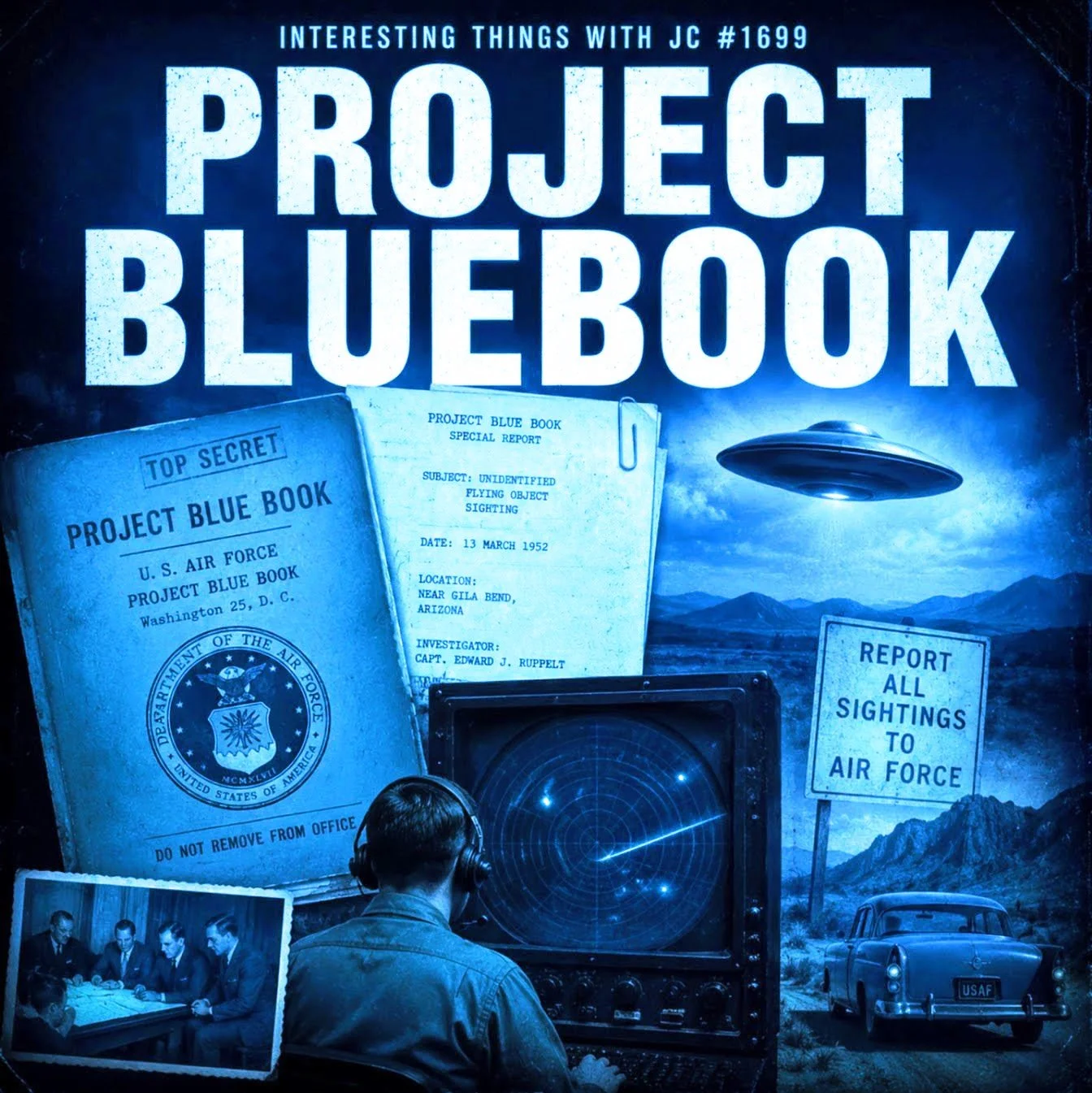
Square podcast cover for Interesting Things with JC #1699 titled Project Bluebook. The design features large white lettering over a blue night sky with a flying saucer, U.S. Air Force Project Blue Book documents, a vintage radar screen, an Air Force radar operator, a roadside sign instructing witnesses to report sightings, and a 1950s automobile in a desert landscape, representing the U.S. Air Force investigation of unidentified flying objects during the Cold War.
Interesting Things with JC #1699:
Project Blue Book
By the early 1950s, the United States Air Force had a problem it couldn't simply ignore. Reports of unidentified flying objects were arriving faster than the Air Force could comfortably explain them. Military pilots, commercial aircrews, radar operators, police officers, and ordinary citizens all described strange objects in the sky. Some reports involved little more than bright planets or weather balloons. Others came from experienced observers who insisted they had seen something they simply couldn't explain. Whatever was happening overhead, the reports kept coming, and the Air Force decided they required a permanent investigation.
In March 1952, the Air Force established Project Blue Book at Wright-Patterson Air Force Base in Ohio. It followed two earlier efforts, Projects Sign and Grudge, but Blue Book was intended to become the Air Force's permanent system for investigating UFO reports. Its mission was to determine whether UFOs posed a threat to national security and to analyze every report as scientifically as possible. Even its name reflected that goal. Borrowed from the blue examination books used in colleges, "Blue Book" suggested careful, methodical study rather than speculation.
Captain Edward J. Ruppelt, the project's first director, believed UFO reports deserved to be investigated like any other intelligence problem. He replaced the emotionally charged phrase "flying saucer" with "unidentified flying object," or UFO, introduced standardized reporting forms, and built a nationwide reporting network through Air Force bases. Witness statements, photographs, radar returns, weather data, and aircraft records were gathered and compared. Each report was evaluated against known aircraft, astronomical objects, weather conditions, and every other available piece of evidence before investigators reached a conclusion. Whether a report came from a fighter pilot or a farmer, the goal remained the same: collect the facts first and let the evidence lead the investigation.
Over the next seventeen years, Project Blue Book investigated 12,618 reports. Most eventually found ordinary explanations. Bright planets, meteors, weather balloons, aircraft, satellites, atmospheric conditions, and deliberate hoaxes filled thousands of case files. Yet 701 reports survived every attempt at identification and remained officially classified as "unidentified."
By the mid-1950s, the Air Force had accumulated so many reports that individual investigations were no longer enough. It wanted to know whether patterns were emerging across thousands of cases. That led to Special Report No. 14, a massive statistical study conducted by the Battelle Memorial Institute in 1954. It remains one of the most comprehensive analyses ever performed on Project Blue Book's case files. Critics have debated some of its classifications ever since, but the report became one of the project's defining scientific documents.
Then the project encountered a different kind of problem.
In 1952, a series of highly publicized radar and visual sightings over Washington, D.C., captured national attention and prompted military jets to scramble. Whether those incidents resulted from atmospheric conditions, equipment anomalies, or something else, they demonstrated how quickly UFO reports could become a national issue. The following year, the CIA convened what became known as the Robertson Panel. Its concern extended beyond the sightings themselves. During the Cold War, thousands of UFO reports could overwhelm military communications, consume intelligence resources, or even be exploited by an adversary. From that point forward, Project Blue Book found itself balancing scientific investigation with the realities of national security.
Captain Ruppelt left the project in 1953. Years later, Dr. J. Allen Hynek would argue that Blue Book's character gradually changed after his departure, placing greater emphasis on finding conventional explanations than pursuing difficult unanswered cases. Whether that criticism is entirely fair remains debated, but it marked a turning point in how many participants remembered the project.
No one experienced that evolution more personally than Hynek himself. He joined the project expecting careful investigation to explain nearly every report. Most were explained. But after years of examining the evidence, he concluded that a small number of cases deserved more rigorous scientific study than they were receiving. His growing disagreements with Air Force leadership reflected not a belief that every unexplained object had an extraordinary origin, but a conviction that unanswered questions should remain open until the evidence—not convenience—closed them.
In 2014, the CIA acknowledged that many UFO sightings reported during the late 1950s and 1960s had likely been observations of highly classified U-2 and A-12 OXCART reconnaissance aircraft. Flying at altitudes far beyond normal commercial or military traffic, these aircraft looked unlike anything most people had ever seen. At the time, the government couldn't acknowledge what witnesses were actually observing without revealing some of its most closely guarded defense programs. One significant chapter in the UFO story had remained hidden behind military secrecy.
Project Blue Book officially closed on December 17, 1969. The Air Force concluded that none of the investigations had uncovered evidence that UFOs posed a threat to national security or represented technology beyond contemporary scientific knowledge. Its files were transferred to the National Archives, where they remain available to researchers today.
Project Blue Book was never likely to solve every mystery that crossed its desks. Some reports described ordinary things seen under extraordinary circumstances. Some concealed secret American aircraft that couldn't be acknowledged for years. Seven hundred and one resisted every explanation the Air Force could offer.
What began as a growing stack of unexplained reports became the most extensive official investigation of UFOs in American history. When the project closed in 1969, the questions didn't disappear with it. They were filed away in more than twelve thousand case folders, along with witness interviews, photographs, radar reports, and scientific analyses that continue to be studied today. Whether those remaining unexplained cases represent incomplete evidence, natural phenomena, secret technology, or something else entirely remains open to debate. What is beyond debate is that for seventeen years, the United States Air Force devoted extraordinary time, resources, and scientific effort to answering one persistent question:
What were people really seeing in the sky?
These are interesting things, with JC.
Student Worksheet
Overview: Listen to the podcast episode first. As you listen, record important facts, unfamiliar terms, and questions. If audio is unavailable, use the transcript to complete the lesson.
Learning Goal: Evaluate how Project Blue Book investigated UFO reports using scientific methods while considering the influence of national security during the Cold War.
Part A – Comprehension
Why did the United States Air Force establish Project Blue Book in 1952?
What were the two primary objectives assigned to Project Blue Book?
Who was Captain Edward J. Ruppelt, and what important changes did he introduce?
Approximately how many UFO reports did Project Blue Book investigate?
How many reports remained officially unidentified?
What was Special Report No. 14, and why was it important?
What role did the Robertson Panel play in the history of Project Blue Book?
How did classified U-2 and A-12 reconnaissance aircraft affect some UFO reports?
Why did Dr. J. Allen Hynek become critical of the project's later direction?
What conclusion did the Air Force reach when Project Blue Book ended in 1969?
Part B – Evidence Analysis
For each statement, determine whether it is:
Supported by Evidence
Partially Supported
Not Supported
Every UFO investigated by Project Blue Book was extraterrestrial.
Most reports eventually received conventional explanations.
Some sightings were later connected to classified military aircraft.
The Air Force officially concluded that extraterrestrial spacecraft had visited Earth.
Some reports remained officially unidentified after investigation.
After completing the classifications, explain which pieces of evidence from the episode support your conclusions.
Part C – Historical Thinking
Consider the following question:
Why would thousands of unexplained reports concern military and intelligence agencies during the Cold War, even if many were eventually explained?
Write one well-developed paragraph using evidence from the episode.
Part D – Scientific Investigation
Investigators examined several different sources before reaching conclusions.
Complete the chart below.
Evidence CollectedWhy It Was UsefulWitness statementsRadar returnsWeather recordsAircraft flight dataPhotographsAstronomical information
Part E – Timeline Activity
Place these events in chronological order.
Robertson Panel
Project Sign
Project Blue Book established
Project Blue Book closes
CIA acknowledges U-2 and A-12 sightings
Battelle Memorial Institute Special Report No. 14
Captain Ruppelt becomes director
Part F – Critical Thinking Scenario
Imagine you are assigned to Project Blue Book in 1957.
A commercial airline crew reports observing a bright object traveling silently at high altitude. Radar detects an object briefly before it disappears. Weather conditions are clear.
Describe how you would investigate the report before reaching any conclusions.
Your answer should include:
Information you would collect
Experts you would consult
Possible conventional explanations
Reasons you might classify the report as unresolved
Part G – Reflection
Project Blue Book demonstrates that unanswered questions do not automatically prove extraordinary explanations.
Do you agree that investigators should leave some questions unanswered until additional evidence becomes available?
Support your answer with examples from the episode.
Difficulty Scaling
Level 1: Identify major people, dates, and events.
Level 2: Explain how evidence was used during investigations.
Level 3: Evaluate the relationship between scientific investigation and national security.
Level 4: Defend whether Project Blue Book successfully balanced open inquiry with military responsibilities using evidence from the lesson.
Student Output Expectations
Students should demonstrate:
Accurate historical understanding.
Evidence-based reasoning.
Clear written communication.
Appropriate use of historical vocabulary.
Logical conclusions supported by documented facts rather than speculation.
Academic Integrity
Use the podcast, transcript, and assigned classroom materials when completing this worksheet. Clearly distinguish between documented historical evidence and personal opinion.
Teacher Guide
Quick Start
Begin by asking students whether every unusual observation should immediately receive an extraordinary explanation. Encourage several examples before introducing Project Blue Book as a historical case study in scientific investigation.
Lesson Sequence (Audio First)
Bell Ringer (5 minutes)
Introduce lesson objectives (3 minutes)
Listen to podcast episode (15–18 minutes)
Individual note review (5 minutes)
Student Worksheet (20–25 minutes)
Class discussion (15 minutes)
Assessment and Exit Ticket (10 minutes)
Bell Ringer
Display the following question:
"If two experienced pilots report seeing an unidentified object, what evidence would you want before deciding what they actually observed?"
Allow students to list evidence before discussing their responses.
Learning Goals
Students will learn to:
Differentiate evidence from speculation.
Understand Cold War decision-making.
Recognize how scientific investigations operate.
Evaluate unresolved historical questions objectively.
Audio Guidance
Encourage students to record:
New vocabulary
Important dates
People
Investigation methods
Questions that remain unanswered
Pause briefly after major sections if additional discussion is desired.
Audio Fallback
If audio cannot be played, students should read the transcript independently or in small groups before completing the worksheet.
Estimated Time on Task
Bell Ringer: 5 minutes
Podcast: 15–18 minutes
Worksheet: 25 minutes
Discussion: 15 minutes
Assessment: 10 minutes
Total lesson time: approximately 70 minutes.
Materials
Podcast episode
Printed transcript
Student worksheet
Timeline handout (optional)
Internet access for extension research (optional)
Vocabulary Strategy
Before listening, preview:
UFO
National Security
Radar
Classified Information
Statistical Analysis
Encourage students to use context clues before reviewing formal definitions.
Common Misconceptions
"Unidentified" does not mean extraterrestrial.
Lack of an immediate explanation is not proof of any specific conclusion.
Government investigations often balance public transparency with national security.
Scientific investigations frequently end with uncertainty when evidence is incomplete.
Discussion Prompts
Why was standardized evidence collection important?
How did Cold War politics influence Project Blue Book?
Should investigators continue studying cases without clear explanations?
How can classified technology complicate historical research?
What lessons does Project Blue Book offer modern investigators?
Formative Checkpoints
Observe whether students can:
Separate documented facts from opinions.
Explain the investigative process.
Use vocabulary correctly.
Support conclusions with evidence.
Differentiation
For additional support:
Provide guided notes.
Allow partner discussions.
Highlight key passages within the transcript.
For advanced learners:
Compare Project Blue Book with modern investigations of unidentified aerial phenomena.
Analyze excerpts from Special Report No. 14.
Research Captain Ruppelt or Dr. J. Allen Hynek.
Assessment Differentiation
Students may demonstrate understanding through:
Written responses
Oral presentations
Timeline creation
Evidence charts
Small-group discussion
Time Flexibility
This lesson may be completed in:
One 75-minute class
Two 45-minute class periods
Independent homeschool study
Substitute Readiness
The lesson can be completed without additional instructor preparation by following the sequence provided.
Engagement Strategy
Ask students to become investigators rather than believers or skeptics. Every conclusion should be supported with evidence collected during the lesson.
Extension Activities
Examine declassified Project Blue Book case files.
Compare Cold War intelligence investigations with modern aviation safety investigations.
Research how radar technology evolved during the 1950s and 1960s.
Investigate the history of the U-2 reconnaissance aircraft.
Cross-Curricular Connections
History
Physics
Earth and Space Science
Government
Statistics
Information Literacy
Aviation Technology
Social-Emotional Learning
Students practice respectful discussion when evaluating controversial topics while recognizing the importance of evidence, listening, and intellectual humility.
Skill Emphasis
Critical Thinking
Historical Analysis
Scientific Reasoning
Evidence Evaluation
Communication
Information Literacy
Decision Making
Answer Key
Worksheet Part A
To investigate increasing UFO reports.
Determine national security threats and analyze reports scientifically.
First director; standardized reporting and introduced the term "UFO."
12,618.
Statistical analysis of thousands of reports.
Evaluated the national security implications of widespread UFO reports.
Many later sightings were explained as classified reconnaissance aircraft.
He believed some unexplained cases deserved additional scientific study.
No evidence of a national security threat or technology beyond contemporary scientific knowledge.
Worksheet Part B
Not Supported
Supported
Supported
Not Supported
Supported
Parts C–G
Evaluate responses based upon:
Historical accuracy
Evidence use
Logical reasoning
Clear communication
Appropriate vocabulary
Quiz
Instructions: Select the best answer for each question. Use evidence from the podcast and lesson materials to support your thinking. (Answers are intentionally not provided.)
What was the primary purpose of Project Blue Book?
A. To develop experimental military aircraft
B. To investigate UFO reports and determine whether they posed a national security threat
C. To recruit civilian observers for intelligence operations
D. To promote public interest in space exploration
Which individual introduced standardized reporting procedures and popularized the term "UFO" during Project Blue Book?
A. Dr. J. Allen Hynek
B. Captain Edward J. Ruppelt
C. President Dwight D. Eisenhower
D. General Curtis LeMay
Why was the Robertson Panel convened in 1953?
A. To confirm extraterrestrial visitation
B. To investigate foreign space programs
C. To evaluate the national security implications of widespread UFO reports
D. To transfer Project Blue Book to NASA
Which statement best reflects the Air Force's official conclusion when Project Blue Book ended in 1969?
A. Every report had been completely explained.
B. UFOs represented technology beyond modern science.
C. No evidence demonstrated that UFOs posed a threat to national security or represented technology beyond contemporary scientific knowledge.
D. The investigation would continue under another government agency.
According to the lesson, why were some UFO sightings later explained decades after they occurred?
A. Witnesses admitted they had fabricated their stories.
B. Improved telescope technology revealed astronomical causes.
C. Previously classified reconnaissance aircraft such as the U-2 and A-12 OXCART were publicly acknowledged.
D. Weather satellites became available to investigators.
Assessment
Purpose: Measure students' ability to apply historical understanding, evaluate evidence, and communicate reasoned conclusions based on the lesson.
Open-Ended Question 1
Project Blue Book investigated more than 12,000 reports over seventeen years.
Using evidence from the lesson, explain how investigators attempted to distinguish ordinary explanations from genuinely unidentified cases. Include at least three specific investigative methods.
Open-Ended Question 2
Throughout its history, Project Blue Book balanced scientific investigation with Cold War national security concerns.
Explain how military secrecy influenced both the investigation of UFO reports and the public's understanding of unexplained sightings. Support your answer with evidence from the lesson.
3–2–1 Assessment Rubric
3 – Proficient
Demonstrates accurate historical understanding, uses multiple pieces of evidence, explains reasoning clearly, and correctly applies lesson vocabulary.
2 – Developing
Demonstrates general understanding with minor factual errors or limited supporting evidence.
1 – Beginning
Demonstrates limited understanding, provides little supporting evidence, or relies primarily on unsupported opinions.
Exit Ticket
Before leaving class, answer the following in two or three complete sentences.
What was one new fact you learned about Project Blue Book?
Why is evidence important when investigating extraordinary claims?
What question from today's lesson would you still like historians or scientists to answer?
Standards Alignment
NGSS Science and Engineering Practices
SEP 4 – Analyzing and Interpreting Data
Connection: Students examine historical UFO reports, statistical findings, and investigative records to identify patterns and evaluate conclusions.
Measurable Skill: Analyze multiple sources of evidence before drawing conclusions.
Justification: Mirrors the analytical methods used by Project Blue Book investigators.SEP 7 – Engaging in Argument from Evidence
Connection: Students defend conclusions during worksheet activities, discussions, and assessments using documented historical evidence.
Measurable Skill: Construct evidence-based historical arguments.
Justification: Reinforces scientific reasoning over speculation.
Common Core State Standards – Reading
CCSS.ELA-LITERACY.RH.9-10.1
Connection: Students cite specific evidence from the transcript and lesson activities.
Measurable Skill: Support historical claims using primary and secondary evidence.
Justification: Encourages careful reading and evidence evaluation.CCSS.ELA-LITERACY.RH.11-12.8
Connection: Students evaluate historical claims regarding Project Blue Book and Cold War intelligence.
Measurable Skill: Assess credibility and reasoning presented in historical accounts.
Justification: Develops advanced source evaluation skills.
Common Core State Standards – Writing
CCSS.ELA-LITERACY.WHST.9-10.1
Connection: Students compose evidence-based written responses during assessments.
Measurable Skill: Develop logical historical arguments supported by evidence.
Justification: Reinforces analytical writing.CCSS.ELA-LITERACY.WHST.11-12.9
Connection: Students integrate information from multiple lesson resources into written explanations.
Measurable Skill: Synthesize historical evidence.
Justification: Promotes higher-order historical thinking.
Common Core State Standards – Speaking & Listening
CCSS.ELA-LITERACY.SL.11-12.1
Connection: Students participate in collaborative discussions regarding scientific investigation and national security.
Measurable Skill: Present evidence respectfully while evaluating differing viewpoints.
Justification: Strengthens communication and collaborative reasoning.
C3 Framework
D2.His.1.9-12
Connection: Students investigate historical questions using evidence from government investigations.
Measurable Skill: Evaluate historical sources and explain multiple perspectives.
Justification: Encourages disciplined historical inquiry.
ISTE Standards for Students
ISTE 3a – Knowledge Constructor
Connection: Students evaluate information from historical documents and investigative findings.
Measurable Skill: Gather, organize, and evaluate reliable information.
Justification: Supports digital and information literacy.
Career Readiness Competencies
Analytical Thinking
Students evaluate multiple sources before reaching conclusions.Communication
Students explain evidence clearly through discussion and written responses.Problem Solving
Students investigate unresolved historical questions using systematic reasoning.Adaptability
Students recognize that new evidence can change historical understanding.Professional Judgment
Students distinguish between documented facts, uncertainty, and unsupported claims.
Homeschool / Lifelong Learning Alignment
Independent Learning
Students independently analyze historical investigations and supporting evidence.Information Literacy
Students learn to distinguish credible evidence from speculation.Real-World Application
Students apply investigative reasoning to modern information sources and media.Self-Directed Inquiry
Students develop questions for future historical research.Transferable Life Skills
Students strengthen critical thinking, evidence evaluation, and responsible decision-making.
Show Notes
Project Blue Book remains one of the most extensive official investigations of unidentified flying objects ever conducted by the United States government. This lesson examines how military investigators balanced scientific inquiry with national security during the Cold War while emphasizing the importance of evidence-based reasoning. Students explore how unanswered questions differ from unsupported conclusions and discover why careful investigation remains essential whenever extraordinary claims are made.
References
U.S. Air Force. (n.d.). Unidentified flying objects and Air Force Project Blue Book. https://www.af.mil/About-Us/Fact-Sheets/Display/Article/104590/unidentified-flying-objects-and-air-force-project-blue-book/
National Archives and Records Administration. (2024, June 25). Project BLUE BOOK – Unidentified flying objects. https://www.archives.gov/research/military/air-force/ufos
National Archives and Records Administration. (n.d.). Records related to unidentified flying objects (UFOs) and unidentified anomalous phenomena (UAPs). https://www.archives.gov/research/topics/uaps/rg-collections
National Archives and Records Administration. (n.d.). Bulk downloads for records related to unidentified anomalous phenomena (UAP). https://www.archives.gov/research/catalog/catalog-bulk-downloads/uap-bulk-download
Federal Bureau of Investigation. (n.d.). Project Blue Book (UFO). FBI Vault. https://vault.fbi.gov/Project%20Blue%20Book%20%28UFO%29
National Security Agency. (n.d.). Unidentified flying objects and Air Force Project Blue Book (USAF Fact Sheet 95-03). https://www.nsa.gov/portals/75/documents/news-features/declassified-documents/ufo/usaf_fact_sheet_95_03.pdf
U.S. Air Force Office of Special Investigations. (2020, August 6). Project Blue Book Part 1: UFO reports. https://www.osi.af.mil/News/Features/Display/Article/2302429/project-blue-book-part-1-ufo-reports/
National Archives. (n.d.). Project Blue Book status report number eight. DocsTeach. https://docsteach.org/document/project-blue-book-status-report-number-eight/
National Archives. (n.d.). UFO sighting questionnaire. DocsTeach. https://docsteach.org/document/ufo-questionnaire/
Central Intelligence Agency. (1997). CIA's role in the study of UFOs, 1947–1990. https://www.cia.gov/resources/csi/studies-in-intelligence/studies-in-intelligence-1997/cias-role-in-the-study-of-ufos-1947-1990/
History. (n.d.). Project Blue Book. https://www.history.com/shows/project-blue-book