1678: "The Formal Study of ESP"
Interesting Things with JC #1678: "The Formal Study of ESP" – A Duke University student is identifying symbols on hidden cards without seeing them, his scores repeatedly exceed what chance predicts, and the results trigger years of scrutiny as researchers try to determine whether the effect survives stricter testing.
Curriculum - Episode Anchor
Episode Title: The Formal Study of ESP
Episode Number: 1678
Host: JC
Audience: Grades 9–12, Introductory College, Homeschool, Lifelong Learners
Subject Area: Psychology, Scientific Inquiry, History of Science
Lesson Overview
Objectives:
Explain the origins of formal ESP research.
Describe the experiments conducted by J. B. Rhine and Karl Zener.
Analyze why replication is essential in scientific investigation.
Evaluate extraordinary claims using evidence-based reasoning.
Essential Question: How does science investigate claims that are difficult to observe or measure?
Success Criteria:
I can describe the purpose of Zener card experiments.
I can explain why replication matters in science.
I can distinguish between anecdotal evidence and scientific evidence.
I can evaluate claims using scientific standards.
Student Relevance Statement: Students encounter extraordinary claims regularly through media, technology, and personal experiences. Understanding scientific evaluation helps develop critical thinking skills.
Real-World Connection: Researchers in medicine, psychology, engineering, and technology rely on repeatable evidence before accepting new findings.
Workforce Reality: Many careers require professionals to evaluate data objectively, identify bias, and verify results before making decisions.
Key Vocabulary
ESP (ee-es-PEE): Claimed ability to obtain information without using recognized senses.
Telepathy (tuh-LEP-uh-thee): Alleged communication between minds without sensory interaction.
Premonition (pree-muh-NISH-un): A feeling or prediction that something may happen in the future.
Psychical Research (SY-kih-kul ree-SURCH): Systematic investigation of unusual mental or paranormal claims.
Replication (rep-li-KAY-shun): Repeating a study to determine whether results can be reproduced.
Variable (VAIR-ee-uh-bul): A factor that can change during an experiment.
Statistical Significance (stuh-TIS-ti-kul sig-NIF-i-kuns): A measure of whether results are likely due to chance.
Control (kun-TROHL): Procedures used to reduce outside influences on an experiment.
Evidence (EV-i-dens): Information used to support or challenge a claim.
Hypothesis (hy-POTH-uh-sis): A testable explanation or prediction.
Narrative Core
Open: For centuries, people have reported experiences that seemed to go beyond ordinary senses.
Info: In the late nineteenth and early twentieth centuries, researchers began investigating such claims through organized study.
Details: At Duke University, J. B. Rhine and Karl Zener designed card-guessing experiments intended to measure whether people could obtain information without using recognized sensory channels.
Reflection: Although some results appeared promising, later scrutiny and attempts at replication raised questions about methodology, controls, and statistical interpretation.
Closing: The history of ESP research illustrates how science evaluates extraordinary claims through testing, evidence, and repeatability.
These are interesting things, with JC.
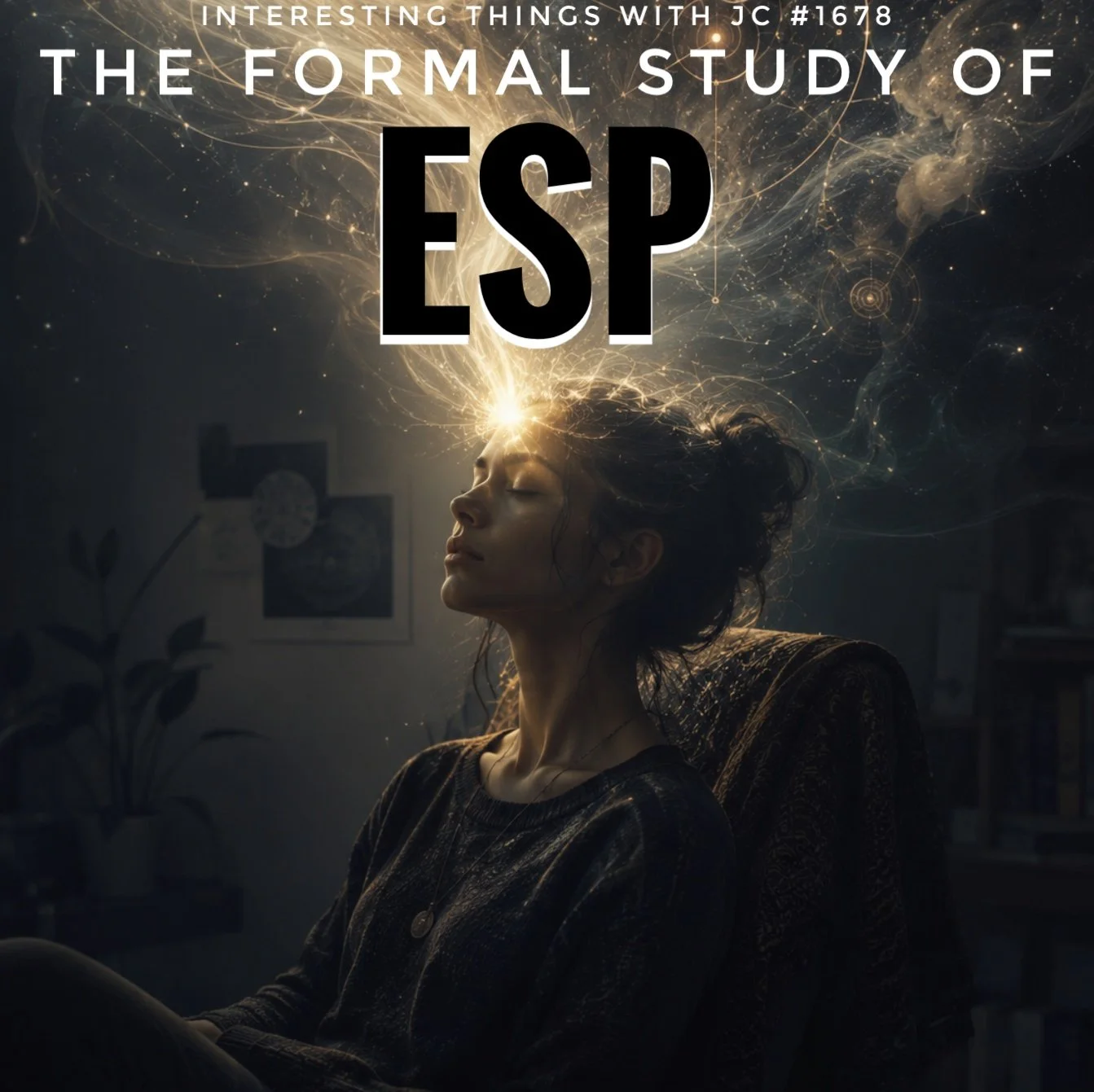
Cover artwork for Interesting Things with JC #1678: The Formal Study of ESP. The composition centers on a seated individual in a darkened room. Their eyes are closed, and a bright glow appears at the forehead. Radiating from this point are intricate, branching streams of light that spread throughout the upper portion of the image, creating an impression of thought, consciousness, or mental activity. The title text “THE FORMAL STUDY OF ESP” appears prominently above the figure, with the acronym “ESP” displayed in very large letters. The visual design is metaphorical and intended to represent historical scientific investigations into claims of extrasensory perception rather than a literal depiction of psychic abilities. The artwork establishes a mood of curiosity, inquiry, and exploration of an unusual scientific question.
Transcript
Interesting Things with JC #1678:
The Formal Study of ESP
In the early 1930s, a college student sat in a room at Duke University staring at a card marked with a simple symbol. Somewhere nearby, another person tried to identify that symbol without seeing it. There were only five possibilities: a circle, a square, a star, a cross, or three wavy lines.
The experiment sounds simple. The question behind it was not.
Can a person know something without using any of the recognized senses?
Stories of telepathy, premonitions, and second sight had existed for centuries. In 1882, the Society for Psychical Research in London became one of the first organizations to investigate such claims systematically. Reports were collected, examined, and debated. Some were exposed as frauds. Others remained unexplained. But the larger question persisted.
Half a century later, J. B. Rhine believed anecdotes weren't enough. Trained as a biologist and working at Duke University, he wanted evidence that could be measured, counted, and tested.
Working with psychologist Karl Zener, who designed the now-famous symbols, Rhine built experiments around a deck of twenty-five cards. Five symbols appeared five times each. Random guessing should produce about five correct answers per deck. If someone consistently scored higher, statistics could show whether chance was a reasonable explanation.
The experiments attracted attention when some participants appeared to perform well above expectation. The most famous was a Duke student named Hubert Pearce. His scores were impressive enough that Rhine published the results in his 1934 book Extra-Sensory Perception, helping introduce the term ESP to a much wider audience.
For a brief period, the results appeared promising enough to attract serious scientific attention.
Then came the scrutiny.
Researchers attempted to repeat the findings. Critics questioned the procedures. Could subjects see reflections on the cards? Were subtle cues being transmitted unintentionally? Were the cards shuffled rigorously enough? Could statistical quirks create results that looked extraordinary but weren't?
Those questions pointed to a larger principle. Science is not built on a surprising result. It is built on whether that result can be repeated.
As the years passed, that became the central challenge for ESP research. Some studies reported effects. Others found nothing unusual. Results that seemed impressive under one set of conditions often weakened or disappeared under stricter controls.
By the late twentieth century, mainstream science remained unconvinced that ESP had been demonstrated to the standard required for acceptance.
Yet the lasting story was never really about card guessing.
It was about an effort to take one of humanity's oldest mysteries and place it under controlled observation. Rhine and his colleagues tried to move a question from intuition and personal experience into the world of measurement and evidence.
The answer they found was not certainty.
What they revealed instead was how difficult it can be to test an extraordinary claim, and how carefully science must separate what feels true from what can actually be demonstrated.
These are interesting things, with JC.
Student Worksheet
Comprehension Questions
What question were Rhine and his colleagues attempting to answer?
What were Zener cards used for?
Why was Hubert Pearce significant to the research?
What concerns did critics raise?
What conclusion does the episode present about ESP research?
Analysis Questions
Why is replication important in science?
How can experimental design influence results?
Should unusual claims require stronger evidence? Explain.
Reflection Prompt
Describe a claim you have heard that would require scientific testing. How would you investigate it?
Difficulty Scaling
Foundational: Questions 1–3.
Intermediate: Questions 4–5 and Analysis 1.
Advanced: Analysis 2–3 and Reflection.
Student Output
One completed worksheet.
One written reflection paragraph of 150–250 words.
Academic Integrity Guidance
Use your own words.
Support claims with evidence from the episode.
Avoid copying responses from classmates or online sources.
Teacher Guide
Quick Start: Play the episode, distribute the worksheet, and facilitate evidence-based discussion.
Pacing Guide (Audio-First):
Bell Ringer (5 min)
Vocabulary Preview (5 min)
Listen to Episode (8 min)
Worksheet Completion (15 min)
Discussion (10 min)
Exit Ticket (2 min)
Bell Ringer: Write a brief response: “Can personal experience alone prove something is true?”
Audio Guidance: Encourage students to listen for examples of evidence, testing, and skepticism.
Audio Fallback: Read the transcript aloud and pause for discussion after each major section.
Time on Task: 45–50 minutes.
Materials:
Episode audio or transcript
Worksheet
Writing materials
Vocabulary Strategy: Introduce replication, statistical significance, and hypothesis before listening.
Misconceptions:
A surprising result automatically proves a claim.
One successful experiment is sufficient evidence.
Unexplained events automatically confirm ESP.
Discussion Prompts:
Why do scientists repeat experiments?
What makes a claim scientifically testable?
How should researchers respond to criticism?
Formative Checkpoints:
Vocabulary understanding
Worksheet completion
Participation in discussion
Differentiation:
Provide vocabulary supports.
Allow verbal responses.
Offer guided notes.
Assessment Differentiation:
Extended time as needed.
Oral assessment option.
Reduced writing load with teacher approval.
Time Flexibility: May be condensed to 30 minutes or expanded into a two-day lesson.
Substitute Readiness: Transcript and worksheet allow full implementation without specialized content knowledge.
Engagement Strategy: Have students design a simple experiment to test an unusual claim.
Extensions:
Research the Society for Psychical Research.
Compare ESP studies with modern psychological experiments.
Cross-Curricular Connections:
Statistics
Psychology
History of Science
SEL Connection: Encourages open-mindedness balanced with critical thinking.
Skill Value Emphasis: Evidence evaluation, reasoning, communication, and scientific literacy.
Answer Key:
Whether information could be obtained without recognized senses.
Controlled symbol-guessing experiments.
He produced notable scores reported by Rhine.
Experimental controls, cues, shuffling, and statistical concerns.
ESP has not met the level of evidence required for broad scientific acceptance.
Quiz
Which university hosted Rhine's ESP research?
A. Harvard University
B. Duke University
C. Yale University
D. Princeton UniversityHow many different symbols appeared on Zener cards?
A. Three
B. Four
C. Five
D. TenWhat was the primary purpose of the experiments?
A. Test memory
B. Test eyesight
C. Measure ESP claims
D. Study personalityWhat major issue challenged the findings?
A. Cost
B. Weather
C. Replication
D. Equipment shortagesAccording to the episode, science depends most heavily on:
A. Popular opinion
B. Personal belief
C. Repeated evidence
D. Tradition
Assessment
Open-Ended Questions
Explain how Rhine attempted to apply scientific methods to ESP claims.
Describe why replication is considered a cornerstone of scientific investigation.
Rubric (3–2–1)
3: Thorough explanation with accurate evidence and reasoning.
2: Adequate explanation with minor omissions.
1: Limited understanding or insufficient evidence.
Exit Ticket
In one sentence, explain why extraordinary claims require careful testing.
Standards Alignment
NGSS Science and Engineering Practices
Analyzing and Interpreting Data: Students evaluate experimental results from ESP studies and determine whether evidence supports conclusions.
Constructing Explanations and Designing Solutions: Students explain how Rhine's experiments attempted to test claims under controlled conditions.
Engaging in Argument from Evidence: Students use evidence from the episode to support or challenge scientific claims.
Obtaining, Evaluating, and Communicating Information: Students analyze historical and scientific information and communicate evidence-based conclusions.
NGSS Crosscutting Concepts
Cause and Effect: Students examine whether observed results can be attributed to ESP, chance, or methodological factors.
Patterns: Students identify expected versus unexpected statistical patterns in experimental outcomes.
Stability and Change: Students investigate how scientific interpretations change as new evidence emerges.
Common Core State Standards (ELA/Literacy)
CCSS.ELA-LITERACY.RST.11-12.1: Cite specific textual evidence to support analysis of scientific and technical information.
CCSS.ELA-LITERACY.RST.11-12.2: Determine central ideas and summarize complex scientific concepts accurately.
CCSS.ELA-LITERACY.RST.11-12.7: Integrate and evaluate information presented in multiple formats and media.
CCSS.ELA-LITERACY.RST.11-12.8: Evaluate hypotheses, data, analysis, and conclusions in scientific texts.
CCSS.ELA-LITERACY.WHST.11-12.1: Write arguments focused on discipline-specific content using valid reasoning and evidence.
CCSS.ELA-LITERACY.WHST.11-12.9: Draw evidence from informational texts to support analysis and reflection.
CCSS.ELA-LITERACY.SL.11-12.1: Initiate and participate effectively in collaborative discussions.
C3 Framework for Social Studies
D2.His.1.9-12: Evaluate how historical events and developments were shaped by unique circumstances.
D2.His.4.9-12: Analyze complex interactions among historical developments.
D3.1.9-12: Gather and evaluate sources while considering credibility and relevance.
D3.2.9-12: Evaluate the strengths and limitations of evidence used by historical and scientific investigators.
D4.1.9-12: Construct arguments using precise claims, evidence, and reasoning.
ISTE Standards for Students
1.3 Knowledge Constructor: Critically evaluate information and evidence from multiple sources.
1.4 Innovative Designer: Apply systematic processes to investigate and solve problems.
1.7 Global Collaborator: Engage in discussions that incorporate diverse viewpoints while maintaining evidence-based reasoning.
Career and Technical Education (CTE) Readiness
Evaluate claims using objective evidence rather than assumptions.
Interpret data and statistical information for decision-making.
Demonstrate critical-thinking skills used in research, healthcare, public policy, technology, and business fields.
Communicate findings clearly through written and verbal analysis.
Apply scientific reasoning to real-world problem solving.
College and Career Readiness Skills
Information Literacy
Evidence Evaluation
Quantitative Reasoning
Research Methodology
Critical Thinking
Oral and Written Communication
Ethical Use of Information
Homeschool and Lifelong Learning Alignment
Develop independent inquiry skills.
Practice evaluating extraordinary claims using evidence.
Strengthen media literacy and source evaluation.
Apply scientific thinking to everyday decisions.
Build habits of intellectual curiosity and skepticism balanced with open-mindedness.
Psychology and Social Science Alignment
Understand the role of experimental design in behavioral research.
Examine the relationship between observation, hypothesis formation, and testing.
Analyze how confirmation bias and expectancy effects can influence results.
Evaluate the importance of replication in establishing scientific consensus
Show Notes
This lesson explores one of the most famous attempts to investigate paranormal claims through scientific methods. Students examine how researchers designed experiments, how critics evaluated those experiments, and why replication remains essential to scientific acceptance. The lesson strengthens critical thinking, evidence evaluation, and scientific literacy while demonstrating how science addresses difficult and controversial questions.
References
Britannica. (2026). J. B. Rhine. https://www.britannica.com/biography/J-B-Rhine
Britannica. (2026). Extrasensory perception. https://www.britannica.com/topic/extrasensory-perception
Cambridge University Library. (n.d.). Society for Psychical Research. https://www.lib.cam.ac.uk/collections/departments/archives-modern-and-medieval-manuscripts-and-university-archives-0
Duke University Libraries. (2024). Women in Science and Medicine at the Rubenstein Library: Parapsychology. https://guides.library.duke.edu/women-science/parapsychology
Society for Psychical Research. (n.d.). Our history. https://www.spr.ac.uk/about/our-history