1677: "The Benben Stone"
Interesting Things with JC #1677: "The Benben Stone" – A sacred stone once stood at the center of Egypt’s solar temple, marking the place where creation was believed to begin. The stone disappeared, but its shape continued to appear atop pyramids and obelisks for thousands of years.
Curriculum - Episode Anchor
Episode Title: The Benben Stone
Episode Number: 1677
Host: JC
Audience: Grades 9–12, Introductory College, Homeschool Learners, Lifelong Learners
Subject Area: Ancient History, Archaeology, Religious Studies, Architecture, Cultural Studies
Lesson Overview
Objectives:
Explain the role of the Benben Stone in ancient Egyptian creation beliefs.
Analyze how religious ideas influence architecture and cultural traditions.
Evaluate the relationship between mythological narratives and physical monuments.
Distinguish between historical evidence and scholarly speculation.
Essential Question: How can a lost object continue to shape a civilization long after it disappears?
Success Criteria:
Describe the Benben Stone and its significance in Egyptian cosmology.
Connect the Benben concept to pyramids, obelisks, and pyramidia.
Explain the symbolism of creation, kingship, rebirth, and the rising sun.
Assess claims about the Benben using evidence-based reasoning.
Student Relevance Statement: Students encounter symbols every day that represent ideas larger than themselves. The Benben demonstrates how powerful symbols can influence culture, architecture, religion, and identity across thousands of years.
Real-World Connection: Modern monuments, memorials, religious structures, and national symbols often reflect foundational stories and values, much like the Benben influenced ancient Egyptian architecture.
Workforce Reality: Archaeologists, historians, museum curators, architects, preservation specialists, and cultural resource managers frequently analyze how ideas are expressed through objects, buildings, and historical landscapes.
Key Vocabulary
Benben(BEN-ben) — Sacred stone associated with creation in ancient Egyptian belief.
Nun(NOON) — The primordial waters that existed before creation.
Atum(AH-toom) — Creator deity associated with the beginning of existence.
Heliopolis (Iunu)(hee-lee-OP-oh-lis; ee-OO-noo) — Major religious center of sun worship in ancient Egypt.
Cosmology(koz-MOL-uh-jee) — A culture's explanation of the origin and structure of the universe.
Bennu(BEN-noo) — Sacred bird symbolizing renewal and rebirth.
Pyramidion(pir-uh-MID-ee-on) — The capstone placed at the top of a pyramid.
Obelisk(OB-uh-lisk) — Tall stone monument with a pyramidal top.
Electrum(ih-LEK-trum) — Naturally occurring alloy of gold and silver used for decorative purposes.
Archaeological Evidence(ar-kee-uh-LOJ-ih-kul EV-ih-dens) — Physical remains used to study the past.
Narrative Core
Open: Imagine a sacred object so important that it inspired some of the most recognizable structures in human history, yet no one alive has ever seen it.
Info: The Benben Stone stood at the heart of ancient Egyptian religious tradition. According to Egyptian creation stories, the first mound of land emerged from the dark waters of Nun. Upon this mound appeared the creator god Atum, marking the beginning of creation.
Details: Located within the great solar temple of Heliopolis, the Benben symbolized the first point where order emerged from chaos. It became associated with the rising sun and the Bennu bird, linking it to cycles of renewal and rebirth. Later, pyramid capstones and obelisk tips echoed its form, often covered in gold or electrum to reflect the morning sunlight.
Reflection: Although the original stone disappeared long ago, its symbolism survived. The Benben demonstrates how powerful ideas can outlast physical objects and continue shaping culture, architecture, and belief for centuries.
Closing: These are interesting things, with JC.
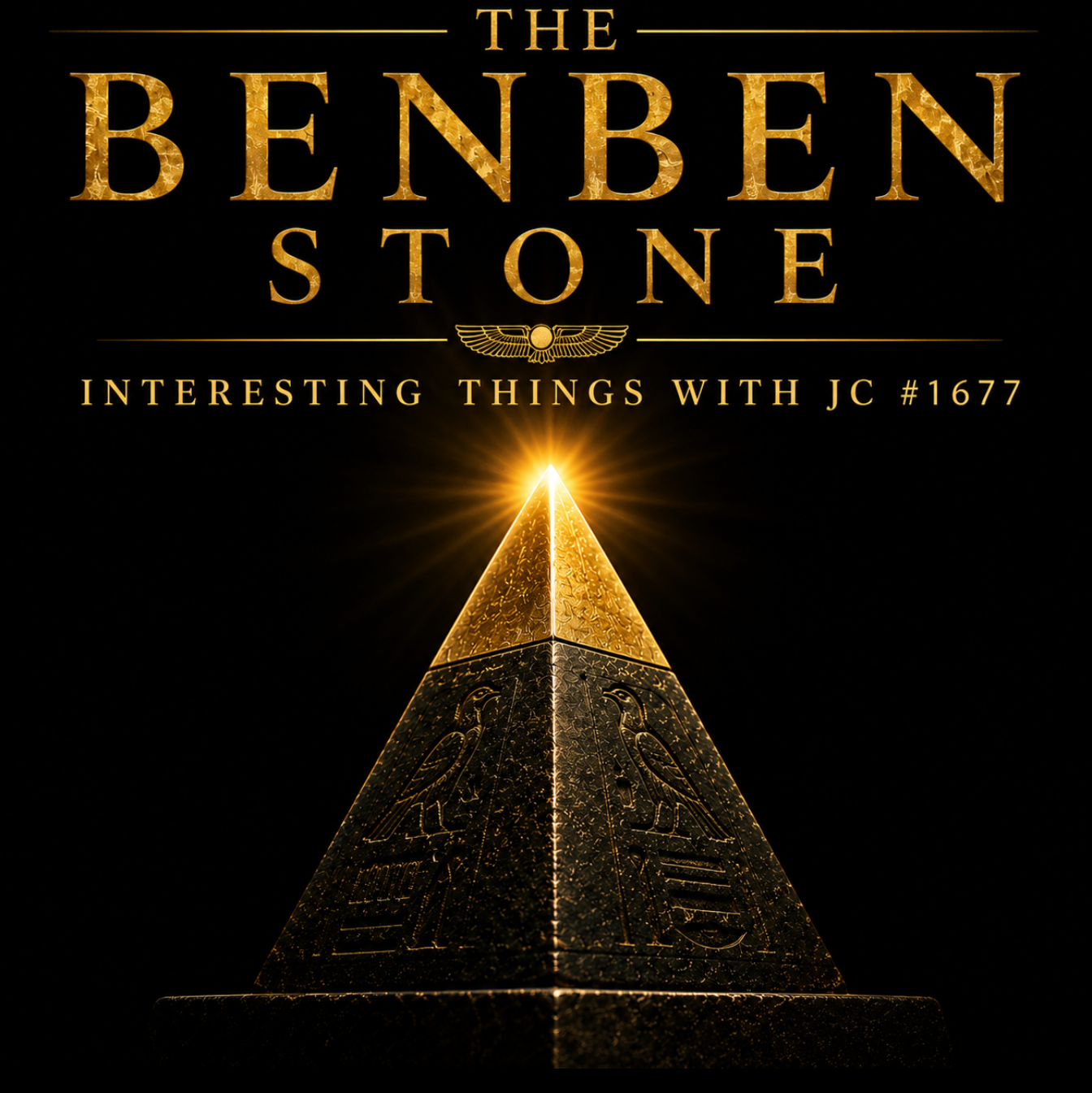
A black-background promotional graphic titled The Benben Stone. Large gold text fills the upper portion of the image. Below the title stands a dark Egyptian-style pyramidion engraved with symbolic carvings and crowned with a polished golden cap. Bright sunlight radiates from the pyramid's apex, creating a dramatic halo effect. The imagery evokes the ancient Egyptian concept of the Benben, the sacred primordial stone associated with creation, the first sunrise, and the origin of the world. The episode branding, Interesting Things with JC #1677, appears beneath the title.
Transcript
Interesting Things with JC #1677:
"The Benben Stone"
In Heliopolis, there once stood a sacred stone no living person has ever seen.
The Egyptians called it the Benben. In their oldest creation myth, before land, before temples, before kings, there was only the endless dark waters of Nun. From those waters rose the first mound. On it appeared the creator god Atum. At the heart of the great solar temple in Iunu stood a pointed stone that marked this primal moment, the place where creation first touched solid ground.
The original Benben has vanished. What remains is its power as an idea: a sacred pointed stone tied to the first light of dawn and the meeting of heaven and earth. It became associated with the rising sun and the moment creation began. Egyptian tradition also linked the Benben to the Bennu bird, a symbol of renewal that was said to alight upon it, connecting the stone to the recurring cycles of rebirth reflected in the daily return of the sun.
Later, the related word benbenet named the polished pyramidia, the capstones that crowned pyramids and obelisks. These gleaming stones, often sheathed in gold or electrum, caught the morning sun at their highest point. In that flash of light, the entire monument echoed the Benben, renewing the story of creation, kingship, death, and rebirth with every sunrise.
Its peak became a symbol of the moment the world began.
Some suggest the lost Benben may have been a meteorite, and the Egyptians did prize iron fallen from the sky for sacred objects. But without the stone itself, this remains speculation.
The stronger truth is mysterious enough. A single lost object in a vanished temple inspired the shapes that defined Egyptian sacred architecture for millennia. The stone disappeared, but the idea behind it continued to rise.
These are interesting things, with JC.
Student Worksheet
Comprehension Questions
What was the Benben Stone according to Egyptian tradition?
What role did Nun play in the Egyptian creation story?
Who was Atum and why is he important in this narrative?
How was the Benben connected to the Bennu bird?
What architectural features were inspired by the Benben?
Analysis Questions
Why might ancient Egyptians have connected sunlight with creation and renewal?
How did architecture help preserve religious ideas in ancient Egypt?
Why is it important for historians to separate evidence from speculation?
What does the disappearance of the Benben tell us about historical reconstruction?
Reflection Prompt
Can an idea be more influential than a physical object? Use evidence from the episode and a modern example to support your response.
Difficulty Scaling
Level 1: Answer comprehension questions using details from the transcript.
Level 2: Complete comprehension and analysis questions.
Level 3: Complete all questions and write a 300–500 word reflection with supporting evidence.
Student Output Expectations
Complete responses in complete sentences.
Support analysis with evidence from the episode.
Cite specific examples when explaining conclusions.
Academic Integrity Guidance
Use your own words when answering.
Support claims with information from the lesson.
Distinguish clearly between facts presented and personal interpretations.
Teacher Guide
Quick Start
Play the podcast episode.
Have students record key symbols and themes.
Facilitate discussion on how ideas influence architecture.
Complete worksheet activities.
Finish with assessment and exit ticket.
Pacing Guide (Audio-First)
Bell Ringer – 5 minutes
Vocabulary Preview – 5 minutes
Podcast Listening – 5 minutes
Discussion – 10 minutes
Worksheet Activities – 15 minutes
Assessment – 10 minutes
Exit Ticket – 5 minutes
Bell Ringer
What monuments or buildings symbolize important ideas today?
Why might societies create physical objects to represent beliefs?
Audio Guidance
Encourage students to listen for symbols.
Pause after references to Nun, Atum, and the Bennu bird.
Have students note connections between myth and architecture.
Audio Fallback
Use the transcript for guided reading.
Conduct annotation activities focused on symbolism and evidence.
Time on Task
Total lesson time: 50–60 minutes.
Expand discussion for longer class periods.
Materials
Episode audio
Transcript
Student worksheet
Writing materials
Projector or display device
Vocabulary Strategy
Preview terms before listening.
Create a concept map connecting Benben, Atum, Nun, and Bennu.
Misconceptions
Mythology is not the same as verified history.
Lack of surviving evidence does not prove a theory.
Religious symbolism often influences architecture.
Discussion Prompts
Why do civilizations create origin stories?
How can architecture communicate beliefs?
Why does symbolism remain powerful over time?
What makes evidence reliable?
Formative Checkpoints
Vocabulary understanding
Listening notes
Discussion participation
Worksheet responses
Differentiation
Provide guided notes for emerging learners.
Allow verbal responses when appropriate.
Use visual diagrams showing pyramidia and obelisks.
Assessment Differentiation
Written essay
Oral presentation
Graphic organizer
Comparative analysis chart
Time Flexibility
Condensed version: 30 minutes.
Extended research version: 90 minutes.
Substitute Readiness
Transcript-based lesson can be completed without audio.
Worksheet and assessment are self-contained.
Engagement Strategy
Compare the Benben to symbolic landmarks students recognize.
Use images of pyramids and obelisks to identify recurring forms.
Extensions
Research Egyptian creation myths.
Investigate pyramid construction.
Compare creation stories from multiple civilizations.
Cross-Curricular Connections
History: Ancient Egypt.
Literature: Mythological narratives.
Art: Symbolism in design.
Architecture: Monument construction.
Earth Science: Meteorites and ancient materials.
SEL Connection
Explore how communities develop shared identities through stories and symbols.
Skill Emphasis
Historical reasoning
Evidence evaluation
Cultural analysis
Critical thinking
Informational reading
Answer Key
Comprehension:
Sacred stone symbolizing creation.
Primordial waters before creation.
Creator god who appeared on the first mound.
Symbolized renewal and rebirth.
Pyramidia, pyramids, and obelisks.
Analysis:
Sunlight represented life, order, and renewal.
Buildings preserved religious symbolism visually.
Evidence supports reliable conclusions.
Historians must work with incomplete records and available evidence.
Quiz
What did the Benben primarily symbolize?
A. Military power
B. Agricultural success
C. The beginning of creation
D. River navigationAccording to Egyptian tradition, what existed before creation?
A. Mountains
B. Nun
C. Cities
D. KingsWhich deity appeared on the first mound?
A. Osiris
B. Horus
C. Anubis
D. AtumThe Bennu bird was associated with:
A. Warfare
B. Trade
C. Renewal and rebirth
D. NavigationWhat architectural feature most directly reflected the Benben?
A. Temple doors
B. Pyramid capstones
C. Tomb paintings
D. Harbor walls
Assessment
Open-Ended Questions
Explain how the Benben Stone influenced Egyptian architecture and religious symbolism.
Evaluate the statement: "The idea behind the Benben became more important than the object itself." Support your response with evidence.
3–2–1 Rubric
3 – Advanced
Accurate understanding
Strong use of evidence
Thoughtful analysis
2 – Proficient
Mostly accurate understanding
Some supporting evidence
Clear explanation
1 – Developing
Limited understanding
Minimal evidence
Incomplete explanation
Exit Ticket
What is one new fact you learned about the Benben?
What evidence best supports its importance?
Why do you think the Benben remained influential after it disappeared?
Standards Alignment
NGSS
HS-ETS1-1: Analyze major global challenges and evaluate solutions by examining how societies create structures that reflect cultural needs and beliefs.
HS-ETS1-3: Evaluate historical design solutions by examining how Egyptian architectural forms embodied religious concepts.
Science and Engineering Practice: Construct explanations from available evidence and identify limitations where evidence is incomplete.
CCSS – English Language Arts
CCSS.ELA-LITERACY.RH.9-10.1: Cite specific textual evidence to support analysis of historical sources.
CCSS.ELA-LITERACY.RH.9-10.2: Determine central ideas and summarize complex historical content.
CCSS.ELA-LITERACY.RH.11-12.6: Evaluate authors' claims and distinguish evidence from speculation.
CCSS.ELA-LITERACY.WHST.9-12.1: Write evidence-based arguments concerning historical interpretation.
CCSS.ELA-LITERACY.SL.9-12.1: Initiate and participate effectively in collaborative discussions.
C3 Framework for Social Studies
D2.His.1.9-12: Evaluate how historical events and developments were shaped by unique circumstances of time and place.
D2.His.4.9-12: Analyze complex interactions among historical cultures and institutions.
D2.His.14.9-12: Analyze multiple causes and effects of historical events and developments.
D3.1.9-12: Gather and evaluate sources while identifying strengths and limitations.
D4.1.9-12: Construct arguments using claims, evidence, and reasoning.
ISTE Standards
ISTE 1.3 Knowledge Constructor: Evaluate information sources and distinguish supported claims from speculation.
ISTE 1.7 Global Collaborator: Examine how cultural traditions influence human societies across time.
ISTE 1.1 Empowered Learner: Build knowledge through inquiry, reflection, and evidence-based investigation.
Career Readiness
Historical Research: Evaluate primary and secondary evidence.
Archaeology: Interpret material culture responsibly.
Museum Studies: Communicate historical significance to public audiences.
Architecture and Design: Analyze how symbolism influences structural design.
Cultural Resource Management: Preserve and interpret heritage sites.
UK National Curriculum Alignment
Develop chronological understanding of ancient civilizations.
Analyze historical interpretations using evidence.
Understand how beliefs influenced societal development and architecture.
IB MYP / Lifelong Learning Alignment
Investigate cultural narratives and their influence on human societies.
Develop inquiry skills through analysis of evidence and interpretation.
Connect historical understanding to broader questions of identity, belief, and continuity.
Apply critical-thinking skills to distinguish documented facts from hypotheses.
Homeschool and Lifelong Learning Competencies
Historical inquiry and source evaluation.
Cultural literacy and comparative analysis.
Critical reading and reflective writing.
Independent research and evidence-based reasoning.
Recognition of how ideas influence institutions, traditions, and built environments.
Show Notes
The Benben Stone occupies a unique place in ancient Egyptian history because its physical form has been lost while its influence remains visible in some of the world's most recognizable monuments. This lesson explores how Egyptian creation beliefs shaped architecture, religious symbolism, and cultural identity. Students examine the relationship between mythology, evidence, and historical interpretation while developing critical-thinking skills that apply to history, archaeology, architecture, and modern cultural studies.
References
Allen, J. P. (2015). The ancient Egyptian pyramid texts (2nd ed.). SBL Press. https://www.sbl-site.org/assets/pdfs/pubs/9781628371147_OA.pdf
British Museum. (n.d.). Ancient Egyptian creation myths. Glencairn Museum. https://www.glencairnmuseum.org/newsletter/2021/7/13/ancient-egyptian-creation-myths-from-watery-chaos-to-cosmic-egg
Lesko, L. H. (1991). Utterance 600. In Ancient Egyptian literature. OMNIKA. https://omnika.org/texts/325
Nuzzolo, M. (2017). Heliopolis and the solar cult in the third millennium BC. Journal of Egyptian Archaeology. https://www.jstor.org/stable/26524908
UCL Museums. (2013). The meteoric origins of Egypt's first ironwork. https://blogs.ucl.ac.uk/museums/2013/09/01/23856/