1676: "Thomas Sowell"
Interesting Things with JC #1676: "Thomas Sowell" – A young government economist studies labor conditions in Puerto Rico and finds that policies designed to help poor workers are leaving some without jobs. The same disconnect between intentions and outcomes keeps appearing in case after case, pushing Thomas Sowell to question ideas he once believed and follow the evidence wherever it leads.
Curriculum - Episode Anchor
Episode Title: Thomas Sowell
Episode Number: 1676
Host: JC
Audience: Grades 9–12, introductory college, homeschool, lifelong learners
Subject Area: Economics, history, civic reasoning, media literacy
Lesson Overview
Learning Objectives:
Explain how evidence can challenge prior beliefs.
Analyze the difference between policy intentions and policy outcomes.
Identify trade-offs, incentives, and unintended consequences in economic decision-making.
Evaluate Thomas Sowell’s career as an example of disciplined intellectual revision.
Essential Question: How should evidence shape the way people evaluate ideas, policies, and beliefs?
Success Criteria: Students can cite examples from the episode, explain one economic trade-off, and write a reasoned response about evidence-based thinking.
Student Relevance Statement: Students make choices every day where good intentions are not enough; outcomes matter.
Real-World Connection: Employers, voters, researchers, and citizens must evaluate whether actions actually solve problems.
Workforce Reality: Strong careers require discipline, evidence review, intellectual humility, and responsibility for results.
Key Vocabulary
Incentives(in-SEN-tivz): Rewards or pressures that influence behavior.
Trade-off(TRAYD-awf): A choice that requires giving up one benefit to gain another.
Unintended Consequences(un-in-TEN-did KON-suh-kwen-siz): Results that were not planned or expected.
Minimum Wage(MIN-uh-mum WAYJ): The lowest legal wage employers may pay workers.
Evidence(EV-uh-dens): Information used to support or challenge a claim.
Marxism(MARK-siz-um): A political and economic theory focused on class conflict and ownership of production.
Public Intellectual(PUB-lik in-tuh-LEK-choo-ul): A thinker who communicates ideas to a broad public audience.
Empirical(em-PEER-ih-kul): Based on observation, data, or experience.
Narrative Core
Open: A young economist studies labor conditions in Puerto Rico and sees a conflict between policy goals and real-world results.
Info: Thomas Sowell’s life included poverty, Harlem, military service, and advanced study at Harvard, Columbia, and the University of Chicago.
Details: His early interest in Marxist ideas changed as he examined data, incentives, trade-offs, and unintended consequences.
Reflection: The episode asks students to consider how people should respond when evidence challenges what they already believe.
Closing: These are interesting things, with JC.
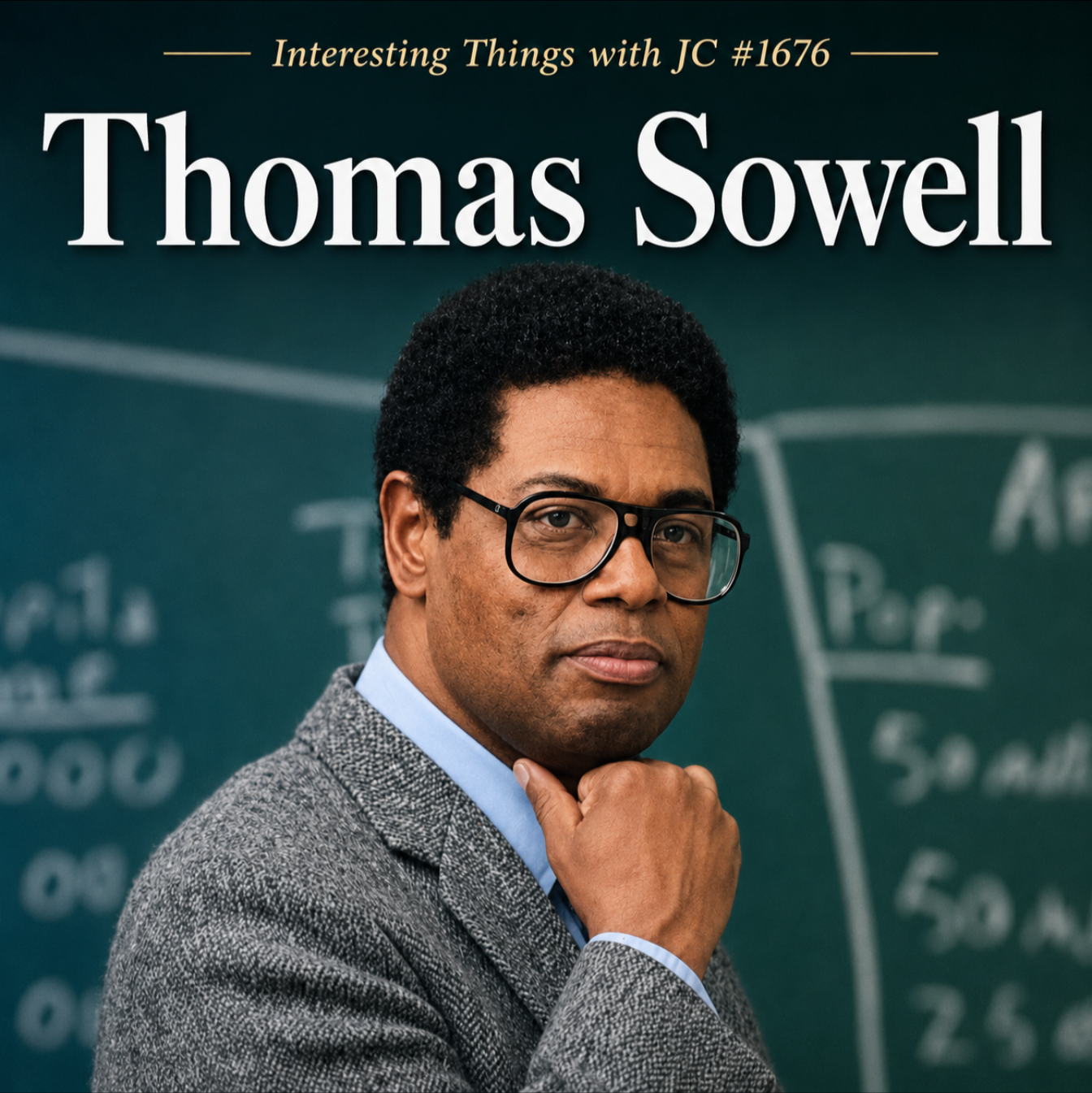
This podcast cover image presents a scholarly theme centered on Thomas Sowell. The subject is shown from the chest up in front of a blurred chalkboard containing mathematical notation and geometric sketches. His thoughtful pose and direct gaze suggest analysis, learning, and intellectual inquiry. The large, high-contrast white title text “Thomas Sowell” dominates the composition, making the episode topic immediately clear. The design uses a dark teal background and muted academic colors to reinforce themes of economics, education, and public scholarship. The image functions as episode artwork introducing a discussion of Thomas Sowell's life, ideas, and contributions as an economist and public intellectual.
Transcript
Interesting Things with JC #1676:
"Thomas Sowell"
In the late 1950s, a young economist working for the federal government found himself studying labor conditions in Puerto Rico. What he saw there would stay with him for the rest of his life.
The policies under examination were designed to help poor workers. On paper, the logic seemed obvious. Higher wages should mean a better standard of living. Yet as Thomas Sowell (SOH-ul) examined employment data and conditions on the ground, he noticed something troubling. Some of the very people those policies were intended to help were finding it harder to get jobs at all. A wage increase that benefited workers who remained employed could leave others with no job to go to.
The more he examined the evidence, the harder it became to ignore.
Sowell was not someone predisposed to reject those ideas. Born in North Carolina in 1930, he moved to Harlem as a child and grew up amid economic hardship and racial discrimination. He left high school before graduating, worked a series of manual jobs, served in the U.S. Marine Corps during the Korean War era, and later entered college through the GI Bill. His academic journey eventually took him through Harvard, Columbia, and the University of Chicago, where he earned a doctorate in economics.
Harlem exposed Sowell to poverty, limited opportunity, and the realities of race in America, but it also exposed him to ambition, self-reliance, and people determined to build lives despite difficult circumstances. Those experiences remained part of the lens through which he would later examine economic and social questions.
During his younger years, Sowell found Marxist thought persuasive. It offered explanations for many of the inequalities he had witnessed firsthand. Like many intellectuals of his generation, he believed those ideas helped explain how society worked.
Then experience began colliding with theory.
Puerto Rico was one example, but it became part of a larger pattern. Again and again, Sowell encountered situations where intentions and outcomes failed to align. Programs created to solve problems sometimes produced new ones. Policies praised for their compassion occasionally carried costs that received far less attention. Over time, he became less interested in what a policy was supposed to accomplish and more interested in what it actually accomplished.
That habit of mind followed him into subjects far beyond economics.
Sowell developed a way of examining issues that focused relentlessly on consequences. Compared to what? At what cost? What happened afterward? Who gained? Who lost? Those questions followed him into education, race, culture, immigration, politics, and history. Again and again, he focused less on intentions than outcomes.
Over the following decades, he became one of America's most widely read public intellectuals. Books such as Basic Economics reached millions of readers by explaining incentives, trade-offs, scarcity, and unintended consequences without requiring advanced mathematics. Admirers praised his rigor. Critics challenged many of his conclusions. Yet both sides often found themselves engaging with the same body of evidence because Sowell insisted on asking what happened when ideas met reality.
History has produced many economists, scholars, and commentators. What makes Thomas Sowell stand out is his willingness to reexamine beliefs he once held and follow the evidence wherever it led.
Changing your mind is often described as a virtue. Doing it publicly, over a lifetime, while building a career around that principle, is far less common.
For Thomas Sowell, some of the most important discoveries were not about economics. They came from a lifelong willingness to let facts have the final word.
These are interesting things, with JC.
Student Worksheet
Comprehension Questions:
What labor issue was Sowell studying in Puerto Rico?
Why did the wage policy appear helpful on paper?
What unintended result did Sowell notice?
What experiences shaped Sowell before his academic career?
What question does the episode suggest people should ask about policies?
Analysis Questions:
Explain the difference between a policy’s intention and its outcome.
Why might evidence cause someone to rethink a belief?
How do incentives and trade-offs appear in the episode?
Reflection Prompt: Write one paragraph explaining why changing one’s mind can be difficult but valuable.
Difficulty Scaling: Basic: answer using episode details; Advanced: compare the episode to another real-world policy or school rule.
Student Output: Submit complete sentence answers and one paragraph reflection.
Academic Integrity Guidance: Use your own words and cite the episode when referring to specific claims.
Teacher Guide
Quick Start: Begin with the podcast audio before discussion or notes.
Pacing Guide: 5 minutes bell ringer, 5 minutes audio, 10 minutes comprehension, 15 minutes analysis, 10 minutes discussion, 5 minutes exit ticket.
Bell Ringer: Ask students: “Can a rule have good intentions but bad results?”
Audio Guidance: Students listen once without writing, then replay key portions for notes.
Audio Fallback: If audio is unavailable, teacher reads the transcript aloud.
Time on Task: 50 minutes standard; 30-minute version uses comprehension, one analysis question, and exit ticket.
Materials: Transcript, worksheet, writing paper or LMS response form.
Vocabulary Strategy: Preview incentives, trade-off, and unintended consequences before listening.
Misconceptions: Students may assume criticizing outcomes means criticizing compassion; emphasize evidence-based evaluation.
Discussion Prompts:
What does the episode suggest about evidence and humility?
Why are consequences important in economics?
How can people disagree while using the same evidence?
Formative Checkpoints: Listen for correct use of trade-off, outcome, and evidence.
Differentiation: Provide sentence stems for developing writers and extension comparison tasks for advanced students.
Assessment Differentiation: Allow oral responses, written paragraphs, or graphic organizers.
Time Flexibility: Shorten by assigning reflection as homework.
Substitute Readiness: Play/read transcript, assign worksheet, collect exit tickets.
Engagement Strategy: Use a quick “intention vs. outcome” chart on the board.
Extensions: Students research another economist or policy case involving unintended consequences.
Cross-Curricular Connections: Economics, U.S. history, government, sociology, English argument writing.
SEL Connection: Emphasize intellectual humility and respectful disagreement.
Skill Emphasis: Evidence evaluation, reasoning, cause-and-effect analysis.
Answer Key:
Puerto Rico labor conditions and wage policy.
Higher wages seemed likely to improve workers’ living standards.
Some workers had more difficulty finding jobs.
Poverty, Harlem, racial discrimination, work, military service, and higher education.
What actually happened, compared to what was intended?
Quiz
What economic issue is central to the Puerto Rico example?
A. Inflation
B. Minimum wage and employment
C. International trade
D. Banking regulationWhat did Sowell increasingly focus on when evaluating policy?
A. Popularity
B. Intentions only
C. Outcomes and consequences
D. Political slogansWhich term means results that were not planned?
A. Scarcity
B. Unintended consequences
C. Revenue
D. ProductivityWhich experience was part of Sowell’s background?
A. Service in the U.S. Marine Corps
B. Career as a professional athlete
C. Childhood in California
D. Medical trainingWhat larger lesson does the episode emphasize?
A. Never change beliefs
B. Evidence should be ignored when uncomfortable
C. Facts can challenge theories
D. Economics avoids real life
Assessment
Open-Ended Questions:
Explain how the episode shows the difference between good intentions and measurable outcomes.
Describe why Sowell’s willingness to revise his beliefs is important for scholarship and citizenship.
3–2–1 Rubric:
3: Clear claim, accurate episode evidence, strong explanation.
2: Understandable claim, some evidence, partial explanation.
1: Limited claim, little evidence, unclear reasoning.
Exit Ticket: Name one belief, rule, or policy that should be judged by results, and explain why in two sentences.
Standards Alignment
NGSS Alignment
HS-ETS1-3: Evaluate solutions to complex real-world problems based on criteria, trade-offs, and consequences. Students analyze how labor policies may achieve some goals while creating unintended outcomes.
HS-ETS1-2: Design and evaluate solutions by breaking larger problems into smaller, measurable components. Students examine employment, wages, and economic incentives as interconnected variables.
Science and Engineering Practice: Analyzing and Interpreting Data: Students assess evidence presented in the episode and distinguish observations from assumptions.
Crosscutting Concept: Cause and Effect: Students investigate how policy decisions can generate both intended and unintended consequences.
Crosscutting Concept: Systems and System Models: Students recognize labor markets as systems where changes in one area may affect multiple outcomes.
CCSS English Language Arts Alignment
CCSS.ELA-LITERACY.RI.9-10.1: Cite strong textual evidence to support analysis of the episode and related informational sources.
CCSS.ELA-LITERACY.RI.9-10.2: Determine central ideas and explain how they develop throughout the narrative.
CCSS.ELA-LITERACY.RI.9-10.8: Evaluate claims, reasoning, and evidence presented by the speaker.
CCSS.ELA-LITERACY.RI.11-12.3: Analyze complex ideas and how individuals and events interact over time.
CCSS.ELA-LITERACY.RI.11-12.6: Determine an author's perspective and evaluate how evidence supports conclusions.
CCSS.ELA-LITERACY.W.9-10.1: Write arguments supported by evidence and logical reasoning.
CCSS.ELA-LITERACY.W.11-12.1: Develop claims using relevant evidence and analysis.
CCSS.ELA-LITERACY.SL.9-10.1: Initiate and participate effectively in collaborative discussions.
CCSS.ELA-LITERACY.SL.11-12.4: Present findings and evidence clearly and logically.
CCSS.ELA-LITERACY.L.9-10.6: Acquire and accurately use academic and domain-specific vocabulary.
C3 Framework Alignment
D2.Eco.1.9-12: Analyze how incentives influence choices made by individuals, businesses, and governments.
D2.Eco.6.9-12: Evaluate the role of scarcity, opportunity costs, and trade-offs in economic decision-making.
D2.Eco.8.9-12: Examine how economic institutions affect employment and productivity.
D2.His.1.9-12: Evaluate historical sources and evidence regarding past events and ideas.
D2.His.14.9-12: Analyze multiple causes and effects of historical developments.
D3.1.9-12: Gather and evaluate sources while identifying strengths and limitations of evidence.
D4.1.9-12: Construct arguments using claims, evidence, and reasoning.
ISTE Standards Alignment
ISTE 1.3a Knowledge Constructor: Students plan investigations and gather information from credible sources.
ISTE 1.3b Knowledge Constructor: Students evaluate the accuracy and perspective of information sources.
ISTE 1.3d Knowledge Constructor: Students build knowledge by actively exploring real-world issues.
ISTE 1.7c Global Collaborator: Students contribute constructively to discussions involving differing viewpoints.
ISTE 1.7d Global Collaborator: Students examine issues from multiple perspectives to deepen understanding.
Career and Technical Education (CTE) Alignment
Critical Thinking and Problem Solving: Analyze evidence before making decisions.
Information Literacy: Assess the reliability and relevance of information.
Professional Communication: Explain conclusions using evidence-based reasoning.
Ethical Decision-Making: Consider both intended and unintended outcomes of actions.
Workplace Readiness: Demonstrate adaptability when presented with new evidence.
Economics Standards Alignment
Scarcity and Choice: Explain how limited resources require trade-offs.
Opportunity Cost: Evaluate what is gained and lost through policy decisions.
Market Incentives: Analyze how incentives influence individual behavior.
Labor Markets: Examine relationships among wages, employment, and worker opportunity.
Public Policy Evaluation: Compare intended goals with measurable outcomes.
Historical Thinking Skills
Historical Contextualization: Place Sowell's experiences within the social and economic conditions of mid-20th-century America.
Continuity and Change Over Time: Analyze how Sowell's views evolved throughout his life.
Evidence-Based Interpretation: Distinguish between personal belief and documented evidence.
Historical Causation: Investigate how experiences influenced intellectual development.
Media Literacy Alignment
Source Evaluation: Assess the credibility of information and supporting evidence.
Claim Verification: Distinguish between assertions and substantiated conclusions.
Perspective Analysis: Recognize how different interpretations can emerge from the same evidence.
Critical Consumption: Evaluate arguments based on outcomes rather than rhetoric.
College and Career Readiness Competencies
Analytical Reasoning: Interpret complex information and draw evidence-based conclusions.
Intellectual Humility: Revise conclusions when confronted with stronger evidence.
Research Literacy: Gather, assess, and synthesize information from multiple sources.
Communication Skills: Present arguments clearly and respectfully.
Decision-Making: Evaluate consequences before recommending solutions.
Independent Learning: Demonstrate curiosity and self-directed inquiry.
Homeschool and Lifelong Learning Alignment
Independent Inquiry: Investigate real-world questions through evidence and research.
Civic Literacy: Understand how public policies affect individuals and communities.
Financial and Economic Literacy: Apply economic reasoning to everyday decisions.
Reflective Thinking: Examine personal assumptions and beliefs critically.
Lifelong Learning Habits: Develop a commitment to evidence, curiosity, and continuous learning.
Measurable Mastery Outcomes
Students will be able to:
Define incentives, trade-offs, scarcity, and unintended consequences.
Explain how Thomas Sowell's experiences influenced his intellectual development.
Distinguish between policy intentions and policy outcomes.
Analyze evidence used to support an economic argument.
Construct a written response using claims, evidence, and reasoning.
Participate in evidence-based discussions with peers.
Evaluate competing viewpoints while maintaining academic neutrality.
Apply economic reasoning to contemporary issues.
Demonstrate understanding of cause-and-effect relationships in public policy.
Reflect on the role of evidence in changing beliefs and decision-making.
Show Notes
Thomas Sowell’s life and work provide a classroom-ready case study in evidence-based thinking, economic reasoning, and intellectual humility. This episode helps students examine how policies can produce results different from their intentions and why responsible thinkers must ask careful questions about consequences, trade-offs, and facts.
References
Sowell, T. (2000). A personal odyssey. Free Press. https://www.amazon.com/Personal-Odyssey-Thomas-Sowell/dp/0684864657
Thomas Sowell. (n.d.). Hoover Institution. https://www.hoover.org/profiles/thomas-sowell
Britannica. (2025, July 29). Thomas Sowell. https://www.britannica.com/biography/Thomas-Sowell
Riley, J. L. (2021). Maverick: A biography of Thomas Sowell. Basic Books. https://manhattan.institute/book/maverick-a-biography-of-thomas-sowell
National Endowment for the Humanities. (2002). Thomas Sowell. https://www.neh.gov/about/awards/national-humanities-medals/thomas-sowell
Manhattan Institute. (2021, May 27). Thomas Sowell’s Harlem years. https://manhattan.institute/article/thomas-sowells-harlem-years