Interesting Things with JC #1713: "How Do You Catch Legionnaires' Disease?"
Fifty-four people are diagnosed with Legionnaires' disease in two Manhattan neighborhoods as investigators test cooling towers across the area. Legionella genetic material appears in systems at 31 buildings, but finding the bacterium and finding the source are not the same thing.
Curriculum - Episode Anchor
Episode Title: How Do You Catch Legionnaires' Disease?
Episode Number: 1713
Host: JC
Audience: Grades 9–12, Introductory College, Homeschool, Lifelong Learners
Subject Area: Biology, Microbiology, Public Health, Environmental Health
Lesson Overview
Learning Objectives:
Explain how Legionella bacteria can grow in human-made water systems and reach the lungs through aerosolized water droplets.
Analyze how environmental conditions, water-system design, and cooling towers can contribute to disease transmission.
Distinguish preliminary PCR detection from evidence identifying a specific outbreak source.
Evaluate public-health information using evidence, uncertainty, and precise scientific language.
Essential Question: How can a naturally occurring bacterium become a public-health threat through human-made water systems?
Success Criteria: Students can accurately explain the transmission pathway of Legionnaires' disease, identify conditions that support Legionella growth, interpret the limits of preliminary PCR findings, and use evidence to distinguish confirmed information from an unresolved outbreak question.
Student Relevance Statement: Buildings, water systems, and public-health investigations affect daily life even when the underlying infrastructure is mostly invisible. Understanding disease transmission helps students evaluate health information without confusing exposure, infection, and contagion.
Real-World Connection: Public-health departments, laboratories, building operators, engineers, and health-care professionals must combine environmental testing, patient data, water-system maintenance, and risk communication during a Legionnaires' disease investigation.
Workforce Reality: Environmental health and outbreak investigation require technical training, disciplined sampling, documentation, communication, and professional judgment. A positive screening result can justify precautionary action without proving that a specific system caused an outbreak.
Key Vocabulary
Legionnaires' disease(LEE-juh-nairz dih-ZEEZ): A serious type of pneumonia caused by Legionella bacteria.
Legionella pneumophila(lee-juh-NEL-uh new-MOF-ih-luh): A species of Legionella associated with many cases of Legionnaires' disease.
Aerosolized droplets(AIR-uh-sol-ized DROP-lits): Tiny liquid droplets suspended in air that can be inhaled.
Cooling tower(KOO-ling TOW-er): A water-containing structure used in some large cooling systems that can release mist into the air.
Biofilm(BY-oh-film): A community of microorganisms attached to a surface and surrounded by a protective biological matrix.
Stagnant water(STAG-nuhnt WAW-ter): Water with little or no movement, allowing increased water age and potentially favorable microbial conditions.
PCR testing(pee-see-AR TES-ting): Polymerase chain reaction testing used to detect specific genetic material.
Pneumonia(new-MOH-nee-uh): An infection that causes inflammation in the lungs.
Disinfection(dis-in-FEK-shun): A process used to reduce or eliminate harmful microorganisms.
Surveillance(ser-VAY-luhns): Systematic collection and analysis of health information to monitor disease patterns.
Narrative Core
Open: A mysterious pneumonia outbreak following a 1976 American Legion convention led investigators to identify a previously unrecognized bacterium.
Info:Legionella occurs naturally in freshwater but can become a health concern when it grows in human-made water systems and reaches people through inhaled contaminated mist.
Details: Warm water conditions, stagnation, reduced disinfectant residual, and biofilm can support bacterial growth. Cooling towers can generate small water droplets capable of carrying bacteria into the air. The 2026 Upper East Side investigation demonstrates why PCR screening, remediation, patient surveillance, and continued source investigation serve different but connected purposes.
Reflection: Detecting Legionella genetic material in a water system does not automatically establish that the system caused an outbreak. Students must separate detection, transmission, disease, and source attribution while recognizing why health officials may act before every laboratory question is resolved.
Closing: These are interesting things, with JC.
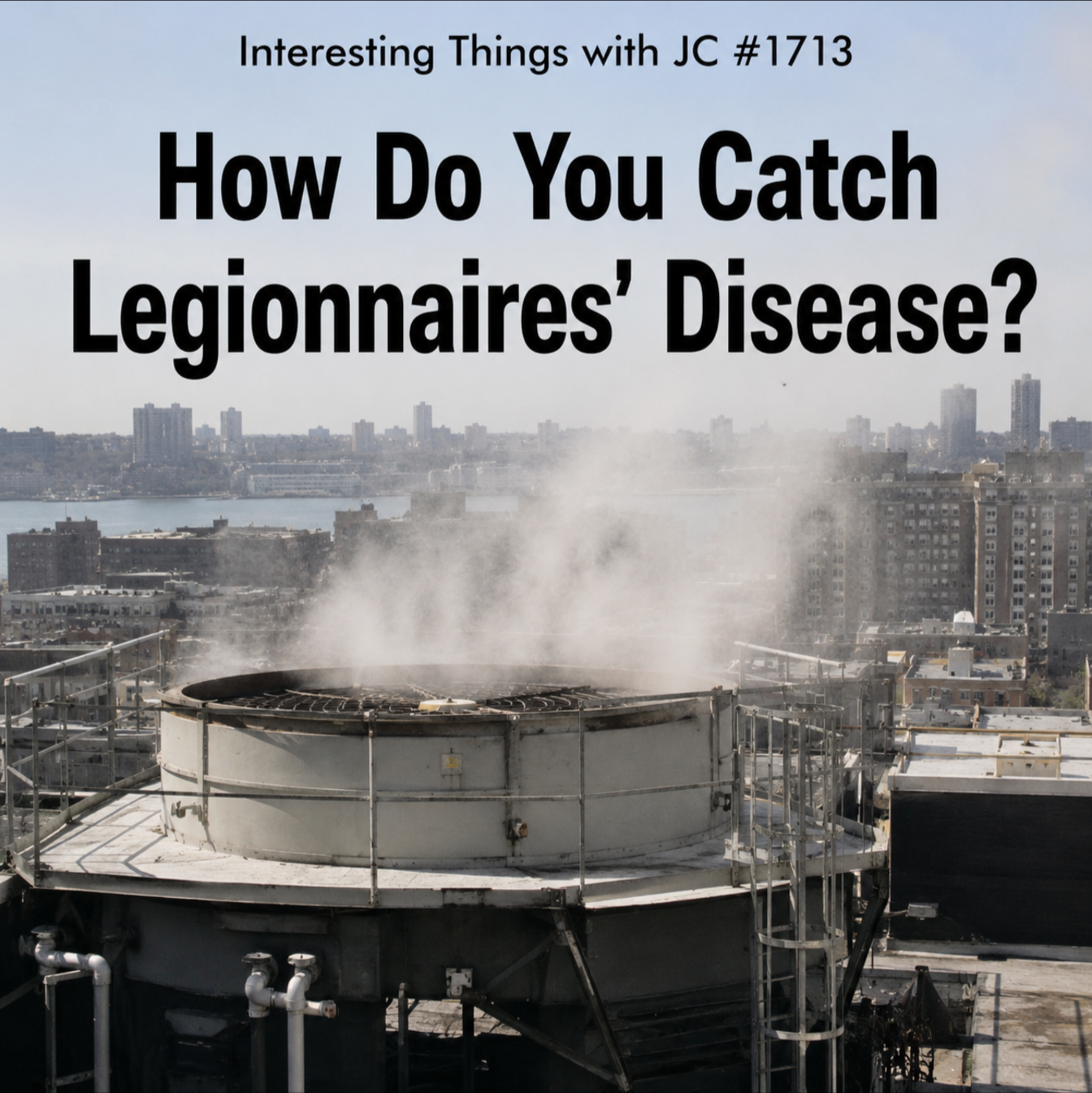
Photograph of a large rooftop cooling tower releasing a cloud of water vapor above a dense city skyline. Black text reads, “How Do You Catch Legionnaires’ Disease?” with “Interesting Things with JC #1713” at the top.
Transcript
Interesting Things with JC #1713:
"How Do You Catch Legionnaires' Disease?"
In 1976, 221 people became sick after an American Legion convention in Philadelphia. Thirty-four died. Investigators found severe pneumonia, but the cause stayed hidden until CDC microbiologist Joseph McDade isolated a bacterium no one had recognized before: Legionella pneumophila.
Now New York City is tracing it again.
As of July 10, 2026, 54 people had been diagnosed in Carnegie Hill and Yorkville on Manhattan's Upper East Side. Eighteen remained hospitalized. The investigation centered on cooling towers, and initial PCR testing found Legionella genetic material in tower systems at 31 buildings. Those results don't prove which tower caused the outbreak, but the city ordered cleaning and disinfection while testing continued.
Legionella naturally exists in freshwater, usually at levels too low to cause disease. The problem begins inside human-made water systems. Between about 77 and 113 degrees Fahrenheit, or 25 to 45 Celsius, it can multiply. Stagnant water, low disinfectant levels, and biofilm can give it somewhere to grow.
A cooling tower can then turn contaminated water into microscopic droplets and release them into the air. Breathe enough of that mist into the lungs, and Legionnaires' disease can develop. It isn't considered contagious, and New York says residents in the affected ZIP codes can still drink tap water, shower, cook, and use home air conditioners.
The disease can bring fever, chills, muscle aches, cough, confusion, and diarrhea. People over 50, smokers, and those with chronic illness or weakened immune systems face greater risk. Antibiotics can treat it, but early care matters.
Reported U.S. cases have generally climbed since 2000. The bacterium didn't suddenly appear. We built larger, warmer, more complicated water systems where it could multiply, then created machines capable of putting that water into the air.
In Philadelphia, investigators had to discover the bacterium. Fifty years later, the work is often finding the water system that gave it a way to reach us.
These are interesting things, with JC.
Student Worksheet
Comprehension Questions:
What bacterium did Joseph McDade isolate following the 1976 outbreak investigation?
What type of disease is Legionnaires' disease?
Identify three conditions in human-made water systems that can support Legionella growth.
How can a cooling tower contribute to human exposure?
Why did the preliminary PCR results not prove which cooling tower caused the 2026 outbreak?
Identify three groups described as facing greater risk.
Analysis Questions:
Construct the transmission pathway from freshwater bacteria to disease in the lungs. Include at least four stages.
Explain why "not contagious" does not mean "cannot spread through the environment."
Why might public-health officials order cleaning and disinfection after a positive PCR screening result even before a specific outbreak source is confirmed?
Compare the scientific problem investigators faced in Philadelphia in 1976 with the investigative problem described in New York City in 2026.
The episode connects increasing reported cases with larger and more complicated water systems. Explain why students should distinguish this explanatory interpretation from a single experimentally proven cause of the national trend.
Reflection Prompt: Much of modern life depends on infrastructure people rarely see. In 100–150 words, explain how the Legionnaires' disease example changes the way you think about maintenance, monitoring, or professional responsibility.
Difficulty Scaling: Level 1 students complete comprehension questions and a labeled transmission sequence. Level 2 students complete all questions with episode evidence. Level 3 students complete all tasks and write a claim-evidence-reasoning analysis evaluating the limits of preliminary PCR findings.
Student Output: Submit six comprehension answers, five analysis responses, one 100–150-word reflection, and, for Level 3, a 150–200-word claim-evidence-reasoning response.
Academic Integrity Guidance: Use the episode and assigned sources as evidence. Explain ideas in your own words. Do not invent case numbers, laboratory findings, or causal conclusions. Clearly distinguish reported facts from your interpretation.
Teacher Guide
Quick Start: Begin with the podcast. Before playback, tell students to listen for a chain of events: where the bacterium grows, how it enters the air, and how it reaches the lungs.
Pacing Guide: 0–3 minutes: listening prompt and podcast. 3–8 minutes: students independently reconstruct the transmission pathway. 8–15 minutes: vocabulary and pathway review. 15–25 minutes: analyze PCR testing and source uncertainty. 25–40 minutes: worksheet analysis. 40–50 minutes: discussion and formative checks. 50–57 minutes: quiz or assessment. 57–60 minutes: exit ticket.
Bell Ringer: What is the difference between detecting a microorganism somewhere and proving that it caused a specific person's illness? Write two sentences.
Audio Guidance: Students should listen first without the worksheet questions. Ask them to record five short notes under the labels Growth, Water System, Air, Lungs, and Investigation.
Audio Fallback: Read the transcript aloud without interrupting for instruction. If oral delivery is unavailable, students complete one silent reading and mark each point where the transmission pathway changes location.
Time on Task: Standard delivery requires 55–60 minutes. A focused version covering audio, transmission, PCR interpretation, and the exit ticket requires approximately 35 minutes.
Materials:
Podcast audio or transcript
Student Worksheet
Writing materials or digital response platform
Optional building water-system or cooling-tower diagram
Optional five-stage transmission organizer
Vocabulary Strategy: Preteach aerosolized droplets and PCR testing. Allow students to encounter cooling tower and biofilm in context before formal definitions. Require accurate use of Legionella, aerosolized droplets, and PCR testing during analysis.
Misconceptions:
Legionnaires' disease is generally not spread from person to person.
A home air conditioner is not the same as a water-based cooling tower.
Drinking water is not the transmission pathway described for the Upper East Side community cluster.
Detecting bacterial genetic material by PCR does not establish that live bacteria from that system caused specific cases.
Natural presence of a bacterium does not mean disease is inevitable.
An association between infrastructure conditions and disease trends should not automatically be described as a single proven cause of every reported increase.
Discussion Prompts:
At what point does naturally occurring Legionella become a public-health concern?
Why are cooling towers relevant to an airborne mist exposure pathway?
What does PCR testing tell investigators?
What does preliminary PCR testing not tell investigators?
Why can precautionary action occur before final source attribution?
How does precise language reduce unnecessary fear during a disease investigation?
Formative Checkpoints: After listening, students arrange Growth → Water System → Aerosolization → Inhalation → Lung Infection in sequence. After vocabulary, students explain why a cooling tower differs from a home air conditioner. Before assessment, students classify four statements as confirmed finding, preliminary finding, interpretation, or unresolved question.
Differentiation: Provide a partially completed transmission pathway for students needing support. Use sentence frames such as "PCR evidence shows ___, but it does not prove ___." Advanced students should evaluate how environmental and patient evidence could be combined during source attribution.
Assessment Differentiation: Students with writing accommodations may submit a labeled evidence chart followed by a shorter explanatory paragraph. Advanced students should identify one limitation of PCR screening and propose an additional category of evidence needed to strengthen source attribution.
Time Flexibility: For 30 minutes, use the podcast, transmission sequence, analysis questions 2 and 3, and exit ticket. For a 90-minute block, add a simulated outbreak evidence exercise in which students rank environmental findings by evidentiary strength.
Substitute Readiness: Play or read the episode first. Students complete the five-label listening task and worksheet. Review the transmission sequence and PCR misconception. Administer the quiz and collect the exit ticket.
Engagement Strategy: Give students five cards labeled Freshwater, Building Water System, Cooling Tower Mist, Lungs, and Pneumonia. Students arrange the pathway, then identify conditions or events required to move from one stage to the next.
Extensions: Create a water-management risk map for a fictional building. Compare PCR screening with culture-based confirmation at a conceptual level. Analyze national surveillance trends and identify questions the trend line alone cannot answer.
Cross-Curricular Connections: Biology addresses bacterial growth and disease. Environmental science examines built water systems. Engineering considers system maintenance and control. Mathematics supports trend interpretation. English language arts develops evidence-based explanation and precise public communication.
SEL Connection: Students practice managing uncertainty through evidence rather than assumption. Discussion emphasizes careful listening, responsible communication, and willingness to revise conclusions as new information becomes available.
Skill Value Emphasis: The lesson emphasizes analytical thinking, communication, problem solving, adaptability, and professional judgment. Students learn that responsible decisions may require action under uncertainty while still maintaining precise limits on what the evidence proves.
Answer Key:
Comprehension: 1. Legionella pneumophila. 2. A serious type of pneumonia. 3. Acceptable answers include favorable warm-water temperatures, stagnant water, low disinfectant levels, and biofilm. 4. A cooling tower can generate and release microscopic water droplets containing bacteria that may be inhaled. 5. PCR detected Legionella genetic material but did not establish which system produced the outbreak exposure. 6. People over 50, smokers, and people with chronic illness or weakened immune systems.
Analysis: 1. Strong answers trace Legionella from environmental water into a human-made water system, favorable growth conditions, contaminated aerosol generation, inhalation, and lung infection. 2. Environmental exposure can affect multiple people without infected people transmitting the disease to one another. 3. Precautionary remediation can reduce a possible continuing exposure while source testing remains incomplete. 4. Philadelphia investigators first had to identify the previously unrecognized bacterium; modern investigators may already know the organism and instead work to identify the environmental system responsible for exposure. 5. A national trend and biologically plausible infrastructure explanation do not, by themselves, prove one universal cause for the increase.
Reflection: Answers will vary. Strong responses connect infrastructure to maintenance, monitoring, evidence, and professional responsibility without making unsupported claims.
Quiz
Questions:
Which bacterium is associated with Legionnaires' disease?
A. Escherichia coli
B. Legionella pneumophila
C. Staphylococcus epidermidis
D. Lactobacillus acidophilusWhat is the primary transmission pathway described in the episode?
A. Direct physical contact with an infected person
B. Eating food containing the bacterium
C. Inhaling contaminated microscopic water droplets
D. Being bitten by an infected insectWhich condition can support Legionella growth in a water system?
A. Continuous freezing
B. Stagnant water
C. Complete absence of water
D. Dry moving airWhy did positive PCR screening results at cooling towers not identify the outbreak source by themselves?
A. PCR cannot detect genetic material.
B. Cooling towers never spread water droplets.
C. Detection did not prove which system caused human exposure.
D. Legionnaires' disease is always transmitted between people.Which statement best compares the 1976 and 2026 investigations described in the episode?
A. Both investigations involved discovering an entirely new bacterium.
B. The 1976 investigation identified the bacterium, while the 2026 investigation focused on tracing an environmental source.
C. The 1976 investigation focused only on home air conditioners.
D. The 2026 investigation proved every PCR-positive tower caused disease.
Assessment
Open-Ended Questions:
Explain how Legionella can move from a naturally occurring freshwater bacterium to a cause of pneumonia. Include water-system conditions, aerosolization, and inhalation in your response.
Explain why the 2026 preliminary PCR results could justify cleaning and disinfection while still being insufficient to identify a specific cooling tower as the outbreak source. Use precise evidence language.
3–2–1 Rubric:
3 — Proficient: Provides an accurate claim, uses specific scientific or investigative evidence, explains the transmission or reasoning process, and clearly states evidence limitations.
2 — Developing: Provides a generally accurate explanation with relevant evidence but incomplete reasoning or limited treatment of uncertainty.
1 — Beginning: Provides an incomplete or inaccurate explanation with little evidence or confusion about transmission and source attribution.
Exit Ticket: Complete both statements: "Legionnaires' disease can develop when ___." "A positive preliminary PCR result does not automatically prove ___."
Standards Alignment
NGSS — Science & Engineering Practices
SEP: Analyzing and Interpreting Data — Analyze data to identify significant features and patterns.Direct Connection: Students interpret outbreak case information, PCR screening findings, and national surveillance trends. Measurable Student Skill: Students distinguish a detected pattern or preliminary finding from a demonstrated causal conclusion in at least two responses. Justification: Worksheet Analysis Question 5 and Assessment Question 2 require students to evaluate what data support and where interpretation must remain limited.
SEP: Engaging in Argument from Evidence — Evaluate competing claims and construct arguments using empirical evidence and scientific reasoning.Direct Connection: Students evaluate whether PCR-positive cooling towers can immediately be labeled outbreak sources. Measurable Student Skill: Students construct a claim that accurately explains the evidentiary limits of PCR screening and supports it with investigation details. Justification: The Level 3 worksheet task and second assessment question directly measure evidence-based scientific reasoning.
CCSS Reading
CCSS.ELA-LITERACY.RST.11-12.1 — Cite specific textual evidence to support analysis of science and technical texts.Direct Connection: Students use details about water temperature, aerosolized droplets, PCR testing, and risk groups. Measurable Student Skill: Students incorporate at least two accurate episode details into an analytical response. Justification: Worksheet and assessment questions require students to support explanations with scientific information from the transcript.
CCSS.ELA-LITERACY.RST.11-12.8 — Evaluate the hypotheses, data, analysis, and conclusions in a science or technical text.Direct Connection: Students examine the distinction between preliminary environmental detection and source attribution. Measurable Student Skill: Students identify one supported finding and one conclusion that the available PCR evidence cannot independently establish. Justification: Analysis Questions 3 and 5 directly require evaluation of evidence and conclusions.
CCSS WritingCCSS.ELA-LITERACY.WHST.11-12.2 — Write informative and explanatory texts to examine and convey complex scientific concepts clearly and accurately.Direct Connection: Students explain a multistage environmental disease-transmission pathway. Measurable Student Skill: Students produce an ordered explanation incorporating bacterial growth, aerosolization, inhalation, and lung infection. Justification: Assessment Question 1 measures accurate technical explanation of a complex biological and environmental process.
CCSS Speaking & Listening
CCSS.ELA-LITERACY.SL.11-12.1 — Initiate and participate effectively in collaborative discussions.Direct Connection: Students discuss outbreak evidence, uncertainty, remediation decisions, and public-health communication. Measurable Student Skill: Students contribute one evidence-based interpretation and respond to or refine one peer claim. Justification: Teacher discussion prompts and formative classification tasks require collaborative reasoning and precise communication.
C3 Framework
D4.1.9-12 — Construct arguments using precise and knowledgeable claims, with evidence from multiple sources, while acknowledging counterclaims and evidentiary weaknesses.Direct Connection: Students evaluate public-health action taken before final source confirmation. Measurable Student Skill: Students explain both what preliminary PCR evidence supports and what it does not prove. Justification: Assessment Question 2 directly measures reasoned judgment under incomplete evidence.
ISTE Standards
ISTE 1.3.b — Knowledge Constructor: Evaluate the accuracy, perspective, credibility, and relevance of information, media, data, or other resources.Direct Connection: Students classify outbreak statements as confirmed findings, preliminary findings, interpretations, or unresolved questions. Measurable Student Skill: Students correctly classify evidence statements and justify at least one classification. Justification: The formative checkpoint and worksheet analysis develop information-evaluation skills needed when interpreting rapidly changing health information.
Career Readiness Competencies — Analytical Thinking, Communication, Problem Solving, Adaptability, and Professional JudgmentApplied Career Readiness Competencies — Use evidence, communicate accurately, solve problems, adapt to changing information, and exercise responsible judgment.Direct Connection: Students analyze PCR evidence, explain transmission, propose control reasoning, revise claims when evidence is incomplete, and evaluate precautionary action. Measurable Student Skill: Students identify an evidence limitation, communicate a precise conclusion, explain a response decision, and revise an overconfident claim. Justification: The worksheet, discussion prompts, formative checks, and Assessment Question 2 collectively measure analytical thinking, communication, problem solving, adaptability, and professional judgment in a realistic public-health context.
Homeschool / Lifelong Learning Alignment — Independent Learning, Information Literacy, Real-World Application, Self-Directed Inquiry, and Transferable Life SkillsApplied Independent Inquiry and Information Literacy — Independently evaluate information and transfer evidence-based reasoning to real-world decisions.Direct Connection: Learners extract a transmission pathway from audio, assess preliminary findings, connect infrastructure maintenance to public health, generate follow-up questions, and practice distinguishing detection from proof. Measurable Student Skill: Learners independently produce an accurate evidence sequence, identify one information limitation, formulate one further question, and explain one real-world application. Justification: Audio-first note-taking, the reflection prompt, extension tasks, and exit ticket directly develop independent learning, information literacy, real-world application, self-directed inquiry, and transferable life skills.
Show Notes
Legionnaires' disease begins with a bacterium that naturally exists in freshwater, but the risk changes when Legionella finds favorable conditions inside human-made water systems and contaminated droplets reach the lungs. Using the 1976 Philadelphia outbreak and the 2026 Upper East Side investigation, this lesson helps students trace an environmental disease pathway, understand cooling towers, evaluate preliminary PCR findings, and distinguish detection from proof. The topic matters because modern public health depends not only on identifying microorganisms, but also on understanding the infrastructure, maintenance decisions, and evidence chains that allow exposure to occur.
References
Centers for Disease Control and Prevention. (n.d.). Legionnaires' disease. David J. Sencer CDC Museum. https://www.cdc.gov/museum/online/story-of-cdc/legionnaires/index.html
Centers for Disease Control and Prevention. (2025, August 6). About Legionnaires' disease. https://www.cdc.gov/legionella/about/index.html
Centers for Disease Control and Prevention. (2025, June 9). How Legionella spreads. https://www.cdc.gov/legionella/causes/index.html
Centers for Disease Control and Prevention. (2024, March 15). Monitoring building water. https://www.cdc.gov/control-legionella/php/guidance/monitor-water-guidance.html
Centers for Disease Control and Prevention. (2026, July 8). Legionellosis surveillance and trends. https://www.cdc.gov/legionella/php/surveillance/index.html
New York City Department of Health and Mental Hygiene. (2026, July 10). NYC Health Department releases preliminary list of buildings ordered to clean and disinfect their cooling towers. https://www.nyc.gov/site/doh/about/press/pr2026/preliminary-list-clean-disinfect-cooling-towers-legionnaires.page
New York City Department of Health and Mental Hygiene. (2026). Legionnaires' disease. https://www.nyc.gov/site/doh/health/health-topics/legionnaires-disease.page