Interesting Things with JC #1715: "Hunny, Bunny, and the Twins Who Married the Twins"
Identical twins Hunny and Bunny meet identical twins Elliot and Danny while working at a Catskills hotel, and neither pair can tell the other apart. By the end of the summer, two couples have formed, and the similarities don't stop at their faces.
Curriculum - Episode Anchor
Episode Title: Hunny, Bunny, and the Twins Who Married the Twins
Episode Number: 1715
Host: JC
Audience: Grades 9–12, Introductory College, Homeschool, Lifelong Learners
Subject Area: Genetics, Human Biology, Oral History, Family Relationships
Lesson Overview
Learning Objectives:
Explain how identical twins form and why they are genetically much more similar than ordinary siblings.
Analyze why children of two pairs of identical twins can have an expected genetic relatedness comparable to full biological siblings.
Distinguish genetic relatedness from personal identity, relationships, and individual lived experience.
Evaluate oral history as a source of personal evidence about memory, relationships, and historical experience.
Essential Question: What can the story of two sets of identical twins teach us about the difference between genetic similarity and individual identity?
Success Criteria: Students can explain monozygotic twinning, accurately model the unusual genetic relationship among the cousins in the episode, identify evidence from Hunny and Elliot's oral history, and explain why genetic similarity does not make two people interchangeable.
Student Relevance Statement: Family relationships are described using words such as sibling, cousin, and twin, but biological relatedness can be more complicated than the family label alone suggests. The episode also shows how personal memories reveal dimensions of identity that cannot be reduced to DNA.
Real-World Connection: Genetics, genealogy, medicine, and biological research require careful interpretation of family relationships. Oral historians and journalists also use recorded memories to preserve individual perspectives that may not appear in formal records.
Workforce Reality: Genetics and historical research both demand precision. Professionals must distinguish expected biological relationships from exact individual measurements and separate documented facts from personal memory while treating human subjects as individuals rather than data points.
Key Vocabulary
Identical twins(eye-DEN-tih-kuhl twinz): Twins who develop after one fertilized egg divides into two embryos; also called monozygotic twins.
Monozygotic(mon-oh-zye-GOT-ik): Originating from one fertilized egg that divides during early development.
Genome(JEE-nohm): The complete set of DNA instructions in an organism.
Genetic relatedness(juh-NET-ik ree-LAY-tid-ness): The expected or measured degree of inherited DNA shared between people.
Inheritance(in-HAIR-ih-tuhns): The biological transmission of genetic information from parents to offspring.
Recombination(ree-kom-bih-NAY-shun): The reshuffling of genetic material that occurs during the production of egg and sperm cells.
Full sibling(FULL SIB-ling): A person who shares both biological parents with another person.
Oral history(OR-uhl HIS-tuh-ree): The recording and preservation of personal memories through interviews.
Primary source(PRY-mair-ee SORS): Firsthand evidence created by a person who directly experienced an event or period.
Narrative Core
Open: In 1946, identical twin sisters Hunny and Bunny Feller met identical twin brothers Elliot and Danny Reiken while all four were working at a Catskills hotel.
Info: The two couples formed separate relationships, married in a double wedding, and eventually shared one Brooklyn home while raising their families.
Details: Because Hunny and Bunny were identical twins and Elliot and Danny were also identical twins, children from the two marriages inherited DNA from parental pairs with nearly identical genetic backgrounds. Their expected genetic relatedness was therefore comparable to that of full biological siblings, even though their family relationship was cousin.
Reflection: The genetics make the family scientifically unusual, but Hunny's StoryCorps memory centers on something biology cannot fully describe. After decades of marriage, she identified Elliot not by his resemblance to Danny but by the individual experience of being held by him while they danced.
Closing: These are interesting things, with JC.
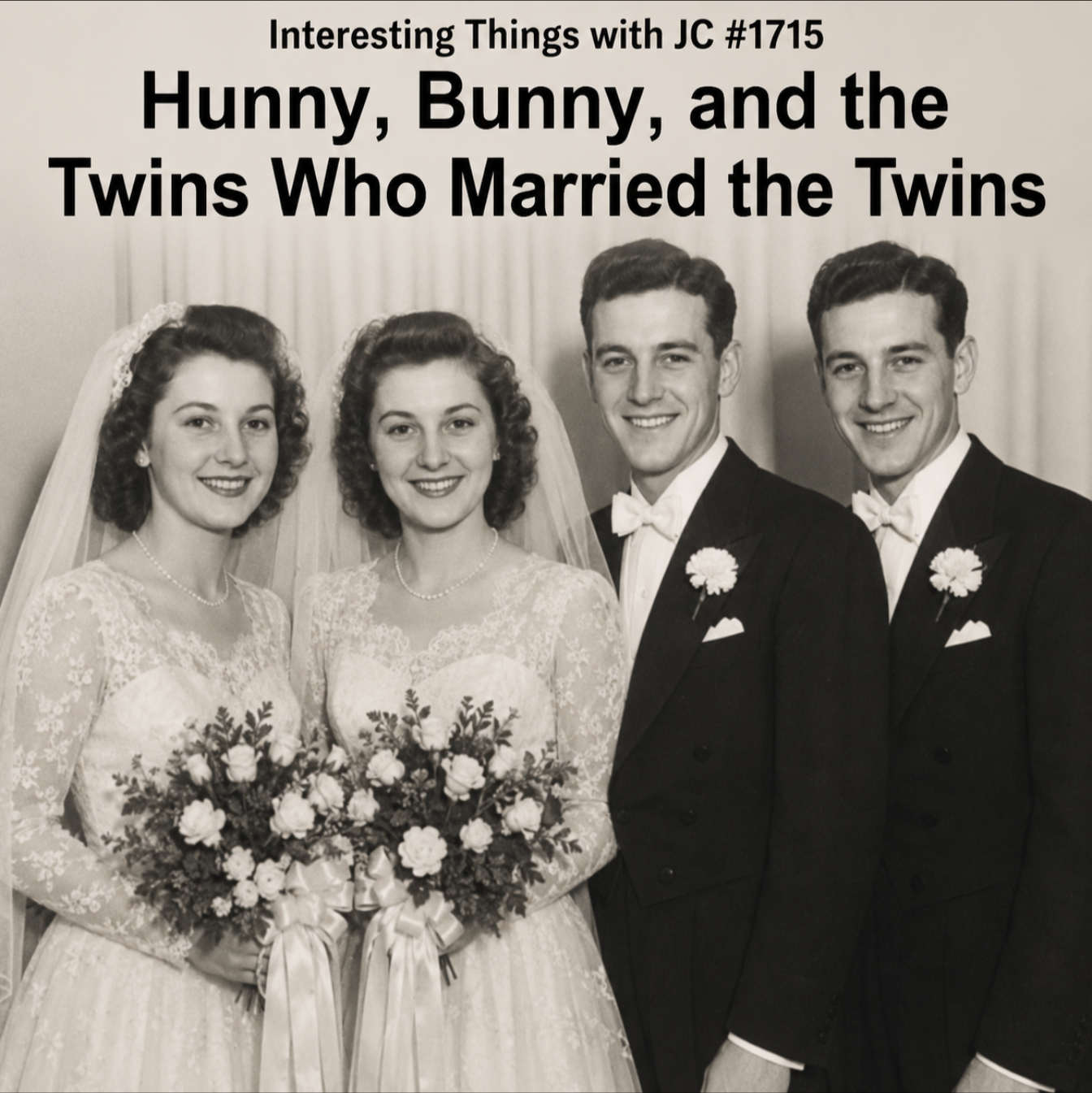
Black-and-white, vintage-style wedding photograph showing two nearly identical brides in lace gowns and veils standing beside two nearly identical grooms in dark tuxedos. The brides hold large floral bouquets as all four pose and smile together. Black text reads, “Hunny, Bunny, and the Twins Who Married the Twins,” with “Interesting Things with JC #1715” at the top.
Transcript
Interesting Things with JC #1715:
"Hunny, Bunny, and the Twins Who Married the Twins"
In the summer of 1946, two teenage sisters named Hunny and Bunny Feller took jobs waiting tables at a hotel in New York's Catskill Mountains. Two musicians working there were Elliot and Danny Reiken, and when the four met, there was an immediate problem. Hunny and Bunny were identical twins. So were Elliot and Danny. As Elliot remembered, the sisters couldn't tell the brothers apart, and the brothers couldn't tell the sisters apart.
By the end of the summer, they'd figured it out. Hunny was with Elliot, Bunny was with Danny, and there was no separating them. The couples eventually had a double wedding with identical gowns and flowers, then honeymooned in Miami Beach at the same time.
Afterward, they bought one house together in Brooklyn.
Bunny and Danny had two children; Hunny and Elliot had three. The sisters were even pregnant at the same time, with their first children born three weeks apart. And because the children's parents were two pairs of identical twins, the cousins shared about as much DNA as full biological siblings.
The four remained under the same roof until Danny died after heart surgery in 1997. Bunny stayed in the Brooklyn house, living upstairs, and in 2010 Hunny and Elliot sat down with StoryCorps after 61 years of marriage.
After a lifetime that began with four people unable to tell one another apart, Hunny knew exactly what made Elliot Elliot. She remembered the way he held her when they danced. He wasn't, she admitted, a fantastic dancer. But the way he held her felt genuine.
Sixty-one years later, that was still the word she chose.
Four identical faces met in the Catskills, married together, and built their lives in one Brooklyn home. But Hunny didn't remember how much Elliot looked like Danny.
She remembered the way he held her.
These are interesting things, with JC.
Student Worksheet
Comprehension Questions:
Where did Hunny and Bunny Feller meet Elliot and Danny Reiken?
What unusual biological characteristic did the two pairs of siblings share?
Which sister formed a relationship with Elliot, and which sister formed a relationship with Danny?
What major living arrangement did the two couples establish after marrying?
Why were the cousins in the family expected to be unusually genetically similar?
What personal memory did Hunny emphasize when describing Elliot after 61 years of marriage?
Analysis Questions:
Explain how identical twins form. How does their biological origin differ from that of ordinary siblings?
Construct a genetic relationship model for one child of Hunny and Elliot and one child of Bunny and Danny. Why is their expected genetic relatedness comparable to full siblings?
Why should the phrase "about as much DNA as full biological siblings" be understood as a statement about expected genetic relatedness rather than a claim that every pair shares an exact fixed percentage?
Compare the scientific value of the genetic information in the episode with the historical value of Hunny and Elliot's StoryCorps interview.
Explain how the final memory about dancing develops the episode's central distinction between physical similarity and individual identity.
Reflection Prompt: In 100–150 words, respond to this idea: Two people can be biologically very similar without being interchangeable. Use the episode and one additional example from human life, biology, or personal experience.
Difficulty Scaling: Level 1 students complete the comprehension questions and a family-relationship diagram. Level 2 students complete all questions and use specific episode evidence. Level 3 students complete all tasks and construct a claim-evidence-reasoning response explaining the cousins' expected genetic relatedness while addressing the role of recombination.
Student Output: Submit six comprehension responses, five analysis responses, and one 100–150-word reflection. Level 3 students also submit a 150–200-word claim-evidence-reasoning response.
Academic Integrity Guidance: Use the episode and assigned sources as evidence. Explain genetic relationships in your own words. Do not treat expected DNA-sharing percentages as exact measurements for a specific individual unless actual genetic testing data are provided. When discussing the family story, distinguish recorded personal memory from independently measured biological evidence.
Teacher Guide
Quick Start: Begin with the podcast. Tell students to listen first for two parallel stories: an unusual family structure and a memory about individual identity. Do not explain the genetic relationship before playback.
Pacing Guide: 0–3 minutes: introduce the dual listening purpose and play the podcast. 3–8 minutes: students sketch the family relationships. 8–18 minutes: review identical twinning and inheritance. 18–28 minutes: model the cousins' expected genetic relatedness. 28–40 minutes: complete worksheet analysis. 40–50 minutes: discuss oral history and identity. 50–57 minutes: quiz or assessment. 57–60 minutes: exit ticket.
Bell Ringer: Identical twins can look extremely similar. Does that mean they are interchangeable as people? Explain your initial answer in two or three sentences.
Audio Guidance: During the first listen, students divide notes into two labels: Genetics and Memory. Under Genetics, record family relationships. Under Memory, record the detail Hunny uses to describe Elliot.
Audio Fallback: Read the transcript aloud in full without stopping for explanation. If oral presentation is unavailable, students complete one uninterrupted silent reading and mark details related to biological similarity with a G and personal memory with an M.
Time on Task: Standard lesson length is 55–60 minutes. A focused audio, family-model, genetics explanation, and exit ticket lesson can be completed in approximately 35 minutes.
Materials:
Podcast audio or transcript
Student Worksheet
Writing materials or digital response platform
Family relationship diagram template
Optional chromosome or inheritance model
Optional colored markers for maternal and paternal inheritance
Vocabulary Strategy: Preteach monozygotic and genetic relatedness. Introduce recombination during the family-model activity. Require students to distinguish genome, inheritance, and genetic relatedness in written explanations.
Misconceptions:
Identical twins are separate individuals even when they have extremely similar inherited DNA.
Genetic similarity does not mean identical memories, experiences, personalities, or relationships.
The children in the episode are legally and genealogically cousins, not full siblings.
Family labels and genetic relatedness describe different types of relationships.
Expected DNA-sharing percentages are averages or theoretical expectations, not guaranteed exact values for every pair.
The commonly described 25 percent relationship for children of one pair of identical twins does not fully model this family because both parental pairs were identical twins.
Oral history records firsthand memory but should not automatically be treated as laboratory evidence for a biological claim.
Discussion Prompts:
Why were the four young people initially unable to tell one another apart?
How did the family relationships become genetically unusual?
Why does having two pairs of identical-twin parents change the expected relatedness of the cousins?
What does a genetic model explain well about this family?
What does the genetic model fail to explain about Hunny and Elliot's relationship?
Why is the word "genuine" important in Hunny's memory?
How does the final image of dancing change the meaning of the story?
Formative Checkpoints: After audio, students correctly pair Hunny with Elliot and Bunny with Danny. After genetics instruction, students identify why both maternal and paternal sides matter. Before assessment, students explain the difference between genealogical relationship, expected genetic relatedness, and individual identity.
Differentiation: Provide a four-parent family diagram with the twin relationships already labeled for students needing visual support. Use two colors to represent the nearly identical maternal genomes and two additional colors for the nearly identical paternal genomes. Advanced students should explain why recombination still produces genetically distinct children.
Assessment Differentiation: Students requiring writing support may submit a completed inheritance diagram with a structured explanation using Claim, Evidence, and Reasoning fields. Advanced students should evaluate why the phrase "about as much DNA" is more scientifically responsible than claiming an exact percentage without genetic testing.
Time Flexibility: For a 30-minute lesson, play the audio, build the family diagram, complete Analysis Questions 2 and 5, and use the exit ticket. For a 90-minute block, add a probability-based inheritance simulation and an oral-history source evaluation.
Substitute Readiness: Play or read the episode first. Students complete the Genetics and Memory listening notes, draw the two marriages and their children, and answer the worksheet. Review the explanation that the cousins have expected genetic relatedness comparable to full siblings. Administer the quiz and collect the exit ticket.
Engagement Strategy: Give students four parent cards labeled Hunny, Bunny, Elliot, and Danny. Mark the sisters as one identical-twin pair and the brothers as another. Students construct the two marriages, add one child to each, and reason through why the children inherit from genetically near-equivalent parental pairs.
Extensions: Compare identical and fraternal twinning. Model expected relatedness for ordinary first cousins, double first cousins, and children of two identical-twin couples. Conduct a short oral-history interview about one sensory or emotional detail a person strongly associates with a family member.
Cross-Curricular Connections: Biology and genetics address inheritance and monozygotic twins. Mathematics connects to probability and expected values. English language arts examines narrative structure and word choice. History addresses oral-history methodology. Psychology can explore identity and individual experience without assuming genetic determinism.
SEL Connection: The lesson emphasizes recognizing people as individuals rather than reducing them to appearance or biological similarity. Students practice attentive listening and examine how small personal details can carry emotional meaning in long-term relationships.
Skill Value Emphasis: Students develop analytical thinking, model building, evidence evaluation, communication, and professional judgment. They practice knowing when a biological model is useful and when a human question requires a different kind of evidence.
Answer Key:
Comprehension:
1. They met while working at a hotel in New York's Catskill Mountains.
2. Hunny and Bunny were identical twins, and Elliot and Danny were also identical twins.
3. Hunny was with Elliot, and Bunny was with Danny.
4. The couples bought and shared one house in Brooklyn.
5. Each child's parents came from two identical-twin pairs, giving the cousin pairs expected genetic relatedness comparable to full biological siblings.
6. Hunny remembered the way Elliot held her while they danced and described it as genuine.
Analysis:
1. Identical or monozygotic twins develop after one fertilized egg divides into two embryos. Ordinary siblings result from separate fertilization events and inherit different combinations of parental DNA.
2. Hunny and Bunny had nearly the same inherited genomes, while Elliot and Danny also had nearly the same inherited genomes. A child of Hunny and Elliot and a child of Bunny and Danny therefore inherit from genetically near-equivalent maternal and paternal sources, producing expected relatedness comparable to full siblings.
3. Recombination and inheritance involve random genetic transmission, and actual DNA sharing can vary. An expected relationship is not the same as a measured exact percentage for a particular pair.
4. Genetics explains biological inheritance and expected relatedness. The StoryCorps interview provides firsthand evidence of memory, emotion, and personal experience.
5. The dancing memory shows that Hunny distinguished Elliot through a specific relationship and experience rather than physical appearance alone.
Reflection: Answers will vary. Strong responses explain that biological similarity does not erase individual experiences, relationships, choices, or identity and support the explanation with an appropriate example.
Quiz
Questions:
How do identical twins typically form?
A. Two unrelated embryos combine.
B. One fertilized egg divides into two embryos.
C. Two eggs are fertilized by the same sperm cell.
D. One person inherits DNA from only one parent.Why were the children of the two couples unusually genetically related?
A. They were all born in the same house.
B. Their parents were two pairs of identical twins.
C. They were born within the same month.
D. They inherited identical memories.Which statement best describes the children from the two marriages?
A. They were genealogically siblings and genetically unrelated.
B. They were genealogically cousins with expected genetic relatedness comparable to full siblings.
C. They were identical twins born to different parents.
D. They shared no more inherited DNA than unrelated people.What type of source is Hunny and Elliot's StoryCorps interview?
A. A laboratory experiment
B. A genetic test
C. An oral-history primary source
D. A mathematical simulationWhy is Hunny's memory about dancing important to the episode?
A. It proves dancing ability is genetically inherited.
B. It explains why identical twins always choose different careers.
C. It emphasizes personal recognition and relationship beyond physical similarity.
D. It shows Elliot and Danny had different genomes because they danced differently.
Assessment
Open-Ended Questions:
Explain why the children of Hunny and Elliot and the children of Bunny and Danny had an expected genetic relatedness comparable to full biological siblings. Include identical twins, inheritance, and recombination in your explanation.
Explain how the episode uses Hunny's memory of dancing to develop an idea that genetics alone cannot fully explain. Use at least two details from the episode.
3–2–1 Rubric:
3 — Proficient: Presents an accurate explanation, uses specific biological or narrative evidence, clearly connects evidence to the conclusion, and distinguishes genetic relatedness from individual identity.
2 — Developing: Presents a generally accurate claim with relevant evidence but incomplete genetic reasoning or limited explanation of the narrative meaning.
1 — Beginning: Presents an incomplete or inaccurate claim with little evidence or major confusion about twins, inheritance, or identity.
Exit Ticket: Complete both statements: "The cousins' genetics were unusual because ___." "Hunny's memory of Elliot shows ___."
Standards Alignment
NGSS — Science & Engineering Practices
SEP: Developing and Using Models — Develop and use a model based on evidence to illustrate relationships between systems or components.
Direct Connection: Students construct a family and inheritance model involving two identical-twin parental pairs and their children.
Measurable Student Skill: Students correctly represent four parents, two twin relationships, two marriages, and the expected genetic relationship between children of the separate marriages.
Justification: Student Worksheet Analysis Question 2 and the engagement strategy directly require students to use a model to explain an unusual inheritance relationship.
SEP: Using Mathematics and Computational Thinking — Use mathematical representations of phenomena to support claims and explanations.
Direct Connection: Students examine expected genetic relatedness and distinguish theoretical averages from exact individual measurements.
Measurable Student Skill: Students explain why expected DNA-sharing values describe a relationship model but do not guarantee an exact percentage for a specific pair.
Justification: Analysis Question 3 and Assessment Question 1 directly measure interpretation of quantitative genetic expectations.
CCSS Reading
CCSS.ELA-LITERACY.RST.11-12.1 — Cite specific textual evidence to support analysis of science and technical texts.
Direct Connection: Students use transcript evidence concerning the two identical-twin pairs and their children to explain genetic relatedness.
Measurable Student Skill: Students cite at least two accurate family or inheritance details in a genetics explanation.
Justification: Worksheet Analysis Questions 2 and 3 and Assessment Question 1 require evidence-based interpretation of biological information.
CCSS.ELA-LITERACY.RI.11-12.3 — Analyze a complex set of ideas or sequence of events and explain how specific individuals, ideas, or events interact and develop.
Direct Connection: Students analyze how the 1946 meeting, double marriage, shared household, family structure, and 2010 interview shape the episode's meaning.
Measurable Student Skill: Students explain how at least three events contribute to the narrative's final focus on individual recognition.
Justification: Analysis Question 5 and Assessment Question 2 require students to connect narrative events rather than treat them as isolated facts.
CCSS Writing
CCSS.ELA-LITERACY.WHST.11-12.2 — Write informative and explanatory texts to examine and convey complex scientific concepts clearly and accurately.
Direct Connection: Students explain monozygotic twinning, inheritance, recombination, and expected genetic relatedness.
Measurable Student Skill: Students produce an organized scientific explanation using at least three required genetics concepts accurately.
Justification: Assessment Question 1 directly measures clear written explanation of a complex inheritance relationship.
CCSS.ELA-LITERACY.W.11-12.9 — Draw evidence from literary or informational texts to support analysis, reflection, and research.
Direct Connection: Students analyze Hunny's dancing memory as evidence of the episode's theme of individual identity.
Measurable Student Skill: Students support a narrative interpretation with at least two episode details.
Justification: Analysis Question 5 and Assessment Question 2 require text-based interpretation rather than unsupported personal reaction.
CCSS Speaking & Listening
CCSS.ELA-LITERACY.SL.11-12.1 — Initiate and participate effectively in collaborative discussions with diverse partners on Grades 11–12 topics, texts, and issues.
Direct Connection: Students discuss genetic similarity, family labels, oral history, and individual identity.
Measurable Student Skill: Students contribute one evidence-based interpretation and respond to or refine one peer's claim.
Justification: Teacher discussion prompts require collaborative analysis across biological and narrative evidence.
C3 Framework
D2.His.10.9-12 — Detect possible limitations in various kinds of historical evidence and differing secondary interpretations.
Direct Connection: Students evaluate the StoryCorps recording as firsthand personal memory while distinguishing it from laboratory or genetic evidence.
Measurable Student Skill: Students identify one strength and one limitation of oral history as evidence.
Justification: Analysis Question 4 directly requires students to compare the evidentiary role of oral history with biological information.
ISTE Standards
ISTE 1.3.b — Knowledge Constructor: Evaluate the accuracy, perspective, credibility, and relevance of information, media, data, or other resources.
Direct Connection: Students distinguish recorded memory, family history, expected genetic models, and exact DNA measurement.
Measurable Student Skill: Students correctly identify which type of source or evidence would support a personal-memory claim, a family-history claim, and an exact DNA-sharing claim.
Justification: The worksheet, misconceptions, and academic integrity guidance require learners to match claims with appropriate evidence.
Career Readiness Competencies
Analytical Thinking — Examine relationships and distinguish categories that may overlap without being identical.
Direct Connection: Students compare genealogical labels with genetic relatedness.
Measurable Student Skill: Students accurately explain why the children can be cousins by family relationship while having expected genetic relatedness comparable to siblings.
Justification: Analysis Question 2 directly measures category-based analytical reasoning.
Communication — Explain scientific and human information with precise language appropriate to the evidence.
Direct Connection: Students use terms such as expected genetic relatedness rather than presenting an unmeasured individual percentage as exact.
Measurable Student Skill: Students construct a scientifically qualified explanation using accurate genetics vocabulary.
Justification: Assessment Question 1 requires precise technical communication.
Problem Solving — Build a model to resolve an unusual family and inheritance relationship.
Direct Connection: Students diagram the two twin pairs, marriages, and offspring.
Measurable Student Skill: Students produce a model that correctly explains why both parental sides affect the cousins' relatedness.
Justification: The engagement activity and worksheet require students to solve the genetics problem through structured modeling.
Adaptability — Revise an initial assumption when a familiar family label does not fully describe biological relatedness.
Direct Connection: Students move beyond the assumption that all first cousins have the same expected genetic relationship.
Measurable Student Skill: Students revise a general statement about cousin relatedness after analyzing the family structure.
Justification: The genetics model requires students to adapt a familiar inheritance rule to an unusual case.
Professional Judgment — Match the strength and type of a claim to the evidence available.
Direct Connection: Students distinguish expected genetic similarity from actual individual DNA-test results and firsthand memory from biological measurement.
Measurable Student Skill: Students accurately qualify one genetic claim and classify one oral-history claim.
Justification: Analysis Questions 3 and 4 directly measure disciplined evidence judgment.
Homeschool / Lifelong Learning Alignment
Independent Learning — Extract parallel scientific and narrative ideas from an audio source.
Direct Connection: Learners independently organize first-listen notes under Genetics and Memory.
Measurable Student Skill: Learners record at least two accurate details in each category.
Justification: The audio-first listening task directly builds independent information organization.
Information Literacy — Identify different evidence types and use each for an appropriate purpose.
Direct Connection: Learners compare genetics information with a StoryCorps oral-history interview.
Measurable Student Skill: Learners explain one appropriate use and one limitation of each evidence type.
Justification: Analysis Question 4 explicitly measures information literacy.
Real-World Application — Apply genetic relationship concepts to family structures beyond a standard textbook pedigree.
Direct Connection: Learners analyze a documented family involving two identical-twin couples.
Measurable Student Skill: Learners correctly construct and explain the unusual pedigree.
Justification: The worksheet and engagement strategy place genetics in a real family context.
Self-Directed Inquiry — Generate further questions about inheritance, twins, or oral-history evidence.
Direct Connection: Learners may extend the lesson through twinning research or an oral-history interview.
Measurable Student Skill: Learners formulate one focused research or interview question and identify an appropriate evidence source.
Justification: Extension activities directly encourage learner-directed investigation.
Transferable Life Skills — Recognize the limits of labels and evaluate people and information with greater precision.
Direct Connection: Students examine the differences among appearance, genetic similarity, family category, and individual identity.
Measurable Student Skill: Learners explain why one label cannot fully describe all four dimensions of the story.
Justification: The reflection prompt and exit ticket transfer careful classification and evidence reasoning beyond genetics.
Show Notes
In 1946, identical twin sisters Hunny and Bunny Feller met identical twin brothers Elliot and Danny Reiken while working at a Catskills hotel. The two couples married, shared a Brooklyn home, and raised children whose unusual family structure produced an expected genetic relatedness comparable to that of full siblings. This lesson uses their remarkable story to explore identical twins, inheritance, recombination, family relationships, and oral history. It matters because the genetics explain why the family was biologically unusual, while Hunny's memory after 61 years of marriage reveals why biological similarity can never fully explain individual identity or human connection.
References
McAdams, T. A., Hannigan, L. J., Eilertsen, E. M., Gjerde, L. C., Ystrom, E., & Rijsdijk, F. V. (2018). Revisiting the children-of-twins design: Improving existing models for the exploration of intergenerational associations. Behavior Genetics, 48, 397–412. https://pmc.ncbi.nlm.nih.gov/articles/PMC6097723/
National Human Genome Research Institute. (n.d.). Identical twins. https://www.genome.gov/genetics-glossary/identical-twins
StoryCorps. (n.d.). Two by two. https://storycorps.org/animation/two-by-two/
StoryCorps. (2010, May 28). Hunny Reiken and Elliot Reiken. https://storycorps.org/stories/hunny-reiken-and-her-husband-elliot/
StoryCorps. (2024, April 10). Sibling stories. https://storycorps.org/sibling-stories/
The Tech Interactive. (2015, March 25). I am an identical twin. What percentage of genes do my children share with my twin's children?https://www.thetech.org/ask-a-geneticist/articles/2015/dna-shared-between-children-identical-twins/