1716: "The Legendary Jim Kilts"
Interesting Things with JC #1716: "The Legendary Jim Kilts"
Gillette had missed earnings expectations for 14 straight quarters, yet most of its executives were still earning top performance ratings. Jim Kilts saw the contradiction immediately, and fixing it changed one of America's most iconic companies.
Curriculum - Episode Anchor
Episode Title: The Legendary Jim Kilts
Episode Number: 1716
Host: JC
Audience: Grades 9–12, Introductory College, Homeschool, Lifelong Learners
Subject Area: Business Leadership, Marketing, Organizational Behavior, Economics, Career Readiness
Lesson Overview
Objectives:
Explain how performance measurement influences organizational outcomes.
Analyze Jim Kilts' leadership decisions during Gillette's turnaround.
Evaluate the relationship between incentives and organizational behavior.
Apply accountability principles to real-world situations.
Essential Question: Why do organizations fail when they measure the wrong things?
Success Criteria: Students will identify the leadership challenges at Gillette, explain why performance metrics matter, analyze Kilts' management decisions using evidence from the podcast, and apply these concepts to another organization.
Student Relevance: Students are evaluated every day through grades, athletics, employment, and extracurricular activities. Understanding how measurement affects behavior prepares them for future academic and professional success.
Real-World Connection: Every successful organization depends on meaningful performance measurements to improve decision-making, encourage innovation, and achieve long-term goals.
Workforce Reality: Effective leaders create accountability systems that reward behaviors leading to measurable organizational success rather than rewarding appearances or routine activity.
Key Vocabulary
Accountability(uh-KOWN-tuh-BIL-ih-tee) — Responsibility for achieving measurable results.
Performance Metrics(per-FOR-muhns MET-riks) — Standards used to evaluate success.
Leadership(LEE-der-ship) — The ability to guide individuals or organizations toward shared goals.
Innovation(in-uh-VAY-shun) — The introduction of new ideas, products, or processes.
Return on Invested Capital (ROIC)(ri-TURN on in-VEST-ed CAP-ih-tul) — A financial measure of how effectively a company uses invested capital to generate profits.
Incentive(in-SEN-tiv) — A reward intended to encourage specific behaviors.
Performance Review(per-FOR-muhns ree-VIEW) — A formal evaluation of an employee's work performance.
Organizational Culture(or-guh-nuh-ZAY-shun-ul KUL-chur) — The shared values, expectations, and behaviors within an organization.
Narrative Core
Open: In 2001, Jim Kilts became the first outsider to lead Gillette in nearly seventy years. Although the company owned some of the world's strongest consumer brands, its financial performance had steadily declined.
Info: Gillette had missed earnings expectations for fourteen consecutive quarters, sales had remained flat for four years, and investors had lost confidence. Yet nearly two-thirds of senior managers continued receiving top performance ratings.
Details: Kilts recognized that Gillette's products were not the problem. Brands such as Gillette, Duracell, Braun, and Oral-B remained market leaders, while the Mach3 razor represented years of engineering innovation. The real issue was a performance measurement system that rewarded employees despite poor organizational results. Kilts rebuilt the leadership team, simplified priorities, reduced unnecessary costs, increased investment in innovation and marketing, and redesigned how success was measured. Within two years, Gillette achieved record earnings per share and stronger returns on invested capital. In 2005, Procter & Gamble acquired Gillette for approximately $57 billion.
Reflection: Organizations naturally produce more of whatever they reward. When incentives emphasize appearances instead of measurable outcomes, performance suffers. Effective leaders align incentives, accountability, and organizational goals.
Closing: Jim Kilts demonstrated that leadership begins with measuring what truly matters. Organizations succeed when they reward behaviors that produce meaningful results rather than simply recognizing activity. These are interesting things, with JC.
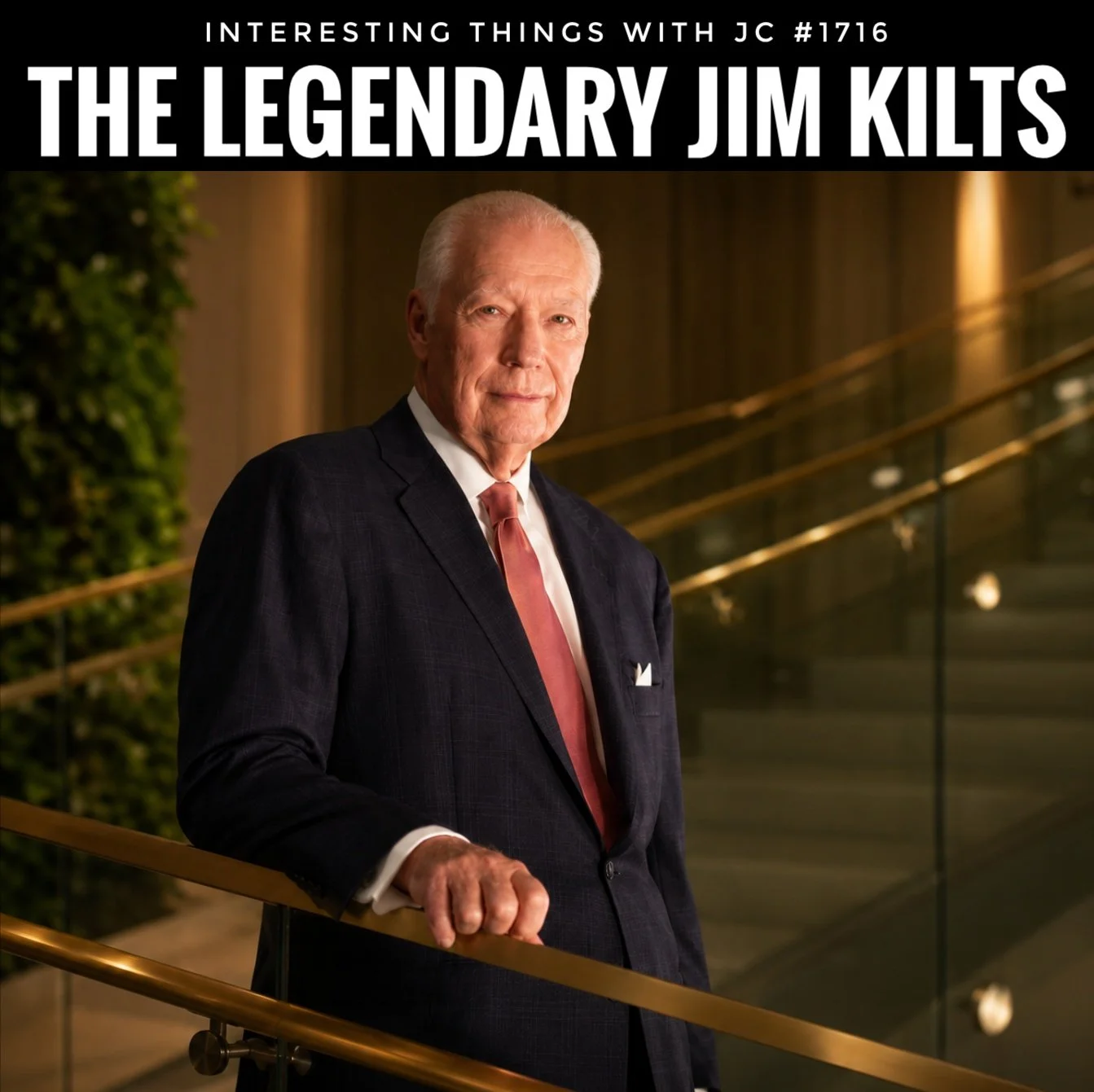
Portrait of business executive Jim Kilts in a corporate setting. Used to illustrate this noncommercial educational and informational episode examining his leadership and the Gillette turnaround. Displayed under the principles of fair use for non-commercial commentary, criticism, scholarship, research, and historical reference.
Transcript
Interesting Things with JC #1716:
“The Legendary Jim Kilts”
When Jim Kilts became CEO of Gillette in 2001, he found something that made no sense.
The company had missed earnings expectations for 14 consecutive quarters. Sales had been flat for four years. Wall Street had lost confidence.
Yet roughly two thirds of Gillette's senior managers were still receiving top performance ratings.
Something was measuring the wrong thing.
Kilts was the first outsider to lead Gillette in nearly 70 years. After three decades in consumer products, including leadership roles at General Foods, Kraft, and Nabisco, he had built a reputation for fixing troubled companies.
Gillette wasn't short on great products. It owned some of the world's strongest consumer brands, including Gillette, Duracell, Braun, and Oral-B. Its Mach3 razor took five years to develop and was protected by 35 patents.
The products were not the problem.
The scorecard was.
Kilts rebuilt the leadership team, eliminated unnecessary costs, simplified priorities, and reinvested in innovation and marketing. But one of his biggest changes was attacking how success was measured.
If a business keeps missing its goals while nearly everyone earns excellent performance reviews, the reviews are meaningless.
Within two years, Gillette was reporting record earnings per share and stronger returns on invested capital.
Then came one of the biggest consumer products deals in history.
In 2005, Procter & Gamble acquired Gillette in a transaction worth approximately $57 billion, and Kilts became vice chairman of the combined company.
He later described his philosophy in the book Doing What Matters: How to Win with a Less-Is-More Strategy, face the unvarnished truth, focus on the few things that truly drive the business, and hold people accountable for results.
He also helped establish the James M. Kilts Center for Marketing at the University of Chicago Booth School of Business, supporting research built on real consumer data and scholarships for future business leaders.
Jim Kilts didn't become legendary because he sold razors or batteries.
He became legendary because he understood a principle that applies almost everywhere:
If you reward the wrong behaviors, you'll get the wrong results.
These are interesting things, with JC.
Student Worksheet
Directions: Listen to the podcast episode before completing this worksheet. If audio is unavailable, read the transcript carefully. Support your answers with evidence from the episode. Answer in complete sentences unless otherwise directed.
Comprehension
What major problem did Jim Kilts discover shortly after becoming CEO of Gillette?
How many consecutive quarters had Gillette missed earnings expectations?
Why did Kilts believe the company's products were not the real problem?
Name two major brands owned by Gillette during Kilts' leadership.
What was wrong with Gillette's performance review system?
Analysis
Why can rewarding the wrong behaviors damage an organization?
Explain why employees might continue making poor decisions if they continue receiving excellent performance evaluations.
Jim Kilts focused on measuring results instead of appearances. Describe another organization where this principle could improve performance.
Why do you think Wall Street lost confidence in Gillette?
Which leadership decision made by Kilts do you believe had the greatest impact? Defend your answer using evidence from the podcast.
Reflection
Think about a school, sports team, club, or workplace.
What behaviors are rewarded?
Are those rewards encouraging the right outcomes?
If you were the leader, what would you measure differently?
Difficulty Scaling
Level 1: Complete Questions 1–5.
Level 2: Complete Questions 1–10.
Level 3: Complete all questions and write a one-page reflection explaining why accurate performance measurement is essential for effective leadership.
Student Output Expectations
Students should demonstrate:
Accurate recall of podcast information.
Evidence-based analysis.
Clear written communication.
Application of leadership principles to new situations.
Academic Integrity Guidance
Complete your own work using evidence from the podcast or transcript. When referencing outside information, properly cite the source.
Teacher Guide
Quick Start: Begin class by playing the podcast episode. Encourage students to listen specifically for problems Jim Kilts identified before discussing the solutions he implemented.
Pacing Guide (Audio-First):
Bell Ringer — 5 minutes
Podcast Listening — 6–8 minutes
Vocabulary Review — 5 minutes
Worksheet Completion — 20 minutes
Class Discussion — 10 minutes
Exit Ticket — 5 minutes
Bell Ringer:
Display the following question:
"Should employees receive excellent performance reviews if the company continues performing poorly? Explain your reasoning."
Allow students to write individually before discussion.
Audio Guidance:
Encourage students to listen for:
The contradiction Kilts discovered.
Evidence supporting his conclusions.
Leadership actions he implemented.
The lesson's central principle.
Audio Fallback:
If audio cannot be played, students should silently read the transcript before completing classroom activities.
Time on Task: Approximately 50–60 minutes.
Materials
Podcast audio or transcript
Student worksheet
Writing utensils or digital devices
Whiteboard or projector
Vocabulary Preparation
Review:
Accountability
Performance Metrics
Incentives
Leadership
Return on Invested Capital
Discuss examples before listening.
Common Misconceptions
Good products automatically guarantee business success.
High employee ratings always indicate organizational excellence.
Leadership focuses only on motivation rather than accountability.
Financial success depends solely on marketing.
Clarify that organizational systems strongly influence employee behavior.
Discussion Prompts
Why did Gillette's performance review system fail?
What happens when incentives conflict with organizational goals?
How can leaders improve accountability without discouraging employees?
Why are honest performance measurements difficult but necessary?
Can this lesson apply outside of business? Explain.
Formative Checkpoints
During discussion, verify students can:
Identify Gillette's core problem.
Explain why incentives shape behavior.
Connect performance measurement with organizational outcomes.
Apply lesson concepts to another setting.
Differentiation
Support
Allow students to annotate the transcript.
Pair students for discussion.
Provide sentence starters for written responses.
Extension
Research another corporate turnaround.
Compare Jim Kilts' leadership with another CEO.
Analyze how performance metrics affect professional sports, healthcare, or education.
Assessment Differentiation
Students may demonstrate understanding through:
Written responses.
Oral presentations.
Small-group discussions.
Graphic organizers.
Reflective essays.
Time Flexibility
45-minute class:
Bell Ringer
Podcast
Comprehension Questions
Exit Ticket
60-minute class:
Complete worksheet
Full discussion
Reflection activity
90-minute class:
Add case-study comparison
Small-group presentations
Leadership debate
Substitute Readiness
Provide:
Podcast transcript
Student worksheet
Discussion questions
Answer key
Lesson can be completed without instructor specialization.
Engagement Strategy
Have students work in teams to identify examples where organizations reward activity instead of results. Share examples and discuss possible improvements.
Extensions
Read excerpts from Doing What Matters.
Investigate the Procter & Gamble acquisition of Gillette.
Research how incentives influence organizational culture.
Compare performance measurement systems across industries.
Cross-Curricular Connections
Business
Economics
Marketing
Psychology
Communications
Mathematics (financial performance metrics)
SEL Connection
Students practice:
Responsible decision-making
Self-reflection
Ethical leadership
Personal accountability
Constructive communication
Skill Emphasis
Students strengthen:
Critical thinking
Evidence evaluation
Analytical reasoning
Communication
Leadership analysis
Decision making
Problem solving
Answer Key
Comprehension
Gillette rewarded managers highly despite poor company performance.
Fourteen consecutive quarters.
Gillette owned strong global brands and innovative products.
Accept any two: Gillette, Duracell, Braun, Oral-B.
Performance reviews rewarded employees despite poor organizational results.
Analysis
6–10: Answers will vary but should reference incentives, accountability, leadership decisions, measurable outcomes, and evidence from the episode.
Reflection
Responses should demonstrate thoughtful application of performance measurement concepts to a real-world setting while supporting conclusions with logical reasoning.
Quiz
Directions: Choose the best answer for each question. Do not use outside resources unless directed by your instructor.
What problem did Jim Kilts identify immediately after becoming CEO of Gillette?
A. The company lacked recognizable brands.
B. The company had too many manufacturing facilities.
C. Senior managers received excellent performance ratings despite poor company results.
D. Gillette had stopped investing in research and development.
Which statement best summarizes Kilts' leadership philosophy?
A. Increase spending in every department.
B. Reward effort regardless of results.
C. Focus on the few factors that truly drive business success.
D. Expand product lines before improving operations.
Which Gillette product was highlighted as an example of innovation?
A. SensorExcel
B. Fusion
C. Mach3
D. Trac II
What happened after Gillette's turnaround?
A. The company declared bankruptcy.
B. Gillette became privately owned.
C. Procter & Gamble acquired Gillette.
D. Gillette sold its Duracell division before restructuring.
According to the episode, what is the central leadership lesson?
A. Great products always guarantee success.
B. Marketing is more important than leadership.
C. Organizations produce the behaviors they reward.
D. Financial success depends primarily on cutting costs.
Assessment
Performance Task: Demonstrate your understanding of leadership, accountability, and organizational performance by applying concepts from the episode to real-world situations.
Open-Ended Question 1
Jim Kilts believed Gillette's biggest problem was not its products but its performance measurement system. Explain why inaccurate performance measurements can prevent an organization from succeeding. Use evidence from the podcast to support your explanation.
Open-Ended Question 2
Identify an organization you belong to or are familiar with (school, sports team, business, volunteer organization, or workplace). Describe one behavior that is rewarded and evaluate whether that reward supports the organization's goals. Recommend one improvement based on Jim Kilts' leadership philosophy.
3–2–1 Rubric
3 – Exceeds Expectations
Demonstrates thorough understanding of the episode.
Uses multiple pieces of evidence.
Applies leadership principles accurately.
Writing is organized, clear, and well supported.
2 – Meets Expectations
Demonstrates accurate understanding.
Uses at least one supporting example.
Applies concepts with minor errors or omissions.
Writing is generally organized.
1 – Approaching Expectations
Demonstrates limited understanding.
Provides minimal supporting evidence.
Application of concepts is incomplete or inaccurate.
Writing lacks organization or sufficient detail.
Exit Ticket
Before leaving class, answer the following in one or two sentences:
What is one performance measurement you encounter in everyday life, and how could changing that measurement influence people's behavior?
Standards Alignment
NGSS Science and Engineering Practices
SEP 4 – Analyzing and Interpreting Data
Students analyze organizational performance data to identify relationships between measurement systems and business outcomes. This supports evidence-based reasoning and decision-making.
SEP 8 – Obtaining, Evaluating, and Communicating Information
Students evaluate information presented in the podcast, discuss leadership decisions, and communicate conclusions supported by evidence.
CCSS Reading
CCSS.ELA-LITERACY.RI.11-12.1
Cite strong and thorough textual evidence to support analysis of leadership decisions discussed in the transcript.
Connection: Students reference specific statements from the episode when answering worksheet and assessment questions.
CCSS.ELA-LITERACY.RI.11-12.2
Determine central ideas and analyze their development throughout an informational text.
Connection: Students identify the central principle that organizations produce the behaviors they reward.
CCSS Writing
CCSS.ELA-LITERACY.W.11-12.1
Write arguments supported by evidence and logical reasoning.
Connection: Students defend recommendations for improving organizational performance.
CCSS.ELA-LITERACY.W.11-12.9
Draw evidence from informational texts to support analysis and reflection.
Connection: Assessment responses require evidence directly from the transcript.
CCSS Speaking and Listening
CCSS.ELA-LITERACY.SL.11-12.1
Initiate and participate effectively in collaborative discussions.
Connection: Students discuss accountability, incentives, and leadership during guided classroom activities.
C3 Framework
D2.Eco.1.9-12
Analyze how incentives influence economic decision-making.
Connection: Students evaluate how performance reviews affected management behavior at Gillette.
ISTE Standards for Students
1.3 Knowledge Constructor
Students evaluate information from multiple sources and construct evidence-based conclusions.
Connection: Students analyze leadership decisions using the podcast, transcript, and classroom discussion.
Career Readiness Competencies
Analytical Thinking
Students interpret organizational performance problems using evidence.
Communication
Students communicate conclusions through discussion and written responses.
Problem Solving
Students propose improved measurement systems for organizations.
Adaptability
Students recognize how leaders adjust strategies when existing systems fail.
Professional Judgment
Students evaluate ethical and effective leadership practices based on measurable results.
Homeschool / Lifelong Learning Alignment
Independent Learning
Students complete guided analysis using informational media.
Information Literacy
Students distinguish between evidence and opinion when evaluating leadership decisions.
Real-World Application
Students connect organizational accountability principles to everyday experiences.
Self-Directed Inquiry
Students investigate additional examples of leadership and business transformation.
Transferable Life Skills
Students develop critical thinking, responsible decision-making, effective communication, and accountability applicable across careers and personal life.
Show Notes
This lesson explores how legendary business leader Jim Kilts transformed Gillette by changing what the company measured and rewarded. Rather than focusing solely on products or profits, students examine how incentives influence behavior, why accountability matters, and how effective leaders align organizational goals with measurable outcomes. Through discussion, analysis, and reflection, learners discover that successful leadership often begins with measuring the right things.
References
Centerview Capital Consumer. (n.d.). Our team. https://www.centerviewcapital.com/consumer/our-team/
Commoncog. (n.d.). The fast track quick screen elimination process: Jim Kilts at Gillette. https://commoncog.com/c/cases/jim-kilts-gillette-turnaround/
Kilts, J. M., Manfredi, J. F., & Lorber, R. L. (2007). Doing what matters: How to get results that make a difference—The revolutionary old-school approach. Crown Business. https://www.penguinrandomhouse.com/books/92533/doing-what-matters-by-james-m-kilts-with-john-f-manfredi-and-robert-l-lorber/
Knox College. (2023). 2023 Knox College commencement program. https://www.knox.edu/documents/Commencement/Comm%20Program%202023%20FINAL%20no%20crops.pdf
U.S. Securities and Exchange Commission. (2005, January 28). Procter & Gamble and Gillette announce merger agreement. https://www.sec.gov/Archives/edgar/data/41499/000095010305000139/jan2705_ex9901.htm
University of Chicago Booth School of Business. (n.d.). James M. Kilts, ’74. https://www.chicagobooth.edu/alumni/distinguished-alumni-award/honorees/james-kilts
University of Chicago Booth School of Business. (2019, April 24). James M. Kilts, ’74, to fund professorship and faculty research prize in marketing. https://www.chicagobooth.edu/alumni/stories/kilts-gift
University of Chicago Booth School of Business. (2021, February 4). James M. Kilts, ’74, boosts his ardent support of marketing at Booth with $6.5 million gift. https://www.chicagobooth.edu/why-booth/stories/james-kilts-gift