Interesting Things with JC #1718: "Why Is There a Gap in the Toilet Seat?"
Airports, restaurants, offices, and highway rest stops all use toilet seats with the same piece missing from the front. It looks unfinished, appears almost everywhere, and the empty space is doing something most people never notice.
Curriculum - Episode Anchor
Episode Title: Why Is There a Gap in the Toilet Seat?
Episode Number: 1718
Host: JC
Audience: Grades 9–12, Introductory College, Homeschool, Lifelong Learners
Subject Area: Engineering, Public Health, Building Design, Human Factors Engineering
Lesson Overview
Objectives:
Explain why open-front toilet seats became the standard in public restrooms.
Describe how plumbing codes address hygiene and public health.
Analyze how engineering designs often prioritize function over appearance.
Evaluate how seemingly ordinary objects reflect scientific, engineering, and public health decision-making.
Essential Question:
Why would engineers intentionally remove part of a toilet seat instead of making a complete one?
Success Criteria:
Students can:
Explain the hygienic purpose of an open-front toilet seat.
Describe the role of plumbing codes in public facilities.
Identify how engineering design solves real-world problems.
Support conclusions using evidence from the episode.
Student Relevance Statement:
Students encounter public restrooms almost daily but rarely consider the engineering and health decisions behind their design. This lesson demonstrates how everyday objects are intentionally designed to improve safety and sanitation.
Real-World Connection:
Architects, plumbers, engineers, facility managers, public health officials, and building inspectors rely on standardized plumbing codes to create safer public spaces.
Workforce Reality:
Professionals responsible for public buildings must balance cost, safety, maintenance, hygiene, accessibility, and legal compliance. Small design changes can have significant impacts when facilities serve thousands of people.
Key Vocabulary
Open-front toilet seat(OH-pən FRONT TOY-lit SEET) — A toilet seat with a gap at the front designed for public-use restrooms.
Hygiene(HIGH-jeen) — Practices that help maintain health and reduce the spread of germs.
Contamination(kun-tam-uh-NAY-shun) — The presence of unwanted substances, including microorganisms, on surfaces.
International Plumbing Code (IPC)(in-ter-NASH-uh-nuhl PLUM-ing KODE) — A model code that establishes standards for plumbing systems and fixtures.
Public facility(PUB-lik fuh-SIL-uh-tee) — A building or location designed for use by the general public.
Engineering design(en-juh-NEER-ing dih-ZINE) — The process of developing solutions to practical problems using science and mathematics.
Sanitation(san-uh-TAY-shun) — Methods used to maintain clean conditions that protect public health.
Shared surface(SHARED SUR-fiss) — A surface touched by many different users.
Narrative Core
Open
Most people have noticed that toilet seats in public restrooms look different from the one at home. Instead of forming a complete oval, the front section is missing. It looks unfinished, but that missing piece is entirely intentional.
Info
Open-front toilet seats have been part of plumbing standards for decades. Building codes specify their use in many public and employee restroom facilities because public restrooms face different sanitation challenges than private bathrooms.
Details
Removing the front portion creates additional space that reduces the likelihood of body or hand contact with the front of the seat during personal hygiene. It also removes the portion of the seat most likely to become contaminated during urination. While the design cannot eliminate germs, it reduces one common contact surface on fixtures that may be used hundreds of times each day by different people.
The design illustrates a key engineering principle: solving a practical problem with a simple physical modification. Rather than relying on complicated technology, engineers adjusted the shape of an everyday object to improve hygiene, simplify cleaning, and support public health goals.
Reflection
Many engineered products appear unusual until their purpose is understood. The open-front toilet seat reminds us that effective design often prioritizes function, safety, and cleanliness over appearance. Small design decisions can improve the experience of millions of people every day.
Closing
These are interesting things, with JC.
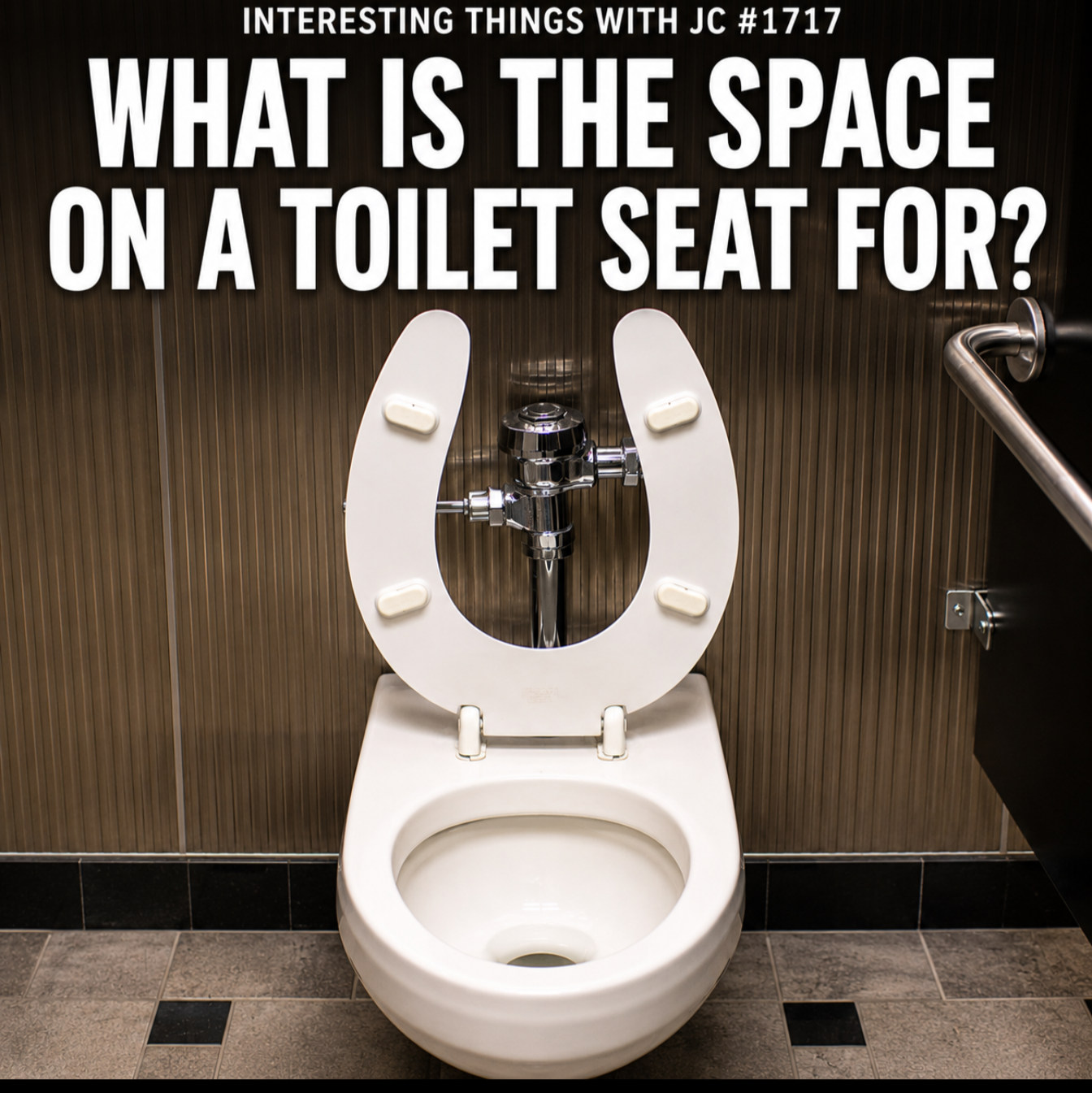
A color photograph shows a clean public restroom with a white commercial toilet centered in the frame. The toilet seat and lid are raised, revealing an open-front toilet seat with a noticeable gap at the front. A chrome flush valve is visible behind the seat against a dark, vertically textured wall. Portions of stainless-steel grab bars and restroom partition hardware are visible along the sides, indicating a commercial restroom setting. The floor consists of gray tile with black accent squares.
Large white, all-capital text overlays the upper portion of the image. At the very top, smaller text reads, "INTERESTING THINGS WITH JC #1717." Below it, much larger text asks, "WHAT IS THE SPACE ON A TOILET SEAT FOR?" The image serves as a title graphic introducing a discussion about the purpose of the open-front design commonly found on public toilet seats.
Transcript
Interesting Things with JC #1718:
Why Is There a Gap in the Toilet Seat?
You see them in airports, restaurants, office buildings, and highway rest stops. The toilet seat looks perfectly normal except for the front, where several inches are simply missing. At home, you probably have a complete oval. In public, it looks like somebody forgot a piece.
They didn't.
It's called an open-front toilet seat, and the International Plumbing Code requires this style in public and employee toilet facilities, with certain exceptions.
The reason is hygiene. Removing the front section creates space for personal cleaning without the hand or body contacting the front of a shared seat. It also removes the part of the seat most likely to be contaminated during urination.
That matters more in a public restroom because the toilet may serve hundreds of strangers. The gap doesn't sterilize anything. It simply removes one contact surface from a fixture built for repeated public use.
And this isn't a new design. Open-front seats have appeared in American plumbing requirements for decades. What looks like an incomplete toilet seat became a standard feature because public plumbing is designed around a very different problem than the bathroom in your house.
Your toilet serves a family. A public toilet serves whoever walks through the door next.
So the missing section isn't broken, and it isn't a manufacturer saving a few inches of plastic. The empty space is there because, on a public toilet seat, sometimes the most useful surface is the one that isn't there.
These are interesting things, with JC.
Student Worksheet
Instructions: Listen to the podcast episode first. If audio is unavailable, read the transcript carefully. Answer each question using complete sentences and evidence from the episode.
Comprehension
What is an open-front toilet seat?
Where are open-front toilet seats commonly found?
Why does the International Plumbing Code require this design in many public restrooms?
Which part of the toilet seat has been removed?
Does removing the front opening make the toilet sterile? Explain.
Analysis
Explain how removing part of the toilet seat can improve hygiene.
Why are the sanitation needs of a public restroom different from those of a private home?
How does this design demonstrate that engineering often focuses on solving practical problems instead of making products look attractive?
What assumptions might someone make if they did not know the purpose of the missing section?
Describe another everyday object whose unusual design has a practical purpose.
Reflection
Describe a time when you learned the purpose behind an everyday object that you had never questioned before.
Why is understanding engineering decisions important in everyday life?
Challenge Extension
Research one additional feature commonly found in public restrooms that is designed for sanitation or accessibility. Explain:
What it is
Why it exists
Who benefits from it
How it improves public health or safety
Difficulty Scaling
Level 1: Answer only the comprehension questions.
Level 2: Complete the comprehension and analysis sections.
Level 3: Complete all sections, including the research extension, using evidence from reliable sources.
Student Output Expectations
Students should produce:
Complete sentences
Evidence-based responses
Clear explanations using vocabulary from the lesson
Original work demonstrating understanding of the episode
Academic Integrity Guidance
Use your own words whenever possible.
Support answers with evidence from the episode.
Properly credit any outside research used in the extension activity.
Avoid copying directly from internet sources.
Teacher Guide
Quick Start
Begin by asking students whether they have ever noticed the gap in public toilet seats. Allow students to offer explanations before revealing the answer through the podcast.
Pacing Guide (Audio-First)
Bell Ringer — 5 minutes
Vocabulary Preview — 5 minutes
Podcast Listening — 4 minutes
Guided Discussion — 10 minutes
Student Worksheet — 20 minutes
Review and Closure — 6 minutes
Bell Ringer
Display the question:
"Why do public toilet seats look different from the ones found in most homes?"
Students write one prediction before hearing the episode.
Audio Guidance
Play the complete podcast uninterrupted the first time.
During a second listening (optional), have students identify evidence supporting the episode's main claim.
Audio Fallback
If audio is unavailable:
Distribute the transcript.
Conduct a shared reading.
Highlight engineering vocabulary.
Continue with the worksheet as planned.
Time on Task
Approximately 45–50 minutes.
Materials
Podcast audio
Transcript
Student worksheet
Whiteboard or projector
Internet access (optional for extension)
Vocabulary Preparation
Review:
Hygiene
Contamination
Sanitation
Engineering Design
Plumbing Code
Ask students to predict each word's meaning before instruction.
Common Misconceptions
The opening exists to save manufacturing costs.
The seat is broken.
The opening improves flushing.
The design eliminates germs completely.
The design is unique to modern buildings.
Clarify that the purpose is improved hygiene and reduced contact, not sterilization.
Discussion Prompts
Why do public facilities require different engineering solutions than private homes?
Can a simple design change solve a major public health problem?
Should building codes require features that most people never notice?
What other everyday objects are designed primarily for safety?
Formative Checkpoints
Students should be able to:
Define an open-front toilet seat.
Explain why the front section is removed.
Distinguish sanitation from sterilization.
Connect engineering design to public health.
Differentiation
Support
Provide vocabulary cards.
Allow partner discussion.
Use guided notes.
Advanced Learners
Research plumbing codes.
Compare international restroom standards.
Investigate accessibility requirements under the Americans with Disabilities Act (ADA).
Assessment Differentiation
Students may demonstrate learning through:
Written responses
Oral presentation
Infographic
Short explanatory video
Classroom discussion
Time Flexibility
30-minute version:
Audio
Discussion
Comprehension only
60-minute version:
Full lesson
Research extension
Class presentations
Substitute Readiness
This lesson is self-contained and includes:
Transcript
Worksheet
Discussion questions
Assessment activities
Answer key
No specialized background knowledge is required.
Engagement Strategy
Conduct an "Engineering Mystery."
Show only an image of an open-front toilet seat and ask students to determine why it was designed that way before revealing the episode.
Extensions
Students research:
Automatic faucets
Sensor-operated soap dispensers
Hands-free door pulls
Flush valves
Touchless restroom technology
Compare how each reduces disease transmission.
Cross-Curricular Connections
Engineering
Human-centered design
Product development
Health Science
Disease prevention
Public sanitation
Government
Building regulations
Public safety standards
Business
Facility management
Maintenance planning
SEL Connection
Students practice:
Curiosity
Evidence-based reasoning
Respectful discussion about everyday public health topics
Skill Emphasis
Students develop:
Observation
Critical thinking
Evidence evaluation
Scientific reasoning
Engineering literacy
Communication
Answer Key
Comprehension
A public toilet seat with the front section removed.
Airports, restaurants, office buildings, highway rest stops, and other public facilities.
To reduce contact with commonly contaminated areas and improve hygiene.
The front portion.
No. It reduces one contact surface but does not sterilize the fixture.
Analysis (Sample Responses)
It reduces body and hand contact with the front of the seat.
Public toilets serve hundreds of unrelated users each day.
The design prioritizes function over appearance.
They may believe it is broken or made cheaply.
Answers will vary but should explain the practical purpose of another engineered object.
Reflection
Responses will vary but should demonstrate thoughtful connections between engineering decisions and everyday life.
Quiz
Instructions: Select the best answer for each question. Do not use notes or the transcript unless instructed by your teacher.
Why do many public toilet seats have an opening at the front?
A. To reduce manufacturing costs
B. To improve hygiene and reduce contact with commonly contaminated areas
C. To allow water to drain more quickly
D. To make the toilet lighter
Which organization's model code requires open-front toilet seats in many public and employee restroom facilities?
A. National Weather Service
B. Environmental Protection Agency
C. International Plumbing Code
D. Department of Transportation
The missing front section primarily helps by:
A. Making toilets flush faster
B. Creating space for personal cleaning while reducing contact with the seat
C. Lowering the water level
D. Preventing toilet clogs
Why are public restroom designs different from those in most homes?
A. Public buildings use different plumbing materials.
B. Public restrooms are designed to serve many unrelated users throughout the day.
C. Public toilets use less water.
D. Public buildings cannot use complete toilet seats.
Which statement best summarizes the main idea of the episode?
A. Public toilet seats are incomplete because manufacturers save plastic.
B. Open-front toilet seats are a deliberate engineering design that supports public hygiene.
C. Open-front seats are a recent invention.
D. All toilets should use identical seat designs.
Assessment
Open-Ended Questions
Explain how the design of an open-front toilet seat demonstrates the relationship between engineering, public health, and building codes. Use evidence from the episode to support your answer.
Choose an everyday object that has a design feature many people overlook. Describe the feature, explain why it exists, and compare it to the purpose of the open-front toilet seat.
Exit Ticket
Before leaving class, answer the following in one or two sentences:
"What is one everyday object you now realize was intentionally designed to solve a problem, and what problem does it solve?"
Standards Alignment
NGSS Science and Engineering Practice: Defining Problems and Designing Solutions
Connection: Students analyze how a simple engineering modification addresses a public sanitation problem.
Measurable Outcome: Students explain how engineering design solves practical challenges using evidence from the episode.
Justification: The lesson emphasizes identifying a real-world problem and evaluating an effective design solution.
NGSS Science and Engineering Practice: Constructing Explanations
Connection: Students explain why open-front toilet seats are used in public facilities.
Measurable Outcome: Students develop evidence-based explanations supported by the podcast.
Justification: Students use scientific reasoning rather than assumptions.
CCSS.ELA-LITERACY.RST.11-12.2
Determine the central ideas or conclusions of a text.
Connection: Students identify the episode's primary explanation.
Measurable Outcome: Students summarize the central idea using supporting evidence.
Justification: The worksheet and assessment require identifying and explaining the main concept.
CCSS.ELA-LITERACY.RST.11-12.7
Integrate and evaluate multiple sources of information.
Connection: Extension activities require comparing the episode with additional research.
Measurable Outcome: Students synthesize information from multiple reliable sources.
Justification: Supports information literacy and evidence evaluation.
CCSS.ELA-LITERACY.WHST.9-12.2
Write informative/explanatory texts.
Connection: Students explain engineering decisions in writing.
Measurable Outcome: Students produce organized, evidence-based responses.
Justification: The assessment emphasizes explanatory writing.
CCSS.ELA-LITERACY.SL.11-12.1
Initiate and participate effectively in collaborative discussions.
Connection: Students discuss engineering and public health design decisions.
Measurable Outcome: Students contribute ideas supported by evidence.
Justification: Classroom discussions reinforce analytical communication.
C3 Framework Dimension 2: Evaluating Sources and Using Evidence
Connection: Students distinguish between assumptions and evidence-based explanations.
Measurable Outcome: Students justify conclusions using facts from the lesson.
Justification: Encourages inquiry and critical evaluation.
ISTE Standard 1.3 – Knowledge Constructor
Connection: Students research additional public sanitation technologies.
Measurable Outcome: Students evaluate credible sources and communicate findings.
Justification: Reinforces responsible digital research skills.
Career Readiness Competencies
Analytical Thinking: Evaluate how engineering solves public health challenges.
Communication: Explain technical concepts clearly using evidence.
Problem Solving: Identify practical design solutions for real-world needs.
Adaptability: Recognize that different environments require different engineering approaches.
Professional Judgment: Understand how regulations and standards guide design decisions in public facilities.
Homeschool / Lifelong Learning Alignment
Independent Learning: Investigate everyday objects through self-directed inquiry.
Information Literacy: Evaluate reliable sources when researching engineering topics.
Real-World Application: Connect classroom learning to familiar public environments.
Self-Directed Inquiry: Develop curiosity by asking why common objects are designed as they are.
Transferable Life Skills: Apply observation, critical thinking, and evidence-based reasoning to everyday experiences.
Show Notes
Why do public toilet seats have a gap in the front? This episode explores the engineering, sanitation, and public health reasons behind one of the most overlooked features in everyday life. Students discover how building codes and human-centered design influence the objects they use every day, demonstrating that even small design choices can improve hygiene, safety, and functionality for millions of people.
References
International Code Council. (2024). International Plumbing Code (IPC). https://codes.iccsafe.org/content/IPC2024P1
Centers for Disease Control and Prevention. (2024). Healthy Water: Hygiene. https://www.cdc.gov/hygiene/
National Institute for Occupational Safety and Health. (2023). Workplace Safety and Health Topics. https://www.cdc.gov/niosh/
American Society of Plumbing Engineers. (2023). Plumbing Engineering Design Handbook. https://www.aspe.org/