1718: "The Moment New York Set the Style"
Interesting Things with JC #1718: "The Moment New York Set the Style"
Discover how Eleanor Lambert’s 1943 "Press Week" broke the fashion world’s reliance on Paris and established the American look as a global powerhouse. We examine the wartime ingenuity and iconic designers that transformed New York into the epicenter of modern style.
Curriculum - Episode Anchor
Episode Title: The Moment New York Set the Style
Episode Number: 1718
Host: JC
Audience: Grades 9–12, Introductory College, Homeschool, Lifelong Learners
Subject Area: History, Fashion Design, Media Studies, Economics, Sociology
Lesson Overview
Objectives:
Analyze how wartime economic constraints (Limitation Order L-85) acted as a catalyst for design innovation.
Evaluate Eleanor Lambert’s role in institutionalizing the "Press Week" model as a strategic shift in global industry power.
Distinguish between a culture of imitation (dependency) and the development of a localized design philosophy (The American Look).
Assess the legacy of Press Week in establishing the global "Big Four" fashion circuit.
Essential Question:
How can necessity, such as wartime rationing, drive long-term structural change in a global industry?
Success Criteria:
Students explain how the Nazi occupation of Paris created a market void for American designers.
Students identify key designers (McCardell, Mainbocher, Maxwell) and the specific innovations they introduced.
Students describe the logistical strategies Eleanor Lambert used to bypass traditional media gatekeepers.
Students support conclusions regarding the shift from "copying" to "creating" using evidence from the podcast.
Student Relevance Statement:
Large industries often rely on outdated traditions until a crisis forces them to adapt. Understanding how New York designers solved the "rationing problem" helps students recognize how innovation is frequently born from constraints.
Real-World Connection:
Modern businesses often experience "disruption" similar to the 1943 fashion industry. Understanding Lambert’s approach provides a template for how to manage transitions in media, logistics, and branding.
Workforce Reality:
Professionals in public relations, supply chain management, and creative direction must often create their own opportunities when external supply lines or traditional systems fail.
Key Vocabulary
Couture (koo-TOOR): High-end, custom-fitted fashion design.
Limitation Order L-85: A War Production Board regulation that strictly limited the amount of fabric permitted in garment construction.
Sportswear: Practical, interchangeable clothing designed for the modern lifestyle rather than theatrical display.
Gatekeeper: A person or institution that controls access to information or markets.
Institutionalize: To establish as a permanent practice or custom.
Bias-cut: A technique of cutting fabric at a 45-degree angle to the grain, allowing it to drape elegantly and move with the body.
Narrative Core
Paris held the title of fashion capital for decades. The shift to New York City was not a matter of taste; it was a strategic response to a world at war. When Nazi occupation cut off access to French couture, Eleanor Lambert did not wait for the situation to resolve. She organized the industry, invited the media, and proved that American designers were ready to set their own pace.
Discussion Prompts
Why might an industry prefer to "copy" established leaders rather than innovate?
How does a government regulation—like L-85—actually force more creativity rather than less?
What is the difference between a PR stunt and a structural change? Why was Press Week the latter?
How do we see the influence of "The American Look" in the clothes we wear today?
Assessment
Evidence-Based Response: "Using the podcast and provided citations, write a paragraph explaining why the year 1943 was a turning point for American fashion independence. Cite at least two specific design innovations mentioned."
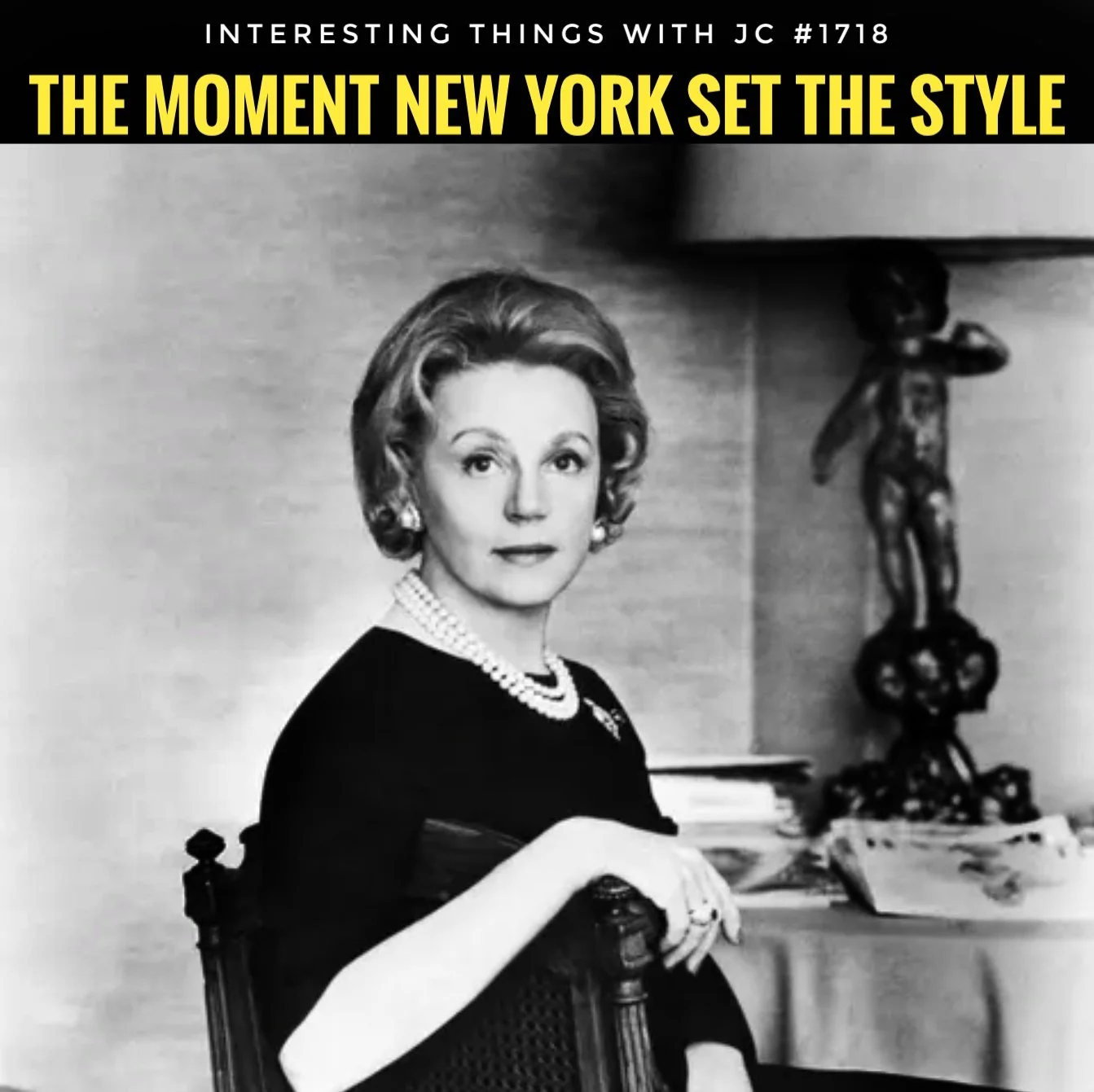
A black-and-white portrait of fashion publicist Eleanor Lambert, who is dressed in a dark boat-neck top and a multi-strand pearl necklace, sitting at a desk with a decorative sculpture in the background. The image header reads: 'INTERESTING THINGS WITH JC #1718: THE MOMENT NEW YORK SET THE STYLE'. This image is utilized strictly for non-commercial, educational purposes under the principles of fair use. Its inclusion in this curriculum package is intended to support historical analysis and media literacy education by providing relevant visual context for the study of 20th-century American history.
Transcript
Interesting Things with JC #1718:
"The Moment New York Set the Style"
Paris held the title of fashion capital for decades. If you wanted to know what was in style, you looked toward France. The shift to New York City began because the United States had to take matters into its own hands.
In 1943, World War II was in full swing and Paris was under Nazi occupation. American department stores and magazines were cut off from French couture. Before this, the American fashion industry mostly copied or adapted French designs for the mass market. Eleanor Lambert, a prominent publicist for the New York Dress Institute, recognized this void as an opportunity to establish domestic independence. She was a force of nature who realized that if America wanted to lead, it had to stop waiting for permission from Paris.
On July 19, 1943, she launched the first Press Week. She bypassed traditional gatekeepers by flying 150 fashion editors from across North America to New York City. She covered their travel costs and held runway presentations at the Plaza and Pierre hotels. This was a massive gamble, but it was a calculated one. By concentrating the media in one location, she created a unified American fashion front that could not be ignored.
This event institutionalized a design philosophy known as The American Look. New York prioritized sportswear, creating practical, interchangeable separates for the working woman. Designers worked under the War Production Board's Limitation Order L-85, which restricted fabric usage. To comply, designers eliminated pleats, shortened hemlines, and used minimal yardage without sacrificing elegance.
Visionary designers led this movement. Claire McCardell revolutionized casual dress with bias-cut denim wrap dresses, deep pockets, and comfortable flats. Her designs were built for speed and utility, reflecting a country transitioning into a total wartime economy. Mainbocher, the first American couturier to achieve global status, famously crafted chic, utilitarian uniforms for the U.S. Navy WAVES. Vera Maxwell introduced the weekend wardrobe, a system of jackets, skirts, and trousers designed to be mixed and matched. These designers weren't just creating clothes; they were solving engineering problems on the human form.
The commercial success of Press Week transformed global perception of American ingenuity. It shifted the focus of Vogue and Harper's Bazaar from European imports to American design. Press Week became a bi-annual tradition, providing the blueprint for the global fashion circuit, including the modern fashion weeks held in Paris, Milan, and London.
By the summer of 1943, the United States stopped following the lead of others and began setting the pace. The industry had finally recognized that real style wasn't found in a dusty Parisian archive, but in the ingenuity of a designer solving the problems of the modern day.
These are interesting things, with JC.
Student Worksheet
Name: ____________________________
Date: ____________________________
Class: ____________________________
Listening Instructions
Listen to the podcast episode once without taking notes. During the second listening, record key facts, important people, and major events that explain how New York City became the global center of fashion.
Part A — Comprehension
Answer in complete sentences.
Why did the American fashion industry rely on French designs before 1943?
What role did World War II and the Nazi occupation play in the shift toward American fashion independence?
Who was Eleanor Lambert, and why was her role as a publicist crucial to this shift?
What was the specific purpose of the first "Press Week"?
Explain Limitation Order L-85 and how it affected clothing design.
What is "The American Look," and how did it differ from traditional European couture?
How did Claire McCardell, Mainbocher, and Vera Maxwell contribute to the new American aesthetic?
According to the episode, how did Press Week influence the modern "Big Four" fashion circuit?
Part B — Analysis
Use evidence from the podcast.
How does the concept of "doing more with less" apply to both the designers mentioned and the economic environment of 1943?
Why is it significant that Lambert flew editors to New York and paid for their travel, rather than just sending them press releases?
Compare the "gatekeeper" model of fashion journalism before 1943 with the model created by Press Week.
Part C — Historical Evidence
For each statement, write Fact, Interpretation, or Opinion.
The War Production Board issued Limitation Order L-85.
Eleanor Lambert was the most important person in American fashion history.
Sportswear became the defining aesthetic of the American Look.
Press Week was the most successful PR campaign of the 1940s.
Paris, Milan, London, and New York currently form the "Big Four" fashion circuit.
Part D — Timeline
Place these events in chronological order.
Establishment of the New York Dress Institute
Nazi occupation of Paris
Creation of the first Press Week
Implementation of Limitation Order L-85
Rise of the "Big Four" global fashion circuit
Part E — Reflection
Write one paragraph.
Prompt: Innovation is often described as being "born from constraints." Using the example of fabric rationing in 1943, explain how a restriction can actually lead to better, more creative results. Provide one modern example of a professional or personal "constraint" that forced you to find a better way of doing something.
Expected Length: 8–10 sentences.
Teacher Guide
Quick Start
Begin class by displaying this question: "If you were told you had to design a wardrobe using half the fabric you normally use, how would you change your style?" Briefly discuss student answers before playing the podcast.
Common Misconceptions
"Fashion Week" has always existed in the same format.
American designers were inherently better than French designers in 1943.
Rationing orders like L-85 were meant to harm the fashion industry, not reshape it.
Discussion Prompts
Why do institutions often wait for a crisis to change their business model?
What makes an aesthetic "practical" versus "theatrical," and why did the war make practicality more valuable?
In a digital age, does the "Press Week" model of gathering people in one place still matter? Why?
Pacing Guide
Bell Ringer: 5 min
First Listening: 5 min
Discussion: 10 min
Second Listening: 5 min
Worksheet: 20 min
Closing Discussion: 10 min
This resource is designed to be used with "Interesting Things with JC" Episode 1718.
Academic Integrity & Assessment Scaling
Difficulty Scaling
Level 1 (Foundational): Complete Parts A and D. Focus on identifying facts and basic chronological order.
Level 2 (Analytical): Complete Parts A, B, and D. Students must synthesize the relationship between wartime constraints and design output.
Level 3 (Advanced): Complete all sections, including Part C (Evidence Analysis) and the Reflection. Students are expected to use primary source context to support their arguments and distinguish between objective facts and historical interpretation.
Assessment Differentiation
Students may demonstrate mastery through:
Written Synthesis: An essay comparing the 1943 shift to a modern industry disruption (e.g., the rise of e-commerce or digital media).
Visual Portfolio: Designing a "ration-friendly" garment sketch that follows the principles of 1943 utility (minimal yardage, functional features, no excess).
Media Analysis: Creating a mock press release for a hypothetical event that mirrors Lambert’s strategy of bypassing traditional gatekeepers.
Teacher Notes: The "Interesting Things" Methodology
Audio-First Pedagogy The core of this curriculum is the audio-first approach. By playing the episode without visual aids, you force students to practice active listening—a critical skill for information retention. When listening a second time, encourage them to act like investigative journalists: What was the specific evidence JC used to prove the shift was intentional?
Differentiation Strategies
Support: Provide a "Vocabulary Bank" with the definitions from the Episode Anchor already filled in. Pair students during the second listening to allow for peer-to-peer fact verification.
Extension: Challenge high-achieving students to research another instance where a "proxy" (like Lambert) changed a global industry by bypassing traditional power structures. Have them present their findings to the class.
Materials Checklist
Podcast Audio
Student Worksheet (Parts A–E)
Access to the Episode Transcript (for close reading)
Whiteboard for the "Constraint vs. Innovation" brainstorm
Formative Checkpoints During the lesson, ensure students can articulate:
The Pivot: Why WWII necessitated the creation of an independent American fashion industry.
The Engine: Why Eleanor Lambert was the essential catalyst.
The Outcome: Why we use the "Press Week" model today.
Curriculum Standards Alignment
D2.His.1.9-12: Evaluate how historical events and developments were shaped by unique circumstances of time and place.
D2.His.16.9-12: Integrate evidence from multiple relevant historical sources and interpretations into a reasoned argument about the past.
D2.Eco.1.9-12: Analyze how incentives influence choices that may result in policies that have a range of consequences.
D2.Civ.12.9-12: Analyze the political and economic systems that define how societies organize resources and power.
Workforce Reality & Life Skills Connection
Crisis Management: Students learn that external pressures (like war or economic collapse) are not just threats but signals to pivot. In a modern career, this is the ability to maintain composure and look for the "gap" in the market when a standard system fails.
Strategic Networking: Eleanor Lambert did not just "hold an event"; she performed logistical diplomacy. Students learn that true influence comes from knowing who needs to be in the room and removing the barriers (like travel costs) that prevent them from getting there.
Problem-Solving under Constraints: The L-85 Order is a masterclass in creative engineering. This teaches students that "unlimited resources" are rarely the key to success; rather, defined limits often force the most innovative and memorable solutions.
Show Notes
When teaching this, remind your students that history is often recorded as if it were inevitable—as if Paris were always destined to be challenged. But the reality is that Eleanor Lambert had to choose to act. Just like the vote on July 2, 1776, the shift in 1943 was a human decision that changed the trajectory of an entire industry. It’s a powerful lesson in personal agency.
References
Black, S. (2009). The American Look: Fashion, Sportswear and the Image of Women in 1930s and 1940s New York. I.B. Tauris. https://www.ibtauris.com
Buckland, S. S. (1996). Promoting American Fashion 1940 Through 1945: From Understudy to Star [Doctoral dissertation, Ohio State University]. https://etd.ohiolink.edu
Fashion History Timeline. (2018). Claire McCardell. Fashion Institute of Technology. https://fashionhistory.fitnyc.edu/claire-mccardell
Glam Observer. (2023). How Eleanor Lambert created fashion week. https://glamobserver.com
History 101. (2024). The history of fashion week. https://www.history101.nyc
Louisiana State Museum. (2022). Fashion in the 1940s: Limitation Order L-85. https://louisianastatemuseum.org
Medium. (2021). The woman who invented fashion week. https://medium.com
Marie Claire. (2022). A brief history of fashion week. https://www.marieclaire.com
The New York Times. (2003). Eleanor Lambert, Empress of Seventh Avenue, dies at 100. https://www.nytimes.com
Welters, L., & Cunningham, P. A. (Eds.). (2005). Twentieth-Century American Fashion. Berg Publishers. https://www.bloomsbury.com