1720: "The Name That Turned a City into a Canvas"
Interesting Things with JC #1720: "The Name That Turned a City into a Canvas"
A New York City teenager writes the same name across all five boroughs until a newspaper reveals who he is, and within days thousands of others begin creating identities of their own, turning subway trains into moving canvases and pushing graffiti from simple signatures to full-car murals.
Curriculum - Episode Anchor
Episode Title: TAKI 183 and the Rise of Modern Graffiti
Episode Number: 1720
Host: JC
Audience: Grades 9–12, Introductory College, Homeschool, Lifelong Learners
Subject Area: Art History, American History, Urban Studies, Media Studies
Lesson Overview
Lesson Summary:
Students examine how a single newspaper article helped transform graffiti from a localized practice into an internationally recognized artistic movement. They explore the relationship between media coverage, public spaces, artistic innovation, and cultural influence while evaluating how individuals can unintentionally shape history.
Learning Objectives
Explain who TAKI 183 was and why his name became widely recognized.
Describe how The New York Times article influenced the spread of graffiti culture.
Analyze how competition encouraged artistic innovation within graffiti.
Evaluate graffiti's transition from subway cars to galleries and museums.
Essential Question:
How can one person—and one newspaper article—change the course of an artistic movement?
Success Criteria
Identify the historical significance of TAKI 183.
Describe the evolution from tagging to large-scale mural production.
Explain how media exposure accelerated cultural movements.
Support conclusions using evidence from the podcast.
Student Relevance Statement:
Students regularly experience trends spreading rapidly through social media. This lesson demonstrates that similar cultural acceleration existed decades before the internet through newspapers and public spaces.
Real-World Connection:
Modern branding, street art, viral marketing, graphic design, and public art all reflect principles first demonstrated through the widespread visibility of graffiti writing.
Workforce Reality:
Creative industries—including advertising, illustration, typography, architecture, urban planning, and museum studies—depend on understanding how visual communication influences audiences.
Key Vocabulary
Graffiti(gruh-FEE-tee) — Writing or artwork created on public surfaces.
Tag(tag) — A writer's personal signature.
All-City(awl-SIT-ee) — A writer whose name appears throughout an entire city.
Mural(MYUR-ul) — A large artwork painted across an extensive surface.
Typography(tie-PAH-gruh-fee) — The artistic design and arrangement of letters.
Contemporary Art(kuhn-TEMP-uh-rer-ee art) — Art created during the present historical period.
Subway Yard(SUB-way yard) — Storage and maintenance location for subway trains.
Visual Language(VIZH-oo-ul LANG-gwij) — The communication of ideas through imagery and design.
Narrative Core
Open
A simple handwritten name appeared throughout New York City during the early 1970s. Few people knew who was writing it, but nearly everyone riding the subway eventually saw it.
Information
Demetrios, known professionally as TAKI 183, worked as a foot messenger whose routes carried him across all five boroughs. He left his signature wherever he traveled, unknowingly becoming one of the city's first widely recognized graffiti writers.
Details
When The New York Times published a profile about TAKI 183 on July 21, 1971, readers discovered there was a real teenager behind the mysterious signature. The article inspired countless young people to develop their own tags, typically combining a nickname with their street number. Competition quickly encouraged writers to expand beyond simple signatures into elaborate lettering, colorful compositions, and eventually full subway-car murals. Artists such as PHASE 2 and DONDI elevated lettering into a sophisticated visual art form. Graffiti later entered galleries, influenced artists including Jean-Michel Basquiat and Keith Haring, and reached international audiences through the 1983 film Wild Style.
Reflection
Graffiti existed long before TAKI 183, but widespread media attention accelerated its growth. The story demonstrates how public visibility can transform a local activity into a worldwide cultural movement.
Closing
These are interesting things, with JC.
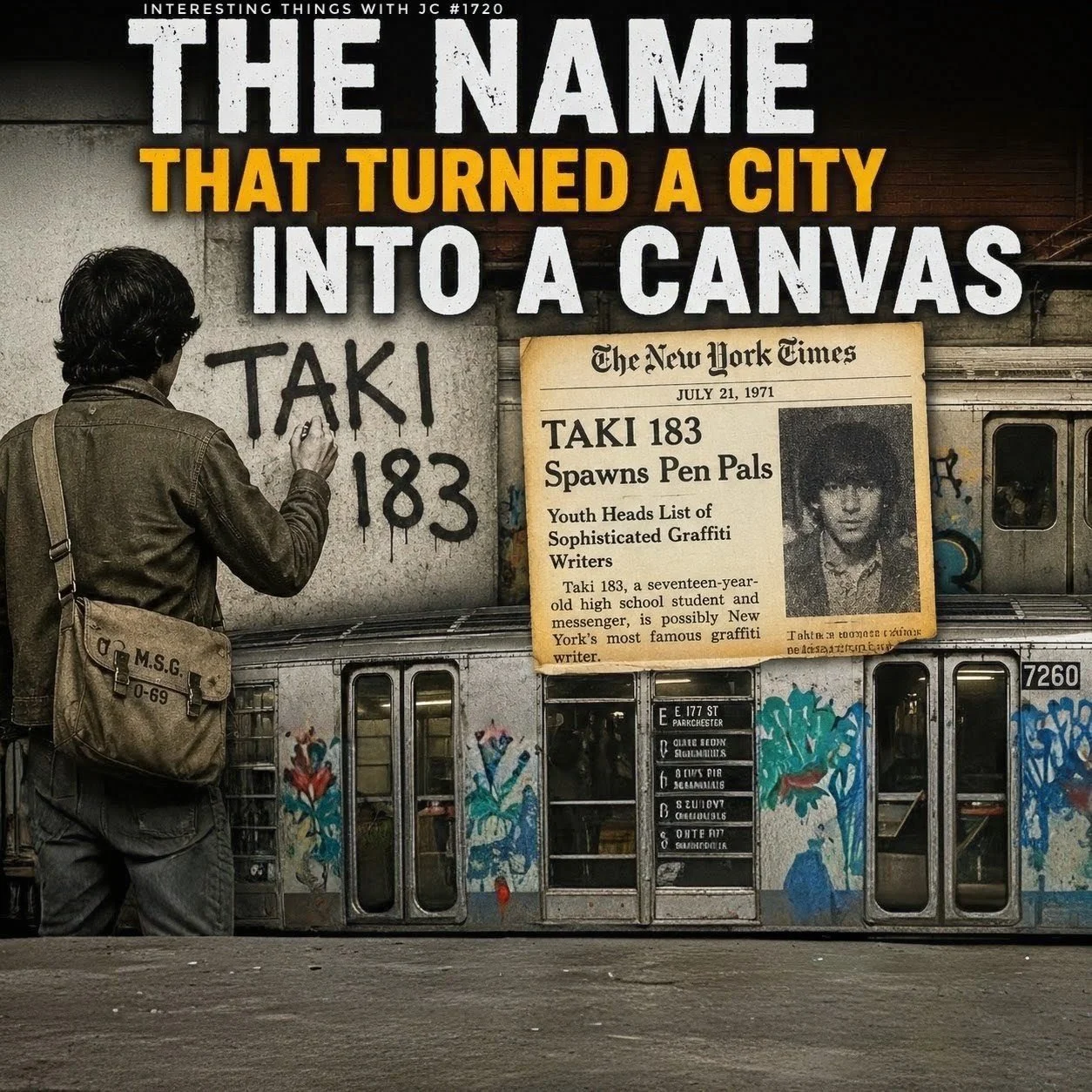
Promotional artwork for Interesting Things with JC #1720 titled "The Name That Turned a City into a Canvas." A young person, shown from behind, spray-paints the words "TAKI 183" on a concrete wall inside a New York City subway setting. A vintage subway train covered with colorful graffiti stretches across the background. An image of the July 21, 1971, New York Times article titled "TAKI 183 Spawns Pen Pals" is prominently displayed, referencing the newspaper story that brought widespread attention to graffiti writer TAKI 183. Large white and gold lettering fills the top of the image with the episode title, emphasizing the transformation of graffiti from a neighborhood practice into a citywide and globally influential art movement.
Transcript
Interesting Things with JC #1720:
The Name That Turned a City into a Canvas
On July 21, 1971, The New York Times published an article titled "TAKI 183 Spawns Pen Pals." It profiled a 17-year-old New York City foot messenger whose name had become impossible to ignore.
Demetrios, known as Taki, lived on 183rd Street in Washington Heights. His job took him across all five boroughs, and he wrote "TAKI 183" wherever he went. He became New York's first widely recognized "all-city" graffiti writer, with his tag appearing in subway stations, on sidewalks, and throughout the city's transit system.
The article did something no one expected. It showed there was a real person behind the signature.
Within days, teenagers across the city were creating names of their own, usually a nickname followed by their street number. The goal became simple: get your name seen everywhere. The subway system became the city's largest moving canvas, carrying each artist's work through every borough every day.
As thousands of tags covered trains, writers had to find new ways to stand out. Simple signatures became bold, colorful lettering. Artists like PHASE 2 and DONDI developed increasingly complex styles, and by the late 1970s, entire subway cars had become full-scale murals stretching nearly 50 feet from end to end.
The movement soon left the train yards. Graffiti entered galleries, artists like Jean-Michel Basquiat and Keith Haring brought its visual language into contemporary art, and the 1983 film Wild Style introduced New York graffiti to audiences around the world.
Graffiti existed before TAKI 183. But one newspaper profile transformed it from a neighborhood phenomenon into a citywide movement, and from there, into one of the most influential art forms of the last half century.
These are interesting things, with JC.
Student Worksheet
Name: ____________________________ Date: ____________________
Directions: Listen to the podcast before completing the worksheet. If audio is unavailable, read the transcript carefully. Answer using complete sentences and evidence from the episode.
Comprehension
Who was TAKI 183, and what job did he have?
What did the number "183" represent?
What newspaper published the article that introduced TAKI 183 to a wider audience?
Why did other teenagers begin creating their own tags?
How did graffiti styles change during the 1970s?
Analysis
Explain why the subway system became an effective place for graffiti writers to display their work.
How did competition between writers contribute to artistic innovation?
Describe how media attention changed graffiti from a local activity into a larger cultural movement.
Compare a newspaper article in 1971 to social media today. How can each influence public behavior?
Reflection
Imagine you are a teenager living in New York City in 1971. After reading the article about TAKI 183, would you have viewed graffiti as vandalism, art, or something in between? Support your answer with evidence from the episode.
Difficulty Scaling
Developing
Complete the comprehension questions.
Proficient
Complete comprehension and analysis questions using evidence.
Advanced
Complete every section and write a one-page explanation describing how public recognition can transform an artistic movement.
Student Output Expectations
Students should demonstrate:
Historical understanding
Evidence-based reasoning
Clear written communication
Connections between media and cultural change
Academic Integrity Guidance
Complete responses independently. Use the podcast and transcript as evidence. Cite specific details rather than copying entire passages.
Teacher Guide
Quick Start
Begin by playing the podcast episode without introduction. Ask students to simply listen for one question:
"How did one person's name become known across an entire city?"
Pacing Guide (Audio-First)
Bell Ringer — 5 minutes
Podcast Listening — 5 minutes
Vocabulary Review — 10 minutes
Worksheet Completion — 20 minutes
Class Discussion — 10 minutes
Exit Ticket — 5 minutes
Total Time: Approximately 55 minutes
Bell Ringer
Display the prompt:
"What makes a name become famous?"
Students write for two minutes before discussion.
Audio Guidance
Encourage students to:
Listen for dates.
Listen for cause-and-effect relationships.
Notice how the story develops from one individual to a worldwide movement.
Audio Fallback
If audio cannot be played:
Read the transcript aloud.
Have students annotate important events.
Pause after each paragraph for discussion.
Time-on-Task
Listening: 10%
Reading/Analysis: 45%
Discussion: 25%
Assessment: 20%
Materials
Podcast audio
Transcript
Student worksheet
Projector or interactive display
Pens or pencils
Vocabulary Strategy
Before listening:
Tag
Graffiti
All-City
Mural
Have students predict each meaning before hearing the episode.
Common Misconceptions
Graffiti began with TAKI 183.
All graffiti is identical.
Graffiti immediately entered museums.
Every graffiti writer painted murals.
Clarify that graffiti existed long before TAKI 183, but his publicity accelerated the movement.
Discussion Prompts
Why did visibility matter so much to graffiti writers?
Could graffiti have become an international movement without newspaper coverage?
How does competition encourage creativity?
Can something begin as vandalism yet influence fine art?
How does public opinion affect artistic movements?
Formative Checkpoints
Students should be able to:
Identify TAKI 183.
Explain why the article mattered.
Describe the evolution from tagging to murals.
Connect media exposure to cultural change.
Differentiation
Support
Provide vocabulary definitions before listening.
Allow partner discussion.
Extension
Research another influential graffiti artist.
Compare New York graffiti to modern street art around the world.
Assessment Differentiation
Students may demonstrate learning through:
Written responses
Oral presentation
Visual timeline
Graphic organizer
Time Flexibility
30-minute class:
Podcast
Discussion
Exit Ticket
60-minute class:
Full lesson
90-minute class:
Include extension research and presentations.
Substitute Readiness
The lesson can be taught directly from the transcript using the pacing guide and worksheet without additional preparation.
Engagement Strategy
Display photographs of early New York subway graffiti after students finish listening. Ask:
"Why do you think artists kept making their letters larger and more elaborate?"
Extensions
Students research:
PHASE 2
DONDI
Jean-Michel Basquiat
Keith Haring
Wild Style (1983)
Students create a timeline showing the evolution of graffiti from tagging to gallery exhibitions.
Cross-Curricular Connections
History
Urban America during the 1970s
Art
Typography and color theory
Media Studies
Journalism's influence on public behavior
Language Arts
Cause-and-effect informational writing
SEL Connection
Students examine how identity, recognition, belonging, and self-expression influence human behavior while considering appropriate and responsible ways to express creativity.
Skill Emphasis
Students practice:
Critical thinking
Historical reasoning
Visual literacy
Evidence evaluation
Communication
Cause-and-effect analysis
Answer Key
Comprehension
A New York City foot messenger and graffiti writer.
His street number (183rd Street).
The New York Times.
They wanted their names seen throughout the city.
Tags evolved into elaborate lettering and eventually full subway-car murals.
Analysis (Sample Responses)
Subways traveled throughout every borough, allowing thousands of people to see each artist's work.
Competition encouraged artists to create increasingly distinctive lettering and larger works.
The newspaper introduced a broad audience to graffiti, inspiring many new participants.
Both newspapers and social media spread ideas rapidly and influence public participation, though today's technology operates much faster.
Quiz
Choose the best answer. Do not write the answers on the quiz.
TAKI 183 became famous primarily because:
A. He won an art competition.
B. He painted museums.
C. His tag appeared throughout New York City.
D. He designed advertisements.
The number "183" referred to:
A. His age.
B. His street.
C. His employee number.
D. His subway route.
Which event greatly increased public awareness of TAKI 183?
A. A television interview.
B. A museum exhibit.
C. A New York Times article.
D. A documentary.
Why did graffiti styles become increasingly elaborate?
A. Paint became cheaper.
B. Writers wanted to stand out.
C. The subway required it.
D. Museums requested murals.
Which artist mentioned in the episode later became well known in contemporary art?
A. Pablo Picasso
B. Claude Monet
C. Keith Haring
D. Norman Rockwell
Assessment
Open-Ended Questions
Explain how one newspaper article helped transform graffiti from a neighborhood activity into an international artistic movement. Use evidence from the episode.
Describe how competition influenced the evolution of graffiti lettering and explain why those artistic developments remain influential today.
3–2–1 Rubric
3 – Exceeds Expectations
Accurate historical understanding
Multiple pieces of supporting evidence
Clear reasoning and organization
2 – Meets Expectations
Mostly accurate information
At least one supporting example
Logical explanation
1 – Developing
Limited understanding
Minimal supporting evidence
Explanation lacks clarity
Exit Ticket
In one or two sentences, answer:
How did media attention help transform graffiti into an internationally recognized art movement?
Standards Alignment
NGSS Science & Engineering Practices (Applicable Skill Integration)
SEP 8 – Obtaining, Evaluating, and Communicating Information
Connection: Students analyze historical information presented in the podcast and transcript.
Measurable Outcome: Students accurately explain how media coverage influenced the growth of graffiti culture using textual evidence.
Justification: Learners evaluate information sources and communicate evidence-based conclusions.
CCSS Reading
CCSS.ELA-LITERACY.RH.9-10.2 – Determine the Central Ideas of a Primary or Secondary Source
Connection: Students identify the central idea that media exposure accelerated a cultural movement.
Measurable Outcome: Students summarize the historical significance of the 1971 newspaper article using supporting evidence.
Justification: Reinforces informational reading and historical analysis.
CCSS.ELA-LITERACY.RH.11-12.6 – Evaluate Authors' Perspectives
Connection: Students examine how journalism shaped public perception.
Measurable Outcome: Students distinguish factual reporting from cultural influence.
Justification: Develops historical source evaluation skills.
CCSS Writing
CCSS.ELA-LITERACY.WHST.9-10.1 – Write Arguments Supported by Evidence
Connection: Reflection and assessment responses require evidence-based reasoning.
Measurable Outcome: Students defend their conclusions using information from the lesson.
Justification: Strengthens analytical writing.
CCSS.ELA-LITERACY.WHST.11-12.2 – Write Informative Texts
Connection: Students explain the historical development of graffiti.
Measurable Outcome: Students organize historical facts into a coherent explanation.
Justification: Builds expository writing skills.
CCSS Speaking & Listening
CCSS.ELA-LITERACY.SL.9-10.1 – Collaborative Discussions
Connection: Classroom discussions examine differing viewpoints regarding graffiti.
Measurable Outcome: Students contribute relevant evidence while responding respectfully to peers.
Justification: Encourages academic discourse and communication.
C3 Framework
D2.His.1.9-12 – Evaluate Historical Change Over Time
Connection: Students analyze the progression from neighborhood tagging to international art.
Measurable Outcome: Students construct a historical timeline demonstrating cultural development.
Justification: Promotes chronological reasoning and historical thinking.
ISTE Standards for Students
ISTE 3 – Knowledge Constructor
Connection: Students evaluate multiple historical sources and distinguish evidence from opinion.
Measurable Outcome: Students synthesize podcast information with additional research.
Justification: Develops information literacy in digital and traditional media.
Career Readiness Competencies
Analytical Thinking
Evaluate historical cause-and-effect relationships.
Interpret evidence before reaching conclusions.
Communication
Present findings clearly through discussion and writing.
Support claims with documented evidence.
Problem Solving
Analyze how artists adapted to increasing competition.
Explain how innovation solved the challenge of standing out.
Adaptability
Examine how artistic styles evolved in response to changing circumstances.
Recognize the importance of innovation in creative professions.
Professional Judgment
Differentiate between historical description and personal opinion.
Evaluate the ethical and cultural impact of public artistic expression.
Homeschool / Lifelong Learning Alignment
Independent Learning
Students independently investigate additional graffiti artists and movements.
Information Literacy
Learners compare multiple reliable historical sources.
Real-World Application
Students connect historical media influence to modern communication platforms.
Self-Directed Inquiry
Students generate additional questions about urban art and cultural history.
Transferable Life Skills
Critical thinking
Evidence evaluation
Historical reasoning
Communication
Visual literacy
Show Notes
This lesson explores how a single newspaper article transformed TAKI 183 from an anonymous teenager into the catalyst for one of the most influential artistic movements of the twentieth century. Students discover how media exposure, public spaces, creativity, and competition combined to reshape urban art, influence contemporary artists, and demonstrate how one individual's actions can unexpectedly leave a lasting cultural legacy.
References
Gastman, R., & Neelon, C. (2011). The History of American Graffiti. Harper Design. https://www.harpercollins.com/products/the-history-of-american-graffiti-roger-gastman
The New York Times. (1971, July 21). TAKI 183 Spawns Pen Pals. https://www.nytimes.com/1971/07/21/archives/taki-183-spawns-pen-pals.html
Museum of the City of New York. (n.d.). City as Canvas: Graffiti Art from the Martin Wong Collection. https://www.mcny.org/exhibition/city-canvas
The Museum of Modern Art. (n.d.). Jean-Michel Basquiat. https://www.moma.org/artists/370
The Broad. (n.d.). Keith Haring. https://www.thebroad.org/art/keith-haring