1737: "Susan and Phil"
Interesting Things with JC #1737: "Susan and Phil"
A woman enters a Fort Worth topless bar because she needs money, but the bouncer watching the door decides she doesn't belong there and asks her to go rattlesnake hunting instead. That unlikely meeting leads two ninth-grade dropouts toward biology degrees, wildlife research, and a scientific career neither believed was possible.
Curriculum - Episode Anchor
Episode Title: Susan and Phil
Episode Number: 1737
Host: JC
Audience: Grades 9–12, introductory college, homeschool students, and lifelong learners
Subject Area: Biography, biology careers, education, perseverance, collaborative learning, wildlife research, and career readiness
Recommended Lesson Length: 55–75 minutes
Instructional Focus: Analyzing how mutual support, disciplined study, educational access, and sustained effort can alter a person’s academic and professional direction
Lesson Overview
Learning Objectives: By the end of the lesson, students will be able to:
Identify and accurately sequence at least five major events in Susan and Philip McClinton’s educational and professional journey.
Analyze how mutual support, persistence, and specific study practices contributed to the couple’s academic success.
Distinguish between claims directly supported by the transcript and conclusions that require inference or outside evidence.
Produce an evidence-based explanation connecting education, scientific curiosity, collaboration, and career development.
Essential Question: How can sustained effort and responsible support from another person change an individual’s educational and professional possibilities?
Success Criteria: Students will:
Cite at least three accurate details from the transcript.
Explain one cause-and-effect relationship in the McClintons’ story.
Evaluate the importance of a specific action, decision, or study strategy.
Communicate a clear conclusion supported by relevant evidence.
Student Relevance Statement: Students often make decisions about education, training, work, and personal goals before they fully understand their own abilities. Susan and Philip’s story demonstrates that earlier academic struggles do not permanently determine later performance.
Real-World Connection: Colleges, employers, scientific organizations, and skilled professions require persistence, communication, evidence evaluation, time management, and the ability to learn with others. These competencies can be developed through deliberate practice.
Workforce Reality: Interest alone does not qualify someone for scientific work. Biology and wildlife careers generally require formal education, technical knowledge, accurate observation, ethical conduct, field experience, communication skills, and a willingness to continue learning. The McClintons’ progress depended on years of study and disciplined work rather than a single moment of inspiration.
Key Vocabulary
Probation(proh-BAY-shuhn): A conditional status in which a person is allowed to continue only by meeting stated requirements. Sul Ross State University admitted Susan and Philip on probation.
Persistence(per-SIS-tuhns): Continued effort despite difficulty, delay, uncertainty, or discouragement.
Mutual support(MYOO-choo-uhl suh-PORT): Assistance exchanged between people, with each person contributing to the other’s progress.
Biology(bye-OL-uh-jee): The scientific study of living organisms and life processes.
Field biologist(feeld bye-OL-uh-jist): A scientist who studies organisms, behavior, or ecological relationships in natural environments.
Wildlife education(WYLDE-lyfe ej-uh-KAY-shuhn): Communication and instruction that help people understand animals, habitats, conservation, and responsible interaction with wildlife.
Parasite-host relationship(PAIR-uh-site hohst ree-LAY-shuhn-ship): An interaction in which one organism benefits by living on or in another organism, usually at some cost to the host.
Inference(IN-fur-uhns): A conclusion reached by combining evidence with logical reasoning.
Academic integrity(ak-uh-DEM-ik in-TEG-rih-tee): Honest and responsible completion of academic work, including accurate use of evidence and acknowledgment of sources.
Professional judgment(pruh-FESH-uh-nuhl JUHJ-muhnt): The responsible use of knowledge, evidence, ethics, and experience when making work-related decisions.
Narrative Core
Open: In 1972, Susan McClinton entered a Fort Worth club because she needed money to support her children. Philip McClinton, the club’s bouncer, noticed her and decided to watch out for her. Their meeting began in an unlikely place, but the decisions that followed redirected both of their lives.
Info: Philip invited Susan to go rattlesnake hunting. During their trips, they discussed Susan’s earlier interest in science. Philip proposed that they return to school, even though neither had completed more than the ninth grade and both doubted that a college would admit them.
Details: Sul Ross State University accepted them on probation. They completed courses together and developed practical ways to help one another learn. Susan placed a cell diagram on the bathroom mirror so Philip would repeatedly review it. Philip encouraged Susan to recognize abilities and professional possibilities she had not previously imagined. They earned bachelor’s degrees in biology in 1992 and master’s degrees in biology six years later.
Reflection: Their progress was not based on instant transformation. It required enrollment, repeated study, shared responsibility, encouragement, technical preparation, and the decision to continue when either person might have stopped. Their later research and wildlife education work grew from curiosity supported by formal training.
Closing: These are interesting things, with JC.
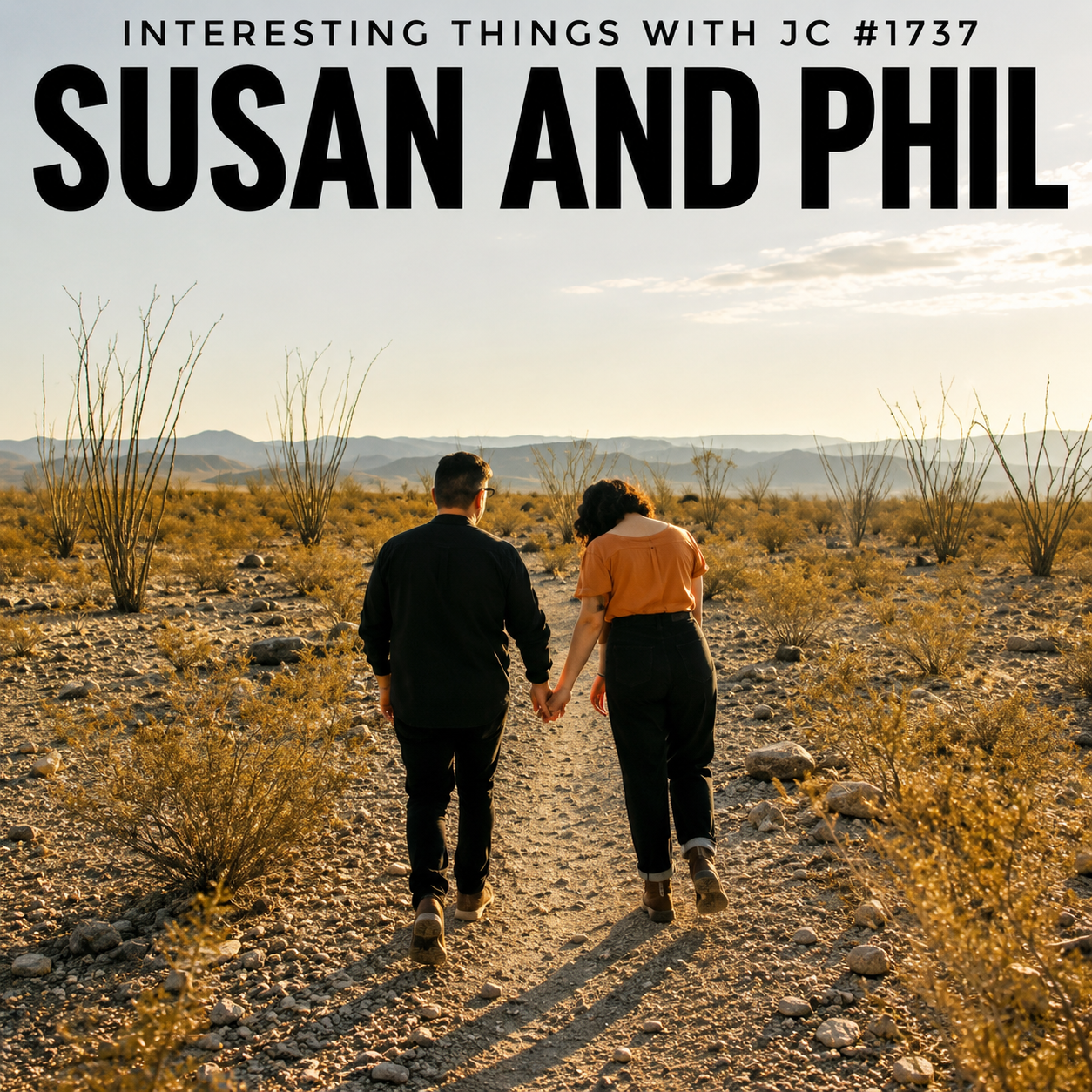
Promotional image for Interesting Things with JC #1737: Susan and Phil. Large black title text appears above a photograph of a man and woman walking hand in hand along a rocky desert trail at sunset. They are seen from behind, surrounded by dry shrubs and tall desert plants, with distant mountains beneath a pale sky.
Transcript
Interesting Things with JC #1737:
"Susan and Phil"
Susan McClinton walked into a topless bar in Fort Worth, Texas, in the fall of 1972 because she needed money. She was raising two children and entered the club's amateur stripping contest for the prize. Near the door was Philip McClinton, the club's bouncer, who watched her long enough to decide she didn't belong there and told her he would keep an eye on her.
That was how they met.
Then Philip asked her out, although his invitation wasn't dinner or a movie.
"I am going to take you rattlesnake hunting."
Susan thought he was out of his mind, but she went, had a good time, and wanted to do it again. During those trips, she told Philip that she had always enjoyed science in school. His response was direct: "Why don't we go back?"
Neither of them had gone beyond the ninth grade. Philip had tried the tenth grade three times and couldn't get through it, and neither believed a college would accept them. Philip told Susan to call and ask. Sul Ross State University admitted them on probation.
They took their courses together.
When Philip began to doubt that he could continue, Susan told him she would get him through it. She taped a diagram of a cell to the bathroom mirror so he would have to study it while he shaved. Philip gave Susan the same support, encouraging her toward work she had never imagined was possible.
In 1992, they earned bachelor's degrees in biology. Six years later, they earned master's degrees in biology from Sul Ross.
They eventually settled in Cody, Wyoming, outside Yellowstone National Park, where the interest that began on those rattlesnake hunts became their life's work. Philip joined the Draper Museum of Natural History, while Susan worked in wildlife education, including serving as an information and education specialist on grizzly bears for the Shoshone National Forest. Together they researched black bears, mountain lions, several species of doves, and parasite-host relationships, publishing and presenting their work along the way.
Years later, Susan called their marriage "a rescue romance."
Then she explained it.
"We saved each other."
The record backs her up. Two people who had left school after the ninth grade walked into college together, stayed when either one might have quit alone, and built their lives around the science they first talked about while looking for rattlesnakes.
These are interesting things, with JC.
Student Worksheet
Directions: Listen to the podcast before reading the transcript. During the first listening, record only major events and questions. During the second listening or transcript review, collect exact evidence. Complete all responses in full sentences unless a different format is specified.
Comprehension
Why did Susan enter the club’s amateur stripping contest?
What unusual activity did Philip suggest for their first outing?
What shared educational limitation made Susan and Philip doubt that a college would accept them?
Under what condition did Sul Ross State University admit them?
Identify one specific strategy Susan used to help Philip study biology.
What degrees did Susan and Philip earn, and in what years did they earn them?
Where did they eventually settle?
Identify two animals or scientific subjects they researched.
Analysis
Construct a six-event timeline showing the progression from Susan and Philip’s first meeting to their wildlife work. Each event must include a brief explanation of why it mattered.
Which decision had the greatest effect on their later lives: going rattlesnake hunting, contacting the university, taking courses together, or continuing when school became difficult? Defend your choice with at least two transcript details.
Analyze the cell-diagram example. What does it reveal about effective studying, repetition, environmental cues, and accountability?
Explain how the statement “We saved each other” functions as both a personal reflection and a claim about cause and effect.
Identify one statement in the transcript that is directly verifiable and one conclusion that requires inference. Explain the difference.
Does the story suggest that encouragement alone is enough for academic success? Use evidence to explain why or why not.
Reflection
Describe one skill, subject, or responsibility that once seemed beyond your ability. Identify one practical action, resource, or support structure that could make progress more realistic.
What is the difference between helping someone and completing that person’s responsibilities for them?
Write three sentences explaining how a supportive partnership can preserve individual responsibility rather than replace it.
Difficulty Scaling
Foundational Level: Answer Comprehension Questions 1–8 and create a four-event timeline using quoted or paraphrased evidence.
Standard Level: Complete all comprehension questions, Analysis Questions 1–4, and one reflection response.
Advanced Level: Complete all sections and add a 250–350-word source evaluation explaining which details are supported by the transcript, which are interpretive, and what additional evidence would be needed to verify the full biography.
Introductory College Level: Complete the advanced task and compare the podcast narrative with two credible factual sources. Evaluate differences in emphasis, selection, and narrative structure.
Student Output Expectations: Submit:
Eight comprehension responses.
One chronological timeline.
Two developed analysis paragraphs of 150–200 words each.
One reflection response of 100–150 words.
At least three accurate references to transcript details.
Academic Integrity Guidance: Use your own wording except when quoting brief transcript phrases. Place quotation marks around exact language. Do not invent biographical details, research findings, motivations, or dialogue. When using outside sources, identify the source and separate verified information from personal interpretation.
Teacher Guide
Quick Start: Prepare the audio and one transcript or worksheet per student. Begin with the bell ringer, play the entire episode without interruption, allow one minute of silent note completion, and then replay or read selected sections for evidence analysis.
Pacing Guide — Audio First:
0–5 minutes: Bell ringer and prediction.
5–10 minutes: First uninterrupted podcast listening.
10–13 minutes: Silent note review and initial central-idea statement.
13–20 minutes: Second listening or guided transcript review.
20–32 minutes: Comprehension questions and event timeline.
32–47 minutes: Small-group analysis and evidence discussion.
47–60 minutes: Independent analytical response.
60–68 minutes: Quiz.
68–75 minutes: Exit ticket and final reflection.
Bell Ringer: Respond in three sentences: “Can a person’s previous academic record accurately predict everything that person may accomplish later? Explain the limits of your answer.”
Audio Guidance: Before playing the episode, ask students to listen for turning points rather than attempting to write every detail. During the first listening, students should record three decisions, two obstacles, and one example of support.
Audio Fallback: When audio is unavailable, the teacher should read the transcript aloud while students listen without viewing the text. Students may then receive the transcript for a second reading. This preserves the listening-first sequence.
Time on Task: Core lesson activities require approximately 55 minutes. The full worksheet, discussion, quiz, and assessment require 70–75 minutes. Advanced source evaluation may be assigned as homework.
Materials:
Podcast audio or teacher-read transcript
Student transcript
Student worksheet
Notebook paper or digital document
Highlighters or annotation tools
Optional timeline template
Optional access to credible digital research sources
Vocabulary Preparation: Preteach probation, mutual support, field biologist, inference, and academic integrity. Ask students to use each term in a sentence connected to the episode.
Content Sensitivity: The opening includes adult employment in a topless bar and an amateur stripping contest. Present the detail factually and without sensationalism. Emphasize that the narrative includes it to explain Susan’s financial situation and the circumstances of the couple’s meeting. Follow applicable school policies and use the teacher-read transcript option when necessary.
Misconceptions:
Misconception: The story proves that anyone can enter any career through determination alone.
Correction: Their progress also required admission, formal coursework, repeated study, degree completion, technical development, and professional experience.Misconception: Philip rescued Susan, or Susan rescued Philip, in a one-directional relationship.
Correction: The account emphasizes reciprocal support.Misconception: Academic probation is a punishment or permanent label.
Correction: In this context, probation was conditional admission that created an opportunity while requiring satisfactory performance.Misconception: Studying together means one person performs the other person’s work.
Correction: Ethical support can include explanation, review, encouragement, accountability, and practice while each learner remains responsible for personal work.Misconception: Wildlife work consists mainly of observing animals.
Correction: Professional work may involve research design, data collection, safety procedures, public education, reporting, presentation, and institutional responsibilities.
Discussion Prompts:
Which obstacle in the story was external, and which obstacles were internal?
What evidence shows that their support was practical rather than merely emotional?
At what point does encouragement become accountability?
Why is the university phone call an important turning point?
How does the final line “We saved each other” reshape the meaning of earlier events?
What information would a careful researcher need before making broader claims about their scientific work?
Formative Checkpoints:
After the first listening, students submit a one-sentence central idea.
During the timeline activity, verify chronological accuracy before students begin analysis.
Ask students to underline evidence and circle the reasoning that connects evidence to a conclusion.
Use a thumbs-up, sideways, or down check to measure understanding of direct evidence versus inference.
Collect one draft claim before students write the full analytical paragraph.
Differentiation:
Provide a partially completed timeline for students who need organizational support.
Supply sentence frames such as, “The decision to ___ was significant because ___.”
Allow students to replay short audio segments.
Pair students strategically for evidence location before independent writing.
Permit speech-to-text for students whose written production limits demonstration of understanding.
Challenge advanced students to evaluate narrative selection, omitted details, and source reliability.
Assessment Differentiation:
Accept an oral evidence-based response when required by an accommodation.
Reduce the number of comprehension questions while preserving the analytical task.
Allow additional processing time.
Provide a vocabulary bank without supplying answers.
For advanced students, require corroboration from two reliable sources and an explanation of source authority.
Time Flexibility: For a 45-minute class, complete the audio, comprehension questions, one analysis response, and exit ticket. Assign the quiz and remaining worksheet tasks independently. For a block period, add source comparison and student presentations.
Substitute Readiness: The substitute should read the bell ringer, play the audio once, direct students to complete comprehension and timeline tasks, and administer the quiz. When audio fails, the substitute should read the transcript aloud before distributing it.
Engagement Strategy: Use a “turning-point line.” Post the major events around the room. Students stand beside the event they believe most changed the couple’s future, discuss evidence with nearby classmates, and then defend their choice.
Extensions:
Research conditional college admission, adult education, or nontraditional student support.
Investigate one wildlife species named in the episode and prepare a one-page scientific profile.
Design a responsible study environment using cues, repetition, and accountability.
Create a short audio biography of a person whose career path included a significant educational transition.
Cross-Curricular Connections:
Biology: Wildlife research, animal behavior, ecological relationships, and scientific communication.
English Language Arts: Narrative structure, central idea, textual evidence, inference, and concise analytical writing.
Psychology: Motivation, self-efficacy, habit formation, memory cues, and social support.
Career and Technical Education: Training pathways, professional conduct, communication, and lifelong skill development.
Mathematics: Constructing a chronological scale from 1972 through 1998 and calculating elapsed time.
SEL Connection: Students examine responsible encouragement, shared resilience, self-efficacy, and the importance of maintaining personal responsibility within supportive relationships.
Skill Value Emphasis: The lesson prioritizes disciplined learning, evidence-based reasoning, communication, adaptability, problem solving, and professional judgment. Students should understand that these skills are transferable across academic, technical, and workplace settings.
Answer Key — Student Worksheet:
Susan entered the contest because she was supporting two children and needed the prize money.
Philip invited her to go rattlesnake hunting.
Neither had progressed beyond the ninth grade; Philip had attempted tenth grade three times.
They were admitted on probation.
Susan taped a diagram of a cell to the bathroom mirror so Philip would repeatedly study it while shaving.
They earned bachelor’s degrees in biology in 1992 and master’s degrees in biology in 1998.
They settled in Cody, Wyoming, outside Yellowstone National Park.
Accept any two: black bears, mountain lions, doves, parasite-host relationships, or subjects accurately identified from the transcript.
A valid timeline should include six chronologically accurate events, such as meeting in 1972, rattlesnake hunting, discussing science, contacting Sul Ross, probationary admission, studying together, earning bachelor’s degrees, earning master’s degrees, moving to Cody, and conducting wildlife work.
Answers will vary. Strong responses identify a decision, cite at least two details, and explain the causal connection.
The cell diagram demonstrates retrieval through repeated exposure, use of an environmental cue, practical support, and individual responsibility for learning.
“We saved each other” is a reflection because it expresses Susan’s interpretation of their relationship. It is also a causal claim because the narrative attributes their persistence and accomplishments partly to reciprocal support.
Directly verifiable statements include degree years or places of employment. Inferences include conclusions about which event mattered most or exactly what either person felt beyond the quoted language.
No. Encouragement contributed, but the transcript also shows application, admission, coursework, studying, persistence, degree completion, and professional work.
Reflection answers will vary but should identify a realistic action and preserve the learner’s responsibility.
Quiz
Why did Susan McClinton enter the amateur contest?
A. She wanted to begin a performance career.
B. She needed prize money while supporting two children.
C. She was conducting research about local businesses.
D. She had been invited by Sul Ross State University.
What did Philip ask Susan to do on their first unusual outing?
A. Visit a biology laboratory
B. Attend a college lecture
C. Go rattlesnake hunting
D. Tour Yellowstone National Park
What action most directly opened the possibility of college enrollment?
A. Philip accepted a museum position.
B. Susan drew a diagram of a cell.
C. They moved to Cody, Wyoming.
D. They contacted Sul Ross State University and asked about admission.
Which detail best demonstrates a concrete study strategy?
A. Susan described the marriage as a rescue romance.
B. Philip decided Susan did not belong in the club.
C. Susan placed a cell diagram on the bathroom mirror.
D. The couple studied several species of doves.
Which statement best expresses the central idea?
A. Scientific careers depend mainly on unusual outdoor experiences.
B. Earlier educational difficulty can be overcome through opportunity, disciplined work, and reciprocal support.
C. College admission guarantees professional success.
D. Personal relationships are more important than technical training.
Assessment
Open-Ended Questions
Evaluate the claim that Susan and Philip’s success resulted from mutual support. Use at least three details from the transcript, and explain how each detail supports or limits the claim.
Identify one turning point in the narrative and explain its immediate effect, long-term effect, and connection to personal responsibility.
3–2–1 Rubric
3 — Proficient: Presents a clear claim; uses three or more accurate details; explains cause, effect, and significance; distinguishes evidence from inference; communicates in organized, complete sentences.
2 — Developing: Presents a relevant claim; uses one or two accurate details; provides partial reasoning; may confuse evidence and inference or leave one part of the question incomplete.
1 — Beginning: Provides a vague or unsupported response; includes inaccurate or minimal evidence; offers little explanation; or does not address the full task.
Exit Ticket
Write one sentence identifying the episode’s most important turning point.
Cite one detail that supports your choice.
Name one transferable skill demonstrated by Susan or Philip and describe one setting in which you could apply it.
Standards Alignment
Alignment Scope: Grades 9–12, introductory college, homeschool, and lifelong learning
Instructional Emphasis: Critical thinking, analysis, communication, evidence evaluation, inquiry, problem solving, reasoning, collaboration, decision making, and career readiness
NGSS — Science and Engineering Practices
Standard: NGSS SEP 8
Official Title: Obtaining, Evaluating, and Communicating Information
Lesson Connection: Students evaluate claims in the transcript, distinguish direct evidence from inference, and communicate evidence-based conclusions in the Student Worksheet and Assessment.
Measurable Student Outcome: Students will cite at least three accurate transcript details and explain how each supports a conclusion.
Justification: The lesson requires students to obtain information from audio and text, evaluate its reliability and meaning, and communicate a supported interpretation.
Standard: NGSS SEP 7
Official Title: Engaging in Argument from Evidence
Lesson Connection: Students defend which decision most affected Susan and Philip’s educational and professional direction.
Measurable Student Outcome: Students will construct a claim supported by at least two relevant details and logical reasoning.
Justification: The worksheet, discussion, and assessment require students to make defensible claims rather than provide unsupported opinions.
Standard: NGSS SEP 1
Official Title: Asking Questions and Defining Problems
Lesson Connection: Students identify the academic barriers Susan and Philip faced and evaluate the actions used to address them.
Measurable Student Outcome: Students will identify one clearly defined problem, describe its constraints, and propose an additional realistic response.
Justification: The lesson develops inquiry and problem definition through analysis of educational obstacles, study practices, and career preparation.
CCSS Reading
Standard: CCSS.ELA-LITERACY.RI.11-12.1
Official Title: Cite Strong and Thorough Textual Evidence
Lesson Connection: Students support comprehension, analysis, and assessment responses with accurate details from the transcript.
Measurable Student Outcome: Students will integrate at least three relevant pieces of evidence into a written analysis.
Justification: Successful completion of the worksheet and assessment depends on selecting and explaining strong textual evidence.
Standard: CCSS.ELA-LITERACY.RI.11-12.2
Official Title: Determine Central Ideas and Analyze Their Development
Lesson Connection: Students determine how persistence, education, and mutual support develop across the narrative.
Measurable Student Outcome: Students will state one central idea and trace its development through at least four events.
Justification: The lesson requires students to explain how the narrative’s central meaning develops over time.
Standard: CCSS.ELA-LITERACY.RI.11-12.3
Official Title: Analyze a Complex Set of Ideas or Sequence of Events
Lesson Connection: Students construct a timeline and analyze how specific decisions, obstacles, and opportunities affected later outcomes.
Measurable Student Outcome: Students will sequence at least six events and explain the significance of each.
Justification: Susan and Philip’s story is understood through the interaction of events rather than through isolated facts.
CCSS Writing
Standard: CCSS.ELA-LITERACY.W.11-12.2
Official Title: Write Informative and Explanatory Texts
Lesson Connection: Students explain how educational access, study practices, persistence, and mutual support contributed to long-term change.
Measurable Student Outcome: Students will produce an organized 150–200-word explanation using accurate evidence and clear reasoning.
Justification: The required written products ask students to explain complex relationships and sequences clearly.
Standard: CCSS.ELA-LITERACY.W.11-12.9
Official Title: Draw Evidence from Informational Texts to Support Analysis, Reflection, and Research
Lesson Connection: Students use transcript evidence in analysis responses, reflection tasks, and the open-ended assessment.
Measurable Student Outcome: Students will paraphrase or briefly quote evidence accurately and connect it to a claim.
Justification: The lesson requires students to use source material responsibly rather than rely only on personal opinion.
CCSS Speaking and Listening
Standard: CCSS.ELA-LITERACY.SL.11-12.1
Official Title: Initiate and Participate Effectively in Collaborative Discussions
Lesson Connection: Students discuss turning points, respond to classmates, and defend interpretations during the engagement activity.
Measurable Student Outcome: Students will contribute one evidence-based claim, one response to a peer, and one clarifying question.
Justification: The discussion tasks require preparation, active listening, collaboration, and reasoned communication.
Standard: CCSS.ELA-LITERACY.SL.11-12.2
Official Title: Integrate Multiple Sources of Information Presented in Diverse Media and Formats
Lesson Connection: Students first listen to the podcast and then use the transcript to verify, revise, and deepen their understanding.
Measurable Student Outcome: Students will revise an initial central-idea statement after comparing the audio with the written transcript.
Justification: The audio-first structure requires students to synthesize information from spoken and written formats.
C3 Framework
Standard: C3 D2.His.14.9-12
Official Title: Analyze Multiple and Complex Causes and Effects of Events in the Past
Lesson Connection: Students analyze how financial need, educational opportunity, personal encouragement, study habits, and persistence contributed to later outcomes.
Measurable Student Outcome: Students will explain at least three causes and distinguish between immediate and long-term effects.
Justification: The narrative provides a clear case study in multicausal historical and biographical reasoning.
Standard: C3 D4.1.9-12
Official Title: Construct Arguments Using Precise and Knowledgeable Claims with Evidence from Multiple Sources
Lesson Connection: Advanced students compare the transcript with credible outside sources and evaluate differences in emphasis and documentation.
Measurable Student Outcome: Students will construct a supported argument using the episode and two reliable sources.
Justification: The advanced task requires corroboration, source evaluation, precise claims, and responsible qualification.
ISTE Standards
Standard: ISTE 1.3.b
Official Title: Knowledge Constructor — Evaluate the Accuracy, Perspective, Credibility, and Relevance of Information
Lesson Connection: Students verify biographical claims and evaluate the authority and usefulness of digital sources.
Measurable Student Outcome: Students will assess two sources for credibility, relevance, corroboration, and limitations.
Justification: The source-evaluation task develops digital information literacy and evidence judgment.
Standard: ISTE 1.6.c
Official Title: Creative Communicator — Communicate Complex Ideas Clearly and Effectively
Lesson Connection: Students may create a digital timeline, short audio biography, or wildlife research profile.
Measurable Student Outcome: Students will produce a logically organized digital artifact containing accurate information and source acknowledgment.
Justification: The extension requires students to select an appropriate format and communicate evidence clearly.
Career Readiness Competencies
Competency: Analytical Thinking
Lesson Connection: Students distinguish direct evidence, inference, and unsupported assumption.
Measurable Student Outcome: Students will accurately classify at least one example of each.
Justification: Academic and workplace decisions depend on separating verified information from interpretation.
Competency: Communication
Lesson Connection: Students explain conclusions in writing and defend interpretations during discussion.
Measurable Student Outcome: Students will present a clear claim, supporting evidence, and a reasoned response to a peer.
Justification: Clear oral and written communication is essential in scientific, educational, technical, and public-facing work.
Competency: Problem Solving
Lesson Connection: Students evaluate how Susan and Philip responded to academic barriers through specific actions and study systems.
Measurable Student Outcome: Students will identify a problem, evaluate the response, and propose one additional practical strategy.
Justification: Effective problem solving requires converting broad difficulties into manageable actions.
Competency: Adaptability
Lesson Connection: Students analyze how Susan and Philip changed direction, entered unfamiliar academic settings, and adjusted their learning strategies.
Measurable Student Outcome: Students will identify two adaptations and explain how each supported progress.
Justification: Education and employment often require individuals to revise plans, learn new skills, and respond constructively to setbacks.
Competency: Professional Judgment
Lesson Connection: Students examine the difference between ethical support, collaboration, and completing another person’s work.
Measurable Student Outcome: Students will describe one appropriate and one inappropriate form of academic assistance.
Justification: Responsible collaboration requires ethical boundaries, accountability, and sound judgment.
Homeschool and Lifelong Learning Alignment
Competency: Independent Learning
Lesson Connection: Learners identify a personal objective and develop a repeatable study strategy.
Measurable Student Outcome: Students will create a one-week plan containing a goal, schedule, resource, and progress check.
Justification: Independent learners need structured systems for maintaining progress without continuous teacher direction.
Competency: Information Literacy
Lesson Connection: Learners verify claims and evaluate the authority and relevance of sources.
Measurable Student Outcome: Students will corroborate one biographical claim with two reliable sources.
Justification: Self-directed learners must be able to judge the quality of information independently.
Competency: Real-World Application
Lesson Connection: Learners connect persistence, study habits, and mutual accountability to a current responsibility.
Measurable Student Outcome: Students will identify one specific application and one observable measure of progress.
Justification: Learning becomes transferable when students apply a principle beyond the original narrative.
Competency: Self-Directed Inquiry
Lesson Connection: Learners develop a focused question about adult education, wildlife biology, scientific careers, or collaborative learning.
Measurable Student Outcome: Students will formulate one researchable question and locate at least two relevant sources.
Justification: Inquiry skills support continued learning beyond the assigned episode.
Competency: Transferable Life Skills
Lesson Connection: Learners practice planning, accountability, communication, evidence use, and responsible decision making.
Measurable Student Outcome: Students will explain how one lesson skill can be used in at least two different settings.
Justification: These skills apply across education, employment, family responsibilities, and lifelong learning.
Show Notes
Susan and Philip McClinton’s path from limited formal schooling to graduate study and wildlife work offers students a focused case study in educational opportunity, disciplined practice, mutual support, and personal responsibility. The lesson asks learners to examine how small actions—including making a phone call, accepting conditional admission, developing concrete study systems, and continuing through doubt—can accumulate into long-term change. It also encourages a realistic understanding of scientific careers by emphasizing formal preparation, evidence evaluation, communication, and sustained professional effort.
References
Buffalo Bill Center of the West. (2014, November 9). Lizards, turtles, and amphibians of the Greater Yellowstone region. https://centerofthewest.org/2014/11/09/points-west-online-lizards-turtles-amphibians-greater-yellowstone-region/
Buffalo Bill Center of the West. (2016, March 27). Bats, debunked and demystified. https://centerofthewest.org/2016/03/27/points-west-bats-debunked-demystified/
StoryCorps. (n.d.). Philip & Susan McClinton. https://storycorps.org/stories/philip-susan-mcclinton/