Interesting Things with JC #1736: "NFL Training Camp"
Every NFL team starts training camp with 90 players, but every practice removes someone from the race until only 53 are left.
Curriculum - Episode Anchor
Episode Title: NFL Training Camp
Episode Number: 1736
Host: JC
Audience: Grades 9–12, Introductory College, Homeschool, Lifelong Learners
Subject Area: Sports Science, Health, Physical Education, Career Readiness, American Football
Lesson Overview
Objectives:
Explain the purpose and structure of NFL training camp.
Analyze how coaches evaluate player performance using objective and subjective measurements.
Describe how sports science and athlete safety have transformed professional football.
Evaluate how competition, preparation, and decision-making influence career opportunities.
Essential Question:
How does NFL training camp combine competition, science, and safety to determine who earns a place on a professional football team?
Success Criteria: Students will be able to:
Describe the roster reduction process.
Identify multiple evaluation methods used by NFL coaches.
Explain the importance of hydration monitoring and workload management.
Discuss how safety standards evolved following significant events.
Student Relevance Statement:
Whether pursuing athletics, college, military service, or any profession, preparation, continuous evaluation, and adaptability are essential skills for success.
Real-World Connection:
Modern organizations increasingly use objective performance data alongside human observation to evaluate employees, improve safety, and maximize productivity.
Workforce Reality:
Professional sports careers demand continuous performance evaluation, resilience, teamwork, discipline, and the ability to improve under constant competition.
Key Vocabulary
Training Camp(TRAY-ning kamp) — The preseason period when NFL teams prepare players and evaluate talent.
Roster(ROSS-ter) — The official list of players on a team.
Preseason(PREE-SEE-zun) — Exhibition games played before the regular season.
Hydration(hy-DRAY-shun) — Maintaining proper body fluid levels.
Heatstroke(HEET-strohk) — A severe medical emergency caused by dangerous overheating.
GPS Tracker(GEE-PEE-ESS TRAK-er) — A wearable device that measures athletic movement and workload.
Workload(WORK-lohd) — The total physical demands placed on an athlete.
Film Study(film STU-dee) — Reviewing recorded practices and games to evaluate performance.
Recovery(ri-KUV-er-ee) — Physical processes that restore the body after exertion.
Roster Cut(ROSS-ter kut) — Removing players from the team during preseason evaluations.
Narrative Core
Open:
Every NFL season begins long before opening kickoff. Before fans see touchdowns or championships, every player must first survive one of the most competitive job interviews in professional sports: training camp.
Info:
Training camp begins with 90-player rosters. Coaches evaluate every athlete through practices, meetings, conditioning, and preseason games before reducing the team to the regular-season limit of 53 players.
Details:
Modern evaluation extends far beyond statistics. Coaches analyze technique, effort, decision-making, consistency, footwork, assignments, and reaction time through detailed film review. Sports scientists monitor hydration through weight changes before and after practice while GPS technology tracks speed, acceleration, total distance, and physical workload. Nutrition is equally important, with some linemen consuming more than 6,000 calories daily during camp.
Following the tragic death of Minnesota Vikings tackle Korey Stringer from heatstroke in 2001, the NFL implemented comprehensive medical oversight, hydration standards, emergency planning, and heat safety protocols that have influenced athletics across many sports.
Reflection:
Training camp demonstrates that success depends on preparation, discipline, continual improvement, teamwork, and adapting to new information. Modern sports combine human judgment with scientific measurement to protect athletes while maximizing performance.
Closing:
These are interesting things, with JC.
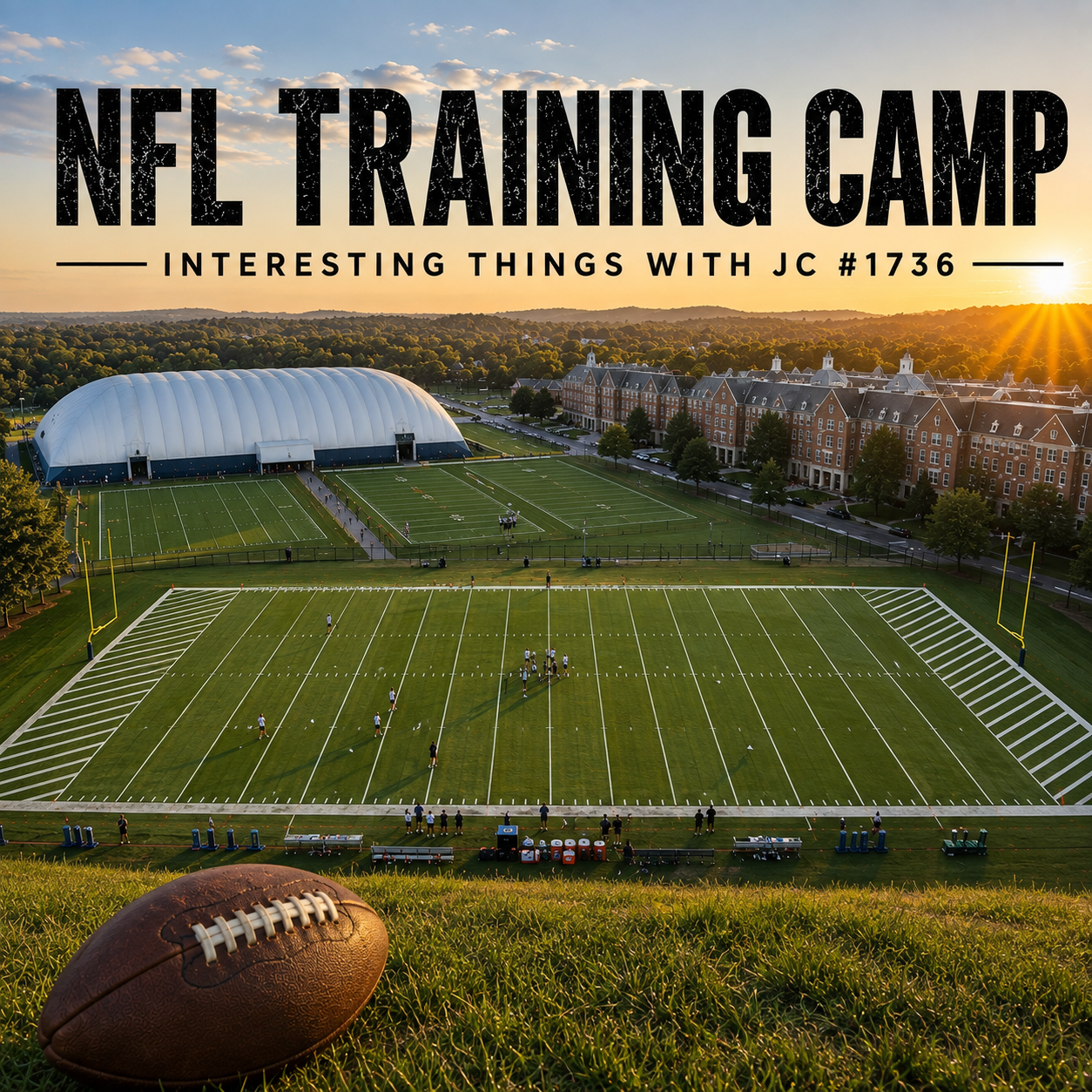
Promotional graphic for Interesting Things with JC episode #1736, titled "NFL Training Camp." A wide aerial view shows several football practice fields at sunset beside a large white indoor practice facility and brick dormitory-style buildings. Small groups of players are scattered across the fields during practice, and a football rests in the grass in the foreground. Large black text across the top reads, "NFL TRAINING CAMP," with "INTERESTING THINGS WITH JC #1736" beneath it.
Transcript
Interesting Things with JC #1736:
NFL Training Camp
Before the first game is played, every NFL team has to make 37 players disappear. Training camp opens with a 90-man roster. By the end of the preseason, only 53 remain. Every practice, every meeting, every drill, and every preseason snap helps determine who stays and who goes.
Training camp wasn't always about evaluating elite athletes. In the NFL's early decades, many players spent the offseason working factory jobs, farming, teaching, or selling insurance because football didn't pay enough to make a living. Coaches took teams to colleges and small towns for weeks at a time because players arrived needing to get back into football shape. Living together in dormitories, away from family and distractions, became part of the process, and a handful of teams still use that model today.
The competition has only become more precise. Every practice is scripted down to individual periods, and every repetition is graded from film. Coaches evaluate far more than touchdowns and tackles. They grade footwork, effort, assignment, reaction time, technique, and consistency, building a detailed record before deciding which 53 players earn a roster spot.
Players are measured just as carefully. Before practice, they're weighed. When practice ends, they're weighed again. Trainers use that change to estimate fluid loss and begin replacing it immediately. Players also wear GPS trackers that record speed, acceleration, distance covered, and workload, giving coaches objective data to balance performance with injury prevention. During the hardest weeks of camp, some offensive and defensive linemen consume more than 6,000 calories a day simply to maintain their playing weight.
One event changed training camp forever. In 2001, Minnesota Vikings tackle Korey Stringer died from heatstroke after practice. His death prompted sweeping changes across the NFL. Every practice now includes certified athletic trainers, physician oversight, emergency medical planning, and strict heat and hydration protocols. Those standards have since influenced athlete safety at every level of sports.
The punishing two-a-day practices that once defined training camp have largely disappeared, replaced by limits on full-contact work, advanced sports science, and recovery programs designed to keep players healthy through a 17-game season. But one thing hasn't changed. Before a single regular-season kickoff, every player has already faced the hardest opponent of the year: the teammate standing beside him, trying to earn the very same job.
These are interesting things, with JC.
Student Worksheet
Listening Instructions: Listen to the podcast episode first. If audio is unavailable, carefully read the transcript before completing the activities.
Student Name: ______________________
Date: ______________________
Learning Target: Demonstrate an understanding of how NFL training camps evaluate athletes while balancing performance, health, and safety.
Part A: Comprehension
How many players are on an NFL roster when training camp begins?
How many players remain on the active roster before the regular season?
Why did early NFL players need lengthy training camps?
List four factors coaches evaluate besides touchdowns and tackles.
What information do GPS trackers collect during practice?
Why are players weighed before and after practice?
What major event led to significant safety reforms during NFL training camps?
How have modern training camps changed compared to earlier decades?
Part B: Analysis
Explain why objective data, such as GPS measurements, is valuable alongside coaches' observations.
Why might consistency be more valuable than one outstanding performance during training camp?
Compare the training camp experience of NFL players in the 1940s with today's athletes.
Explain how sports science helps improve both player performance and player safety.
Part C: Reflection
Write one well-developed paragraph (8–10 sentences).
Prompt:
If you were responsible for selecting the final 53-player roster, what qualities would matter most to you? Explain how character, effort, teamwork, and measurable performance should influence your decisions.
Difficulty Scaling
Developing
Complete Part A.
Proficient
Complete Parts A and B using evidence from the transcript.
Advanced
Complete all sections and include examples from other sports, careers, or personal experiences.
Student Output Expectations
Students should demonstrate:
Accurate recall of information.
Evidence-based reasoning.
Clear written communication.
Connections between sports science and real-world decision-making.
Academic Integrity Guidance
Use your own words unless directly quoting the transcript.
Support responses with evidence from the episode.
Cite examples accurately.
Complete all written work independently unless collaboration is assigned.
Teacher Guide
Quick Start: Begin class by playing the podcast episode. If audio equipment is unavailable, distribute the transcript and have students complete a guided reading before discussion.
Pacing Guide (Audio-First):
Bell Ringer (5 minutes)
Podcast Listening (6–8 minutes)
Vocabulary Review (5 minutes)
Class Discussion (10 minutes)
Student Worksheet (20 minutes)
Review and Exit Ticket (5–7 minutes)
Bell Ringer:
Ask students:
"If you had to choose only 53 people from a group of 90 applicants for an important job, what qualities would you value most?"
Allow students to share brief responses before introducing the lesson.
Audio Guidance
Encourage students to listen for:
Numbers and statistics.
Changes over time.
Safety improvements.
Examples of technology in sports.
Audio Fallback
If audio is unavailable:
Read the transcript aloud.
Assign partner reading.
Conduct a guided close-reading discussion.
Estimated Time on Task: 45–60 minutes
Materials
Podcast audio or transcript
Student worksheet
Notebook
Projector or interactive display (optional)
Vocabulary Strategy
Before listening, preview:
Hydration
Workload
Film study
Recovery
Heatstroke
Have students predict how each term might relate to professional football.
Common Misconceptions
Bigger athletes are automatically the best players.
Coaches only evaluate game statistics.
Professional athletes no longer need conditioning.
Modern technology replaces coaching experience.
Safety rules make athletes less competitive.
Discussion Prompts
Why is consistency important in professional sports?
Should objective data outweigh a coach's personal observations? Why or why not?
How has sports science changed athletics over the past several decades?
What lessons from NFL training camps apply to other careers?
Formative Checkpoints
During instruction, verify students can:
Explain roster reductions.
Describe at least three evaluation methods.
Explain hydration monitoring.
Describe why Korey Stringer's death changed league policies.
Connect sports science to athlete safety.
Differentiation
For additional support:
Provide vocabulary cards.
Pair students for discussion.
Offer guided notes.
Allow verbal responses before writing.
For enrichment:
Research another professional sport's preseason evaluation process.
Compare sports performance analytics across different leagues.
Investigate wearable technology used in other professions.
Assessment Differentiation
Students may demonstrate learning through:
Written responses.
Oral presentations.
Graphic organizers.
Short research summaries.
Multimedia presentations.
Time Flexibility
30 Minutes
Audio
Discussion
Comprehension questions
45 Minutes
Standard lesson
60 Minutes
Full worksheet
Extended discussion
Reflection writing
Substitute Readiness
This lesson may be taught without specialized football knowledge by following the transcript, discussion prompts, worksheet, and answer key.
Engagement Strategy
Ask students to imagine they are NFL general managers making final roster decisions. Throughout the lesson, have them justify which athletes they would keep and why using evidence from the episode.
Extensions
Research NFL Combine testing.
Investigate careers in athletic training.
Compare modern sports analytics with traditional scouting.
Examine heat safety procedures in high school athletics.
Cross-Curricular Connections
Biology: Human physiology and hydration.
Health: Heat illness prevention.
Mathematics: Data analysis and performance metrics.
Technology: GPS tracking and wearable devices.
Business: Personnel evaluation and hiring decisions.
SEL Connection
Students practice:
Self-discipline.
Goal setting.
Perseverance.
Respect for teammates and competitors.
Constructive decision-making under pressure.
Skill Emphasis
Critical thinking
Observation
Evidence evaluation
Data interpretation
Communication
Collaboration
Professional judgment
Ethical decision-making
Answer Key
Comprehension
90 players.
53 players.
Many players worked offseason jobs and needed time to regain football conditioning.
Possible answers: footwork, effort, assignments, reaction time, technique, consistency.
Speed, acceleration, distance covered, and workload.
To estimate fluid loss and guide hydration.
Korey Stringer's death from heatstroke in 2001.
Greater use of sports science, fewer full-contact practices, improved medical oversight, enhanced recovery programs, and stricter safety protocols.
Analysis (Sample Responses)
Objective data provides measurable evidence that complements coaching observations.
Consistency demonstrates reliability throughout a long season.
Earlier athletes often worked non-football jobs and needed conditioning, while today's players train year-round using advanced sports science.
Sports science reduces injury risk while improving conditioning, recovery, and performance.
Quiz
Directions: Select the best answer for each question. Use evidence from the episode to support your thinking if asked during class discussion. Do not write the answers on this sheet.
Why does NFL training camp begin with a 90-player roster?
A. To allow every college player to participate
B. To evaluate players before selecting the regular-season roster
C. To prepare for international competition
D. To replace injured coaches
Which of the following is NOT specifically mentioned as something coaches evaluate?
A. Footwork
B. Assignment execution
C. Reaction time
D. College grade point average
Why are players weighed before and after practice?
A. To determine body fat percentage
B. To estimate fluid loss and guide hydration
C. To calculate sprint speed
D. To determine jersey size
Which event led to major changes in NFL heat safety protocols?
A. Expansion to a 17-game season
B. The introduction of GPS tracking
C. The death of Korey Stringer from heatstroke
D. The elimination of preseason games
Which statement best summarizes modern NFL training camps?
A. Coaches rely only on statistics from preseason games.
B. Technology has replaced coaches' judgment.
C. Scientific data and coaching observations work together to evaluate athletes while protecting player health.
D. Every player who enters training camp makes the final roster.
Assessment
Open-Ended Question 1
Explain how technology has changed the way NFL teams evaluate players. Use at least three examples from the episode.
Open-Ended Question 2
Describe how the NFL balances competition with player safety during training camp. Why is this balance important for both athletes and teams?
3–2–1 Rubric
Level 3 – Proficient
Demonstrates accurate understanding of the episode.
Uses multiple pieces of evidence from the transcript.
Explains ideas clearly with thoughtful analysis.
Makes meaningful real-world connections.
Level 2 – Developing
Demonstrates basic understanding.
Uses some evidence from the episode.
Explains ideas with limited detail.
Makes simple connections.
Level 1 – Beginning
Demonstrates limited understanding.
Provides little or no supporting evidence.
Responses are incomplete or unclear.
Exit Ticket
On one sentence each, answer the following before leaving class:
One new fact I learned today…
One question I still have…
One way sports science improves athlete safety…
Standards Alignment
National Alignment Overview
This lesson integrates literacy, science, health, technology, inquiry, and career readiness through an examination of NFL training camp. Students analyze informational text, interpret evidence, evaluate technological applications, and examine how scientific research has improved athlete safety.
Next Generation Science Standards (NGSS)
HS-ETS1-3 — Engineering Design: Evaluate a Solution to a Complex Real-World Problem
Lesson Connection: Students examine GPS monitoring, hydration measurement, and recovery programs used during training camp.
Measurable Skill: Evaluate how technology improves both athletic performance and player safety.
Alignment Justification: Students analyze how engineering and sports science solve real-world health and performance challenges.
Science and Engineering Practice: Analyzing and Interpreting Data
Lesson Connection: Students interpret workload measurements, hydration data, and performance evaluations.
Measurable Skill: Use evidence to support conclusions about athlete monitoring.
Alignment Justification: The lesson requires students to analyze quantitative information and explain its practical application.
Common Core State Standards – Reading
CCSS.ELA-LITERACY.RST.11-12.2 — Determine Central Ideas of Informational Text
Lesson Connection: Students identify major concepts presented in the podcast transcript.
Measurable Skill: Summarize complex informational content objectively.
Alignment Justification: Students distinguish central ideas from supporting details throughout the lesson.
CCSS.ELA-LITERACY.RST.11-12.7 — Integrate and Evaluate Multiple Sources of Information
Lesson Connection: Students connect the podcast with teacher discussion and supplemental readings.
Measurable Skill: Compare evidence across multiple informational sources.
Alignment Justification: Students synthesize information from audio, text, and instructor-guided resources.
Common Core State Standards – Writing
CCSS.ELA-LITERACY.WHST.11-12.2 — Write Informative/Explanatory Texts
Lesson Connection: Reflection and assessment responses require explanatory writing supported by evidence.
Measurable Skill: Produce organized, evidence-based written responses.
Alignment Justification: Students explain how evaluation methods and sports science contribute to team success.
CCSS.ELA-LITERACY.WHST.11-12.9 — Draw Evidence from Informational Texts
Lesson Connection: Students support worksheet and assessment responses using information from the transcript.
Measurable Skill: Cite relevant evidence accurately.
Alignment Justification: Students demonstrate evidence-based reasoning throughout the lesson.
Common Core State Standards – Speaking and Listening
CCSS.ELA-LITERACY.SL.11-12.1 — Collaborative Discussions
Lesson Connection: Students participate in guided discussions regarding competition, technology, and athlete safety.
Measurable Skill: Build upon classmates' ideas using evidence and respectful dialogue.
Alignment Justification: Structured classroom discussion promotes critical thinking and communication.
College, Career, and Civic Life (C3) Framework
D2.Soc.16.9-12 — Interpret the Effects of Technology and Institutions on Society
Lesson Connection: Students examine how sports science and organizational policies transformed professional football.
Measurable Skill: Analyze institutional responses to safety challenges.
Alignment Justification: Students investigate how organizations adapt using research, technology, and policy improvements.
ISTE Standards for Students
ISTE 1.3 — Knowledge Constructor
Lesson Connection: Students evaluate evidence presented through the podcast and supporting instructional materials.
Measurable Skill: Critically evaluate information from reliable sources.
Alignment Justification: Students build knowledge through inquiry and evidence-based analysis.
Career Readiness Competencies
Analytical Thinking
Lesson Connection: Students evaluate multiple forms of player performance data.
Measurable Skill: Interpret qualitative and quantitative evidence before making decisions.
Alignment Justification: Mirrors workplace decision-making processes used in professional sports and other industries.
Communication
Lesson Connection: Students explain conclusions through discussion and written responses.
Measurable Skill: Present evidence clearly using academic language.
Alignment Justification: Effective communication is essential across all professional environments.
Problem Solving
Lesson Connection: Students evaluate how technology addresses athlete safety challenges.
Measurable Skill: Recommend evidence-based solutions to real-world problems.
Alignment Justification: Demonstrates application of scientific reasoning to practical situations.
Adaptability
Lesson Connection: Students examine how players continually adjust to evaluation and changing expectations.
Measurable Skill: Recognize the importance of flexibility during performance evaluation.
Alignment Justification: Adaptability is a critical workforce competency in rapidly changing environments.
Professional Judgment
Lesson Connection: Students justify roster decisions using objective evidence rather than personal preference.
Measurable Skill: Apply fair, evidence-based decision-making.
Alignment Justification: Reinforces ethical evaluation practices used across professional careers.
Homeschool / Lifelong Learning Alignment
Independent Learning
Lesson Connection: Students independently analyze the transcript and complete written responses.
Measurable Skill: Demonstrate self-directed comprehension and reflection.
Alignment Justification: Supports autonomous learning in flexible educational settings.
Information Literacy
Lesson Connection: Students distinguish factual evidence from opinion while evaluating sports information.
Measurable Skill: Assess source credibility and relevance.
Alignment Justification: Develops transferable research and evaluation skills.
Real-World Application
Lesson Connection: Students connect sports performance evaluation with hiring, training, and workplace assessment.
Measurable Skill: Transfer classroom learning to professional and everyday situations.
Alignment Justification: Encourages practical application beyond athletics.
Self-Directed Inquiry
Lesson Connection: Extension activities encourage further investigation into sports medicine and performance science.
Measurable Skill: Develop meaningful research questions and locate reliable answers.
Alignment Justification: Promotes curiosity and continuous learning.
Transferable Life Skills
Lesson Connection: Students examine perseverance, preparation, accountability, and teamwork.
Measurable Skill: Apply personal responsibility and reflective thinking to future academic and career goals.
Alignment Justification: Reinforces skills valuable across education, employment, and lifelong learning.
Show Notes
This lesson uses the story of NFL training camp to explore how preparation, evaluation, science, and safety intersect in one of the world's most competitive professional sports. Students learn that success depends on more than athletic ability alone; disciplined preparation, objective evaluation, teamwork, informed decision-making, and continual improvement are essential in athletics and nearly every career. By examining the evolution of player safety and performance analytics, learners gain a deeper appreciation for the role of science and technology in protecting people while improving performance.
References
National Athletic Trainers' Association. (n.d.). National Athletic Trainers' Association. https://www.nata.org/
National Football League. (n.d.). NFL Football Operations. https://operations.nfl.com/
National Football League. (n.d.). NFL player health and safety. https://www.nfl.com/playerhealthandsafety/
National Football League. (n.d.). NFL training camp roster FAQs: Defining injured reserve, PUP list, NFI, and more. https://www.nfl.com/news/nfl-training-camp-roster-faqs-defining-injured-reserve-pup-list-nfi-and-more
Pro Football Hall of Fame. (n.d.). Korey Stringer. https://www.profootballhof.com/players/korey-stringer/
The Korey Stringer Institute. (n.d.). Korey Stringer Institute. https://koreystringer.institute.uconn.edu/
USA Football. (n.d.). Heat preparedness and hydration. https://usafootball.com/health-safety/