Interesting Things with JC #1735: "The SpaceX Rocket That Crashed on the Moon"
A spent SpaceX Falcon 9 upper stage drifted through space for more than a year after completing its mission before gravity pulled it into the moon, where its impact created a new crater that spacecraft can study.
Curriculum - Episode Anchor
Episode Title: SpaceX Rocket Lunar Impact
Episode Number: 1735
Host: JC
Audience: Grades 9–12, introductory college, homeschool, and lifelong learners
Subject Area: Space science, physics, astronomy, engineering, and information literacy
Lesson Overview
Lesson Length: 55–75 minutes
Instructional Approach: Audio-first scientific inquiry followed by evidence analysis
Learning Objectives:
Explain how gravitational forces can alter the long-term trajectory of an unpowered rocket stage.
Calculate or interpret relationships among mass, velocity, kinetic energy, and impact effects.
Distinguish direct observations, scientific estimates, model-based predictions, and later measurements.
Evaluate the responsibilities associated with tracking and disposing of hardware in cislunar space.
Essential Question: How can scientists reconstruct and evaluate the path and effects of an uncontrolled object traveling between Earth and the moon?
Success Criteria: Students can describe the rocket stage’s trajectory, identify at least two impact effects, classify claims by evidence type, and support an explanation with information from the episode.
Student Relevance Statement: Satellite launches, navigation systems, communications technology, and lunar exploration depend on engineers making responsible decisions about spacecraft trajectories and discarded hardware.
Real-World Connection: Astronomers, orbital analysts, spacecraft engineers, and mission planners use observations and mathematical models to track objects, study impacts, and improve future missions.
Workforce Reality: Space careers require mathematical discipline, careful documentation, collaborative decision-making, and a willingness to revise conclusions when new measurements become available.
Key Vocabulary
Cislunar(sis-LOO-nər): The region of space between Earth and the moon, including areas influenced by both bodies’ gravity.
Upper stage(UP-er stayj): The portion of a multistage rocket that operates after lower stages separate and helps place a payload on its intended trajectory.
Trajectory(truh-JEK-tuh-ree): The path followed by an object moving through space.
Gravitational perturbation(grav-ih-TAY-shuh-nuhl per-ter-BAY-shuhn): A change in an object’s path caused by the gravitational influence of another body.
Kinetic energy(kih-NET-ik EN-er-jee): The energy an object possesses because of its motion, calculated as one-half of its mass multiplied by the square of its velocity.
Regolith(REG-uh-lith): The loose dust, soil, and broken rock covering the lunar surface.
Ejecta(ee-JEK-tuh): Material thrown outward from an impact site.
Impact crater(IM-pakt KRAY-ter): A depression formed when a fast-moving object strikes a solid surface.
Orbital model(OR-bih-tuhl MOD-uhl): A mathematical representation used to reconstruct or predict an object’s position and motion.
Lunar limb(LOO-nər lim): The apparent outer edge of the moon as viewed by an observer.
Narrative Core
Open: A rocket stage can finish its assigned mission yet continue moving through space for months or years. Without propulsion, its path depends on momentum and the gravitational influence of nearby bodies.
Info: The Falcon 9 upper stage associated with the January 2025 Blue Ghost launch remained in space after payload deployment and later struck the moon near the Einstein crater region.
Details: The stage had an estimated mass near 3,900 kilograms and an impact speed of approximately 2.43 kilometers per second. Because kinetic energy increases with the square of velocity, the collision released substantial energy, excavated a new crater, and displaced lunar regolith. Scientists could compare later observations with pre-impact models to evaluate the accuracy of their calculations.
Reflection: The event demonstrates both scientific capability and operational responsibility. Researchers can track uncontrolled objects and study their effects, while mission planners must consider what happens to hardware after its primary task is finished.
Closing: These are interesting things, with JC.
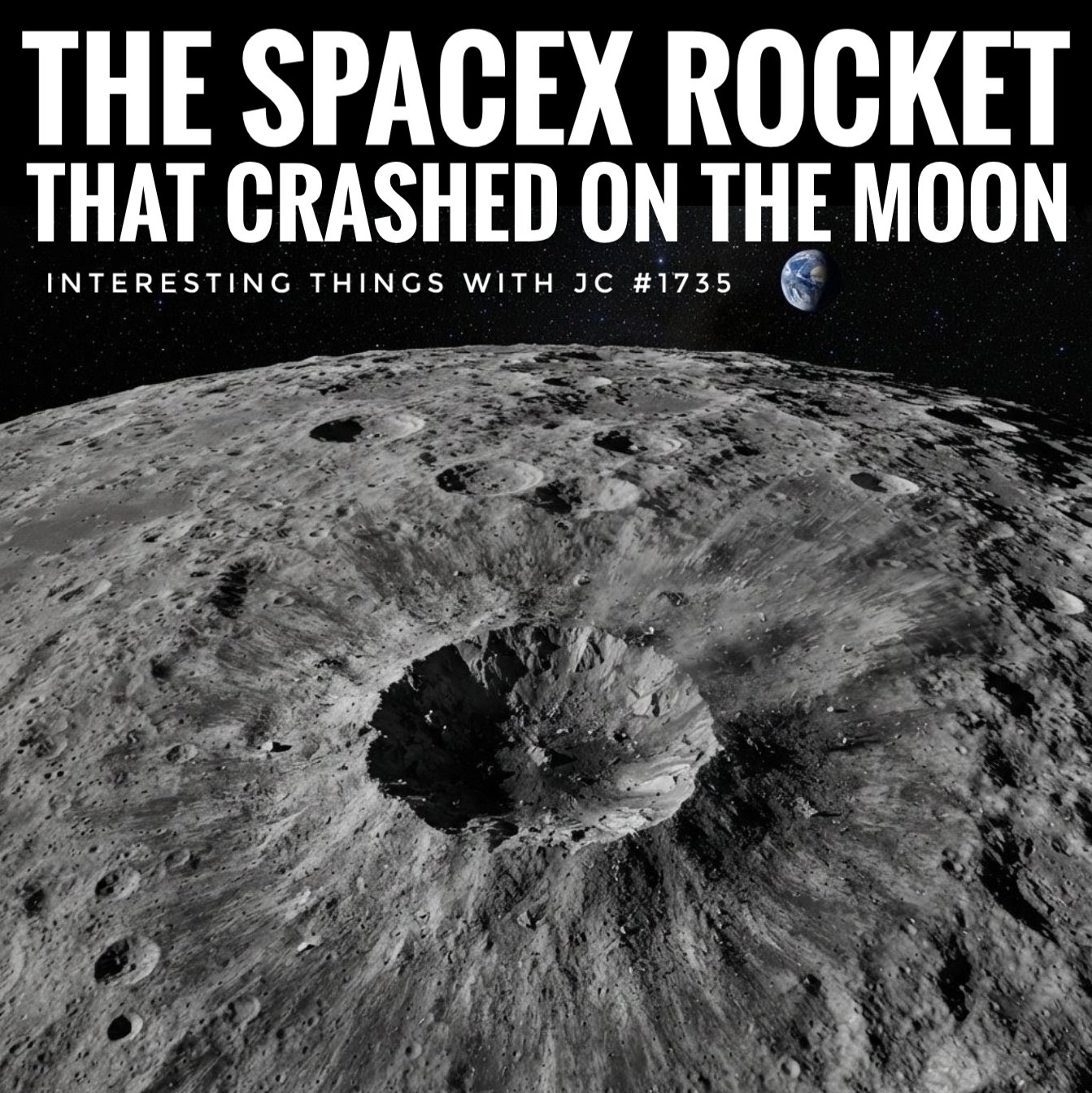
Promotional graphic for “The SpaceX Rocket That Crashed on the Moon,” showing a detailed grayscale lunar surface with a large crater in the foreground, Earth in the star-filled sky, and bold white title text above. Smaller text reads, “Interesting Things with JC #1735.”
Transcript
Interesting Things with JC #1735:
"When a SpaceX Rocket Crashed on the Moon"
A SpaceX Falcon 9 rocket stage has created a brand-new impact site on the moon.
At approximately 2:34 a.m. Eastern on August 5, 2026, the 45-foot-long, 8,800-pound (13.7-meter, 4-metric-ton) upper stage struck the lunar surface at about 5,400 miles per hour, or 8,700 kilometers per hour. It launched Firefly Aerospace's Blue Ghost lunar lander in January 2025. After releasing its payload, the stage exhausted its fuel and was left in a high Earth orbit with no propulsion and no way to change course.
Over the following 18 months, the combined gravity of Earth, the moon, and the Sun gradually altered its path until astronomers confirmed it was on a collision course with the lunar surface. The impact occurred near Einstein crater on the moon's western limb, an area that's difficult to observe from Earth.
Scientists estimate the collision released energy roughly equal to three tons of TNT, likely excavating a crater about 60 to 90 feet, or 18 to 30 meters, wide and throwing a plume of dust and rock high above the surface. Although the impact wasn't visible to most observers on Earth, NASA's Lunar Reconnaissance Orbiter and South Korea's Danuri spacecraft are expected to image the site in the coming days. Those images will allow scientists to measure the crater, map the debris field, and compare the results with computer models of lunar impacts.
Unlike most rocket stages, this one never burned up in Earth's atmosphere or fell harmlessly into the ocean. It completed its mission 18 months ago, drifted through cislunar space for more than a year, and has now become part of the moon's landscape.
These are interesting things, with JC.
Student Worksheet
Directions: Listen to the complete podcast before reading the transcript. During the first listening, record the sequence of events. During the second listening or transcript review, identify evidence, predictions, and scientific estimates.
Comprehension Questions:
What mission did the Falcon 9 upper stage help launch?
Why was the upper stage unable to make a controlled course change?
Which three celestial bodies influenced the stage’s long-term trajectory?
Where was the stage predicted to strike the moon?
What two spacecraft were identified as possible sources of post-impact images?
What scientific measurements could researchers obtain from those images?
Analysis Questions:
Classify each statement as confirmed before impact, predicted before impact, or requiring post-impact confirmation:
The stage launched in January 2025.
The stage would travel approximately 2.43 kilometers per second at impact.
A crater 18–30 meters wide formed.
A plume rose above the lunar surface.
The final impact point was near Einstein crater.
Explain why a rocket stage without fuel can continue moving and changing direction in space.
Use (KE=\frac{1}{2}mv^2), a mass of 3,900 kilograms, and a speed of 2,430 meters per second to estimate the stage’s kinetic energy.
Explain why uncertainty in the stage’s mass, speed, angle, construction, or impact surface could change the predicted crater size.
Evaluate this claim: “The rocket was no longer operating, so it was no longer part of a space mission.” Support your answer with evidence.
Identify one sentence in the transcript that states a prediction as though it has already been observed. Rewrite it using scientifically accurate pre-impact language.
Reflection Prompt: What responsibility should launch providers have for tracking or managing upper stages after payload deployment? Address scientific feasibility, mission limits, and potential effects on future exploration.
Difficulty Scaling:
Foundation: Complete comprehension questions 1–6 and analysis questions 1–2.
On-Level: Complete all comprehension questions and analysis questions 1–5.
Advanced: Complete every task, show the kinetic-energy calculation, and compare the result with the transcript’s TNT estimate.
Introductory College: Evaluate uncertainties in the prediction and propose a post-impact observation plan using at least three measurable variables.
Student Output: Submit one completed worksheet containing short answers of 1–3 sentences, one labeled kinetic-energy calculation, and a reflection response of 150–250 words.
Academic Integrity Guidance: Use the episode, teacher-provided sources, and your own calculations. Clearly identify any outside source or digital tool used. Do not present generated text, copied explanations, or another student’s calculations as your own work.
Teacher Guide
Quick Start: Play the podcast without distributing the transcript. Ask students to record the object, timeline, forces, predicted outcome, and evidence needed for confirmation. Provide the transcript only after the first listening.
Pacing Guide:
Podcast launch and first listening—5 minutes: Students listen without interruption and record the event sequence.
Bell ringer discussion—5 minutes: Students separate what happened before August 5 from what was predicted to happen.
Second listening or transcript review—8 minutes: Students mark measurements, estimates, and future observations.
Vocabulary and physics connection—10 minutes: Review trajectory, perturbation, kinetic energy, regolith, and ejecta.
Worksheet investigation—15–20 minutes: Students answer comprehension and analysis questions.
Evidence-status discussion—10 minutes: Groups compare confirmed facts with predictions.
Assessment and exit ticket—7–12 minutes: Students complete an open-ended response or exit ticket.
Bell Ringer: A spacecraft engine shuts down while the craft is moving through space. Does the spacecraft stop, continue in a straight line, or follow another path? Explain what forces could affect it.
Audio Guidance: Before playing the episode, tell students to listen for chronology, measurements, causes, and words that communicate certainty. Pause only after the first uninterrupted listening.
Audio Fallback: Read the transcript aloud or assign alternating paragraphs to students. Preserve the audio-first sequence by requiring students to listen to the complete oral reading before annotating the printed text.
Time on Task: Core lesson: 55 minutes. Full calculation, discussion, and assessment: 75 minutes.
Materials:
Podcast audio or teacher-read transcript
Student worksheet
Calculator
Pencil or digital annotation tool
Optional diagram of the Earth–moon system
Vocabulary Strategy: Display each term with a student-friendly definition. Ask pairs to connect each word to a specific sentence or event in the transcript.
Misconceptions:
“Objects stop moving when engines shut down.” Explain that inertia maintains motion while gravity changes the trajectory.
“There is no gravity in space.” Gravity acts throughout space, although its strength decreases with distance.
“A prediction is the same as an observation.” A prediction is model-based and remains subject to confirmation.
“The largest gravitational body always determines the entire path.” The trajectory reflects initial conditions and the combined influence of multiple bodies.
“An estimate of crater size proves the crater’s actual dimensions.” Direct imaging is needed to measure the final result.
Discussion Prompts:
Why is this collision scientifically valuable even though it was not designed as an experiment?
Which variables would scientists need to predict the impact accurately?
What evidence would confirm or disprove the predicted crater dimensions?
How should engineers balance mission performance, fuel limits, cost, and disposal planning?
Does an object remain a human responsibility after it stops functioning? Why?
Formative Checkpoints:
Ask students to identify one force and one motion principle involved in the stage’s path.
Check whether students square velocity in the kinetic-energy formula.
Require students to label at least three transcript claims by evidence status.
Have students explain the difference between ejecta and an impact crater.
Differentiation:
Developing readers: Supply a timeline with missing events and a vocabulary word bank.
Multilingual learners: Pair terms with diagrams and allow initial explanations in the student’s strongest language.
Students needing numerical support: Provide a partially completed kinetic-energy equation.
Advanced learners: Ask students to investigate how impact angle and surface composition affect crater morphology.
Auditory learners: Replay selected sentences and allow oral responses before written work.
Assessment Differentiation: Students may submit a written explanation, annotated scientific diagram, or recorded two-minute explanation, provided they address the same evidence and reasoning criteria.
Time Flexibility: For a 40-minute period, complete the first listening, vocabulary review, comprehension questions, and exit ticket. Assign the analysis and reflection tasks as homework.
Substitute Readiness: Provide the transcript, worksheet, calculator instructions, and answer key. The substitute should read or play the episode first, then direct students through the worksheet in order.
Engagement Strategy: Assign students to an “impact investigation team.” Give each group one role: trajectory analyst, impact physicist, observation planner, or mission-responsibility reviewer. Groups report one finding and one remaining uncertainty.
Extensions:
Compare the event with an intentional Apollo upper-stage impact or the unidentified rocket-body impact observed by LRO in 2022.
Model the relationship between velocity and kinetic energy using a spreadsheet.
Design an observation checklist for comparing pre-impact and post-impact lunar images.
Research methods for passivating, deorbiting, or tracking upper stages.
Cross-Curricular Connections:
Physics: Inertia, gravity, velocity, kinetic energy, and collisions.
Mathematics: Unit conversion, scientific notation, proportional reasoning, and uncertainty.
Earth and space science: Lunar geology, regolith, cratering, and orbital systems.
Engineering: Mission constraints, disposal planning, and risk management.
English language arts: Source evaluation, precise language, and evidence-based explanation.
Career education: Orbital analysis, aerospace engineering, data interpretation, and professional judgment.
SEL Connection: Students practice intellectual humility by separating what is known from what is predicted and by revising conclusions when new evidence appears.
Skill Value Emphasis: The lesson develops analytical thinking, quantitative reasoning, communication, evidence evaluation, problem solving, adaptability, and responsible decision-making.
Answer Key:
Comprehension
It helped launch Firefly Aerospace’s Blue Ghost lunar lander; the launch also carried ispace’s Resilience lander.
The stage had exhausted or lacked usable propulsion for a controlled course change.
Earth, the moon, and the Sun.
Near the Einstein crater region on the lunar limb or far-side region.
NASA’s Lunar Reconnaissance Orbiter and South Korea’s Danuri spacecraft.
Scientists could measure the crater, locate the impact, map ejecta or debris, examine surface changes, and compare observations with models.
Analysis
Launch date: confirmed before impact. Predicted velocity: predicted before impact. Crater size: requires post-impact confirmation. Plume behavior: predicted and requiring observation. Final impact point: predicted before impact and requiring final confirmation.
Inertia allows the stage to continue moving after propulsion ends. Earth, lunar, and solar gravity alter its speed and direction over time.
(KE=\frac{1}{2}(3,900)(2,430^2)). (2,430^2=5,904,900). Estimated kinetic energy: approximately (1.15\times10^{10}) joules.
Each variable affects how energy is delivered to the surface and how material is displaced. A shallow angle, hollow structure, weak surface material, or different speed could produce a different crater and ejecta pattern.
Responses will vary. Strong answers explain that the primary payload mission had ended, but tracking, observation, risk evaluation, and responsibility for the hardware continued.
Example: “Scientists predict that the collision will release energy roughly equal to three tons of TNT and may excavate a crater approximately 18–30 meters wide.”
Reflection: Accept reasoned positions supported by evidence. Strong responses recognize technical and fuel constraints while supporting tracking, documentation, disposal planning, and coordination.
Quiz
What caused the upper stage’s trajectory to change after it stopped using propulsion?
A. Atmospheric wind above the moon
B. Combined gravitational influences
C. Continuous thrust from the payload
D. Magnetic attraction from lunar rocksWhy is velocity especially important when calculating kinetic energy?
A. Velocity is divided by mass
B. Velocity remains constant in every orbit
C. Velocity is squared in the equation
D. Velocity determines the object’s chemical compositionWhat is lunar ejecta?
A. Fuel remaining inside a rocket
B. Material thrown from an impact site
C. Light reflected by a spacecraft
D. A vehicle orbiting the moonWhich finding would require post-impact observation?
A. The launch occurred in January 2025
B. The object was a Falcon 9 upper stage
C. The stage had been tracked before impact
D. The resulting crater measured 25 meters acrossWhat is the principal scientific value of imaging the site after impact?
A. It would restart the rocket’s propulsion system
B. It would recover the entire rocket stage
C. It would allow predictions to be compared with observed results
D. It would prevent all future objects from reaching the moon
Assessment
Open-Ended Questions:
Explain how inertia and gravitational perturbations can cause an unpowered rocket stage to travel for more than a year and eventually collide with the moon. Use at least three vocabulary terms.
Develop a post-impact investigation plan. Identify three measurements researchers should collect, explain the instrument or observation needed for each, and state how each measurement would test a prediction from the episode.
3–2–1 Rubric:
3—Proficient: The response is scientifically accurate, uses specific episode evidence, distinguishes prediction from observation, applies relevant vocabulary, and communicates reasoning clearly.
2—Developing: The response demonstrates partial understanding and includes some evidence, but contains an incomplete explanation, limited vocabulary, or an unclear distinction between prediction and observation.
1—Beginning: The response provides minimal evidence, contains major scientific errors, or does not explain the relationship among motion, gravity, impact, and observation.
Exit Ticket: In three sentences, identify one confirmed fact, one predicted outcome, and one observation needed to determine whether the prediction was accurate.
Standards Alignment
NGSS Science and Engineering Practices
HS-ESS1-4 — Use mathematical or computational representations to predict the motion of orbiting objects in the solar system. Connection: Students explain how gravitational influences altered the upper stage’s trajectory. Measurable outcome: Students construct or interpret a model linking inertia, gravity, and the predicted lunar impact. Justification: The trajectory analysis directly applies mathematical and conceptual representations of orbital motion.
HS-PS2-4 — Use mathematical representations of Newton’s law of gravitation and Coulomb’s law to describe and predict gravitational and electrostatic forces between objects. Connection: The lesson examines the combined influence of Earth, the moon, and the Sun. Measurable outcome: Students identify how gravitational forces produce changes in motion without active propulsion. Justification: Worksheet analysis question 2 requires students to apply gravitational reasoning to a real object.
HS-PS3-1 — Create a computational model to calculate the change in the energy of one component in a system when the change in energy of the other components and energy flows are known. Connection: Students calculate the stage’s approximate kinetic energy. Measurable outcome: Students correctly apply (KE=\frac{1}{2}mv^2) and interpret the result. Justification: The numerical worksheet task directly measures energy-modeling ability.
CCSS Reading
CCSS.ELA-LITERACY.RST.9-10.1 — Cite specific textual evidence to support analysis of science and technical texts. Connection: Students support explanations with details from the transcript. Measurable outcome: Students cite at least two episode facts in an analysis response. Justification: The worksheet and assessment require evidence-based scientific reasoning.
CCSS.ELA-LITERACY.RST.11-12.2 — Determine the central ideas or conclusions of a text and summarize complex concepts accurately. Connection: Students identify the event sequence, scientific significance, and remaining uncertainties. Measurable outcome: Students produce an accurate summary distinguishing the main event from supporting details. Justification: The listening notes and comprehension tasks require concise synthesis.
CCSS.ELA-LITERACY.RST.11-12.8 — Evaluate the hypotheses, data, analysis, and conclusions in a science or technical text. Connection: Students separate model-based estimates from observed results. Measurable outcome: Students correctly classify claims as confirmed, predicted, or awaiting verification. Justification: Evidence-status analysis is a central lesson product.
CCSS Writing
CCSS.ELA-LITERACY.WHST.9-10.2 — Write informative or explanatory texts to examine and convey complex scientific ideas clearly and accurately. Connection: Students explain orbital motion and impact physics. Measurable outcome: Students organize a response using accurate vocabulary, evidence, and cause-and-effect reasoning. Justification: Both open-ended assessment questions require scientific explanation.
CCSS.ELA-LITERACY.WHST.11-12.9 — Draw evidence from informational texts to support analysis, reflection, and research. Connection: Students use the transcript and approved sources to discuss mission responsibility. Measurable outcome: Students integrate evidence into a supported judgment. Justification: The reflection task links factual evidence with reasoned decision-making.
CCSS Speaking and Listening
CCSS.ELA-LITERACY.SL.9-10.1 — Initiate and participate effectively in collaborative discussions. Connection: Students work in impact-investigation roles and compare evidence classifications. Measurable outcome: Students contribute one evidence-based finding and respond to another group’s reasoning. Justification: The structured discussion requires preparation, collaboration, and clear communication.
C3 Framework
D2.His.12.9-12 — Use questions generated about multiple historical sources to pursue further inquiry and investigate additional sources. Connection: Students question whether claims are predictions or completed observations and identify evidence needed after the event. Measurable outcome: Students generate at least two follow-up inquiry questions for post-impact research. Justification: The lesson emphasizes chronological source evaluation and changing evidence.
D4.1.9-12 — Construct arguments using precise and knowledgeable claims with evidence from multiple sources. Connection: Students evaluate responsibility for uncontrolled space hardware. Measurable outcome: Students state a defensible claim, use relevant evidence, and address a practical constraint. Justification: The reflection prompt and discussion directly assess evidence-based judgment.
ISTE Standards
ISTE 1.3.b — Students evaluate the accuracy, perspective, credibility, and relevance of information, media, data, or other resources. Connection: Students compare the transcript’s completed-event language with the pre-impact status of available evidence. Measurable outcome: Students identify unsupported certainty and rewrite a claim accurately. Justification: Analysis question 6 explicitly measures digital and scientific information literacy.
ISTE 1.5.b — Students collect data or identify relevant data sets, use digital tools to analyze them, and represent data to facilitate problem solving and decision-making. Connection: Students may model kinetic energy or compare predicted and measured crater data. Measurable outcome: Students calculate, organize, and interpret impact variables. Justification: The extension and assessment plan connect data analysis to scientific decisions.
Career Readiness Competencies
Analytical Thinking: Students separate known quantities, model-based estimates, and unknown results. Measurable outcome: Correct classification of at least four claims. Justification: Aerospace work depends on disciplined interpretation of incomplete evidence.
Communication: Students explain technical concepts using precise vocabulary and organized reasoning. Measurable outcome: A clear oral or written explanation supported by episode evidence. Justification: Scientific findings must be communicated to specialists and non-specialists.
Problem Solving: Students calculate kinetic energy and design a post-impact investigation. Measurable outcome: A valid calculation and a three-measurement observation plan. Justification: The tasks require applying scientific knowledge to a new operational problem.
Adaptability: Students revise a conclusion when post-impact data differ from predictions. Measurable outcome: Students identify how at least one model would need revision. Justification: Technical professionals must respond constructively to new evidence.
Professional Judgment: Students evaluate disposal responsibility while considering fuel, mission, cost, and safety constraints. Measurable outcome: A balanced recommendation supported by evidence. Justification: Real aerospace decisions require responsibility without ignoring operational limitations.
Homeschool / Lifelong Learning Alignment
Independent Learning: Learners use the episode, transcript, calculations, and reference materials to construct an explanation without continuous instructor direction. Measurable outcome: Completion of the evidence chart and reflection.
Information Literacy: Learners distinguish predictions, estimates, reporting, and direct observations. Measurable outcome: Accurate classification and revision of time-sensitive claims.
Real-World Application: Learners connect Newtonian motion and kinetic energy to an actual aerospace event. Measurable outcome: Correct explanation of the stage’s uncontrolled path and impact energy.
Self-Directed Inquiry: Learners generate questions about crater measurement, ejecta, trajectory accuracy, or hardware disposal. Measurable outcome: At least two researchable follow-up questions.
Transferable Life Skills: Learners practice quantitative reasoning, source evaluation, responsible judgment, and clear communication. Measurable outcome: A supported decision that acknowledges evidence and uncertainty.
Show Notes
A spent Falcon 9 upper stage from the 2025 Blue Ghost launch was predicted to strike the moon near the Einstein crater region on August 5, 2026. This lesson uses the event to teach orbital motion, gravitational perturbations, kinetic energy, lunar cratering, and the distinction between scientific prediction and confirmed observation. Students calculate impact energy, assess the language of certainty, plan post-impact measurements, and consider the practical responsibilities involved in managing hardware beyond Earth orbit. The topic matters because expanding lunar activity will require accurate tracking, disciplined engineering, clear communication, and responsible long-term planning.
References
Associated Press. (2026, July 31). A discarded SpaceX rocket is on a high-speed collision course with the moon. https://apnews.com/article/512c4dd708b4cda1160d30b764f9fdb5
Berger, E. (2026, April 29). A Falcon 9 rocket will hit the Moon this summer at seven times the speed of sound. Ars Technica. https://arstechnica.com/space/2026/04/a-falcon-9-upper-stage-will-strike-the-moon-in-august/
Campbell, T., Battle, A., Gray, B., Sanchez, J. A., Cantillo, D., LeCorre, L., & Reddy, V. (2026). Physical characterization of Moon impactor 2025-010D. arXiv. https://arxiv.org/abs/2608.00360
Fernando, B., Heldmann, J., Gray, B., Ortiz, J., Euser, B., Seligman, D. Z., Kim, E., Colaprete, A., Alessi, E. M., Koschny, D., Cook, A., Green, J., King, P., Teng, S., Graninger, D., Goldberg, A., Cooke, W., Skrutskie, M. F., Schlaufman, K., Schmerr, N., Donahue, C. M., & Chanover, N. J. (2026). Observational planning for the 2026 August 5 Falcon 9 upper stage lunar impact. arXiv. https://arxiv.org/abs/2607.14625
Jo, W., Goldstein, D. B., Varghese, P. L., Trafton, L. M., Steckloff, J. K., & Mahieux, A. (2026). Predicted ejecta dynamics and observability of the 2026 Falcon 9 upper stage lunar impact. arXiv. https://arxiv.org/abs/2607.23904
NASA. (2022, June 24). NASA’s Lunar Reconnaissance Orbiter spots rocket impact site on Moon. https://www.nasa.gov/missions/lro/nasas-lunar-reconnaissance-orbiter-spots-rocket-impact-site-on-moon/
Reuters. (2026, August 4). Piece of SpaceX rocket will crash into the moon Wednesday. https://www.reuters.com/science/piece-spacex-rocket-will-crash-into-moon-wednesday-2026-08-04/
ABC7 New York. (2026, August 4). A piece of a SpaceX rocket is about to hit the moon. https://abc7ny.com/story/piece-spacex-rocket-is-hit-moon/19625899/
BBC News. (2026, August 4). What will happen when a SpaceX rocket collides with the Moon? https://www.bbc.com/news/articles/cx25yn22l97o
Gray, B. (2026, August 1). Upper stage impacting the moon on 2026 August 5. Project Pluto. https://www.projectpluto.com/25010d.htm
National Aeronautics and Space Administration. (2026, August 4). NASA Will Attempt to Observe Rocket Part's Lunar Impact. NASA Humans in Space. https://www.nasa.gov/humans-in-space/commercial-space/nasa-will-attempt-to-observe-rocket-parts-lunar-impact/
Reuters. (2026, August 4). Piece of SpaceX rocket will crash into the moon Wednesday. Reuters Science. https://www.reuters.com/science/piece-spacex-rocket-will-crash-into-moon-wednesday-2026-08-04/
USA Today. (2026, August 4). A SpaceX rocket is on a collision course with the moon. https://www.usatoday.com/story/news/nation/2026/08/04/spacex-rocket-crash-moon/91168813007/
WIRED. (2026, August 3). The SpaceX Falcon Lunar Crash Is a Warning for Moon Bases. https://www.wired.com/story/spacex-falcon-moon-crash-warning-for-lunar-bases/