1739: "R&B in the Rain"
Interesting Things with JC #1739: "R&B in the Rain"
The Temptations use rain to hide a man’s tears, but later R&B records keep putting people in the same weather for different reasons. Ann Peebles hears an absent lover in every drop, New Edition turns rain into a relationship test, and Ashanti puts it inside a story about getting away.
Curriculum - Episode Anchor
Episode Title: R&B in the Rain
Episode Number: 1739
Host: JC
Audience: Grades 9–12, introductory college, homeschool, lifelong learners
Subject Area: Music History, R&B/Soul, Media Studies, English Language Arts
Lesson Overview
Learning Objectives:
Trace how rain imagery changes meaning across selected R&B recordings from the 1960s through the early 2000s.
Analyze metaphor, symbolism, sound effects, sampling, and visual imagery as storytelling techniques.
Compare how different artists use a recurring image to communicate heartbreak, memory, intimacy, conflict, resilience, and change.
Support interpretations with specific evidence from the podcast transcript and researched musical context.
Essential Question: How can artists reuse the same image across generations while giving it different meanings?
Success Criteria: Students can identify at least three distinct meanings attached to rain, compare two recordings or eras using evidence, and explain how sound or visual presentation contributes to meaning.
Student Relevance Statement: Familiar images such as weather, places, clothing, and objects can carry emotional meaning in songs, films, advertising, social media, and everyday communication. Learning to recognize these choices strengthens media literacy.
Real-World Connection: Musicians, filmmakers, advertisers, journalists, and other communicators routinely combine words, sounds, images, and inherited cultural references to communicate ideas efficiently.
Workforce Reality: Creative industries require more than artistic taste. Researchers, producers, editors, writers, educators, and media professionals must verify information, interpret source material carefully, communicate clearly, and understand how audiences construct meaning.
Key Vocabulary
R&B(ahr-en-bee) — Rhythm and blues; a broad musical tradition that has developed through multiple styles and periods.
Metaphor(MET-uh-for) — A comparison or representation in which one thing communicates meaning through another.
Symbolism(SIM-buh-liz-um) — The use of an image, object, sound, or action to represent ideas beyond its literal meaning.
Motif(moh-TEEF) — A recurring element that develops or reinforces meaning within or across works.
Sound effect(sound ih-FEKT) — Recorded or created sound used to establish atmosphere, setting, or meaning.
Sampling(SAM-pling) — Incorporating part of an existing recording into a new recording.
Intertextuality(in-ter-TEKS-choo-AL-ih-tee) — Meaning created through connections between one work and other works.
Visual imagery(VIZH-oo-ul IM-ij-ree) — Images used to communicate mood, ideas, relationships, or narrative information.
Narrative Core
Open: Rain is ordinary weather, but R&B artists have repeatedly turned it into emotional language. The same physical event can conceal tears, awaken memories, create solitude, test commitment, intensify romance, or accompany escape.
Info: The episode follows this recurring motif from The Temptations and The Dramatics through Ann Peebles, Oran “Juice” Jones, New Edition, Missy Elliott and Timbaland, SWV, and Ashanti. Rather than treating rain as having one fixed meaning, the narrative emphasizes how context changes interpretation.
Details: The progression also demonstrates changing storytelling tools. The Dramatics incorporate recorded rain and thunder into the soundscape. Missy Elliott and Timbaland connect a new recording to Ann Peebles through sampling. Music video adds another layer by making rain visible as well as audible or lyrical.
Reflection: A recurring artistic device does not have to remain static. Its usefulness may come precisely from its flexibility: audiences recognize the image while artists redefine what it means.
Closing: These are interesting things, with JC.
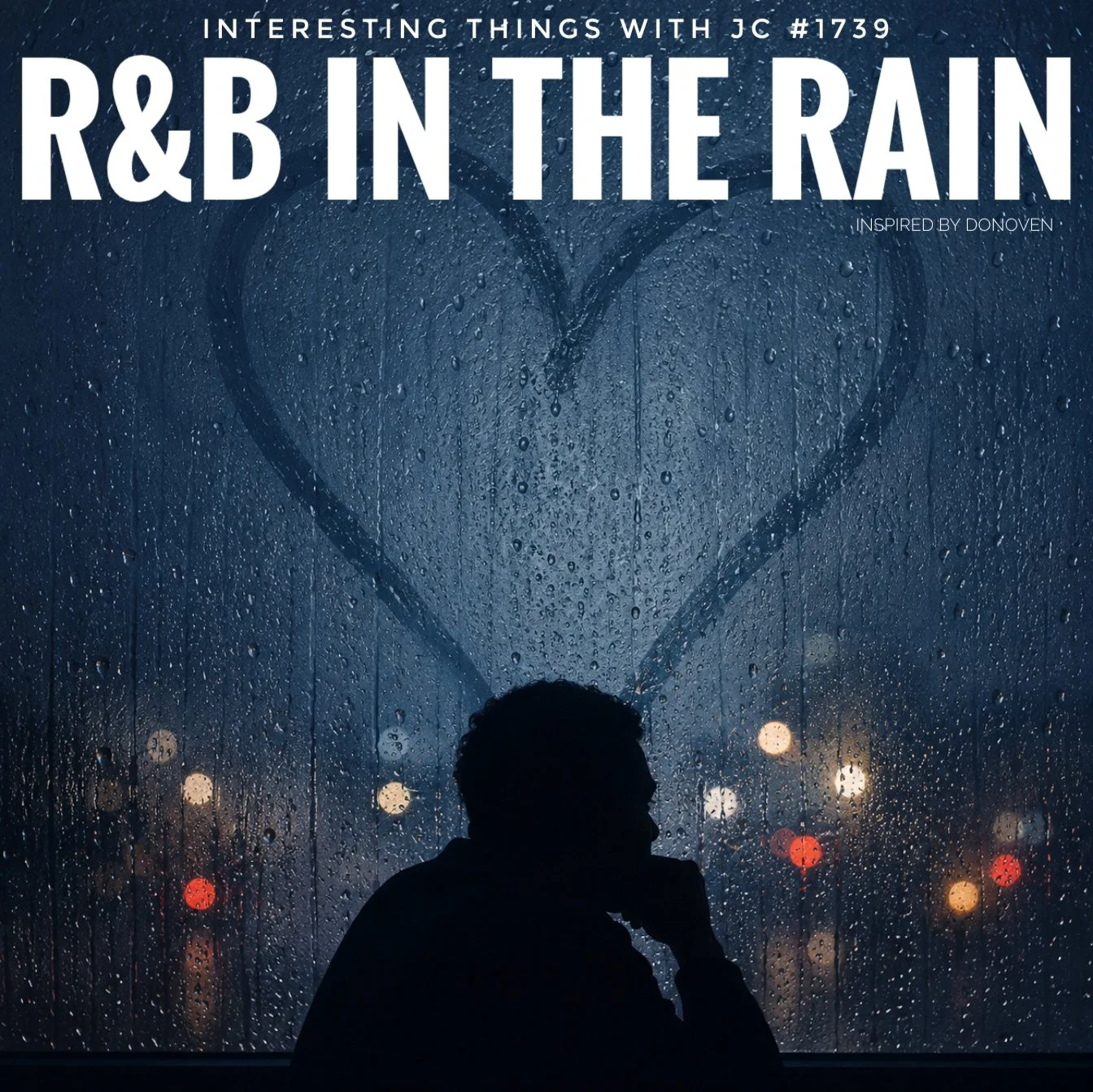
Dark blue, rain-soaked scene viewed through a window covered in water droplets. A silhouetted person sits in the foreground with their head resting on one hand, while blurred red, amber, and white city lights glow outside. Large white text across the top reads “R&B IN THE RAIN,” with “INTERESTING THINGS WITH JC #1739” above it and “INSPIRED BY DONOVEN” in smaller text at right.
Transcript
Interesting Things with JC #1739:
"R&B in the Rain"
In 1967, The Temptations released “I Wish It Would Rain,” with David Ruffin singing about a man who wanted the weather to hide his tears. If it rained hard enough, nobody would know he was crying.
R&B kept coming back to that idea, but the rain didn’t always mean the same thing. In 1972, The Dramatics opened “In the Rain” with thunder and falling water, giving a heartbroken man somewhere to be alone with what he was feeling. Then Ann Peebles turned it around with “I Can’t Stand the Rain” in 1973. She didn’t want the rain at all. Every drop against the window reminded her of somebody who wasn’t there anymore.
By the 1980s, R&B was finding other things to do with it. Oran “Juice” Jones used “The Rain” as the setting for confronting a woman who had cheated on him. Then New Edition’s “Can You Stand the Rain” made the weather a test. Anybody can be there when things are going well. What happens when they aren’t?
The 1990s brought some of those older records along. Missy Elliott and Timbaland reached back to Ann Peebles for “The Rain (Supa Dupa Fly),” putting part of that 1973 record inside something that sounded completely new. SWV went another direction with “Rain,” where the weather wasn’t about heartbreak at all. It was about being completely wrapped up in somebody.
And once music video became a big part of R&B, the rain didn’t have to stay in the lyrics. You could actually put the singer out there in it. Wet streets, soaked clothes, water running down somebody’s face — it gave the camera something you could see when the song was about something you couldn’t.
By 2003, Ashanti’s “Rain on Me” used that familiar image in a much harder story. Its video dealt with an abusive relationship and a woman finally getting away from it. The rain was still there, but what it carried had changed again.
That’s probably why it has lasted so long in R&B. Rain can hide your tears, bring somebody back to mind, test a relationship, or come down while you’re finally walking away.
Same rain. Different people standing in it.
These are interesting things, with JC.
Student Worksheet
Directions: Listen to the podcast first without stopping. Record brief observations about how rain is used in each example. Then use the transcript as evidence while completing the questions. When a question asks for evidence, identify the artist, song, or specific detail that supports your answer.
Listening Notes: As you listen, track how the meaning of rain changes.
The Temptations — “I Wish It Would Rain”: Rain represents ______________________________
The Dramatics — “In the Rain”: Rain represents ______________________________
Ann Peebles — “I Can’t Stand the Rain”: Rain represents ______________________________
Oran “Juice” Jones — “The Rain”: Rain represents ______________________________
New Edition — “Can You Stand the Rain”: Rain represents ______________________________
Missy Elliott — “The Rain (Supa Dupa Fly)”: Connection to an earlier recording: ______________________________
SWV — “Rain”: Rain represents ______________________________
Ashanti — “Rain on Me”: Rain represents ______________________________
Comprehension: Answer each question in 1–2 complete sentences.
Why does the man described in The Temptations’ “I Wish It Would Rain” want it to rain?
What sounds introduce The Dramatics’ “In the Rain,” and what kind of setting do they create?
Why is rain unwelcome in Ann Peebles’ “I Can’t Stand the Rain”?
How is rain used differently in Oran “Juice” Jones’ “The Rain”?
What does rain represent in New Edition’s “Can You Stand the Rain”?
What earlier recording is connected to Missy Elliott and Timbaland’s “The Rain (Supa Dupa Fly)”?
How does the episode describe rain in SWV’s “Rain”?
What does music video allow artists to do with rain that audio alone cannot?
How is rain connected to the story presented in Ashanti’s “Rain on Me” video?
Evidence Check: Before beginning the analysis section, select three examples from the episode and record the evidence you would use to explain each one.
Example 1 — Artist/Song: ______________________________
Meaning of Rain: ______________________________
Transcript Evidence: ______________________________Example 2 — Artist/Song: ______________________________
Meaning of Rain: ______________________________
Transcript Evidence: ______________________________Example 3 — Artist/Song: ______________________________
Meaning of Rain: ______________________________
Transcript Evidence: ______________________________
Analysis: Answer Questions 1–4 in 3–5 complete sentences. Use specific episode evidence in every response.
Same Weather, Different Meaning: Compare The Temptations’ “I Wish It Would Rain” with Ann Peebles’ “I Can’t Stand the Rain.” Why is rain wanted in one example but unwanted in the other?
Rain as Metaphor: Explain why the rain in New Edition’s “Can You Stand the Rain” represents more than weather. What is the song asking someone to withstand?
Connecting Generations: The episode explains that Missy Elliott and Timbaland reached back to Ann Peebles for “The Rain (Supa Dupa Fly).” How does sampling allow an older recording to become part of something new?
Sound and Image: Choose either The Dramatics’ use of rain and thunder sounds or the episode’s discussion of rain in music videos. Explain how the technique makes an emotion or idea more concrete for the audience.
Synthesis: Answer in one developed paragraph of 5–7 sentences.
Select three examples from different decades. Explain how rain remains a recognizable motif while its meaning changes. Your response must include:
A clear claim
Three accurate episode examples
At least two specific pieces of transcript evidence
An explanation of what changes between the examples
An explanation of what remains consistent
Reflection: Answer in one developed paragraph.
Think of a recurring image from music, film, literature, advertising, photography, or another form of media. What is the image? Describe at least two different meanings a creator could give it and explain how context would determine which meaning an audience understands.
Difficulty Scaling:
Level 1 — Identify: Complete the Listening Notes and Comprehension questions. Accurately identify what rain represents in at least four episode examples.
Level 2 — Analyze: Complete Level 1 plus the Evidence Check and Analysis questions. Compare examples and support interpretations with specific evidence.
Level 3 — Synthesize: Complete Levels 1 and 2 plus the Synthesis response. Build an argument across three different decades and explain both continuity and change.
Extension — Investigate: Research one additional R&B song that uses rain or another weather image. Determine whether the imagery is literal, metaphorical, symbolic, or a combination. Compare your example with one recording from the episode and identify the source used to verify your information.
Student Output Expectations:
Listening Notes: One concise idea for each recording.
Comprehension: 1–2 complete sentences per response.
Evidence Check: Three examples with specific supporting details.
Analysis: 3–5 complete sentences per response with episode evidence.
Synthesis: One developed paragraph of 5–7 sentences using three examples from different decades.
Reflection: One developed paragraph explaining at least two possible meanings.
Extension: If assigned, one researched comparison supported by a credible source.
Quality Check: Before submitting, confirm:
I answered every assigned question.
I used specific evidence when the directions required it.
I explained my evidence instead of only summarizing the episode.
I distinguished literal weather from metaphorical or symbolic meaning.
I checked artist and song names against the transcript.
I reviewed my work for clarity and completeness.
Academic Integrity Guidance: Your interpretation should be your own and should be supported by the episode, transcript, and any teacher-approved research you use. Clearly distinguish information taken from a source from conclusions you draw yourself. If you use outside research or an AI tool when permitted by your instructor, acknowledge that assistance according to class requirements. Do not submit generated or copied analysis as your own work.
Teacher Guide
Quick Start: Play the podcast before teaching vocabulary or explaining the episode’s central idea. Ask students to listen for one question: “What does rain mean in each example?” After the first listen, collect observations without immediately judging interpretations. Use the transcript during the second pass to move students from observation to evidence-based analysis.
Pacing Guide (Audio-First):
0–3 minutes — Bell Ringer: Students independently list three emotions, situations, or ideas rain could represent in a story.
3–8 minutes — First Listening: Play the complete podcast without interruption. Students record each artist or song they recognize and a short description of what rain appears to mean.
8–12 minutes — Initial Response: Students compare observations with a partner, then identify examples where rain carries noticeably different meanings.
12–17 minutes — Vocabulary and Second Pass: Introduce motif, metaphor, symbolism, sampling, intertextuality, and visual imagery. Revisit selected transcript passages as needed.
17–30 minutes — Student Worksheet: Students complete comprehension questions followed by evidence-based analysis.
30–40 minutes — Discussion: Use the discussion prompts to compare interpretations and examine how meaning changes across decades and media.
40–48 minutes — Assessment: Students complete the open-ended assessment individually.
48–50 minutes — Exit Ticket: Students identify one meaning of rain and explain why context determines that meaning.
Bell Ringer: “What emotions, situations, or ideas can rain represent in a story?” Students list three possibilities independently. After the podcast, return to the list and ask which predictions appeared in the episode and which did not.
Audio Guidance: Keep the first listening uninterrupted so students experience the episode’s chronological narrative as a whole. During this listen, students should capture only brief notes: artist or song, approximate decade, and meaning of rain. Use the transcript after listening to verify details and locate evidence.
Audio Fallback: If the podcast cannot be played, read the verbatim transcript aloud or assign alternating paragraphs to student readers. Students complete the same listening task as a reading task. Do not summarize the transcript before students encounter it.
Time on Task: Core lesson—approximately 50 minutes. Extended lesson—75–90 minutes with comparative listening, source verification, or independent research.
Materials:
Episode audio
Verbatim episode transcript
Student Worksheet
Assessment and Exit Ticket
Writing materials or digital document
Optional teacher-approved research access for extension activities
Vocabulary Prep: Do not front-load the entire vocabulary list before the first listening. After students encounter the episode, introduce the terms as analytical tools. Connect motif to recurring rain, metaphor and symbolism to changing meanings, sound effect to The Dramatics, sampling and intertextuality to Missy Elliott and Ann Peebles, and visual imagery to music-video storytelling.
Misconceptions:
Rain always symbolizes sadness. Correction: The episode presents rain as concealment, solitude, unwanted memory, adversity, intimacy, confrontation, and escape depending on context.
A recurring motif must keep the same meaning. Correction: A motif can remain recognizable while its function changes between works.
Sampling means simply covering an older song. Correction: Sampling incorporates material from an existing recording into a new recording.
Every song discussed belongs to one intentional artistic tradition. Correction: The episode compares recurring uses of rain; students should not assume that every artist was deliberately responding to every earlier example.
Interpretation and fact are interchangeable. Correction: Students should distinguish documented details from conclusions they draw about those details.
Discussion Prompts:
Which example changes the meaning of rain most dramatically? What evidence supports your choice?
Why might weather work especially well as a metaphor for internal emotions or relationship conditions?
What do the thunder and falling-water sounds in The Dramatics example contribute that words alone might not?
How does the connection between Ann Peebles and Missy Elliott demonstrate intertextuality across generations?
How does music video change what an audience can experience when rain moves from lyrical imagery to something visible?
What does “Same rain. Different people standing in it” communicate about the episode as a whole?
Formative Checkpoints:
After First Listening: Students identify at least four distinct meanings associated with rain.
After Vocabulary Prep: Students correctly distinguish motif from metaphor and sampling from a cover performance.
During Worksheet: Students support interpretations with specific episode details rather than personal preference alone.
During Discussion: Students respond to another interpretation by adding evidence, questioning evidence, or refining their own conclusion.
Before Assessment: Students can explain the episode’s central idea in one sentence without referring to notes.
Differentiation:
Additional Support: Provide a three-column organizer labeled Artist/Song | What Rain Means | Evidence.
Developing Readers: Allow students to follow the transcript during a second listening and highlight evidence before writing.
Language Support: Preteach vocabulary with brief examples and permit initial discussion with a partner before independent responses.
Advanced Learners: Require distinctions among motif, metaphor, symbolism, and intertextuality and ask students to evaluate where those categories overlap.
Independent Learners: Allow self-paced movement from transcript annotation to worksheet analysis and research extension.
Assessment Differentiation: Preserve the same evidence and reasoning expectations while allowing students to demonstrate understanding through a written response, recorded oral explanation, or teacher-approved visual comparison. Every format must include a clear claim, accurate evidence, and explanation of how the evidence supports the conclusion.
Time Flexibility: For a 30-minute version, use the Bell Ringer, complete podcast, Comprehension Questions 1–4, Analysis Question 1, brief discussion, and Exit Ticket. For a 50-minute version, use the complete core pacing guide. For a 75–90-minute version, add comparative listening, source verification, or the independent research extension.
Substitute Readiness: The lesson can be taught without specialized R&B knowledge. Begin with the transcript or audio, follow the pacing sequence, use the worksheet questions in order, and consult the Answer Key for factual responses. If audio is unavailable, use the Audio Fallback without changing the learning objectives.
Engagement Strategy: Build a class Rain Meaning Timeline. As each recording appears, students place the artist and song in chronological order and assign a concise interpretation such as concealment, solitude, memory, confrontation, relationship test, intimacy, or escape. Afterward, students examine the timeline for continuity and change rather than treating the examples as isolated songs.
Extensions:
Research one additional R&B song that uses rain or another weather image and determine whether the imagery functions literally, metaphorically, symbolically, or in multiple ways.
Compare an audio-only example with a music video and analyze what visual storytelling adds or changes.
Investigate a documented sample used in a later recording and explain how knowledge of the earlier source affects interpretation of the newer work.
Create a short annotated timeline showing how one recurring image changes meaning across at least four cultural works.
Cross-Curricular Connections:
English Language Arts: Metaphor, symbolism, motif, central idea, textual evidence, and comparative analysis.
History: Chronology, continuity and change, and cultural artifacts as evidence of different periods.
Media Studies: Relationships among lyrics, recorded sound, performance, and music-video imagery.
Technology: Sampling, recorded sound, and the development of production techniques.
Visual Arts: Translating abstract emotions and ideas into visible imagery.
SEL: Use the episode to examine how creative works represent difficult emotions without requiring students to disclose personal experiences. When discussing the Ashanti example, keep attention on media analysis, representation, agency, and narrative construction rather than asking students to share experiences involving abuse or relationships.
Skill Emphasis: Prioritize analytical thinking, evidence evaluation, communication, comparison, inquiry, reasoning, adaptability, and professional judgment. Reinforce the discipline of separating what the episode explicitly states from what students reasonably infer.
Answer Key:
Comprehension
“I Wish It Would Rain”: The narrator wants rain to hide his tears so other people will not know he is crying.
“In the Rain”: The episode describes thunder and falling water at the opening.
“I Can’t Stand the Rain”: Ann Peebles’ narrator does not welcome the rain because it reminds her of someone who is no longer there.
“Can You Stand the Rain”: Rain represents difficult circumstances that test whether a relationship can endure when things are not going well.
“The Rain (Supa Dupa Fly)”: The episode connects Missy Elliott and Timbaland’s recording to Ann Peebles’ “I Can’t Stand the Rain.”
Music Video: Rain can become visible through wet streets, soaked clothing, and water on performers, giving audiences a physical image for emotions or situations that are otherwise abstract.
Analysis
The Temptations and Ann Peebles: Strong responses should explain that The Temptations’ narrator wants rain because it conceals visible sadness, while Peebles’ narrator rejects rain because it triggers painful memory. The weather remains the same; the characters’ relationships to it differ.
New Edition: Strong responses should recognize rain as a metaphor for adversity. The question is not simply whether someone can tolerate bad weather but whether a relationship can withstand difficult circumstances.
Sampling and Intertextuality: Strong responses should explain that using material connected to Ann Peebles places an older recording inside a newer musical context, creating a recognizable relationship between works from different generations.
Cross-Decade Comparison: Answers will vary. Students must accurately identify two examples, explain how their meanings differ, and identify the recurring rain image as the point of continuity.
Closing Statement: Strong responses should explain that the physical image remains recognizable while its emotional or narrative meaning changes according to the person, situation, era, and artistic context.
Reflection: Answers will vary. A successful response identifies a recurring image, gives at least two plausible meanings, and explains how context changes its interpretation.
Assessment Guidance: For both open-ended questions, use the 3–2–1 rubric. A proficient response must make a clear claim, use accurate episode evidence, and explain how the evidence supports the interpretation rather than merely summarizing the examples.
Quiz Answer Key: 1. B; 2. C; 3. B; 4. A; 5. D.
Exit Ticket: Accept any episode-supported interpretation if the student identifies a specific meaning of rain and explains how the surrounding character, relationship, lyrics, sound, or visual context produces that meaning.
Quiz
In The Temptations example, why does the narrator want rain?
A. To remember an earlier relationship
B. To conceal his tears
C. To prove his loyalty
D. To begin a confrontation
Which recording described in the episode begins with thunder and falling water?
A. “Rain”
B. “The Rain”
C. “In the Rain”
D. “Rain on Me”
Which artist's earlier recording is sampled in “The Rain (Supa Dupa Fly)”?
A. Ashanti
B. Ann Peebles
C. SWV
D. New Edition
In “Can You Stand the Rain,” rain primarily functions as:
A. a metaphor for difficult circumstances
B. a historical reference
C. background sound without symbolic meaning
D. a description of a particular storm
What is the episode’s main idea?
A. R&B artists generally use rain to communicate one fixed meaning.
B. Rain disappeared from R&B when music videos became popular.
C. Sampling replaced metaphor in 1990s R&B.
D. R&B artists repeatedly use rain while changing what it represents.
Assessment
Open-Ended Questions:
Using at least three episode examples from different decades, explain how rain operates as a recurring motif whose meaning changes with context.
Explain how one production technique—sound effects, sampling, or music-video imagery—extends the meaning communicated by lyrics. Support your argument with episode evidence.
3–2–1 Rubric:
3 — Proficient: Makes a clear claim, uses accurate and specific evidence, compares meanings or techniques, and explains the connection between evidence and conclusion.
2 — Developing: Provides a reasonable claim and some accurate evidence but offers incomplete comparison or explanation.
1 — Beginning: Provides limited evidence, relies mainly on summary or unsupported opinion, or does not clearly connect evidence to the claim.
Exit Ticket: In two sentences, identify one meaning rain carries in the episode and explain why that meaning depends on context rather than the weather itself.
Standards Alignment
NGSS — Science and Engineering Practices
Standard: Engaging in Argument from Evidence, Grades 9–12
Connection: Students distinguish claims, evidence, and interpretation while analyzing how rain imagery changes across songs and decades.
Measurable Student Skill: Construct and defend an interpretation using relevant transcript evidence.
Lesson Alignment: Student Worksheet analysis questions, class discussion, and both open-ended assessment questions.
Justification: The lesson requires students to support conclusions with evidence rather than unsupported opinion.
CCSS Reading
Standard: CCSS.ELA-LITERACY.RI.11-12.1 — Cite Strong and Thorough Textual Evidence
Connection: Students cite details from the transcript when explaining how artists use rain as metaphor, motif, and symbolism.
Measurable Student Skill: Select and explain at least two relevant transcript details supporting an interpretation.
Lesson Alignment: Student Worksheet Analysis Questions 1, 4, and 5; Assessment Question 1.
Justification: Students must connect claims directly to specific evidence from the episode.Standard: CCSS.ELA-LITERACY.RI.11-12.2 — Determine Central Ideas
Connection: Students identify the episode’s central idea and explain how examples from different decades develop it.
Measurable Student Skill: State the central idea and trace its development through at least three examples.
Lesson Alignment: Quiz Question 5, Student Worksheet Analysis Question 5, and Exit Ticket.
Justification: The lesson centers on how one recurring image gains different meanings through changing contexts.Standard: CCSS.ELA-LITERACY.RI.11-12.5 — Analyze an Author’s Structure
Connection: Students examine how the episode moves chronologically from the 1960s through the 2000s to build its argument.
Measurable Student Skill: Explain how chronological organization supports comparison and meaning.
Lesson Alignment: Narrative Core, timeline activity, and Student Worksheet Analysis Question 4.
Justification: The episode’s structure helps students recognize both continuity and change across time.
CCSS Writing
Standard: CCSS.ELA-LITERACY.W.11-12.2 — Write Informative and Explanatory Texts
Connection: Students explain how artistic techniques such as symbolism, sound effects, sampling, and music video contribute to meaning.
Measurable Student Skill: Produce a clear explanation using accurate examples and appropriate vocabulary.
Lesson Alignment: Student Worksheet analysis responses and Assessment Question 2.
Justification: Students must organize evidence and explanation into a coherent analytical response.Standard: CCSS.ELA-LITERACY.W.11-12.9 — Draw Evidence from Informational Texts
Connection: Students use the podcast transcript and approved research sources to support written analysis.
Measurable Student Skill: Integrate relevant source evidence while distinguishing fact from interpretation.
Lesson Alignment: Academic Integrity Guidance, research extension, and both assessment questions.
Justification: The lesson requires responsible evidence use in analytical writing.
CCSS Speaking and Listening
Standard: CCSS.ELA-LITERACY.SL.11-12.1 — Initiate and Participate Effectively in Collaborative Discussions
Connection: Students compare interpretations of metaphor, sampling, sound, and visual storytelling.
Measurable Student Skill: Contribute evidence, respond to others, and refine an interpretation during discussion.
Lesson Alignment: Teacher Guide discussion prompts, formative checkpoints, and engagement strategy.
Justification: Students develop understanding through evidence-based collaborative reasoning.Standard: CCSS.ELA-LITERACY.SL.11-12.4 — Present Information, Findings, and Supporting Evidence Clearly
Connection: Students may present their analysis in written, oral, or visual form.
Measurable Student Skill: Communicate a focused claim with organized evidence and clear reasoning.
Lesson Alignment: Assessment Differentiation and Extensions.
Justification: The lesson supports multiple presentation formats while maintaining the same analytical expectations.
C3 Framework
Standard: D2.His.2.9-12 — Analyze Change and Continuity in Historical Eras
Connection: Students trace how the rain motif remains recognizable while its meaning changes across decades of R&B.
Measurable Student Skill: Compare at least three chronological examples and identify both continuity and change.
Lesson Alignment: Timeline engagement strategy, Student Worksheet Analysis Question 4, and Assessment Question 1.
Justification: The lesson uses cultural works to examine historical development over time.Standard: D2.His.14.9-12 — Analyze Multiple and Complex Causes and Effects
Connection: Students consider how artist perspective, musical production, cultural context, and visual media affect meaning.
Measurable Student Skill: Explain how more than one factor shapes the interpretation of a song or video.
Lesson Alignment: Discussion Prompts 3–5 and Assessment Question 2.
Justification: Students move beyond simple summary by evaluating how several creative choices interact.
ISTE Standards
Standard: ISTE 1.3 — Knowledge Constructor
Connection: Students researching an additional song locate, evaluate, and organize digital information.
Measurable Student Skill: Select a credible source, identify relevant evidence, and connect it to the lesson’s concepts.
Lesson Alignment: Research extension and Academic Integrity Guidance.
Justification: The extension develops digital research and information-literacy skills.Standard: ISTE 1.6 — Creative Communicator
Connection: Students communicate analysis through writing, audio, or a teacher-approved visual format.
Measurable Student Skill: Choose an appropriate medium and present evidence-based conclusions clearly.
Lesson Alignment: Assessment Differentiation and Extensions.
Justification: Students adapt communication methods while preserving accuracy and analytical depth.
Career Readiness Competencies
Analytical Thinking: Students compare how the same image functions differently across artists, songs, and decades.
Measurable Student Skill: Identify patterns, differences, and contextual meaning.
Lesson Alignment: Student Worksheet analysis questions and Assessment Question 1.
Justification: Comparative interpretation supports decision-making in media, research, education, and communications.Communication: Students explain interpretations using clear claims, evidence, and reasoning.
Measurable Student Skill: Present a defensible conclusion orally or in writing.
Lesson Alignment: Discussion prompts, worksheet responses, and assessments.
Justification: Clear evidence-based communication is essential across academic and professional settings.Problem Solving: Students evaluate competing interpretations and determine which is best supported by context.
Measurable Student Skill: Resolve an interpretive question by examining evidence and rejecting weak assumptions.
Lesson Alignment: Formative checkpoints and Student Worksheet Analysis Questions 2 and 3.
Justification: The lesson requires disciplined reasoning rather than immediate or unsupported conclusions.Adaptability: Students recognize that a familiar artistic device can change function across audience, era, and medium.
Measurable Student Skill: Revise an interpretation when new evidence or context is introduced.
Lesson Alignment: Comparative discussion and research extension.
Justification: Flexible thinking helps students respond productively to changing information and conditions.Professional Judgment: Students distinguish verified fact, transcript evidence, and reasonable inference.
Measurable Student Skill: Label claims accurately and avoid presenting interpretation as established fact.
Lesson Alignment: Academic Integrity Guidance, Misconceptions, and source-verification extension.
Justification: Responsible judgment is necessary in research, media, education, and workplace communication.
Homeschool and Lifelong Learning Alignment
Independent Learning: Learners can complete the audio, transcript, worksheet, and assessment with limited instructor support.
Measurable Student Skill: Organize listening, reading, and response tasks independently.
Lesson Alignment: Quick Start, Audio Fallback, Difficulty Scaling, and Student Output requirements.
Justification: The lesson provides a complete structure for self-paced learning.Information Literacy: Learners evaluate sources and separate documented information from interpretation.
Measurable Student Skill: Identify credible evidence and explain how it supports a conclusion.
Lesson Alignment: Academic Integrity Guidance and research extension.
Justification: Source evaluation strengthens responsible independent inquiry.Real-World Application: Learners apply concepts such as metaphor, symbolism, and visual imagery to everyday media.
Measurable Student Skill: Analyze an unfamiliar song, advertisement, film scene, or media example.
Lesson Alignment: Reflection Prompt and Cross-Curricular Connections.
Justification: The lesson connects classroom analysis to common communication environments.Self-Directed Inquiry: Learners select an additional example of weather imagery and investigate it independently.
Measurable Student Skill: Develop a focused question, gather evidence, and present a supported conclusion.
Lesson Alignment: Extensions.
Justification: The task moves learners from guided analysis to independent research.Transferable Life Skills: Learners practice comparison, reasoning, evidence evaluation, communication, and decision-making.
Measurable Student Skill: Apply the same analytical process in a new academic, professional, or personal context.
Lesson Alignment: Worksheet, discussion, assessment, and exit ticket.
Justification: These skills remain useful beyond music study and formal education.
Show Notes
“R&B in the Rain” explores how one familiar image has carried changing meanings across decades of R&B, from hidden tears and heartbreak to memory, relationship tests, intimacy, sampling, visual storytelling, and escape. For classrooms, the episode provides a compact way to teach motif, metaphor, symbolism, intertextuality, evidence-based interpretation, and media literacy while showing students how artists can inherit familiar creative language and transform it for new contexts. This episode was inspired by the humour and style of Donoven Darshawn Rice.
References
Sexton, P. (2026). ‘I Wish It Would Rain’: It was pouring No. 1s for The Temptations. uDiscover Music. https://www.udiscovermusic.com/stories/temptations-i-wish-it-would-rain-song/
Stax Records. (2025). In the Rain – The Dramatics.https://staxrecords.com/number-ones/in-the-rain/
AllMusic. (n.d.). I Can’t Stand the Rain — Ann Peebles.https://www.allmusic.com/song/i-cant-stand-the-rain-mt0010882325
Apple Music. (n.d.). Oran “Juice” Jones.https://music.apple.com/us/artist/oran-juice-jones/379120
Apple Music. (n.d.). Can You Stand the Rain — New Edition.https://music.apple.com/us/song/1792683790
Palmer, T. (2022). Revisiting Supa Dupa Fly at 25: Missy Elliott is still inspired by her debut record. Recording Academy. https://www.grammy.com/news/missy-elliott-interview-supa-dupa-fly-the-rain-25th-anniversary/
Apple Music. (n.d.). Rain — SWV.https://music.apple.com/us/song/253641178
Ashanti. (2018). Rain on Me. Universal Music Group. https://www.youtube.com/watch?v=RwMd8r0gvZc