1780: "The Hoover Dam Angels"
Interesting Things with JC #1780: "The Hoover Dam Angels"
Visitors rub the bronze toes of Hoover Dam's 30-foot angels for good luck, unaware that the floor beneath them contains a star chart designed to reveal the dam's dedication date thousands of years in the future. The figures stand above an astronomical record that accounts for the slow wobble of Earth's axis.
Curriculum - Episode Anchor
Episode Title: The Hoover Dam Angels
Episode Number: 1780
Host: JC
Series: Interesting Things with JC™
Audience: Grades 9–12, introductory college, homeschool, lifelong learners
Subject Area: U.S. History, Earth and Space Science, Engineering, Visual Arts, English Language Arts, Information Literacy
Instructional Duration: 50 minutes
Central Theme: How art, engineering, and astronomy can preserve information for future civilizations.
Curriculum Focus: Evidence-based historical inquiry, interdisciplinary problem-solving, scientific literacy, and communication across time.
Lesson Overview
Lesson Summary
At Hoover Dam, two monumental bronze sculptures stand above a terrazzo celestial chart designed to preserve the date of the dam's dedication. Students investigate how Oskar Hansen combined sculpture, engineering, astronomy, and historical memory to communicate information across thousands of years.
The lesson distinguishes documented historical information from claims requiring further verification and explores the relationship between human-made records and observable natural phenomena.
Learning Objectives
By the end of the lesson, students will be able to:
Identify the artistic, engineering, and astronomical features described in the episode.
Explain how axial precession changes the apparent positions of celestial reference points over long periods.
Analyze the purpose of the celestial chart as a historical communication system.
Evaluate the reliability of historical and technical claims using appropriate evidence.
Essential Question: How can a civilization communicate important information to people thousands of years in the future?
Success Criteria
Students demonstrate mastery when they can:
Accurately describe three features of the Hoover Dam monument.
Explain axial precession using a diagram or written explanation.
Distinguish a documented fact, an attributed claim, and an interpretation.
Design and justify a method for preserving information over a long period.
Student Relevance Statement: Digital files, written languages, and physical records can become inaccessible. Understanding how information survives helps students evaluate the technologies and communication systems they use today.
Real-World Connection: Engineers, archivists, astronomers, artists, and preservation specialists confront similar challenges when designing durable structures, maintaining records, and interpreting historical artifacts.
Workforce Reality: Large infrastructure projects require collaboration among specialists. Technical knowledge alone is insufficient; professionals must also document decisions, communicate across disciplines, and consider the long-term consequences of their work.
Guiding Inquiry: What makes a message understandable when its original creators, language, and cultural context are gone?
Key Vocabulary
Core Terms
Art Deco (ahrt DEK-oh): A design style associated with geometric forms, symmetry, and streamlined ornamentation.
Bronze (BRAHNZ): A metal alloy primarily composed of copper, commonly combined with tin, used in sculpture and other applications.
Casting (KAS-ting): A manufacturing process in which molten material is poured into a mold and allowed to solidify.
Terrazzo (tuh-RAHT-soh): A composite flooring material containing pieces of stone or other aggregates embedded in a binder and polished.
Celestial Chart (suh-LES-chuhl chart): A representation of the positions or apparent arrangement of astronomical objects.
Axial Precession (AK-see-uhl pree-SESH-uhn): The gradual change in the orientation of Earth's rotational axis.
Equinox (EE-kwuh-noks): A time when the Sun crosses Earth's equatorial plane.
Astronomical Calculation (as-truh-NAH-mi-kuhl kal-kyuh-LAY-shuhn): A mathematical determination involving the positions, motions, or properties of celestial objects.
Historical Preservation (his-TOR-i-kuhl prez-er-VAY-shuhn): The protection and maintenance of objects, structures, and records with historical significance.
Primary Source (PRY-mair-ee sors): Original evidence created during the period or event being investigated.
Vocabulary Application: Students must correctly use at least four terms in their worksheet or final assessment.
Narrative Core
Open
Visitors to Hoover Dam encounter two enormous bronze figures whose polished toes reflect a tradition of rubbing them for good luck. Beneath the sculptures lies a less obvious feature: a celestial chart intended to communicate across millennia.
Info
Norwegian-born sculptor Oskar Hansen designed the Winged Figures of the Republic and other artistic elements associated with Hoover Dam. The episode describes the figures as 30 feet tall and weighing more than four tons of bronze each.
The dam was dedicated by President Franklin D. Roosevelt on September 30, 1935.
Details
The episode identifies three technical challenges and innovations:
Bronze casting: Producing enormous sculptures required molds, high temperatures, and controlled pouring.
Stone installation: Workers reportedly used melting ice to lower massive stone blocks into position without scratching them.
Astronomical design: A terrazzo chart recorded celestial positions associated with the dedication date.
The episode states that Hansen worked with astronomical institutions and accounted for axial precession.
Axial precession changes the orientation of Earth's rotational axis over a cycle of approximately 26,000 years. Consequently, the identity of the star nearest the north celestial pole changes over long periods.
The chart was intended to provide future observers with information that could help identify the date of the dam's dedication.
Reflection
The monument illustrates two different approaches to historical memory.
Written inscriptions communicate through language. Astronomical records use observable patterns and mathematical relationships.
Neither approach is automatically permanent or universally understandable. A future observer would still need to recognize the chart's purpose, understand its symbols, and interpret its astronomical information.
Closing
These are interesting things, with JC.
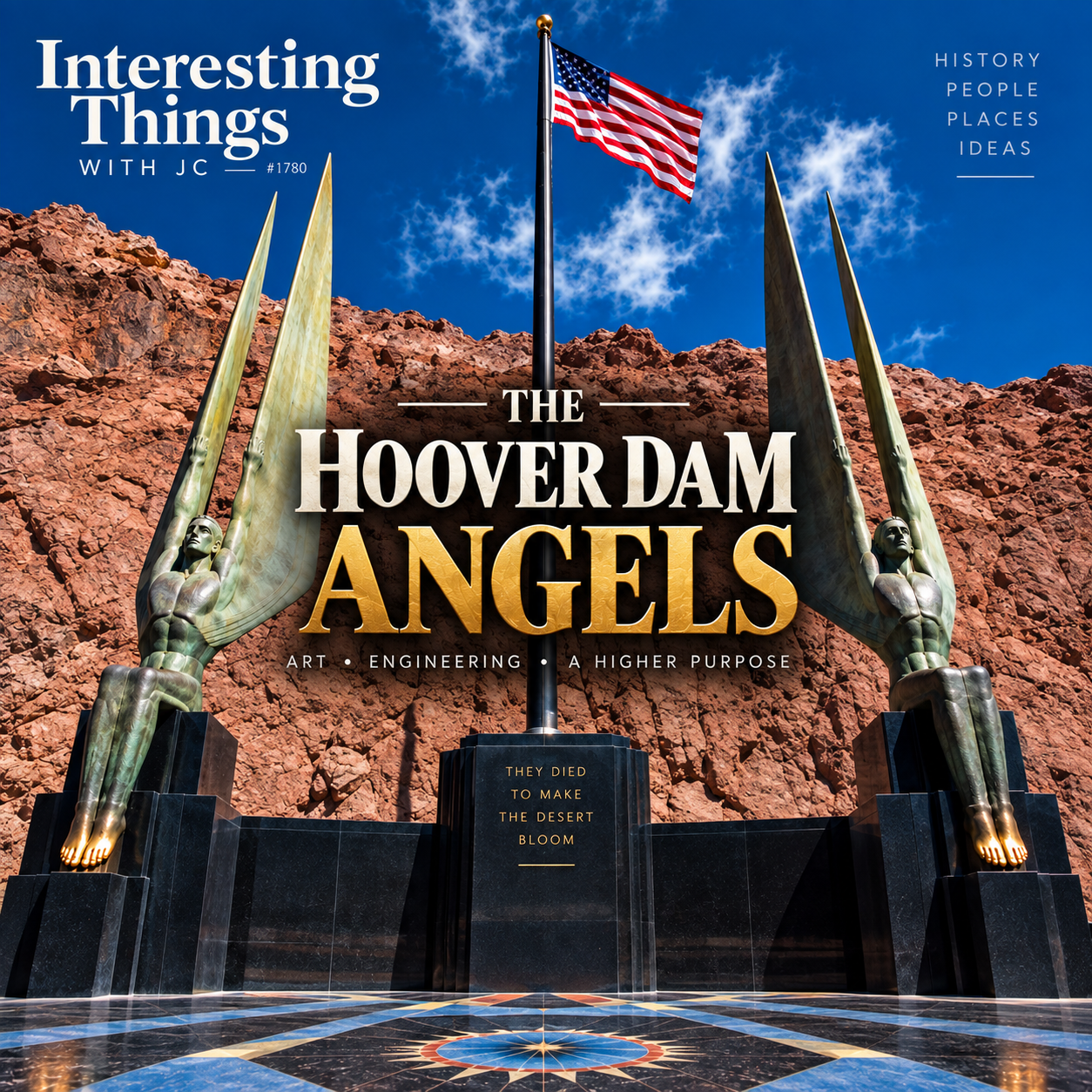
Podcast Cover Art, Episode #1780: “The Hoover Dam Angels”
Square podcast cover featuring the two towering bronze Winged Figures of the Republic at Hoover Dam, Nevada. Their green-patina wings reach upward on either side of a central flagpole flying the American flag. Reddish desert cliffs rise behind the monument beneath a vivid blue sky. The upper-left corner displays “Interesting Things with JC,” with the episode number “#1780” in small white text beside the show name. The upper-right corner reads “History, People, Places, Ideas.”
Large white and gold lettering across the center reads “The Hoover Dam Angels,” followed by the subtitle “Art • Engineering • A Higher Purpose.” The figures' toes are polished gold. A black stone memorial at the center displays the inscription “They died to make the desert bloom.” The foreground features the monument's geometric astronomical floor design, with blue, gold, and reddish accents.
The artwork combines realistic architectural imagery with bold editorial typography and an Art Deco aesthetic.
Transcript
Interesting Things with JC #1780:
"The Hoover Dam Angels"
On the Nevada side of Hoover Dam, two enormous bronze figures stand with their wings reaching skyward. Visitors rub their toes for good luck before heading to Las Vegas, polishing the bronze to a golden shine.
Officially called the Winged Figures of the Republic, they were created by Norwegian-born sculptor Oskar Hansen.
Each stands 30 feet tall and contains more than four tons of bronze. Casting them required 492-ton sand molds and molten bronze heated to 2,500 degrees Fahrenheit, poured in one continuous operation.
Their polished black stone bases presented another challenge. Workers lowered the massive blocks onto slabs of ice, allowing them to settle into position as the ice melted, without scratching the stone.
Hansen also designed the dam's Art Deco reliefs and a memorial plaque honoring workers who died during construction.
But beneath the figures lies his most unusual design.
The terrazzo floor contains a celestial chart recording the positions of stars and planets on September 30, 1935, the day President Franklin Roosevelt dedicated Hoover Dam.
Working with the Smithsonian Institution and the U.S. Naval Observatory, Hansen reportedly performed more than 200,000 astronomical calculations.
He accounted for the precession of the equinoxes, the slow wobble of Earth's axis that completes a cycle approximately every 26,000 years, gradually changing which star serves as the North Star.
The chart was intended to allow someone thousands of years in the future to determine the dedication date, even if every written record had disappeared.
Hansen considered Hoover Dam an achievement comparable to the ancient pyramids. He wanted future civilizations to know when it was built, using the movement of the heavens rather than relying on a language they might no longer understand.
Nearly a century later, visitors continue rubbing the bronze toes, often unaware that the floor beneath them was designed to communicate with people thousands of years into the future.
These are interesting things, with JC.
Student Worksheet
Name: ____________________
Date: ____________________
Episode: 1780 — The Hoover Dam Angels
Instructions: Listen to the episode before answering. Use complete sentences for questions 6–12. Support analytical responses with details from the transcript.
Comprehension
What is the official name of the two bronze sculptures at Hoover Dam?
Who designed the sculptures, and where was he born?
How tall are the figures, and approximately how much bronze does each contain?
Explain how workers used ice to position the polished stone bases.
What historical event does the celestial chart commemorate?
Analysis
Why might workers have chosen ice rather than a method that required sliding the stone directly across another surface?
Explain how axial precession could help astronomers investigate the age of an astronomical record.
Compare the purpose of the bronze sculptures with the purpose of the celestial chart. Identify one similarity and one difference.
The episode reports that Hansen performed more than 200,000 astronomical calculations. What additional evidence would help establish whether this number is accurate?
Identify two challenges that future civilizations might encounter when interpreting the celestial chart.
Reflection
Do you think an astronomical chart could communicate information more effectively than a written inscription over thousands of years? Explain your reasoning and identify at least one limitation of your preferred method.
If you were responsible for creating a monument intended to communicate with people 10,000 years in the future, what information would you preserve, and how would you encode it?
Difficulty Scaling
Level 1 — Foundational: Answer questions 1–5 and 11. Use the vocabulary list and identify one piece of transcript evidence.
Level 2 — Standard: Complete all 12 questions. Support questions 6–12 with evidence and reasoning.
Level 3 — Advanced: Complete all questions and add a 200-word analysis evaluating whether astronomical information can function as a reliable historical dating system.
Applied Design Challenge
Design a message intended to survive for 10,000 years.
Select one important piece of information.
Choose a durable physical medium.
Develop a communication system that does not depend entirely on a modern language.
Identify two ways the message could be misunderstood.
Propose a method for testing whether an unfamiliar observer could interpret it.
Student Output: Submit 12 numbered responses and a one-page design proposal containing a labeled diagram, a 150–200-word explanation, and two identified limitations. Advanced students also submit their additional analysis.
Academic Integrity Guidance: Use the transcript and assigned sources. Distinguish direct evidence from your own interpretation. Credit outside research and identify any AI assistance permitted by your instructor. Do not present invented historical details as established facts.
Teacher Guide
Quick Start: Prepare the episode transcript, a photograph or teacher-drawn diagram of the monument, and a simple illustration of Earth's axial precession. Students first listen without reading, then investigate the episode's historical and scientific claims.
Pacing Guide — Audio First
0–5 minutes: Bell ringer and initial predictions.
5–9 minutes: Play the episode without interruption.
9–14 minutes: Students record three observations and one question; clarify vocabulary.
14–22 minutes: Explain the monument's features and model axial precession.
22–34 minutes: Students complete worksheet comprehension and analysis questions.
34–42 minutes: Conduct the design challenge in pairs.
42–47 minutes: Administer the five-question quiz.
47–50 minutes: Complete the exit ticket.
Bell Ringer
Display the following prompt:
"Imagine discovering an unfamiliar monument built 10,000 years ago. What clues would help you determine when it was constructed?"
Students write two possible clues and explain one limitation of each.
Audio Guidance
Play the complete episode before distributing the transcript.
Ask students to identify the point where the story changes from sculpture and engineering to astronomy.
Replay the celestial-chart passage if necessary.
Distribute the transcript for close reading after the initial listening.
Audio Fallback: If audio is unavailable, read the transcript aloud without modification. Students underline one engineering detail, circle one astronomical detail, and identify the central historical purpose.
Time on Task: 50 minutes total, including approximately 30 minutes of listening, explanation, and investigation; 12 minutes of collaborative and independent application; and 8 minutes of assessment and closure.
Materials
Episode audio or verbatim transcript
Student worksheet
Writing materials
Photograph or diagram of the monument
Globe or ball representing Earth
Pencil representing Earth's rotational axis
Blank paper for the design challenge
Quiz and exit ticket
Vocabulary Preparation
Introduce casting, terrazzo, celestial chart, and axial precession.
Demonstrate the difference between Earth's daily rotation and the much slower change in its rotational-axis orientation.
Ask students to use each term in a sentence connected to the episode.
Historical and Scientific Verification
The Bureau of Reclamation confirms the sculptures' dimensions, bronze quantities, casting process, ice installation method, dedication date, and astronomical purpose. Its historical account describes the star chart as a means of recovering the dedication date through astronomical interpretation.
The Smithsonian's sculpture inventory independently identifies Hansen, the 1935 dedication, the bronze figures, and the black diorite base.
Claims Requiring Qualification
The episode's statement about more than 200,000 calculations and collaboration with two named institutions was not independently established by the sources located for this curriculum.
The reported good-luck practice should be treated as a cultural claim rather than evidence of an actual effect.
The approximately 26,000-year precession cycle should not be confused with the period over which the chart is described as useful. The Bureau of Reclamation specifies approximately 14,000 years for its astronomical precession reference.
Do not modify the verbatim transcript. Address these distinctions during source evaluation.
Common Misconceptions
Misconception: The sculptures are officially named the Hoover Dam Angels. Correction: Their official name is the Winged Figures of the Republic.
Misconception: The chart records the dam's construction start date. Correction: It commemorates the dedication date.
Misconception: Axial precession is the same as Earth's daily rotation. Correction: Rotation and precession are different motions.
Misconception: The North Star remains the same forever. Correction: The direction of Earth's rotational axis changes gradually.
Misconception: Astronomical symbols are automatically understandable to everyone. Correction: Interpretation requires knowledge and contextual clues.
Misconception: A precise historical number is necessarily verified. Correction: Specific numerical claims still require evidence.
Discussion Prompts
Why would an artist incorporate astronomy into a monument associated with engineering?
What assumptions did the chart's designers make about future observers?
How does a monument communicate differently from a written historical document?
What can the monument tell us about the relationship between technical achievement and artistic expression?
What evidence would establish that a proposed long-term communication system actually works?
Formative Checkpoints
After listening: Students identify the monument's official name and purpose.
After vocabulary: Students correctly distinguish rotation from precession.
During worksheet: Students support one analytical response with transcript evidence.
During design challenge: Students identify a potential interpretation problem and propose a solution.
Differentiation
Additional Support: Provide a labeled monument diagram, sentence starters, and a vocabulary reference sheet.
Advanced Learners: Require students to evaluate multiple dating methods and explain their respective limitations.
English Learners: Preteach pronunciation, provide visual vocabulary supports, and permit initial paired discussion before written responses.
Students Requiring Accessibility Supports: Supply accessible digital text, captions when available, enlarged diagrams, and alternative response formats.
Assessment Differentiation
Foundational: Permit oral responses and a labeled diagram accompanied by three explanatory sentences.
Standard: Require complete written responses and a justified design proposal.
Advanced: Require a comparative evaluation of astronomical dating and at least one alternative method.
Apply the same central success criteria to all three levels while adjusting the complexity and response format.
Time Flexibility
30-Minute Version: Complete the audio, vocabulary, questions 1–5 and 7–8, a brief discussion, and the exit ticket.
50-Minute Version: Follow the standard pacing guide.
75-Minute Version: Add a source-comparison exercise and an extended design presentation.
Substitute Readiness
Distribute the transcript and worksheet.
Read or play the episode.
Have students complete questions 1–12 independently.
Allow pairs to discuss the design challenge.
Administer the quiz.
Collect the exit ticket.
Use the answer key below for grading. No specialized equipment is required.
Engagement Strategy: Present the monument initially as a mystery. Reveal the bronze sculptures first, followed by the celestial chart. Ask students to revise their interpretation of the monument after discovering the astronomical feature.
Extensions
Construct a scale drawing of a 30-foot sculpture.
Investigate how museums preserve information about objects whose original languages are no longer understood.
Compare astronomical dating with radiometric dating, dendrochronology, or historical inscriptions, noting that these methods date different kinds of evidence.
Research the design and construction of another major public monument.
Cross-Curricular Connections
Earth and Space Science: Axial precession and astronomical reference systems.
Engineering: Materials, molds, temperature, and installation constraints.
Mathematics: Scale, proportions, time intervals, and measurement.
Visual Arts: Art Deco, symbolism, and public sculpture.
History: The construction and dedication of Hoover Dam.
English Language Arts: Evidence-based interpretation and source evaluation.
Social-Emotional Learning Connection: Collaborative design requires students to listen to alternative interpretations, explain disagreements respectfully, and revise ideas in response to evidence.
Skill Value Emphasis
Evidence-based reasoning
Scientific modeling
Interdisciplinary communication
Design thinking
Historical interpretation
Long-term systems thinking
Answer Key — Student Worksheet
Winged Figures of the Republic.
Oskar Hansen; Norway.
Each stands 30 feet tall and contains more than four tons of bronze.
Workers positioned the stone blocks on ice and allowed the melting ice to lower them gradually without damaging the polished surfaces.
President Franklin D. Roosevelt's dedication of Hoover Dam on September 30, 1935.
Ice permitted gradual vertical positioning while reducing the need to slide the polished stone against another hard surface.
Axial precession gradually changes the orientation of Earth's axis. Astronomers can compare a recorded celestial arrangement with calculated historical positions to investigate the period represented.
Both preserve meaning associated with the dam. The sculptures communicate through artistic symbolism, while the chart encodes astronomical information associated with a date.
Suitable evidence includes Hansen's original notes, calculations, institutional correspondence, engineering archives, or contemporary documentation establishing the number.
Possible challenges include interpreting symbols, recognizing the chart as an astronomical record, identifying its reference system, and reconstructing the intended dating procedure.
Responses vary. Strong answers identify an advantage and limitation of astronomical or written communication and support the comparison logically.
Responses vary. Strong answers identify the information, medium, encoding system, interpretation challenges, and reasons for the proposed design.
Design Challenge — Expected Elements
Clearly identified information
Reasonably durable medium
Communication method not dependent entirely on one language
Two plausible interpretation challenges
A practical method for testing comprehension
Quiz Answer Key: 1—B; 2—C; 3—A; 4—D; 5—B.
Quiz
Student Name: ____________________
Date: ____________________
Instructions: Select the single best answer for each question. Each question is worth one point.
Multiple Choice
1. What is the official name of the bronze sculptures at Hoover Dam?
A. Guardians of the Colorado
B. Winged Figures of the Republic
C. Angels of the Southwest
D. Sentinels of the Desert
2. Why did workers use ice when installing the polished stone bases?
A. To cool the bronze sculptures
B. To strengthen the stone
C. To lower the blocks gradually without scratching them
D. To prevent the stone from expanding
3. What event does the celestial chart commemorate?
A. Hoover Dam's dedication on September 30, 1935
B. The beginning of construction in 1931
C. The completion of the power plant
D. The installation of the first turbine
4. What is axial precession?
A. Earth's daily rotation
B. The movement of Earth around the Sun
C. The movement of stars around Earth
D. The gradual change in the orientation of Earth's rotational axis
5. What was the intended purpose of the celestial chart?
A. To predict future weather conditions
B. To help future observers determine the dam's dedication date
C. To identify locations suitable for new dams
D. To measure the amount of electricity generated by Hoover Dam
Student Response: Record your five selections and submit them to your instructor.
Scoring: Five points possible; one point per correct response.
Assessment
Assessment Type: Evidence-based written analysis and applied design.
Total Possible Score: 6 points for the two open-ended questions, plus completion of the exit ticket and design challenge.
Open-Ended Questions
1. Explain how the celestial chart at Hoover Dam combines astronomy and historical preservation. Your response must identify the event being recorded, explain the relevance of axial precession, and describe one challenge a future observer might face when interpreting the chart.
2. Evaluate the engineering decisions described in the episode. Select either the bronze casting process or the ice-assisted installation method. Explain the problem, describe the solution, and identify one engineering principle illustrated by the example.
Response Requirements: Write 150–200 words per question. Use at least two accurate details from the episode in each response and distinguish factual evidence from interpretation.
Scoring Application
Question 1: 3 points maximum.
Question 2: 3 points maximum.
Total: 6 points.
Mastery Indicator: A score of 5–6 demonstrates achievement of the core analytical objectives. A score of 3–4 indicates a need for targeted reinforcement. A score of 1–2 indicates a need for additional instruction and guided practice.
Exit Ticket
Answer all three prompts:
Identify one historical fact you learned about the monument.
Explain one way astronomy can help preserve chronological information.
Identify one question about the monument that would require additional historical evidence.
Exit Ticket Evaluation: Check for factual accuracy, conceptual understanding, and recognition of evidence limitations.
Assessment Differentiation
Additional Support: Provide sentence starters and permit a labeled diagram with an oral explanation.
Standard: Require both written responses.
Advanced: Require an additional paragraph comparing astronomical dating with another method of historical dating.
Extension Assessment — Long-Term Communication Design
Students submit their proposed message for a future civilization.
Evaluation Criteria
Accurate and clearly defined information
Appropriate material selection
Logical communication system
Recognition of interpretation challenges
Evidence-based design justification
Teacher Feedback Prompt: Identify one successful design decision and one specific revision that would improve the message's durability or interpretability.
Standards Alignment
Alignment Principle: The lesson connects directly to evidence-based reading, scientific modeling, engineering design, historical inquiry, and communication. The standards below identify measurable outcomes rather than claiming that every activity satisfies an entire performance expectation.
NGSS — Science & Engineering Practices
Developing and Using Models — Students construct a physical or illustrated model distinguishing Earth's rotation from axial precession. Measurable outcome: An accurately labeled diagram and explanation.
Constructing Explanations and Designing Solutions — Students explain the ice-assisted installation process and develop a communication system for future observers. Measurable outcome: A design proposal identifying constraints and solutions.
Engaging in Argument from Evidence — Students evaluate the astronomical-calculation claim and identify evidence needed for verification. Measurable outcome: A written distinction between established facts and unverified details.
Obtaining, Evaluating, and Communicating Information — Students compare the episode with historical documentation. Measurable outcome: Two supported factual statements and one appropriately qualified claim.
NGSS — High School Engineering Design
- HS-ETS1-1 — Engineering Design: Analyze a major global challenge to specify qualitative and quantitative criteria and constraints for solutions. Students practice the relevant criteria-and-constraints skill through a long-term communication design problem. This is a partial alignment; the classroom challenge does not independently establish the standard's global scope.
CCSS Reading
CCSS.ELA-LITERACY.RST.9-10.1 — Cite Specific Textual Evidence: Students support technical explanations with precise details from the transcript and source materials.
CCSS.ELA-LITERACY.RST.9-10.2 — Determine Central Ideas or Conclusions: Students identify the episode's central idea and explain the relationship among engineering, art, and astronomy.
CCSS.ELA-LITERACY.RST.9-10.8 — Assess Reasoning and Evidence: Students evaluate whether available evidence supports the reported astronomical calculations.
CCSS.ELA-LITERACY.RST.9-10.9 — Compare and Contrast Findings: Students compare the podcast's claims with historical and scientific sources.
CCSS Writing
CCSS.ELA-LITERACY.WHST.9-10.1 — Write Arguments Focused on Discipline-Specific Content: Students defend a proposed communication system using evidence and reasoning.
CCSS.ELA-LITERACY.WHST.9-10.2 — Write Informative/Explanatory Texts: Students explain the monument's engineering and astronomical features.
CCSS.ELA-LITERACY.WHST.9-10.7 — Conduct Research Projects: Students investigate an unresolved historical claim.
CCSS.ELA-LITERACY.WHST.9-10.8 — Gather Relevant Information from Multiple Authoritative Sources: Students assess the reliability and relevance of evidence.
C3 Framework — Historical Inquiry
D2.His.1.9-12 — Evaluate How Historical Events and Developments Were Shaped by Unique Circumstances: Students explain how the monument reflects its historical setting and intended commemorative purpose.
D2.His.9.9-12 — Analyze the Relationship Between Historical Sources and the Secondary Interpretations Made from Them: Students distinguish the original monument, historical documentation, and the podcast's interpretation.
D3.1.9-12 — Gather Relevant Information from Multiple Sources: Students identify and compare evidence concerning the monument's design and construction.
D3.2.9-12 — Evaluate the Credibility of a Source: Students assess whether a source provides direct support for a technical or historical claim.
ISTE — Applied Learning
1.3.b — Evaluate Information: Students assess the accuracy, perspective, and relevance of digital historical sources.
1.4.a — Design Process: Students use a deliberate process to generate and refine a long-term communication solution.
1.6.c — Communicate Complex Ideas: Students communicate their proposed designs through labeled diagrams and explanatory writing.
UK National Curriculum — Key Stage 4 Connections
Physics — Space Physics: Students explore the use of astronomical observations and reference systems. This is an enrichment connection rather than a direct match to a specific assessed requirement concerning axial precession.
Design and Technology: Students identify material properties, constraints, and manufacturing considerations through the casting and stone-installation examples.
History: Students evaluate sources and develop interpretations of a twentieth-century engineering achievement.
IB — MYP Connections
Sciences — Criterion A: Knowing and Understanding: Students apply scientific knowledge to explain axial precession.
Sciences — Criterion D: Reflecting on the Impacts of Science: Students analyze how scientific knowledge contributes to preserving historical information.
Design — Criterion B: Developing Ideas: Students produce a justified design proposal for long-term communication.
Individuals and Societies — Criterion D: Thinking Critically: Students analyze evidence, interpretations, and source limitations.
Career Readiness Competencies
Critical Thinking: Evaluate claims and identify evidence gaps.
Communication: Explain technical information clearly to different audiences.
Collaboration: Develop and revise a design through peer discussion.
Technology Literacy: Evaluate digital sources and the long-term accessibility of information.
Problem-Solving: Identify constraints and justify proposed solutions.
Professional Responsibility: Distinguish verified information from unsupported assertions.
Homeschool and Lifelong Learning
Independent Inquiry: Research one feature of the monument using authoritative historical sources.
Applied Science: Create and explain a model of axial precession.
Historical Literacy: Compare a modern narrative with historical documentation.
Creative Application: Design a durable message intended for distant future observers.
Evidence of Mastery: A completed worksheet, accurate scientific explanation, source-evaluation response, and justified communication design collectively demonstrate the lesson's intended learning outcomes.
Show Notes
Two towering bronze figures at Hoover Dam conceal an extraordinary connection between art, engineering, astronomy, and historical memory. In episode 1780 of Interesting Things with JC™, discover how sculptor Oskar Hansen created the Winged Figures of the Republic, how workers solved unusual casting and installation challenges, and why a celestial chart beneath the monument records the sky associated with the dam's September 30, 1935, dedication. This episode provides a classroom opportunity to investigate axial precession, evaluate historical evidence, explore engineering solutions, and consider how civilizations might communicate across thousands of years. The central question extends beyond Hoover Dam: How can people preserve knowledge for a future they cannot predict?
References
Historical Sources
Bureau of Reclamation. (n.d.). Hoover Dam: Artwork. U.S. Department of the Interior. https://www.usbr.gov/lc/hooverdam/history/essays/artwork.html
Bureau of Reclamation. (n.d.). The Colorado River and Hoover Dam: Facts and figures. U.S. Department of the Interior. https://www.usbr.gov/lc/region/pao/faq.html
Bureau of Reclamation. (n.d.). Hoover Dam: The story of Hoover Dam. U.S. Department of the Interior. https://www.usbr.gov/lc/hooverdam/history/articles/rhinehart1.html
National Park Service. (n.d.). The greatest dam in the world: Building Hoover Dam (Teaching with Historic Places). U.S. Department of the Interior. https://www.nps.gov/articles/-the-greatest-dam-in-the-world-building-hoover-dam-teaching-with-historic-places.htm
Smithsonian Institution. (n.d.). Winged Figures of the Republic (sculpture). Smithsonian American Art Inventories. https://siris-artinventories.si.edu/ipac20/ipac.jsp?uri=full%3D3100001~%2119458~%216
Scientific Sources
National Aeronautics and Space Administration. (2023). Basics of space flight: Chapter 2, Reference systems. https://science.nasa.gov/learn/basics-of-space-flight/chapter2-1/
NASA Goddard Space Flight Center. (2013, March 1). Nutation and precession. https://earth.gsfc.nasa.gov/geo/multimedia/nutation-and-precession