1781: "The Carnyx"
Interesting Things with JC #1781: "The Carnyx"
Celtic warriors raised bronze carnyxes nearly 10 feet high, blasting sound through open animal jaws above the battlefield. One surviving boar head had a hinged jaw and movable tongue that could rattle as it played, while seven carnyxes later found at a Gallic sanctuary showed the same instrument belonged beyond war.
Curriculum - Episode Anchor
Episode Title: The Carnyx
Episode Number: 1781
Host: JC
Series: Interesting Things with JC™
Audience: Grades 9–12, introductory college, homeschool, lifelong learners
Subject Area: World History, Archaeology, Music History, Engineering, English Language Arts
Instructional Duration: 55 minutes
Central Theme: Reconstructing ancient technology through archaeological evidence and recognizing the limits of historical knowledge.
Lesson Overview
Learning Objectives
Students will be able to:
Identify the carnyx and describe its physical construction, historical setting, and documented uses.
Explain how the Deskford and Tintignac discoveries contributed different kinds of evidence.
Distinguish archaeological evidence, historical interpretation, and unresolved questions.
Construct an evidence-based explanation of how researchers reconstruct ancient instruments and investigate their cultural significance.
Essential Question: How can archaeologists reconstruct an ancient instrument while recognizing the limits of what physical evidence can reveal?
Success Criteria
Students demonstrate mastery when they can:
Identify at least three structural characteristics of the carnyx.
Compare the contributions of Deskford and Tintignac using two accurate details.
Explain one supported conclusion and one unresolved historical question.
Support a written interpretation with at least two specific pieces of evidence from the episode.
Student Relevance Statement: Students regularly encounter reconstructions of the past in museums, documentaries, video games, and digital media. This lesson develops their ability to distinguish authentic evidence from modern interpretation.
Real-World Connection: Archaeologists, museum conservators, musicians, and instrument makers collaborate to reconstruct objects that are incomplete or no longer function as originally intended.
Workforce Reality: Archaeological reconstruction requires documentation, materials analysis, experimental testing, collaboration, and clear communication of uncertainty. A successful reconstruction does not automatically establish how an object was used in every historical setting.
Key Vocabulary
Carnyx (CAR-nicks): A long metal trumpet associated with ancient Celtic peoples, often featuring an animal-shaped bell.
Bell (BEL): The flared or shaped opening of a wind instrument through which sound radiates.
Reconstruction (ree-kun-STRUK-shun): A modern attempt to recreate an object or system using surviving evidence.
Archaeology (ar-kee-OL-uh-jee): The study of past human societies through material remains and their contexts.
Sanctuary (SANK-choo-air-ee): A place associated with religious or ceremonial activity.
Ritual (RICH-oo-ul): A structured or customary activity that may carry religious, ceremonial, or social meaning.
Artifact (AR-tuh-fakt): An object made, modified, or used by humans.
Pitch (PITCH): The perceived highness or lowness of a sound.
Archaeological Context (ar-kee-uh-LOJ-i-kul KON-tekst): The location, surrounding materials, and circumstances in which an archaeological object is discovered.
Narrative Core
Open
An army approaches, but its presence is announced by sound before its warriors appear. A towering metal trumpet rises above the battlefield, ending in an animal's open mouth.
The carnyx introduces a historical mystery: how can researchers understand an instrument that largely disappeared nearly two thousand years ago?
Info
The carnyx was used by Celtic peoples during the last centuries BC and into the Roman period.
Its defining characteristics included:
A long metal body, sometimes reaching approximately three meters.
A raised animal-shaped bell.
A design that could project sound above assembled warriors.
Variations in construction and playing position.
Roman accounts, monuments, and Celtic coins preserved evidence of the instrument's existence.
However, written descriptions and images could not fully establish its construction or sound.
Details
The Deskford Discovery
A bronze boar's head discovered near Deskford, Scotland, in 1816 provided important physical evidence.
Its hinged lower jaw and movable tongue suggested that the animal-shaped bell could contribute additional sounds.
In the early 1990s, John Purser led a reconstruction project based on the surviving head.
John Kenny played the reconstructed instrument in 1993, demonstrating its ability to produce sustained notes, changes in pitch, and varied sounds.
The reconstruction demonstrated possibilities rather than proving the precise sound of every ancient carnyx.
The Tintignac Discovery
In 2004, archaeologists excavating a Gallic sanctuary at Tintignac, France, discovered a deposit containing parts of seven carnyxes.
The finds included:
Six boar-shaped heads.
One serpent-like head.
Enough material to recover one instrument almost completely.
Evidence suggesting variation in playing position.
The sanctuary setting also connected the instruments to ceremonial activity.
Their precise ritual functions and the reasons for their deposition remain uncertain.
Reflection
The discoveries illustrate two different contributions to historical understanding.
Deskford enabled experimental reconstruction and investigation of sound.
Tintignac provided multiple instruments within a documented archaeological setting, revealing construction differences and evidence of ceremonial associations.
Together, they expanded knowledge of the carnyx beyond Roman descriptions and surviving images.
Physical reconstruction can recover aspects of technology without necessarily recovering the complete cultural meaning of its use.
Closing
These are interesting things, with JC.
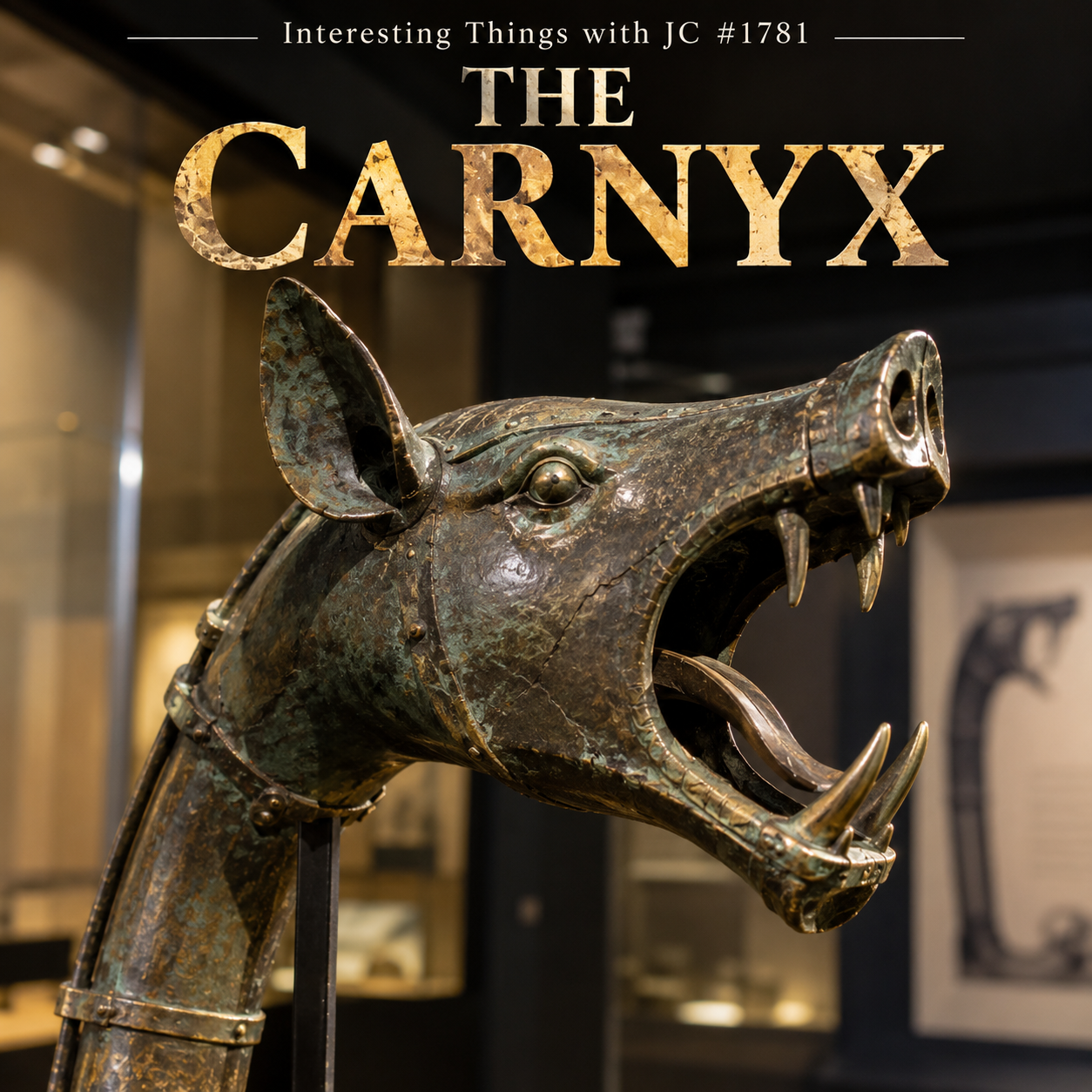
Episode artwork for Interesting Things with JC, number 1781, titled “The Carnyx.” Large, textured gold lettering appears above a close-up of an ancient-style bronze trumpet shaped like a wild boar’s head. The boar has an open mouth, prominent tusks, raised ears, and a weathered green-brown patina. The instrument is displayed against a softly blurred museum background with warm lighting.
Transcript
Interesting Things with JC #1781:
"The Carnyx"
An army could announce itself without a single word. Before the first warrior came into view, an unfamiliar sound might already be carrying across the battlefield, coming from a long bronze horn held high above the men. At the top was the head of an animal, sometimes a wild boar with its jaws open, and the sound came straight out of its mouth. The instrument was called the carnyx (CAR-nicks).
Used by Celtic peoples during the last centuries BC and into the Roman period, the carnyx was a long metal trumpet that could stand roughly 10 feet, or 3 meters, tall. Many were played vertically, with their animal heads raised above the warriors. Roman accounts describe the noise of Celtic war horns, and images of the carnyx appear on Roman monuments and Celtic coins. But those images could tell historians only so much about an instrument that had largely disappeared.
One important piece survived near Deskford, Scotland, where a bronze boar's head was discovered in 1816. It had once formed the bell of a carnyx, and its construction offered clues about how the instrument worked. The lower jaw was hinged, and a movable tongue could add a rattling quality to the sound.
In the early 1990s, a team led by musicologist John Purser used the Deskford head as the basis for a reconstruction. In 1993, musician John Kenny played the resulting instrument, bringing the sound of the carnyx back after nearly two thousand years. It could produce sustained notes, changes in pitch, and a wide range of sounds. The animal head was more than decoration, although the exact sound of an ancient carnyx remains impossible to establish with certainty.
Then, in 2004, archaeologists working at Tintignac (tan-teen-YAK), in central France, uncovered a deposit of ancient metal objects at a Gallic sanctuary. Among them were pieces of seven carnyxes, including enough material to recover one instrument almost completely. Six had boar-shaped heads, while another had a serpent-like head.
The discovery gave researchers substantial remains of several instruments found together in a documented archaeological setting. Their construction also showed that the carnyx was not limited to a single design. One of the Tintignac instruments appears to have been played at an angle closer to horizontal rather than held straight up.
The location of the discovery offered another clue. The instruments were part of a deposit at a sanctuary, alongside other metal objects, including weapons. Their presence there connected them to ritual activity, although archaeologists cannot say precisely how they were used during ceremonies or why they were eventually deposited.
The carnyx was certainly associated with warfare, but the remains at Tintignac place it within the ceremonial life of Celtic communities as well. We cannot establish which use came first, or whether every community treated the instrument in the same way. What the discoveries have given us is a fuller understanding of an instrument that had long been known largely through the accounts and images left by others.
The Deskford reconstruction allowed people to hear a carnyx again, while Tintignac revealed more about how these instruments were made and where they belonged. We can now build them, play them, and hear the remarkable range of sounds they can produce. What we cannot recover is everything those sounds meant to the people who first heard them.
These are interesting things, with JC.
Student Worksheet
Name: ____________________ Date: ____________________
Episode: #1781 — The Carnyx
Instructions: Listen to the episode before answering. Use the transcript to confirm details. Answer in complete sentences and distinguish evidence from interpretation.
Comprehension
What was the carnyx, and which ancient peoples used it?
Describe three physical characteristics of the instrument.
What was discovered at Deskford in 1816?
What did the reconstruction project demonstrate in 1993?
What did archaeologists discover at Tintignac in 2004?
What evidence connects the Tintignac instruments to ceremonial activity?
Analysis
Compare the Deskford and Tintignac discoveries. What different information did each provide?
Why does the existence of a playable reconstruction not prove exactly how ancient carnyxes sounded?
Explain how the Tintignac discovery challenged the idea that the carnyx had only one design or purpose.
Classify the following statements as evidence, interpretation, or unresolved question. Explain each classification.
A. Seven carnyxes were represented in the Tintignac deposit.
B. The instruments may have been used during religious ceremonies.
C. The original musicians played exactly the same notes as modern performers.
D. One instrument appears to have been played at an angle closer to horizontal.
Reflection
What is the difference between reconstructing an ancient object and recovering its cultural meaning?
If you could ask the original carnyx players one question, what would you ask? Explain why the answer would matter to historians.
Difficulty Scaling
Level 1 — Foundational: Complete questions 1–6 using the transcript. Write one or two sentences per answer.
Level 2 — Intermediate: Complete questions 1–12. Support analytical responses with details from the episode.
Level 3 — Advanced: Complete questions 1–12 and write an additional 200-word argument evaluating the strengths and limitations of experimental reconstruction.
Academic Integrity Guidance: Use your own language. Quote the transcript only when necessary and identify quotations. Do not present assumptions about ancient ceremonies, musicians, or sounds as established facts.
Teacher Guide
Quick Start: Prepare the episode audio, transcript, and worksheet. Begin with a sound-based historical question, play the episode without interruption, and guide students toward an evidence-based comparison of Deskford and Tintignac.
Pacing Guide — Audio First
0–5 minutes: Bell ringer and initial predictions.
5–10 minutes: Introduce the essential question and key vocabulary.
10–15 minutes: Play the episode without interruption.
15–22 minutes: Students independently complete comprehension questions.
22–32 minutes: Students compare Deskford and Tintignac in pairs.
32–42 minutes: Facilitate discussion of evidence, interpretation, and uncertainty.
42–50 minutes: Administer the five-question quiz.
50–55 minutes: Complete and collect the exit ticket.
Bell Ringer
Display or read:
"Imagine hearing an unfamiliar sound approaching before you can see its source. What could the sound communicate?"
Students write two possible interpretations and explain what additional evidence they would need.
Audio Guidance: Play the supplied episode recording in full. Ask students to listen first for the historical sequence and the two major discoveries rather than attempting to transcribe every detail.
Audio Fallback: If the recording is unavailable, read the complete transcript aloud at a natural pace. Preserve the original wording and pronunciation guidance.
Time on Task: 55 minutes, including approximately five minutes reserved for episode playback. Adjust playback time to the actual recording length.
Materials
Episode audio or printed transcript.
Student worksheet.
Writing materials or digital response document.
Timer.
Optional images of the Deskford and Tintignac carnyxes from the referenced institutional sources.
Vocabulary Preparation
Introduce carnyx, reconstruction, archaeological context, and ritual before playback.
Ask students to distinguish an artifact from an interpretation of an artifact.
Reinforce the difference between pitch and cultural meaning.
Common Misconceptions
Misconception: Every carnyx had an identical design. Correction: Tintignac revealed differences in animal heads and probable playing positions.
Misconception: The reconstruction reproduces the exact ancient sound. Correction: Missing components and historical performance practices introduce uncertainty.
Misconception: The carnyx was exclusively a battlefield instrument. Correction: Its presence in a sanctuary deposit also connects it to ceremonial life.
Misconception: Finding an object at a sanctuary establishes precisely how it was used. Correction: Archaeological context supports interpretations but does not necessarily reveal individual actions or intentions.
Misconception: Archaeologists know which function came first. Correction: The episode explicitly identifies this as unresolved.
Discussion Prompts
Which discovery contributed more information about the instrument's physical construction, and what specific information did it provide?
What can an archaeological context reveal that an isolated object cannot?
How might a modern musician unintentionally introduce contemporary performance practices into an ancient reconstruction?
Why should historians distinguish a plausible interpretation from a demonstrated fact?
Formative Checkpoints
After playback, students identify Deskford and Tintignac without consulting the transcript.
During pair work, students provide one supported conclusion and one uncertainty for each discovery.
During discussion, students explain why a modern reconstruction is an experiment rather than a complete recovery of the past.
Before the quiz, students identify one statement that would require stronger evidence.
Differentiation
Additional Support: Provide a two-column comparison organizer with the discovery locations already labeled.
Advanced Learners: Require an argument about the evidentiary strengths and limitations of reconstruction.
English Learners: Provide vocabulary definitions and allow an initial oral explanation before written responses.
Introductory College: Require students to distinguish physical evidence, archaeological context, and experimental results.
Homeschool: Conduct a guided discussion followed by an individual evidence table.
Lifelong Learners: Emphasize historical interpretation and the relationship between modern performance and ancient cultural practices.
Assessment Differentiation
Foundational: Accept concise responses identifying accurate evidence and one uncertainty.
Standard: Require two supporting details and a clear explanation.
Advanced: Require evaluation of competing interpretations and explicit acknowledgment of evidence limitations.
Time Flexibility
30 minutes: Play the episode, complete questions 1–6 and 7–8, discuss one uncertainty, and administer the exit ticket.
55 minutes: Follow the complete pacing guide.
75 minutes: Add the evidence table, extended discussion, and written assessment.
90 minutes: Add the advanced reconstruction argument and peer review.
Substitute Readiness: All necessary historical information appears in the transcript. A substitute can conduct the lesson using the transcript, worksheet, quiz, and answer key without additional research.
Engagement Strategy: Use an evidence challenge. Present the claim, "The carnyx was only a weapon of war." Students must identify two pieces of relevant evidence and explain whether the claim is supported, contradicted, or insufficiently established.
Extensions
Create a labeled technical drawing of a carnyx using the episode's descriptions.
Design a hypothetical reconstruction plan identifying surviving evidence and necessary assumptions.
Write a museum label of 150 words explaining what is known and unknown about the instrument.
Compare how sound functions in two historical or contemporary ceremonial settings without assuming that their meanings are identical.
Cross-Curricular Connections
History: Celtic societies and the interpretation of ancient evidence.
Physics: Sound production, resonance, and pitch.
Engineering: Metalworking, structural design, and reconstruction.
Music: Brass instrument performance and experimental music archaeology.
English Language Arts: Evidence-based argumentation and source interpretation.
SEL Connection: Practice intellectual humility by recognizing that uncertainty is a legitimate outcome of historical research. Encourage students to revise their interpretations when new evidence is introduced.
Skill Value Emphasis: Evidence evaluation, analytical reasoning, collaborative inquiry, technical communication, and responsible treatment of uncertainty.
Answer Key — Student Worksheet
A long metal trumpet used by Celtic peoples during the last centuries BC and into the Roman period.
Accept any three: long metal body, approximately three-meter height, animal-shaped bell, boar-shaped head, hinged jaw, movable tongue, or vertical playing position.
A bronze boar's head that had formed the bell of a carnyx.
A reconstructed instrument could produce sustained notes, changes in pitch, and varied sounds.
Parts of seven carnyxes, including enough material to recover one almost completely.
The instruments were found in a deposit at a Gallic sanctuary alongside other metal objects, including weapons.
Deskford supplied a surviving head that enabled reconstruction. Tintignac supplied remains of several instruments in a documented archaeological context, revealing design variation and ceremonial associations.
Missing components, uncertain original playing techniques, and incomplete knowledge of historical performance prevent exact reproduction.
The instruments included different animal heads and possible playing positions. Their sanctuary context also establishes an association beyond warfare.
A: Evidence. B: Interpretation supported by context. C: Unsupported claim; the exact notes cannot be established. D: Interpretation based on physical construction.
Reconstruction investigates an object's physical design and capabilities; cultural meaning depends on historical practices and beliefs that may not survive.
Answers vary. Accept questions about playing techniques, ceremonies, audiences, meanings, or transmission of musical knowledge when students explain their historical significance.
Answer Key — Quiz: 1. B; 2. C; 3. A; 4. D; 5. B.
Assessment Guidance: Award full credit for accurate evidence, sound reasoning, and explicit acknowledgment of uncertainty. Do not require students to assert a specific ceremonial function or exact historical sound.
Quiz
Instructions: Select the single best answer for each question. Each question is worth one point.
1. What was the carnyx?
A. A Roman percussion instrument used in temples.
B. A long metal trumpet associated with Celtic peoples.
C. A wooden flute used exclusively in ceremonies.
D. A bronze shield decorated with animal figures.
2. What was discovered near Deskford in 1816?
A. Seven complete musical instruments.
B. A Roman monument showing musicians.
C. A bronze boar's head from a carnyx.
D. A collection of written musical compositions.
3. What did the 1993 reconstruction demonstrate?
A. A playable carnyx could produce sustained notes and varied sounds.
B. Every ancient carnyx produced exactly the same notes.
C. The instrument was never used in warfare.
D. Ancient musicians always played the instrument horizontally.
4. Why was the Tintignac discovery significant?
A. It proved that Romans invented the carnyx.
B. It revealed the complete musical repertoire of Celtic peoples.
C. It established that the instrument had only one design.
D. It provided remains of seven instruments within a documented archaeological setting.
5. Which conclusion is best supported by the episode?
A. The carnyx was used exclusively during military campaigns.
B. The carnyx was associated with warfare and also had ceremonial connections.
C. Every Celtic community used the instrument identically.
D. Archaeologists have recovered the precise meaning of every carnyx performance.
Assessment
Open-Ended Questions
1. Explain how the Deskford reconstruction and Tintignac discovery contributed to researchers' understanding of the carnyx. Use at least two specific details from each discovery and identify one remaining uncertainty.
2. Evaluate the statement: "Reconstructing an ancient instrument allows researchers to recover its original cultural meaning." Develop an evidence-based response using the carnyx as your example. Distinguish what reconstruction can demonstrate from what remains unknown.
Response Requirements: Write 150–250 words per question. Include accurate historical details, a clear claim, and explicit recognition of uncertainty.
Scoring: Six points total, three per question.
Performance Interpretation
6 points: Both responses meet the proficiency criteria.
4–5 points: Most expectations met; targeted revision recommended.
2–3 points: Partial understanding; additional evidence practice needed.
0–1 point: Revisit the episode and complete a guided comparison.
Exit Ticket
Identify one fact established by archaeological evidence.
Identify one interpretation supported by that evidence.
Identify one question about the carnyx that remains unresolved.
Exit Ticket Success Criterion: All three responses must be distinct, historically accurate, and consistent with the episode.
Standards Alignment
NGSS — Science & Engineering Practices
Constructing Explanations and Designing Solutions: Students explain how the carnyx reconstruction used physical evidence and experimental testing. Measured through worksheet questions 7–8 and Assessment Question 2.
Engaging in Argument from Evidence: Students evaluate whether surviving artifacts establish the instrument's original sound and cultural function. Measured through Assessment Question 2 and the evidence table.
Developing and Using Models: Students create an annotated reconstruction diagram, identifying documented features and hypothetical components. Measured through the optional engineering extension.
Alignment Note: These are NGSS science and engineering practices, not claims that the lesson fulfills a specific NGSS disciplinary performance expectation.
CCSS Reading — Literacy in History/Social Studies
CCSS.ELA-LITERACY.RH.9-10.1 — Cite specific textual evidence to support analysis of primary and secondary sources: Students identify details supporting conclusions about Deskford and Tintignac. Measured through worksheet questions 7–10.
CCSS.ELA-LITERACY.RH.11-12.7 — Integrate and evaluate multiple sources of information presented in diverse formats and media: Students compare the episode's audio narrative with its transcript and optional archaeological images. Measured through the evidence table and discussion.
CCSS Writing
CCSS.ELA-LITERACY.WHST.9-10.1 — Write arguments focused on discipline-specific content: Students develop a claim about the capabilities and limitations of archaeological reconstruction. Measured through Assessment Question 2.
CCSS.ELA-LITERACY.WHST.11-12.9 — Draw evidence from informational texts to support analysis, reflection, and research: Students use specific historical details to explain how archaeological discoveries change interpretations. Measured through both assessment questions.
C3 Framework — History and Inquiry
D2.His.13.9-12 — Critique the appropriateness of the historical sources used in a secondary interpretation: Students evaluate what physical remains, ancient representations, and modern reconstructions can establish.
D2.His.14.9-12 — Analyze multiple and complex causes and effects of events in the past: Students examine how archaeological discoveries and reconstruction experiments contributed to changes in historical understanding.
D3.1.9-12 — Gather relevant information from multiple sources while using origin, authority, structure, context, and corroborative value to guide selection: Students compare the episode with institutional archaeological sources during the optional research extension.
ISTE — Knowledge Constructor
ISTE 1.3.b — Evaluate Information: Students evaluate the accuracy, perspective, credibility, and relevance of historical evidence and reconstruction claims.
ISTE 1.3.c — Curate Information: Students organize relevant evidence into a comparison table and explain how it supports their conclusions.
Career Readiness Competencies
Critical Thinking: Distinguish physical evidence from speculative interpretation.
Research Literacy: Identify relevant information and evaluate its limitations.
Technical Communication: Explain reconstruction procedures and uncertainty clearly.
Collaboration: Compare evidence and refine interpretations through discussion.
Problem Solving: Develop reconstruction proposals within documented constraints.
UK National Curriculum — Key Stage 3 History
Historical Enquiry: Students examine evidence, develop questions, and recognize that historical claims depend on available sources.
Historical Interpretations: Students investigate how new archaeological discoveries can alter interpretations of ancient societies.
Alignment Note: The UK connections are suitable enrichment for learners working beyond or alongside the specified Key Stage 3 history curriculum.
IB — MYP Individuals and Societies
Objective A — Knowing and Understanding: Students demonstrate knowledge of the carnyx and use historical terminology accurately.
Objective B — Investigating: Students formulate questions about reconstruction and identify relevant evidence.
Objective D — Thinking Critically: Students interpret evidence, evaluate competing explanations, and recognize uncertainty.
Homeschool and Lifelong Learning
Independent Inquiry: Investigate an unfamiliar historical technology using a structured research question.
Evidence Evaluation: Separate observed characteristics from reconstructed features.
Historical Understanding: Explain how discoveries change knowledge without necessarily resolving every historical question.
Communication: Produce a concise, evidence-supported interpretation suitable for a museum label or educational presentation.
Alignment Verification: Student work is assessed through observable responses, evidence tables, discussion, written explanations, and optional reconstruction activities. Standards involving multiple sources or modeling require completion of their corresponding extensions.
Show Notes
The carnyx was a towering metal trumpet used by ancient Celtic peoples, recognizable by the animal-shaped head at its upper end. For centuries, knowledge of the instrument depended heavily on historical descriptions, images, and fragmentary remains. The discovery of a bronze boar's head at Deskford, Scotland, and its subsequent reconstruction allowed modern musicians to investigate the instrument's remarkable range of sounds. The discovery of seven carnyxes at Tintignac, France, in 2004 provided additional evidence about their construction, variation, and ceremonial associations. This episode offers an accessible introduction to archaeology, experimental reconstruction, and the challenges of interpreting ancient cultural practices. For classroom use, it demonstrates how researchers combine material evidence and experimentation while acknowledging the limits of historical knowledge. The central lesson extends beyond music: recovering an ancient object's physical form does not necessarily recover everything it meant to the people who made and used it.
References
Archaeological and Museum Sources
Carnyx & Co. (n.d.). The Deskford carnyx. https://carnyx.org.uk/the-deskford-carnyx/
Carnyx & Co. (n.d.). The Tintignac carnyx. https://carnyx.org.uk/the-tintignac-carnyx/
National Museums Scotland. (n.d.). Carnyx / reconstruction. Collections database. https://www.nms.ac.uk/explore-our-collections/collection-search-results/?item\_id=384359
National Museums Scotland. (2019, September 1). Chasing the carnyx, from Scotland to the Sahara. https://blog.nms.ac.uk/2019/09/01/chasing-the-carnyx-from-scotland-to-the-sahara/
Tintignac Archaeological Documentation
Commune de Naves. (n.d.). Site archéologique de Tintignac. https://www.naves19.fr/la-commune/le-patrimoine/site-archeologique-de-tintignac/
Site archéologique de Tintignac-Naves. (n.d.). Les fouilles. https://tintignac.wixsite.com/tintignac-naves/fouilles
Reference Verification Notes
The sources above were checked against accessible institutional, archaeological-site, and specialist reconstruction materials.
The National Museums Scotland collection record confirms a reconstruction produced in 1992 by John Purser and John Creed. The specialist reconstruction documentation identifies John Kenny as a member of the project team and describes the experimental work.
The Tintignac documentation confirms the 2004 discovery, seven represented carnyxes, variation in animal-head designs, and their archaeological association with a sanctuary.