Interesting Things with JC #1481: "The Real History Behind Eleven" – Behind Stranger Things is a darker reality: secret experiments, Cold War paranoia, and psychological tests on real kids. Eleven wasn’t invented. She was based on something real.
Curriculum - Episode Anchor
Episode Title: Interesting Things with JC #1481: “The Real History Behind Eleven”
Episode Number: 1481
Host: JC
Audience: Grades 7–12, college intro courses, homeschool learners, lifelong learners
Subject Area: U.S. History, Psychology, Media Literacy, Cold War Studies, Cultural Studies
Lesson Overview
Students will:
• Define MK-Ultra, psi research, and 20th-century psychological study practices.
• Compare real historical research programs to their fictionalized counterparts in Stranger Things.
• Analyze how 1980s cultural conditions shaped public fear, policy shifts, and media storytelling.
• Explain how historical events influence modern narratives and character creation in popular culture.
Key Vocabulary
• MK-Ultra (em-kay uhl-truh) — A real CIA program from the 1950s–70s involving experiments on human behavior. Used in a sentence: “MK-Ultra informs the scientific atmosphere behind Eleven’s character.”
• Sensory Deprivation (sen-suh-ree dep-ruh-vay-shun) — Isolation from sensory input to study the mind’s response.
• Remote Viewing (ree-moht vyoo-ing) — Cold War–era experiments exploring whether a person could describe a distant location using only the mind.
• Attachment Studies (uh-tach-ment stuh-deez) — Research observing children’s emotional responses in controlled environments.
• Gifted & Talented Programs (gif-tid and tal-uhn-tid proh-grams) — Educational enrichment programs that expanded in the 1980s and sometimes incorporated guided imagery and creative visualization exercises.
Narrative Core
Open – JC introduces Eleven from Stranger Things and reveals that her fictional backstory is rooted in real historical research programs.
Info – The episode outlines MK-Ultra, Cold War psi research, and mid-20th-century psychological experiments on children, connecting them to elements of Eleven’s fictional abilities.
Details – JC details U.S. and Soviet remote-viewing programs, controlled-environment child psychology, 1980s Gifted & Talented practices, and the cultural anxiety of the Stranger Danger era. He also addresses the Montauk legend and its influence on early concept drafts of the show.
Reflection – JC explains why these historical elements make Stranger Things feel emotionally familiar and culturally grounded, even when the supernatural dominates the story.
Closing – These are interesting things, with JC.
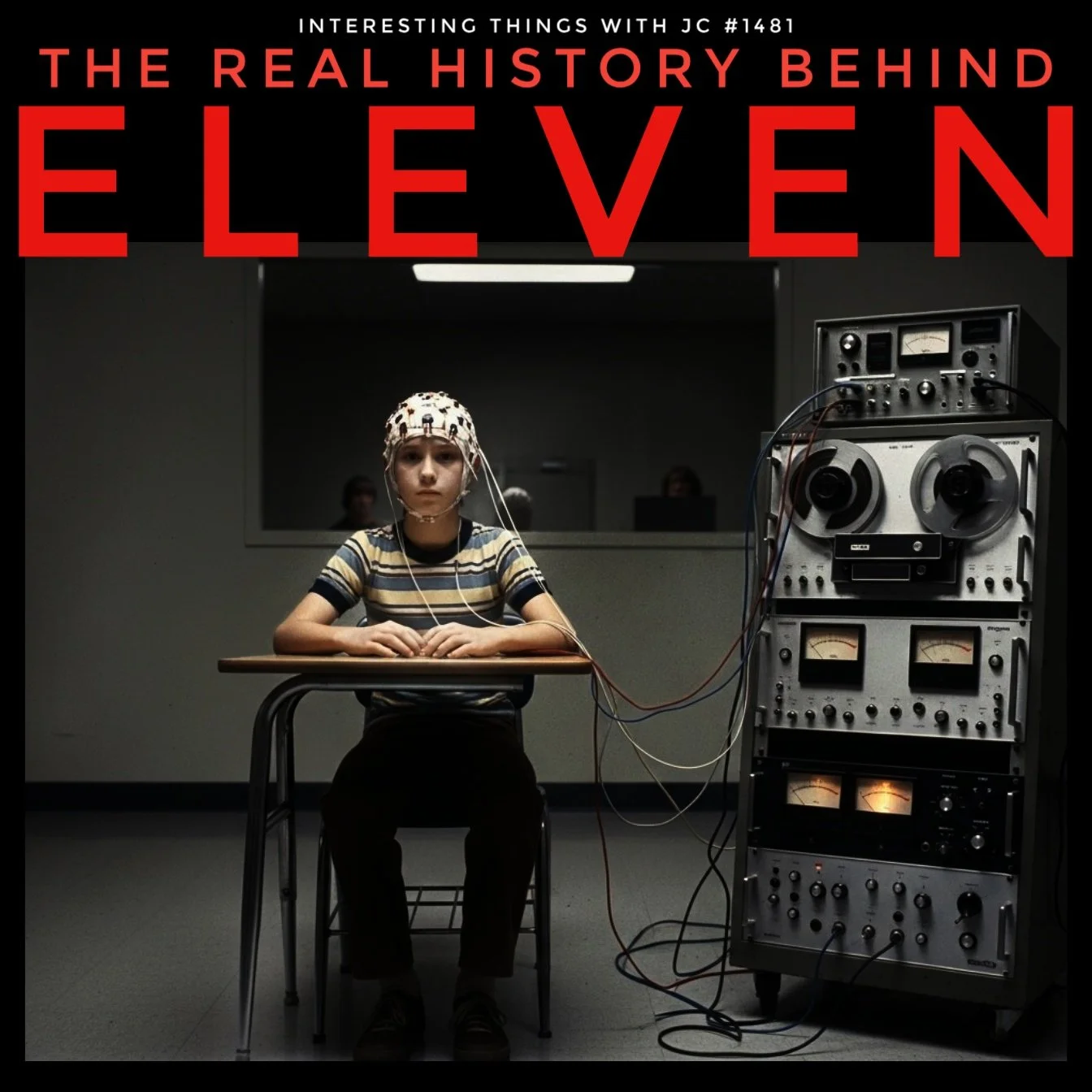
A young child sits alone at a metal school desk in a dim, institutional testing room. The child wears a striped 1970s-style T-shirt and an EEG cap with white cloth-wrapped electrodes that connect by long wires to a tall stack of analog scientific equipment beside the desk. The machine has metal panels, glowing indicator lights, VU meters, and two large reel-to-reel tape decks. In the background, a two-way mirror shows the faint silhouettes of adults observing from another room. Large red title text at the top reads “The Real History Behind Eleven,” and smaller text above it reads “Interesting Things with JC #1481.”
Transcript
If you’ve never seen Stranger Things, here’s all you need to know: one of the main characters is a girl named Eleven, a kid raised inside a government lab and pushed into experiments she never chose. She can reach people far away, slip into a kind of dream-state, and sense things most of us can’t. It feels supernatural on screen, but almost every piece of her backstory comes from real history…the kind that shaped America long before the show ever existed.
The deepest influence is MK-Ultra, the CIA program that ran from the 1950s into the early 70s. These weren’t rumors. They were declassified records describing sensory-deprivation rooms, stress-based conditioning, and chemical tests on unwitting participants. Researchers wanted to understand how the mind breaks, how it adapts, and how far a human can be pushed. When you see Eleven isolated in a tank, cut off from the world, that’s not fantasy. It’s a dramatized version of techniques federal researchers genuinely explored.
Another thread comes from the Cold War race to understand the limits of human perception. Both the United States and the Soviet Union invested in psi research: remote viewing, mental projection, and whether focused attention could gather information at a distance. Programs like Stargate and the Stanford Research Institute’s experiments on gifted subjects produced memos and case files that read eerily like the scenes where Eleven reaches for someone miles away. The science never delivered reliable intelligence, but for decades it was considered worth the funding.
Then there’s the psychology side. From the 1950s through the 1970s, researchers studied how children respond when their environment is tightly controlled. They ran attachment tests behind one-way mirrors, monitored kids in isolation rooms, and observed what happens when the world shrinks down to whatever an adult scientist decides. Eleven’s emotional reactions…the confusion, the loyalty, the fear…line up with this research more closely than with science fiction.
By the early 1980s, which is when Stranger Things takes place, American schools were going through their own shift. Gifted & Talented programs didn’t teach psychic abilities, but they absolutely used techniques from the era’s psychology and New Age movements: guided imagery, creative visualization, dream journaling, quiet sensory exercises, and “higher-order thinking” sessions. Teachers were encouraged to push creativity and focus in new ways, and kids often experienced activities that felt bigger than the explanation they were given. It wasn’t paranormal, but to a child it could feel like the mind was being stretched into new territory. That atmosphere helps define why Eleven’s abilities feel rooted in the world so many viewers grew up in.
Layer on top of that the cultural climate of the early 80s. This was the Stranger Danger era. Etan Patz vanished in 1979. Adam Walsh in 1981. Neighborhoods changed. Schools locked doors. Kids still roamed on bikes until dusk, but parents kept one eye on the news. Childhood became a mix of freedom and fear…the exact emotional weather of Stranger Things, and the backdrop the Duffer Brothers lived through themselves.
And hovering over all of this is the Montauk legend, the modern myth about covert labs on the eastern tip of Long Island. None of that has ever been verified. But when the Duffers first drafted their show, their working title was literally Montauk. They didn’t borrow the claims; they borrowed the atmosphere…the idea that something strange might be happening just beyond the edge of what anyone can prove. It gave them tone, not facts.
Put all of this together: MK-Ultra, Cold War psi research, controversial child-psych studies, the rise of G&T enrichment, early-80s cultural fear, and the Montauk legend, and you get the real blueprint behind Eleven. The supernatural elements are fiction. But the pressure, the secrecy, the psychological experiments, and the way adults once tried to stretch the human mind? Those came straight from the historical record.
And that’s why the show feels so familiar, even when the monsters are pure imagination.
These are interesting things, with JC.
Student Worksheet
Describe how MK-Ultra influenced the depiction of Eleven’s isolation tank scenes.
Explain why Cold War governments funded psi research even without reliable results.
Compare 1950s–70s child psychology studies with Eleven’s emotional responses in the show.
How did the cultural anxieties of the Stranger Danger era shape 1980s childhood?
Creative prompt: Write a short journal entry from the perspective of a 1980s G&T student trying guided imagery for the first time.
Teacher Guide
Estimated Time: 1–2 class periods (45–90 minutes)
Pre-Teaching Vocabulary Strategy:
• Use Frayer models for MK-Ultra, psi research, sensory deprivation.
• Provide short, leveled background blurbs for younger students (grades 7–8).
Anticipated Misconceptions:
• Students may think MK-Ultra was fictional; clarify historical documentation.
• Psi research was real but never yielded verified intelligence results.
• Stranger Things is inspired by, not reenacting, real events.
Discussion Prompts:
• Why do stories grounded in real history feel more believable?
• How do ethics differ between mid-20th-century psychology and modern research standards?
• Should governments fund exploratory research even when outcomes are uncertain?
Differentiation Strategies:
• ESL: Provide vocabulary charts with visuals.
• IEP: Offer guided notes and sentence starters.
• Gifted: Assign comparative analysis between U.S. and Soviet research initiatives.
Extension Activities:
• Research and present a declassified MK-Ultra document.
• Analyze a scene from Stranger Things and trace its historical inspiration.
• Compare media portrayals of Cold War science in other films or series.
Cross-Curricular Connections:
• History: Cold War intelligence culture.
• Psychology: Ethics in research and human behavior studies.
• Media Literacy: Fiction vs. fact in storytelling.
• Sociology: Social fear and cultural shifts in 1980s America.
Quiz
Q1. Which real CIA program most influenced Eleven’s backstory?
A. Operation Paperclip
B. MK-Ultra
C. Project Blue Book
D. Operation Cyclone
Answer: B
Q2. Cold War psi research focused primarily on:
A. Biological weapons
B. Remote viewing and mental projection
C. Outer space communication
D. Oceanographic exploration
Answer: B
Q3. 1950s–70s child psychology studies often examined:
A. Sports performance
B. Children in controlled or isolated environments
C. Robotics and automation
D. Consumer habits
Answer: B
Q4. Gifted & Talented programs in the 1980s sometimes used:
A. Telepathy drills
B. Guided imagery and creative visualization
C. Chemical testing
D. Military simulation training
Answer: B
Q5. The Montauk legend contributed to Stranger Things by providing:
A. Verified historical facts
B. A tonal and atmospheric influence
C. A detailed plot outline
D. Scientific data
Answer: B
Assessment
Explain how multiple historical research programs combined to influence the creation of Eleven’s character.
Analyze how the emotional landscape of the 1980s contributes to the tone of Stranger Things.
3–2–1 Rubric:
3 – Accurate, complete, and thoughtful explanation using episode details
2 – Partially complete or missing specific details
1 – Inaccurate, vague, or unrelated to episode content
Standards Alignment
Common Core (ELA):
• CCSS.ELA-LITERACY.RI.7.3 / RI.11-12.3 – Analyze how historical events influence modern narratives.
• CCSS.ELA-LITERACY.RH.9-10.2 – Determine central ideas of historical texts.
• CCSS.ELA-LITERACY.W.11-12.9 – Draw evidence from informational texts to support analysis.
C3 Framework (Social Studies):
• D2.His.1.6-12 – Evaluate historical sources for credibility.
• D2.His.14.6-12 – Explain multiple causes of historical developments, such as Cold War research culture.
NGSS (Science & Engineering Practices):
• SEP7 – Engage in argument from evidence (e.g., evaluating claims from psi research).
• SEP8 – Obtain, evaluate, and communicate information about scientific ethics and methodology.
ISTE (Digital Literacy):
• ISTE 3A – Evaluate accuracy, perspective, and credibility of information.
• ISTE 6C – Communicate complex ideas clearly through media literacy.
International Equivalents:
UK National Curriculum (History):
• KS3/4: Understanding historical evidence – Evaluate reliability of sources such as declassified documents.
IB MYP Individuals & Societies:
• Criterion A: Knowing and Understanding – Demonstrate knowledge of historical events like MK-Ultra.
Cambridge IGCSE History:
• Domain: Historical Explanation and Source Analysis – Assess how historical conditions shape modern media.
Show Notes
This episode uncovers the real historical programs, psychological research, and cultural anxieties that shaped the fictional character Eleven from Stranger Things. JC walks listeners through MK-Ultra, Cold War psi experiments, child-psychology studies, 1980s enrichment trends, and the broader Stranger Danger climate…offering a factual foundation for understanding why the series feels emotionally grounded despite its supernatural elements. For classrooms, the episode provides a rich entry point into discussions of research ethics, Cold War culture, media literacy, and how popular storytelling draws from real historical contexts to create compelling fiction.
References
Central Intelligence Agency. (1977). Project MK-ULTRA, the CIA’s program of research in behavioral modification: Joint hearing before the Select Committee on Intelligence and the Subcommittee on Health and Scientific Research of the Committee on Human Resources, United States Senate. U.S. Government Printing Office.
https://www.cia.gov/readingroom/document/06760269United States Senate Select Committee on Intelligence, & Subcommittee on Health and Scientific Research of the Committee on Human Resources. (1977). Project MKULTRA, the CIA’s program of research in behavioral modification: Joint hearing before the Select Committee on Intelligence and the Subcommittee on Health and Scientific Research of the Committee on Human Resources, United States Senate, Ninety-fifth Congress, first session, August 3, 1977. U.S. Government Printing Office. https://www.intelligence.senate.gov/1977/08/03/hearings-joint-hearing-subcommittee-health-and-scientific-research-committee-human-resources-project
Arzuk, D. (2021). Gifted children in the 1980s: What changed? Changing Childhoods.
https://changingchildhoods.com/gifted-children-in-the-1980s/Srinivasan, M. (2002). Clairvoyant remote viewing: The US sponsored psychic spying. Strategic Analysis, 26(1). https://ciaotest.cc.columbia.edu/olj/sa/sa_jan02srm01.html
Renfro, P. M. (2020, May 18). How the “stranger danger” panic of the 1980s helped fuel mass incarceration. Jacobin. https://jacobin.com/2020/05/stranger-danger-mass-incarceration-paul-renfro
Midnight Oil Studios. (2019, April 2). The Duffer Brothers. Midnight Oil Studios. https://midnightoilstudios.org/2019/04/02/the-duffer-brothers/
Netflix. (2016). Stranger Things [TV series]. Netflix. https://www.netflix.com/title/80057281