Interesting Things with JC #1482: "The First NFL Thanksgiving Game" – A cold Ohio field. A rising league. A fight for pride that shaped a holiday tradition. The roots of Thanksgiving football still echo with grit and stubborn joy.
Curriculum - Episode Anchor
Episode Title: The First NFL Thanksgiving Football Game: the 1920 Akron Pros vs. Canton Bulldogs
Episode Number: #1482
Host: JC
Audience: Grades 9–12, college intro, homeschool, lifelong learners
Subject Area: U.S. History, Sports History, Social Studies, Media Literacy
Lesson Overview
By the end of this lesson, learners will be able to:
• Define the early structure and purpose of the American Professional Football Association (APFA).
• Compare early professional football equipment, gameplay, and culture with modern traditions.
• Analyze the historical significance of the 1920 Akron Pros vs. Canton Bulldogs Thanksgiving game.
• Explain how the 1920 matchup influenced the development of Thanksgiving football as an American tradition.
Key Vocabulary
• American Professional Football Association (APFA) (A-P-F-A) — The early league formed in 1920 to organize professional football; used in a sentence: The APFA established shared rules and cleaner roster practices before becoming the NFL.
• Legacy (LEH-guh-see) — Something handed down from the past; in context, Canton’s legacy came from its Ohio League dominance.
• Rosters (RAW-sturz) — Official lists of players on a team; teams in 1920 struggled to maintain consistent rosters due to player poaching.
• Contemporary accounts (kuhn-TEM-puh-rare-ee uh-KOUNTS) — Records or reports written at the time of an event; these describe how Canton struggled to gain yards.
• Win percentage (WIN per-SEN-tij) — A calculation used to determine standings; Akron became champions because no team exceeded their win percentage.
Narrative Core
Open
Listeners are hooked by the idea that Thanksgiving football may seem like a timeless American tradition, yet its professional roots go back only to 1920.
Info: The story explains the formation of the APFA, the origins of early professional football, and the reputations of Akron and Canton before their Thanksgiving game.
Details: The game environment, equipment, weather, and the presence of stars like Jim Thorpe and Fritz Pollard reveal how rugged and unrefined early football was.
Reflection: JC highlights how this gritty 1920 matchup captured community spirit, family tradition, and the early identity of American football.
Closing: These are interesting things, with JC.
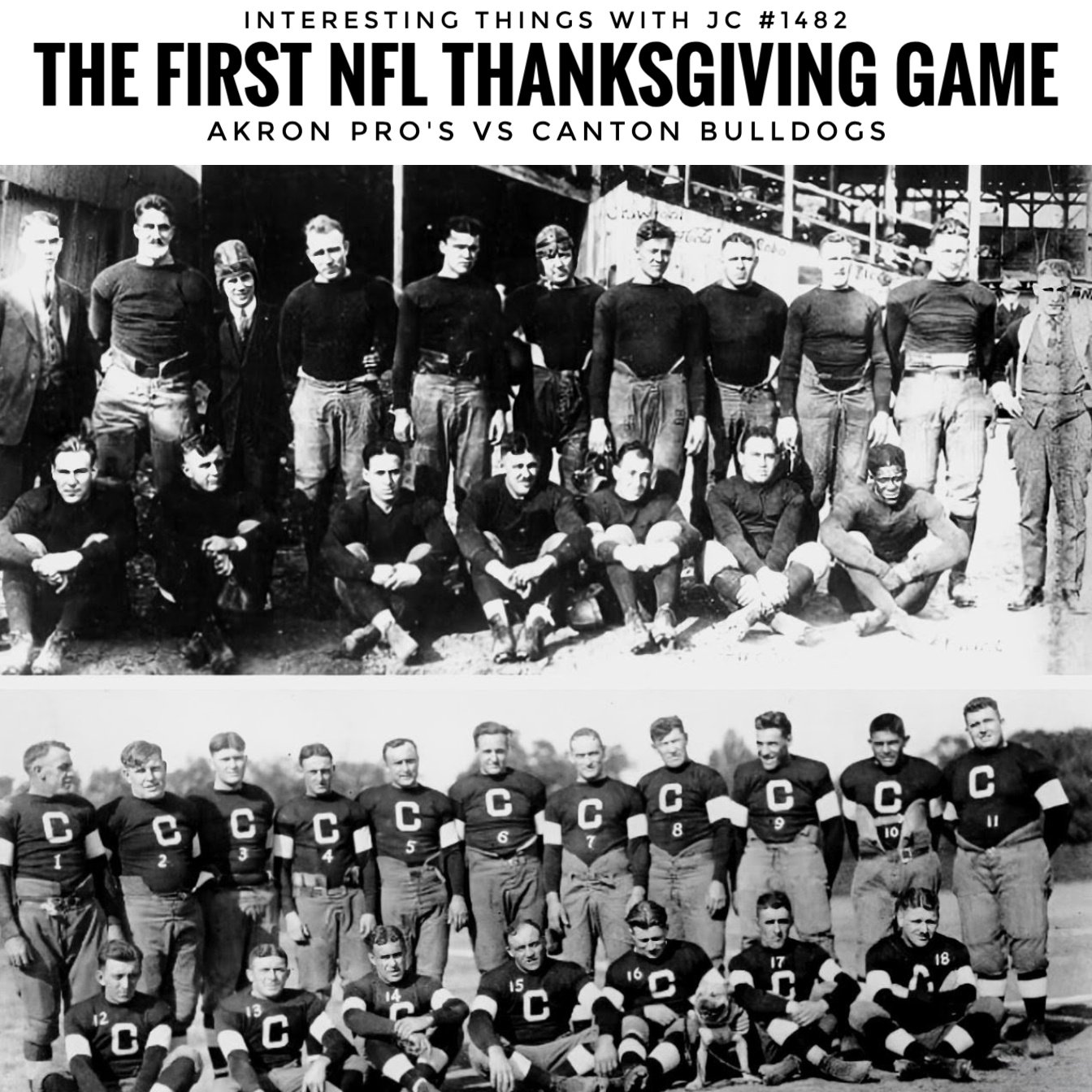
A black and white split-image collage showing two early 20th century professional football teams. The top photo features the Akron Pros standing outdoors in simple long-sleeve jerseys and leather-style uniforms, with some players seated in front and several men in suits standing at the edges. The setting appears to be a dirt field with wooden structures in the background. The bottom photo shows the Canton Bulldogs lined up in uniform rows on a grassy field, wearing dark jerseys with large white “C” letters on the chest and numbered sleeves. Both teams pose formally for the camera, reflecting the rugged look of early pro football. The title text above reads: “Interesting Things with JC #1482. The First NFL Thanksgiving Game. Akron Pro’s vs Canton Bulldogs.”
Transcript
Thanksgiving football started rough and cold, long before big stadiums and TV coverage. On November 25, 1920, the Akron Pros hosted the Canton Bulldogs in the first Thanksgiving matchup under the early league that would soon become the NFL. The field was a frozen dirt lot. Fans stood right on the sideline, close enough that players brushed past them on outside runs.
Canton arrived with Jim Thorpe, Olympic champion and league president. At about 185 pounds or 84 kilos, Thorpe ran with balance and power. He played both ways and returned kicks. His stiff arm was strong enough to knock defenders off their feet. Akron answered with Fritz Pollard, one of the first Black stars in pro football. Pollard played at around 165 pounds or 75 kilos. He relied on quick cuts, acceleration, and misdirection, slipping into gaps before Canton could close them.
Their styles shaped the whole game. Canton tried sweep plays to get Thorpe in space, but Akron sealed the edge and forced him inside. Pollard ran counters and short bursts behind pulling linemen. Tackles were straight body hits because padding was almost nothing. Leather helmets were thin, and some players wore none at all. Every collision carried a full thud you could feel from the sideline.
The first half stayed scoreless. The field broke down into soft dirt and ruts. Canton attempted a long drop kick in the third quarter, a normal part of football at the time, but it curved wide. Late in the fourth quarter Akron finally pushed a drive with two inside runs and a short pass. Pollard helped move the chains, and the Pros punched in a rushing touchdown from a few yards out. They held Canton from there by stacking the line and forcing everything into a crowd.
Akron won 7 to 0. That win helped them finish the season undefeated and earn the first championship under league rules. More than the score, the game showed that pro football could draw a crowd on a holiday afternoon. A rough field, hard tackles, and two of the best athletes of the era helped set the pattern for the Thanksgiving tradition that millions watch now.
These are interesting things, with JC.
Student Worksheet
What was the original name of the NFL in 1920, and why was it created?
Describe two major differences between football equipment in 1920 and modern football equipment.
Why were Akron and Canton considered significant teams before their Thanksgiving matchup?
Explain how Akron’s victory contributed to them becoming league champions.
Creative prompt: Imagine you are a fan standing on the sideline in 1920. Write a short journal entry describing what you see, hear, and feel.
Teacher Guide
Estimated Time
45–60 minutes
Pre-Teaching Vocabulary Strategy
• Introduce terms with brief definitions.
• Show primary-source photographs of early football gear to contextualize vocabulary.
• Have students use each vocabulary term in an original sentence.
Anticipated Misconceptions
• Students may assume football has always been organized like the modern NFL.
• Some may believe early equipment was safer than it actually was.
• Learners may not know that Jim Thorpe and Fritz Pollard were major historical figures.
Discussion Prompts
• How did community identity shape early football rivalries?
• Why do traditions like Thanksgiving football endure across generations?
• How does the rugged nature of early football compare to the modern televised spectacle?
Differentiation Strategies
• ESL: Provide vocabulary cards with visuals; allow sentence frames for responses.
• IEP: Offer guided notes and extended time; allow oral answers.
• Gifted: Encourage deeper research into the Ohio League, segregation in early football, or the evolution of sports media.
Extension Activities
• Primary-source analysis: Compare newspaper coverage of the 1920 game with modern sports journalism.
• Create a timeline of major events from the APFA’s founding to the establishment of the NFL.
• Physics tie-in: Examine how equipment changes affected force absorption and player safety.
Cross-Curricular Connections
• Physics: Impact forces, padding materials.
• Sociology: Community identity and sports traditions.
• Media Literacy: Evolution of sports broadcasting from radio to TV to streaming.
Quiz
What was the APFA’s main purpose in 1920?
A. To increase ticket prices
B. To organize rules and reduce player poaching
C. To promote college football
D. To replace the Ohio League
Answer: BWho was the star player and first president of the APFA?
A. Fritz Pollard
B. Jim Thorpe
C. Red Grange
D. George Halas
Answer: BWhat was the final score of the 1920 Thanksgiving game?
A. 14–7
B. 7–0
C. 10–3
D. 21–14
Answer: BWhy did Akron become league champion in 1920?
A. They scored the most total points.
B. They had the best win percentage.
C. They had the most players.
D. They won a playoff game.
Answer: BWhat best describes early football equipment?
A. Heavy padding and plastic helmets
B. No helmets and thick synthetic pads
C. Simple leather helmets and thin pads
D. Metal helmets and reinforced padding
Answer: C
Assessment
Explain why the 1920 Akron–Canton game helped establish Thanksgiving football as a national tradition.
Analyze how players like Jim Thorpe and Fritz Pollard shaped the early identity of professional football.
3–2–1 Rubric
• 3 – Accurate, complete, thoughtful; includes specific historical details.
• 2 – Partially correct; missing detail or clarity.
• 1 – Inaccurate, vague, or incomplete.
Standards Alignment
Common Core (CCSS – History/Social Studies)
• CCSS.ELA-LITERACY.RH.9-10.2 – Learners determine central ideas from the episode’s historical narrative.
• CCSS.ELA-LITERACY.RH.11-12.3 – Students evaluate explanation of key individuals like Thorpe and Pollard.
• CCSS.ELA-LITERACY.WHST.9-12.2 – Students write informative responses using podcast evidence.
C3 Social Studies Framework
• D2.His.1.9-12 – Analyze change over time in early professional football.
• D2.His.14.9-12 – Evaluate multiple historical perspectives (fans, players, league founders).
ISTE Standards
• ISTE 3.2 Knowledge Constructor – Students build understanding using primary/secondary sources.
• ISTE 3.6 Creative Communicator – Students creatively reframe historical scenes (journal entry task).
UK National Curriculum (History)
• KS4 History: Modern World Depth Study – Understanding how cultural traditions evolve through historical events.
IB MYP Individuals & Societies
• MYP Criterion A: Knowing and Understanding – Demonstrating historical knowledge of early sports institutions.
• MYP Criterion B: Investigating – Using the transcript as a source for inquiry.
Cambridge IGCSE History
• IGCSE History AO1 – Recall and select historical information (teams, dates, events).
• IGCSE History AO2 – Demonstrate understanding of causation and significance.
Show Notes
This episode explores the first major professional Thanksgiving football game in 1920, when the Akron Pros and the Canton Bulldogs met during the APFA’s inaugural season. Listeners learn how early pro football operated before the NFL existed, how rough the game was, and how legendary athletes like Jim Thorpe and Fritz Pollard shaped the sport’s future. For classrooms, this episode matters because it ties sports traditions to broader themes of community, historical change, racial barriers in athletics, and the development of national rituals. Students gain insight into how everyday traditions, like Thanksgiving football, emerge from real historical moments shaped by people, places, and cultural identity.
References
Carroll, B. (1982). It’s time for a belated cheer for the 1920 Akron Pros. The Coffin Corner, 4(12). Professional Football Researchers Association.
https://www.profootballresearchers.org/archives/Website_Files/Coffin_Corner/04-12-119.pdfPro Football Hall of Fame. (n.d.). Thanksgiving Day Game Results. https://www.profootballhof.com/football-history/thanksgiving-day-game-results/
Pro-Football-Reference.com. (n.d.). Canton Bulldogs at Akron Pros – November 25, 1920 (Boxscore & Stats). https://www.pro-football-reference.com/boxscores/192011250akr.htm
NFL. (n.d.). Thanksgiving serves up classic games. https://www.nfl.com/news/thanksgiving-serves-up-classic-games-09000d5d8045a5e3
Brown University Library. (n.d.). About Fritz Pollard. https://library.brown.edu/cds/pollard/aboutpollard.html
Pro Football Hall of Fame. (2020). Hall of Famer Fritz Pollard helped sports, world change for better. https://www.profootballhof.com/news/2020/08/hall-of-famer-fritz-pollard-helped-sports-world-change-for-better/
Gridiron Gentlemen. (2019). NFL 1: The 1920 Akron Pros. https://www.gridirongentlemen.com/nfl-1-the-1920-akron-pros/