
Interesting Things with JC #1506: "Eating the Top Tier of the Wedding Cake" – Saving the cake wasn’t romantic at first. It was practical, hopeful, and rooted in an uncertain future. What we taste now is really a measure of time.
Curriculum - Episode Anchor
Episode Title: “Eating the Top Tier of the Wedding Cake”
Episode Number: 1506
Host: JC
Audience: Grades 9–12, college intro, homeschool, lifelong learners
Subject Area: History, Cultural Studies, Social History, Food History
Lesson Overview
This lesson traces the evolution of saving the top tier of a wedding cake from 18th–19th century Britain to its adaptation in the United States. Students analyze how historical conditions, food science, media coverage, and technological change shaped a tradition that still exists today.
Define
• Define the original practical purpose of saving the top tier of a wedding cake.
Compare
• Compare British and American interpretations of the wedding cake tradition.
Analyze
• Analyze how food science, refrigeration, and social conditions influenced cultural practices.
Explain
• Explain why traditions can endure even after their original function changes.
Key Vocabulary
Fruitcake (FROOT-kayk) — A dense cake made with dried fruit and often alcohol, designed to last for long periods without spoiling.
Preservation (preh-zur-VAY-shun) — Methods used to slow food decay; alcohol and low moisture preserved historical cakes.
Christening (KRIS-uh-ning) — A religious ceremony welcoming a child, traditionally when the saved cake tier was eaten.
Infant mortality (IN-fuhnt mor-TAL-ih-tee) — The rate of infant deaths in a population, historically much higher than today.
Refrigeration (rih-frij-uh-RAY-shun) — Cold storage technology that transformed food safety and storage practices.
Narrative Core
Open: The episode opens by reframing a familiar wedding tradition as a matter of survival and planning, not sentiment.
Info: Listeners learn that British wedding cakes in the 1700s and 1800s were alcohol-soaked fruitcakes designed to last for months.
Details: The tradition spread after Queen Victoria’s widely reported 1840 wedding and later shifted in America as lighter cakes and refrigeration became common.
Reflection: The episode emphasizes that the cake itself was never the point…marking time and survival was.
Closing: These are interesting things, with JC.
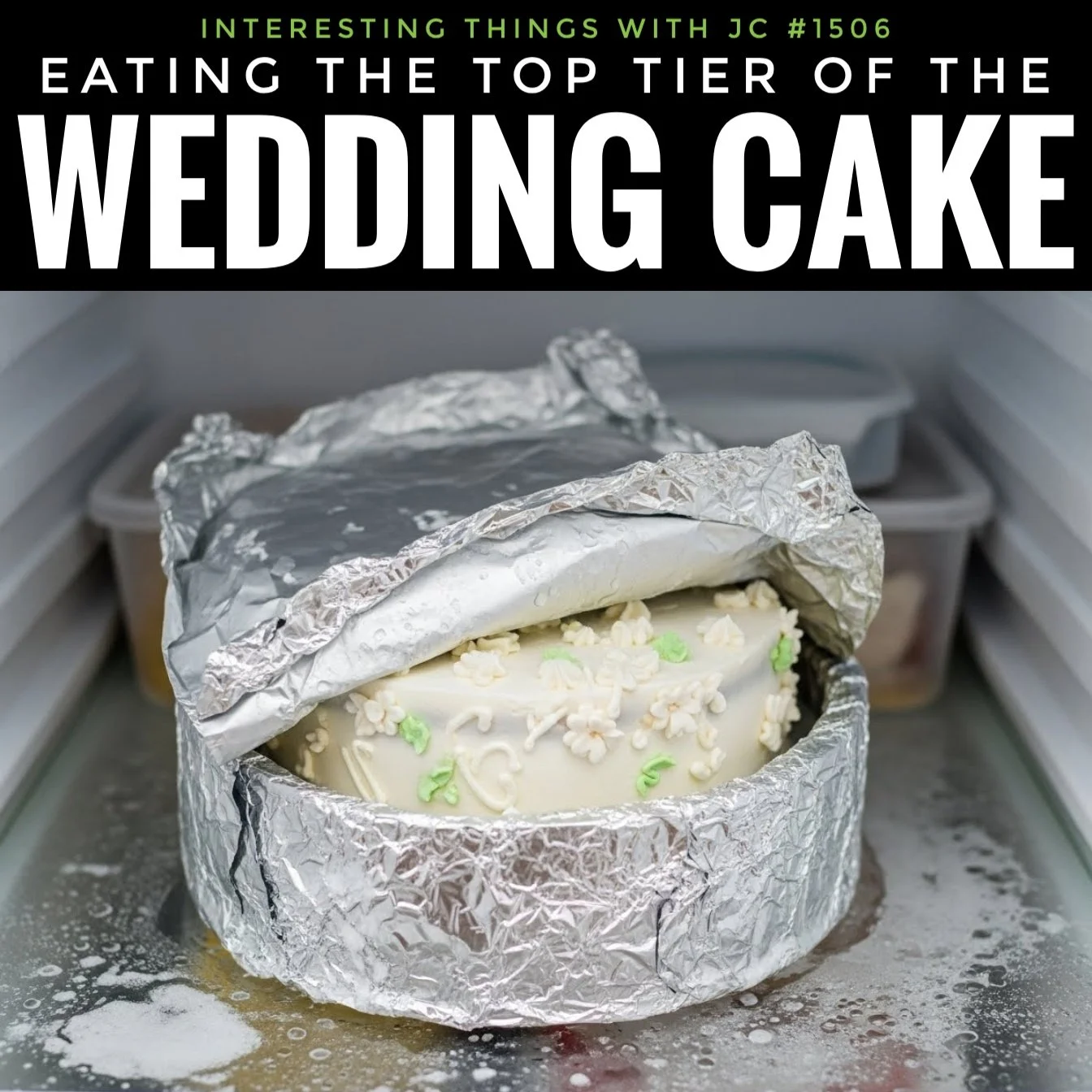
A preserved top tier of a wedding cake, wrapped in aluminum foil and stored in a freezer, with white frosting and small floral decorations visible.
Transcript
Saving the top tier of a wedding cake didn’t start as a sentimental tradition. It started as a practical one.
In Britain during the 1700s and 1800s, wedding cakes were dense fruitcakes soaked in alcohol like brandy or rum. They were low in moisture and naturally preserved. Wrapped properly, they could last months, sometimes longer.
The top tier was saved for a reason. In British custom, it was eaten at the christening of the couple’s first child. At a time when infant mortality was high and life expectancy was shorter, this wasn’t symbolism. It was cautious planning.
The custom spread widely after Queen Victoria’s 1840 wedding, which was heavily reported and copied. American families adopted the practice in the late 1800s, especially among Victorian era households that followed British traditions.
What changed in the US was the cake. Lighter sponge cakes and buttercream became popular. Those don’t age well. Once refrigeration became common in the early 20th century, couples shifted the tradition to eating the top tier on their first anniversary instead.
And just how far can this go?
A slice of wedding cake baked in 1898. The fruitcake had been wrapped, stored, and later frozen. It’s not an official world record. Which tells you something important. This tradition survived because the cake was never the point. Time was.
These are interesting things, with JC.
Student Worksheet
Why were early British wedding cakes able to last for long periods of time?
What historical conditions influenced the original purpose of saving the top tier?
How did Queen Victoria’s wedding affect the spread of this tradition?
Why did the meaning of the tradition change in the United States?
Explain the significance of the 1898 wedding cake example.
Teacher Guide
Estimated Time
• 35–45 minutes
Pre-Teaching Vocabulary Strategy
• Introduce key terms with images of historical cakes and timelines.
Anticipated Misconceptions
• Traditions are always sentimental.
• Food preservation was ineffective before modern technology.
Discussion Prompts
• How do media and public figures influence traditions?
• Why do some traditions last even when conditions change?
Differentiation Strategies
ESL
• Visual aids and simplified sentence starters.
IEP
• Oral responses or graphic organizers.
Gifted
• Independent research on long-lasting foods or preserved artifacts.
Extension Activities
• Investigate historical preservation methods.
• Analyze another tradition popularized by media coverage.
Cross-Curricular Connections
• Science: Food chemistry and preservation
• Media Studies: Influence of mass reporting
• Sociology: Family rituals and continuity
Quiz
Q1. Why were fruitcakes used for weddings in Britain?
A. They were cheaper
B. They were fashionable
C. They lasted a long time
D. They were easier to bake
Answer: C
Q2. When was the saved cake originally eaten?
A. First anniversary
B. Christening of the first child
C. Wedding night
D. One month later
Answer: B
Q3. Who helped popularize the tradition?
A. George III
B. Queen Victoria
C. Elizabeth I
D. Prince Albert
Answer: B
Q4. What caused the tradition to shift in the US?
A. Religious changes
B. Shorter weddings
C. Lighter cakes and refrigeration
D. War rationing
Answer: C
Q5. What does the 1898 cake example demonstrate?
A. Cakes improve with age
B. The tradition was symbolic
C. Preservation methods were effective
D. Time was central to the tradition
Answer: D
Assessment
Open-Ended Questions
Explain how historical living conditions shaped the original wedding cake tradition.
Describe how technology can change the meaning of a cultural practice.
3–2–1 Rubric
3 = Accurate, complete, thoughtful
2 = Partial or missing detail
1 = Inaccurate or vague
Standards Alignment
CCSS.ELA-LITERACY.RH.9-10.2
• Analyze central ideas in historical narratives.
CCSS.ELA-LITERACY.RH.9-10.4
• Interpret vocabulary within historical context.
C3.D2.His.2.9-12
• Analyze change and continuity in historical practices.
ISTE 3a
• Evaluate media-influenced cultural information.
UK National Curriculum History KS4
• Understanding social and cultural change over time.
Cambridge IGCSE History AO1
• Demonstrate historical knowledge and understanding.
Show Notes
This episode explores how saving the top tier of a wedding cake began as a practical response to historical realities rather than a romantic gesture. Originating in Britain with alcohol-preserved fruitcakes and later spreading through media coverage of Queen Victoria’s wedding, the tradition evolved as cake styles and refrigeration changed in the United States. A preserved slice from an 1898 wedding highlights the episode’s central insight: traditions endure not because of objects, but because they help people measure time, continuity, and survival.
