Interesting Things with JC #1507: "The Orange in the Stocking" – In a hard winter, a single piece of fruit could carry the weight of hope. This episode traces a quiet Christmas tradition born of scarcity, kindness, and the power of small things to last a lifetime.
Curriculum - Episode Anchor
Episode Title: The Orange in the Stocking
Episode Number: #1507
Host: JC
Audience: Grades 9–12, college intro, homeschool, lifelong learners
Subject Area: History, Cultural Studies, Sociology, Economics
Lesson Overview:
Students will:
Define the historical significance of Christmas stocking traditions in early 20th-century America.
Compare the role of consumer goods during the Great Depression to modern holiday traditions.
Analyze the economic and cultural value of simple gifts such as oranges during times of scarcity.
Explain how symbols and traditions evolve over time through social and economic influences.
Key Vocabulary
Tradition (truh-DISH-un) — A long-established custom or belief passed down through generations. Example: The tradition of putting fruit in stockings is over a century old.
Luxury (LUK-shuh-ree) — Something desirable but not essential, often expensive or hard to obtain. Example: Oranges were considered a luxury in winter coal towns.
Scarcity (SKAIR-suh-tee) — The state of being in short supply; a lack of resources. Example: Economic scarcity made fruit a rare treat for many children in 1919.
Symbolism (SIM-buh-liz-um) — The use of objects to represent ideas or qualities. Example: The orange symbolized care, effort, and joy during lean times.
St. Nicholas (SAYNT NIK-uh-lus) — The historical figure and saint whose acts of secret giving inspired many Christmas traditions. Example: Stories of St. Nicholas giving gold helped shape the orange-in-stocking custom.
Narrative Core
Open
JC sets the scene: a cold Christmas morning in 1919 Appalachia. A child reaches into a stocking and finds something extraordinary — an orange.Info
JC explains the economic struggles of early 20th-century America, especially in coal towns and rural areas, where money was scarce and expectations were modest.Details
The episode explores the rarity and value of oranges during this era — how they traveled long distances, cost significant money, and brought sensory delight and emotional meaning to children.Reflection
JC shares how these moments left lasting impressions — not as sad memories, but as ones of gratitude and warmth, reinforcing how small acts of kindness matter.Closing
"These are interesting things, with JC."
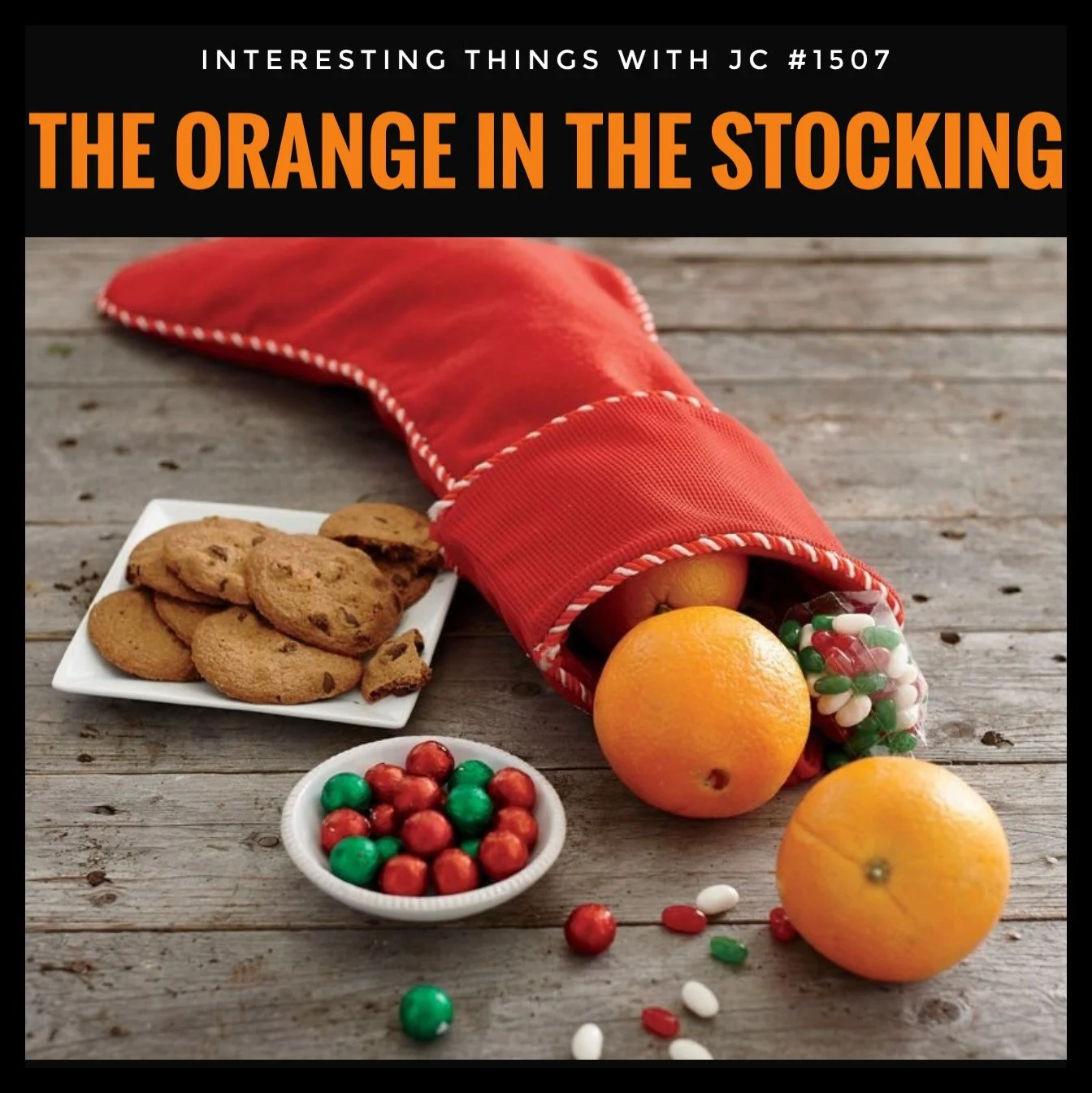
A large red Christmas stocking with white trim lies on a rustic wooden surface. Inside the stocking are two bright oranges and a small bag of festive holiday candies in red, green, and white. Next to the stocking is a white square plate with a stack of chocolate chip cookies and a small white bowl filled with red and green chocolate candies. Some candies are scattered on the table. The image is labeled at the top: “Interesting Things with JC #1507 – The Orange in the Stocking” in bold orange and white text on a black background.
Transcript
Christmas morning, around 1919. Cold enough your breath hangs in the air. Somewhere in the hills of West Virginia or eastern Kentucky, a kid slides out of bed and reaches for a sock hanging by the stove. Inside, there’s one thing that matters. An orange.
Back then, in coal towns and farm country, Christmas didn’t come with piles of gifts. Money was tight. Work could disappear fast. Families did the best they could, and kids learned early not to ask for much. A warm meal counted. A little candy was a bonus. And if you were lucky, you got an orange.
That wasn’t an everyday fruit. Not even close. Outside places like Florida or California, oranges were a winter luxury. They came by train, hauled hundreds of miles, sometimes more than 1,000 miles (1,600 kilometers), packed just right so they wouldn’t freeze. By the time one made it to a mountain town or a small Midwestern depot, it cost real money.
A single orange weighed about 5 ounces (140 grams). To an adult, that’s nothing. To a kid who hadn’t seen fresh fruit in months, it was everything. The smell hit first. Bright. Clean. Sweet. Kids peeled them slow, like they were handling something rare. Some shared slices around the table. Some saved the peel near the stove just to keep the scent around a little longer.
You hear the same story again and again in old family accounts. A stocking with an orange or an apple, a few nuts, maybe peppermint candy. In mining towns, churches or company gatherings made sure every child got at least that much. Not because it was fancy. Because it mattered.
There’s an older idea behind it, too. In stories about St. Nicholas (SAN-nik-uh-lus), gold was given to people who needed help. Over time, that gold turned into something round and bright in a stocking. Nobody had to explain it. You could see it.
By the early 1900s, groups like Sunkist leaned into the tradition, selling oranges as Christmas fruit. Still, for a lot of families, one orange was all there was.
And yet, people remembered it their whole lives. Not with sadness. With gratitude. Because in a hard winter, someone thought ahead. Someone spent a little extra. Someone made sure there was color and sweetness on Christmas morning.
That’s why the orange in the stocking stuck around. It wasn’t a symbol. It was proof that small things, given at the right moment, can mean more than we ever expect.
These are interesting things, with JC.
Student Worksheet
Why were oranges considered a luxury in early 20th-century rural America?
How did economic hardship shape Christmas traditions in coal towns?
What is the connection between St. Nicholas and the tradition of placing oranges in stockings?
Describe how children reacted to receiving an orange. What does this tell us about values at the time?
Write a short paragraph about a simple gift you or someone you know received that carried deep meaning.
Teacher Guide
Estimated Time:
45–60 minutes
Pre-Teaching Vocabulary Strategy:
Use context clue exercises and sentence completion activities to preview vocabulary such as “tradition,” “luxury,” and “scarcity.”
Anticipated Misconceptions:
Students may assume oranges were always accessible or inexpensive.
Some may not understand the historical context of the Great Depression or pre-WWII rural America.
Discussion Prompts:
How do today’s holiday traditions reflect (or differ from) past generations?
What makes a gift meaningful — its cost, or the thought behind it?
How do stories like this help us understand family resilience?
Differentiation Strategies:
ESL: Use bilingual glossary support and visual aids of oranges, coal towns, stockings.
IEP: Provide sentence starters and modified texts for reading.
Gifted: Ask students to research other historical holiday traditions that arose from hardship.
Extension Activities:
Create a multimedia presentation on holiday traditions shaped by economic hardship.
Interview grandparents or older relatives about their childhood holiday experiences.
Analyze advertisements from the 1900s (e.g., Sunkist holiday campaigns).
Cross-Curricular Connections:
Economics: Supply chains, cost of living, commodity trade.
Geography: Map citrus-growing regions and train routes.
Sociology: Family and community support systems during hardship.
English Language Arts: Memoir writing from historical perspectives.
Quiz
What made oranges a special gift in 1919?
A. They were colorful
B. They were rare and expensive in winter
C. They were easy to grow anywhere
D. They were shaped like gold coins
Answer: BWhere were oranges primarily grown in the U.S. at the time?
A. Maine and Vermont
B. Texas and Oklahoma
C. Florida and California
D. New York and Pennsylvania
Answer: CWhat was the original connection between oranges and St. Nicholas?
A. He owned an orange grove
B. He gave out fruit as medicine
C. His gift of gold inspired the orange tradition
D. He invented the stocking tradition
Answer: CHow did children react to receiving oranges?
A. They threw them away
B. They peeled them quickly to eat
C. They cherished them and savored the smell
D. They were disappointed
Answer: CWhy did people remember the orange in the stocking for years?
A. It was their only gift
B. It symbolized community and care
C. It had magical powers
D. It came with money
Answer: B
Assessment
In your own words, explain why the orange in the stocking was so meaningful to children in 1919. Use evidence from the episode.
Reflect on how this tradition might change our view of gift-giving today. What lessons can we take from it?
3–2–1 Rubric:
3 = Accurate, complete, thoughtful
2 = Partial or missing detail
1 = Inaccurate or vague
Standards Alignment
U.S. Standards:
CCSS.ELA-LITERACY.RH.9-10.2 — Determine the central ideas of a primary or secondary source.
Students extract the key theme of economic and emotional value from the story of the orange.CCSS.ELA-LITERACY.RI.11-12.3 — Analyze a complex set of ideas and explain how they interact.
Learners explore how economic hardship shaped holiday customs and meaning.C3.D2.His.1.9-12 — Evaluate how historical events shaped and were shaped by cultural and economic conditions.
Focuses on traditions formed during the Depression and early 1900s.ISTE 1.3.D — Students build knowledge by actively exploring real-world issues and problems.
Connects historical holiday traditions with current societal norms.
UK/International Equivalents:
OCR GCSE History A (Explaining the Modern World) — Thematic study: the impact of change on people and society.
Students compare lived experiences across time using thematic analysis.IB MYP Individuals & Societies Criterion B: Investigation — Students research and understand historical context.
Relates to how economic settings shaped traditions.Cambridge IGCSE History (0470) — Understanding cause and consequence in historical events.
Evaluates how scarcity led to traditions like the orange in the stocking.
Show Notes
This episode of Interesting Things with JC explores the heartfelt tradition of placing an orange in a Christmas stocking — a small act with profound historical and emotional roots. In 1919, a single orange was not only rare in rural America but carried deep symbolic meaning amid economic hardship. The podcast links this simple custom to larger narratives of resilience, care, and gratitude during lean times, making it a powerful story for classrooms studying culture, history, and social values. By uncovering the humble yet impactful story behind a holiday fruit, learners are encouraged to reflect on the power of small gestures and the importance of context in shaping traditions.
References:
Mansky, J. (2018, December 21). Why we should bring back the tradition of the Christmas orange. Smithsonian Magazine. https://www.smithsonianmag.com/arts-culture/why-we-should-bring-back-tradition-christmas-orange-180971101/
Citrus Industry Magazine. (2020, December 21). Pieces of the past: Christmas traditions. https://citrusindustry.net/2020/12/21/pieces-of-the-past-christmas-traditions/
Taste of Home Editors. (2024, January 8). The real reason we put oranges in Christmas stockings. Taste of Home. https://www.tasteofhome.com/article/surprising-reasons-might-find-orange-christmas-stockings/
Country Living Staff. (2021, November 10). The reason we leave oranges in Christmas stockings - History of oranges as stocking stuffers. Country Living. https://www.countryliving.com/life/a40920/oranges-in-christmas-stockings-history/
Morning Ag Clips. (2025, December 5). Christmas citrus: The orange’s Christmas connection. https://www.morningagclips.com/christmas-citrus-the-oranges-christmas-connection/