Interesting Things with JC #1508: “The Log That Gave Gifts” – They feed it. They cover it. They sing threats... then beat it with sticks until it finally poops out presents. Meet Catalonia’s Caga Tió: the wildest, most joyful Christmas tradition you’ve never heard of.
Curriculum - Episode Anchor
Episode Title: The Log That Gave Gifts
Episode Number: #1508
Host: JC
Audience: Grades 9–12, college intro, homeschool, lifelong learners
Subject Area: Cultural Studies, Anthropology, World History, Sociology
Lesson Overview
Students will:
Define traditional Catalan holiday customs, including the Caga Tió and the caganer.
Compare Catalan Christmas traditions with those of other cultures.
Analyze the symbolic and communal roles these traditions play in Catalan society.
Explain how humor and storytelling are used to reinforce cultural memory and values.
Key Vocabulary
Caga Tió (KAH-guh tee-OH) — A traditional Catalan Christmas log with a smiling face, hat, and blanket, “fed” by children until it “gives” small gifts on Christmas through playful rituals.
Barretina (bah-reh-TEE-nuh) — A traditional red Catalan hat, often placed on the Caga Tió during the holiday season.
Turrón (too-ROHN) — A sweet Spanish nougat made from honey and almonds, commonly gifted during the holidays.
Caganer (kah-gah-NARE) — A figurine of a squatting man found in Catalan nativity scenes since the 1700s, symbolizing humor, humility, and fertility.
Catalonia (cat-uh-LOAN-yuh) — An autonomous community in northeastern Spain with a distinct language, culture, and set of holiday customs.
Narrative Core
Open – A humorous yet curious hook about an unusual Christmas tradition in Catalonia: the “pooping log.”
Info – Describes the origin and appearance of the Caga Tió, detailing how it becomes part of the household in early December.
Details – Explains the ritualistic feeding, singing, and eventual "gifting" process, and introduces the caganer as part of broader Catalan holiday humor.
Reflection – Offers insight into how traditions reinforce community, shared humor, and cultural memory—transforming waiting into a collective experience.
Closing – "These are interesting things, with JC."
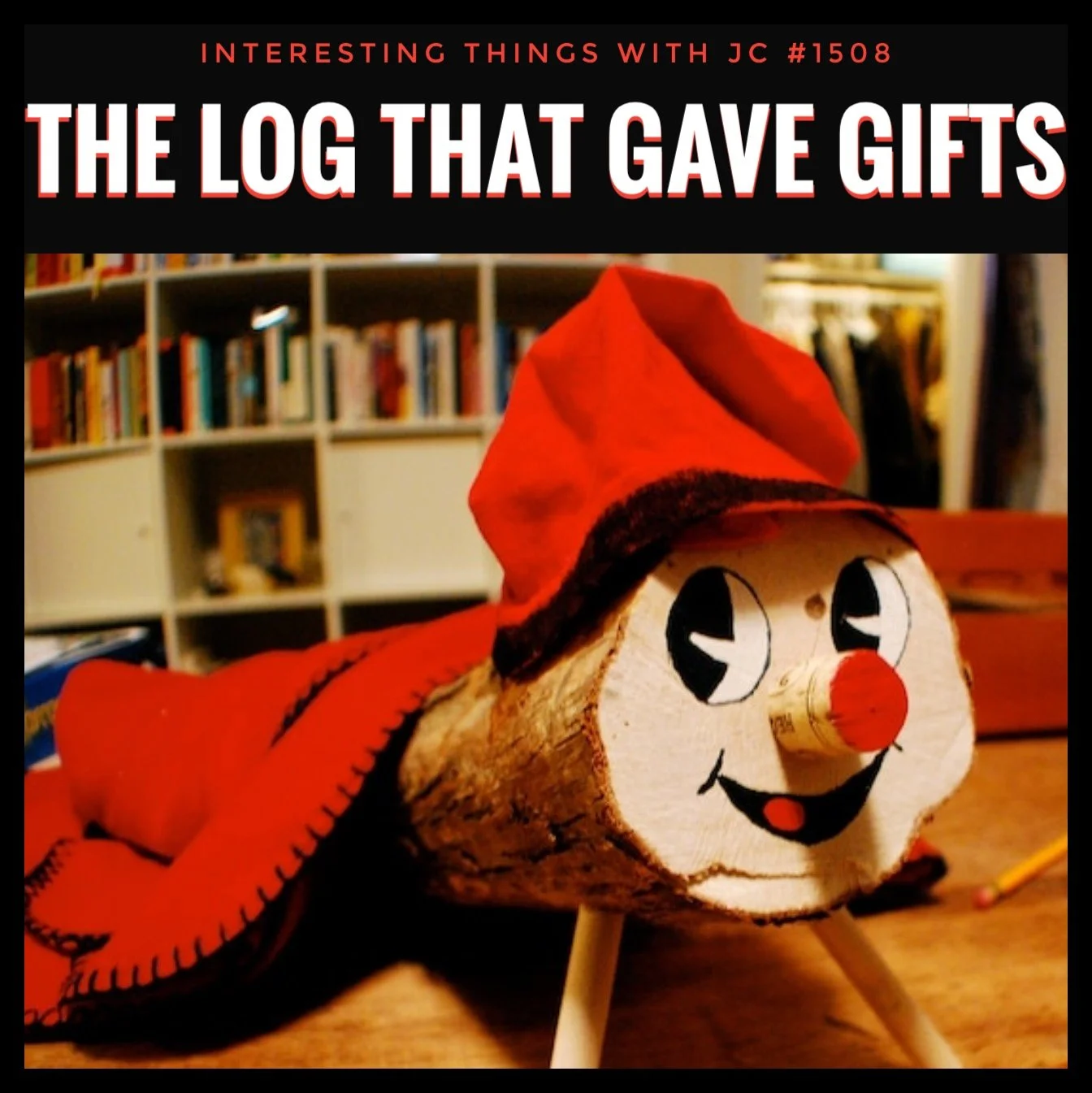
A close-up photo of the Caga Tió, a traditional Catalan Christmas log. The log has a smiling cartoon face painted on its circular front, with large black eyes, a red nose made from a cork, and a red smiling mouth. It wears a red knit hat (called a barretina) and is partially covered by a red blanket with black trim. Two small wooden sticks act as legs, propping the log up on a table. In the background, there is a cozy room with a bookshelf and blurred furniture. The image is part of a podcast episode titled "The Log That Gave Gifts" from Interesting Things with JC #1508, as seen in the bold black-and-red header text.
Transcript
A couple weeks before Christmas, while most folks are putting up lights or arguing about when it’s okay to start playing carols, something else is happening over in Catalonia (cat-uh-LOAN-yuh). Families bring home a short, ordinary log. About a foot long, maybe 12 to 16 inches, around 30 to 40 centimeters. Nothing fancy. Just wood.
Then they paint a smiling face on it, stick on a couple little legs, and top it off with a red knit hat called a barretina (bah-reh-TEE-nuh). They name it the Caga Tió (KAH-guh tee-OH). Translated straight, that means “the pooping log.” No sugarcoating it.
From early December, often starting December 8, that log becomes part of the household. Kids cover it with a blanket to “keep it warm.” Every night, they leave it food. Nuts. Fruit. Sometimes candy. Nobody thinks the log is alive, but everybody plays along. That’s part of the deal.
Then comes Christmas Eve or Christmas Day. The kids grab sticks and gather around. They sing old songs passed down for generations. The lyrics aren’t sweet. They’re more like warnings. If the log doesn’t do its job, it’s going to get whacked a little harder. So the kids tap the log with their sticks, sing louder, and finally lift the blanket.
Out come the gifts.
Not big presents. Small stuff. Candy. Little toys. Turrón (too-ROHN), a dense nougat made from almonds and honey. The parents hid it there earlier, but the moment still lands. The room fills with noise and laughter, and the waiting is over.
This isn’t random silliness. Catalonia has long had a rough-and-ready sense of humor around the holidays. Their nativity scenes often include a squatting figure called the caganer (kah-gah-NARE), quietly doing his business behind a tree. He’s been around since at least the 1700s and is meant to bring good luck and a good harvest.
The Caga Tió fits right in. It’s practical. It’s earthy. It reminds kids that gifts don’t just appear. Someone feeds the log. Someone lifts the blanket. Everybody knows how it works, and they show up anyway.
From the outside, it might look strange. From inside the house, it makes perfect sense. It’s loud. It’s funny. And it sticks, because it turns waiting into something you do together.
Sometimes that’s all a tradition really needs.
These are interesting things, with JC.
Student Worksheet
What is the Caga Tió, and how is it used during the Catalan holiday season?
What does the word “barretina” mean, and what is its cultural significance?
Why is the tradition of feeding the log important, even though no one believes it is real?
How does the tradition of the caganer reflect Catalan values or humor?
Compare this tradition to another cultural holiday practice you’re familiar with. What are the similarities and differences?
Teacher Guide
Estimated Time
60–90 minutes
Pre-Teaching Vocabulary Strategy
Introduce Catalan geography and its distinct culture using maps.
Pronounce and define key terms orally, followed by visual aids (images of Caga Tió, barretina, etc.).
Anticipated Misconceptions
Students may assume the tradition is disrespectful or childish without understanding its deep cultural meaning.
Some may believe the Caga Tió is a widespread Spanish tradition rather than uniquely Catalan.
Discussion Prompts
Why do societies use humor in their rituals?
How do small traditions reinforce big ideas like community or shared history?
Is there value in maintaining traditions that seem “silly” or old-fashioned?
Differentiation Strategies
ESL: Provide bilingual vocabulary sheets and videos of the Caga Tió tradition.
IEP: Use tactile learning by creating paper or cardboard Caga Tiós in class.
Gifted: Research similar “gift-giving” rituals from less commonly studied cultures and present findings.
Extension Activities
Create a mini-documentary or podcast episode on a unique family or cultural tradition.
Research the historical evolution of nativity scenes in Europe and their symbolism.
Cross-Curricular Connections
Sociology – How cultural rituals define group identity.
History – Catalan nationalism and regional customs.
World Languages – Spanish and Catalan language structure and etymology.
Quiz
Q1. What does "Caga Tió" translate to in English?
A. Singing log
B. The pooping log
C. The dancing log
D. Gift-giving log
Answer: B
Q2. What do children traditionally leave for the Caga Tió at night?
A. Gifts
B. Clothing
C. Food
D. Coins
Answer: C
Q3. What happens on Christmas Eve or Day with the Caga Tió?
A. It is thrown in the fireplace.
B. It is used as a decoration only.
C. Children hit it with sticks and sing songs.
D. It is taken to a church for blessing.
Answer: C
Q4. What sweet item is often found under the blanket of the Caga Tió?
A. Churros
B. Chocolate coins
C. Turrón
D. Marzipan
Answer: C
Q5. What figure is found in Catalan nativity scenes that symbolizes good luck?
A. The shepherd boy
B. The drummer
C. The caganer
D. The three kings
Answer: C
Assessment
In your own words, explain how the tradition of the Caga Tió balances humor, tradition, and community values.
Analyze why this tradition has persisted for centuries, despite appearing humorous or strange to outsiders.
3–2–1 Rubric
3 = Accurate, complete, thoughtful
2 = Partial or missing detail
1 = Inaccurate or vague
Standards Alignment
Common Core ELA
CCSS.ELA-LITERACY.RI.9-10.2 — Determine a central idea and analyze its development.
CCSS.ELA-LITERACY.SL.11-12.1 — Engage effectively in collaborative discussions on cultural topics.
C3 Framework for Social Studies
D2.His.2.9-12 — Analyze change and continuity in cultural traditions over time.
D2.Civ.7.9-12 — Evaluate how cultural norms shape communities and group identity.
ISTE (International Society for Technology in Education)
1.1.c — Use technology to seek feedback that informs and improves practice and to demonstrate learning in a variety of ways.
1.7.b — Use collaborative tools to expand perspectives and enrich learning with diverse views.
UK National Curriculum (KS4 Citizenship)
Understanding different identities in the UK and beyond — Explore how communities express identity through customs and traditions.
Cambridge IGCSE Global Perspectives
GP1 — Research and reflect on cultural practices, values, and shared human experiences.
Show Notes
In this episode of Interesting Things with JC, listeners journey into the heart of Catalonia, where a seemingly odd but endearing tradition—the Caga Tió, or "pooping log"—brings warmth, humor, and a sense of community to the holiday season. With historical roots and folkloric symbolism, the tradition highlights how culture uses humor and storytelling to foster togetherness. Rich in ethnographic value, the episode offers students a lens into how societies across the world preserve identity through communal rituals. This lesson connects classroom learners to broader global cultures, reinforcing empathy, comparative analysis, and cultural literacy.
References
Smithsonian Magazine. (2014, December 24). In Catalonia a Christmas log delivers presents in an unusual way. https://www.smithsonianmag.com/smart-news/catalonia-christmas-log-delivers-presents-unusual-way-180953736/
Barcelona City Council. (n.d.). Christmas traditions. https://www.barcelona.cat/nadal/en/traditions/christmas-traditions
Catalunya.com. (n.d.). The "Caga" Tió: Catalonia's magical Christmas tradition. https://www.catalunya.com/en/continguts/article/caga-tio-catalan-pooping-log-1731507242824
Atlas Obscura. (n.d.). Tió de Nadal in Barcelona. https://www.atlasobscura.com/places/caga-tio
Culture Trip. (2020, January 13). Who is Caga Tió, and why do kids beat him up? https://theculturetrip.com/europe/spain/articles/who-is-caga-tio-and-why-do-kids-beat-him-up