Interesting Things with JC #1509: "Christmas Eve, Earthrise" – Christmas Eve 1968: Three astronauts orbit the Moon and witness Earth rising over the lunar horizon. Bill Anders’ spontaneous photograph captured our fragile blue planet like never before, sparking wonder, unity, and the modern environmental movement in a single frame.
Curriculum - Episode Anchor
Episode Title: Christmas Eve, Earthrise
Episode Number: 1509
Host: JC
Audience: Grades 9–12, college intro, homeschool, lifelong learners
Subject Area: History, Space Science, Media Literacy, Ethics
Lesson Overview
Students examine the Apollo 8 mission and the iconic Earthrise photograph to understand how scientific exploration, historical context, and visual media can reshape human perspective. The lesson emphasizes factual history, scientific achievement, and reflective analysis rather than ideology.
Learning Objectives
By the end of this lesson, students will be able to:
Define the significance of the Apollo 8 mission in the history of space exploration.
Explain how the Earthrise photograph changed public perception of Earth.
Analyze how visual evidence can communicate complex ideas more powerfully than words alone.
Compare the historical context of 1968 with modern global perspectives.
Key Vocabulary
Earthrise (urth-ryz) — The photograph of Earth taken from lunar orbit during Apollo 8, showing Earth rising above the Moon’s horizon.
Apollo 8 (uh-pol-oh ayt) — The first crewed mission to orbit the Moon, launched by NASA in December 1968.
Lunar Orbit (loo-ner or-bit) — The curved path of a spacecraft traveling around the Moon.
Perspective (per-spek-tiv) — A way of viewing or understanding something, especially in relation to others.
Broadcast (broad-kast) — A live transmission of audio or video to a wide audience.
Narrative Core
Open: On Christmas Eve, 1968, three astronauts found themselves farther from Earth than any humans before them.
Info: Apollo 8 carried Frank Borman, Jim Lovell, and Bill Anders into lunar orbit, a major milestone in the Space Race.
Details: As the spacecraft rotated, Bill Anders saw Earth rising above the Moon and captured a photograph that revealed Earth as small, fragile, and shared by all.
Reflection: The image offered humanity a rare moment of unity and humility, showing Earth without borders or divisions.
Closing: These are interesting things, with JC.
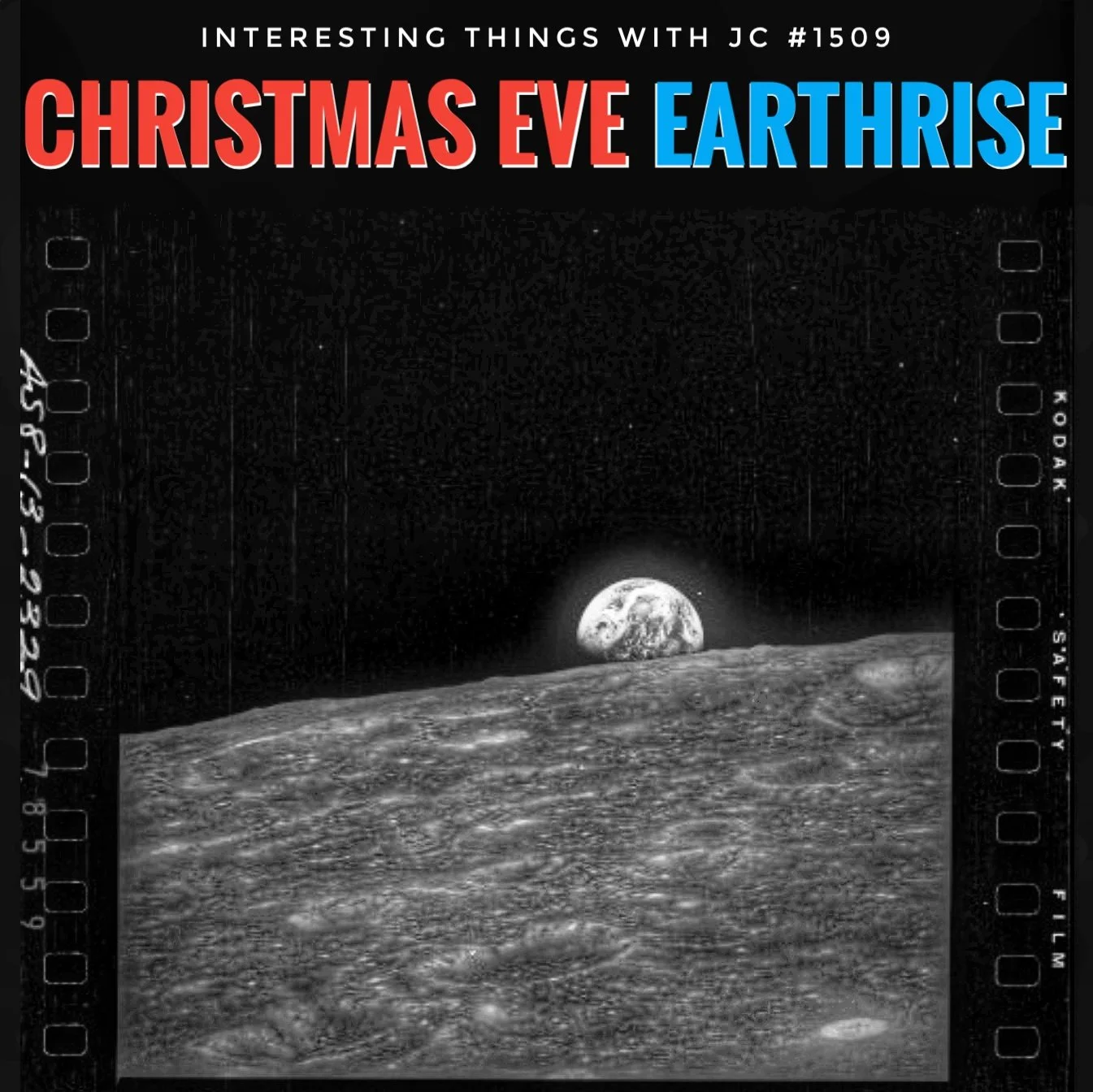
A square podcast cover art with a dark star filled background. At the top small white text reads Interesting Things with JC 1509. Below it the title Christmas Eve Earthrise appears in large bold letters with Christmas Eve in red and Earthrise in blue. The center of the image features a black and white space photograph bordered like a strip of film with sprocket holes along the left and right edges and the word Kodak visible on the right side. Near the upper center of the photograph the Earth appears partially above the Moon’s horizon glowing against the blackness of space while the lower half of the image shows the Moon’s rough cratered surface stretching across the foreground.
Transcript
Interesting Things with JC #1509: "Christmas Eve, Earthrise"
On the night of December 24, 1968, three American astronauts were farther from home than any human beings had ever been.
They were aboard Apollo 8, circling the Moon at about 60 miles (97 kilometers) above its surface. Frank Borman, Jim Lovell, and Bill Anders were moving at roughly 3,600 miles per hour (5,800 kilometers per hour), wrapped in a spacecraft no wider than 12 feet (3.7 meters). Outside the window, the Moon was gray, silent, and lifeless.
Then something unexpected happened.
As the capsule rolled, Bill Anders looked out and saw the Earth rising above the lunar horizon. Not a map. Not a globe. A real, living planet. Blue and white. Thin clouds. No borders. Just a small, fragile ball hanging in black space. He grabbed his camera and took the photo that would soon be known as Earthrise.
That single image told the truth better than any speech ever could. Earth wasn’t big. It wasn’t tough. It looked breakable...fragile…
A short time later, the astronauts went live on television. Nearly one quarter of the world’s population tuned in. From lunar orbit, on Christmas Eve, they read words written thousands of years earlier: “In the beginning, God created the heaven and the earth.”
It wasn’t planned as a sermon. It wasn’t politics. It was literally perspective.
Back home, about a billion people watched from living rooms, hospital wards, and military bases. Wars were still being fought. Arguments hadn’t stopped. But for a moment, everyone saw the same thing. One planet. All of us on it.
Apollo 8 came home safely, splashing down in the Pacific Ocean on December 27, 1968, after traveling about 580,000 miles (933,000 kilometers). But the picture they brought back never stopped traveling.
Earthrise reminded us that everything we argue over sits on something very small, very rare, and very special.
These are interesting things, with JC.
Student Worksheet
Why was Apollo 8 considered a major milestone in space exploration?
Describe what makes the Earthrise photograph different from maps or globes.
How did the timing of the broadcast on Christmas Eve affect its impact?
Explain what JC means by saying the image provided “perspective.”
Teacher Guide
Estimated Time:
45–60 minutes
Pre-Teaching Vocabulary Strategy:
Introduce vocabulary using images of the Moon, Earth, and the Apollo spacecraft, followed by brief student definitions.
Anticipated Misconceptions:
Students may think Earthrise was planned or staged. Clarify that it was an unexpected moment captured spontaneously.
Discussion Prompts:
Why do images sometimes change opinions more effectively than speeches?
How might seeing Earth from space affect how people think about conflict?
Differentiation Strategies:
ESL: Provide sentence starters and visual aids.
IEP: Allow oral responses instead of written ones.
Gifted: Encourage independent research on other influential space images.
Extension Activities:
Analyze another historical photograph that changed public opinion.
Write a reflective paragraph imagining seeing Earth from space.
Cross-Curricular Connections:
Physics: Orbital motion and speed.
Sociology: Shared human experiences.
Ethics: Responsibility toward Earth.
Quiz
Q1. What was Apollo 8 the first mission to accomplish?
A. Land on the Moon
B. Orbit the Moon
C. Build a space station
D. Launch a satellite
Answer: B
Q2. Who took the Earthrise photograph?
A. Frank Borman
B. Jim Lovell
C. Bill Anders
D. Neil Armstrong
Answer: C
Q3. About how far above the Moon was Apollo 8 orbiting?
A. 10 miles
B. 30 miles
C. 60 miles
D. 300 miles
Answer: C
Q4. What made Earthrise powerful to viewers?
A. It showed political borders
B. It showed Earth as fragile and unified
C. It was the first color photo ever
D. It showed the Moon in detail
Answer: B
Q5. When did Apollo 8 return to Earth?
A. December 24, 1968
B. December 25, 1968
C. December 27, 1968
D. January 1, 1969
Answer: C
Assessment
Open-Ended Questions
Explain why Earthrise is still discussed decades later.
Describe how the Apollo 8 mission combined science, history, and human reflection.
3–2–1 Rubric
3 = Accurate, complete, thoughtful
2 = Partial or missing detail
1 = Inaccurate or vague
Standards Alignment
NGSS HS-ESS1-4
Use evidence from space missions to understand Earth’s place in the universe.
CCSS.ELA-LITERACY.RH.9-10.2
Determine central ideas of a historical text.
C3 D2.His.1.9-12
Analyze connections among historical events and developments.
ISTE 3a
Evaluate the accuracy and perspective of digital media.
UK National Curriculum KS4 Science
Earth and space, orbital motion, and observation.
IB MYP Individuals and Societies
Understanding global contexts through historical events.
Show Notes
This episode explores the Apollo 8 mission and the unplanned photograph known as Earthrise, taken on Christmas Eve 1968. Through clear storytelling, JC explains how three astronauts orbiting the Moon offered humanity a new way to see itself. In classrooms, this episode supports discussions about scientific exploration, media literacy, and shared human experience. The story matters today because it reminds students that perspective can shape how societies think, argue, and care for the world they share.
References
National Aeronautics and Space Administration. (n.d.). Apollo 8: Earthrise. https://www.nasa.gov/image-article/apollo-8-earthrise/
National Aeronautics and Space Administration. (n.d.). Apollo 8 astronaut Bill Anders captures Earthrise. https://www.nasa.gov/image-article/apollo-8-astronaut-bill-anders-captures-earthrise/
National Aeronautics and Space Administration. (n.d.). The story behind Apollo 8's famous Earthrise photo. NASA Science. https://science.nasa.gov/resource/the-story-behind-apollo-8s-famous-earthrise-photo/
National Geographic Society. (2021, May 2). Apollo 8 at 50: How the 'Earthrise' photo changed the world. National Geographic. https://www.nationalgeographic.com/science/article/earthrise-apollo-8-photo-at-50-how-it-changed-the-world
The Planetary Society. (2020, April 15). Earthrise (original). https://www.planetary.org/space-images/earthrise