Interesting Things with JC #1510: "Jesus Outside the Bible" – By every normal historical measure, Jesus should have vanished without a trace. Instead, Roman officials, Jewish historians, and rival faiths kept writing about him, often in opposition. When even his critics can’t ignore him, history itself is telling a story.
Curriculum - Episode Anchor
This curriculum framework supports Episode #1510 of Interesting Things with JC, examining the historical evidence for Jesus of Nazareth outside the Christian Bible through Jewish, Roman, and Islamic sources. The lesson emphasizes historical method, primary-source analysis, and the distinction between historical existence and theological belief.
Episode Title: Jesus Outside the Bible
Episode Number: 1510
Host: JC
Audience: Grades 9–12, college intro, homeschool, lifelong learners
Subject Area: World History, Ancient History, Religious Studies, Historical Methodology
Lesson Overview
Students investigate how non-Christian sources reference Jesus of Nazareth and what those sources reveal about his historical existence and impact. The lesson focuses on evaluating hostile, neutral, and reinterpreted accounts to understand how historians assess credibility and significance without relying on theological claims.
Learning Objectives
Students will be able to:
Define the difference between historical evidence and religious belief.
Compare Roman, Jewish, and Islamic references to Jesus outside the New Testament.
Analyze why hostile or neutral sources are valuable in historical study.
Explain how Jesus’s impact is demonstrated through disagreement rather than uniform belief.
Key Vocabulary
Historiography (hi-STOR-ee-OG-ruh-fee) — The study of how history is written and evaluated; historians examine sources like Tacitus and Josephus through historiography.
Primary Source (PRY-mare-ee sorce) — A document created close to the time of an event, such as Roman histories written in the first century CE.
Polemical (puh-LEM-ih-kul) — Writing that argues against a position; some Jewish texts discuss Jesus in a polemical, critical way.
Messiah (muh-SIGH-uh) — A title meaning “anointed one”; Jesus is identified as Messiah in Christianity and Islam, though defined differently.
Crucifixion (kroo-suh-FIK-shun) — A Roman execution method mentioned by Roman historians when describing Jesus’s death.
Narrative Core
Open
Jesus left behind no writings or monuments, yet appears repeatedly in the records of people who rejected his message.
Info
Non-Christian writers such as Josephus, Tacitus, and Pliny the Younger mention Jesus or his followers within historical accounts of Roman and Jewish life.
Details
These writers were often hostile or dismissive, yet still treated Jesus as a real historical figure whose execution and influence were widely known.
Reflection
Disagreement across cultures and religions confirms Jesus’s historical presence rather than erasing it.
Closing
These are interesting things, with JC.
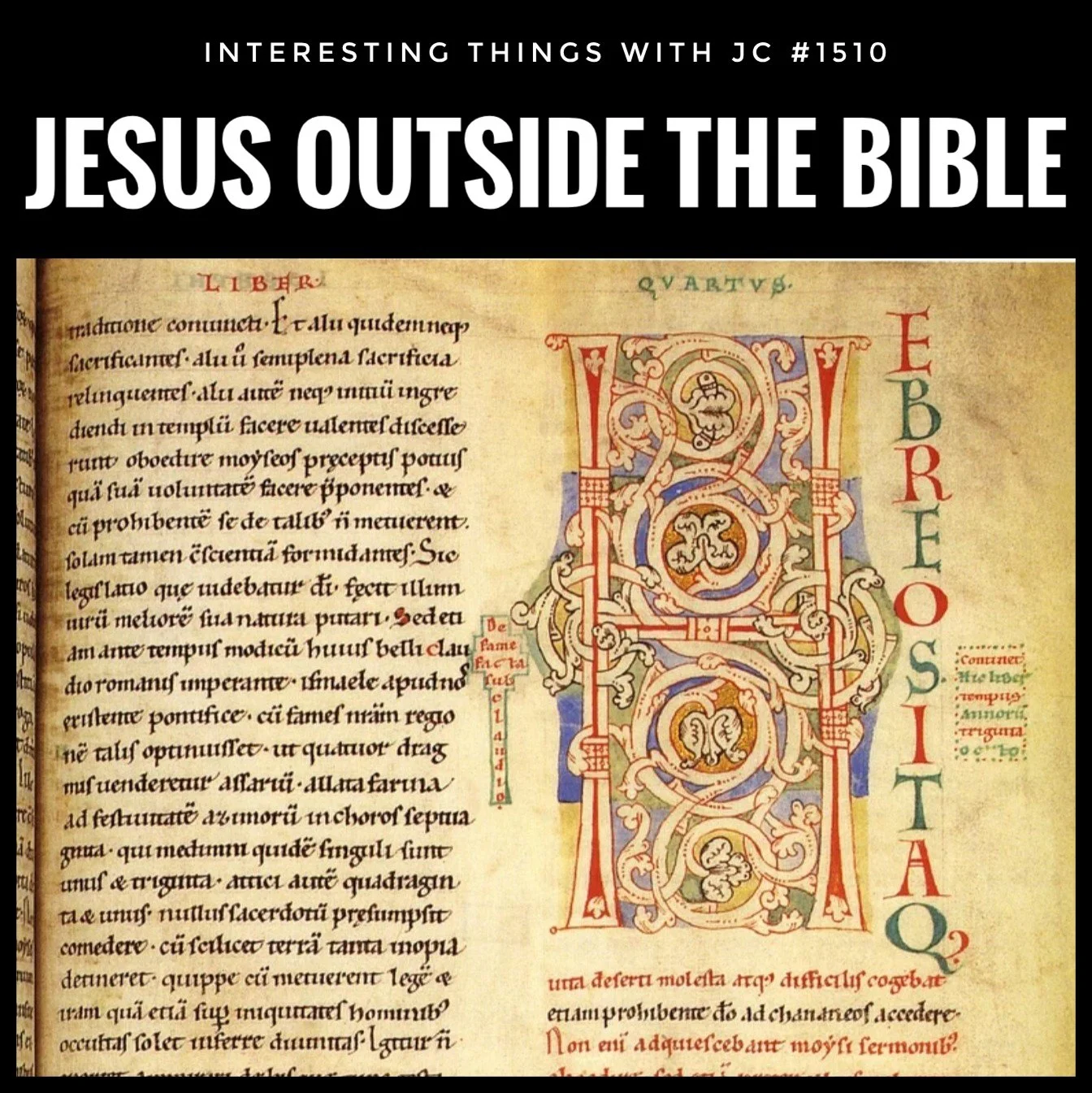
Promotional graphic for Interesting Things with JC episode #1510 titled “Jesus Outside the Bible.” The top portion features a black background with white text reading “INTERESTING THINGS WITH JC #1510” and a large bold title, “JESUS OUTSIDE THE BIBLE.” Below the title is an image of an illuminated medieval manuscript page written in Latin. The page shows dense columns of handwritten text and a large, ornate decorative letter with red, blue, and gold detailing. Along the right margin, the word “EBREOS” appears vertically in red and green letters. The overall image suggests ancient historical texts and scholarly study.
Transcript
Here’s something that doesn’t get talked about enough.
Jesus left behind no book written in his own hand. No buildings. No statues. No official records. We don’t know his height, his weight, or what his voice sounded like. By normal historical standards, he should have disappeared.
Instead, people who didn’t believe in him couldn’t stop writing about him.
One of the earliest was a Jewish historian named Flavius Josephus (FLAY-vee-us joh-SEE-fus). Around 93 to 94 CE, Josephus finished a massive history called Antiquities of the Jews. In it, he mentions Jesus twice.
In one passage, he describes Jesus as a teacher known for unusual deeds, someone who gathered followers and was executed under the Roman governor Pontius Pilate. Scholars agree parts of this paragraph were edited later by Christians, but they also agree Josephus originally wrote about Jesus himself.
The second mention is short and clean. Josephus talks about the execution of a man named James and explains who he was by calling him “the brother of Jesus, who was called Christ.” No praise. No theology. Just identification. That tells us something important. Josephus expected his readers to already know who Jesus was.
And Josephus was not a Christian.
About twenty years later, a Roman historian named Tacitus (TASS-ih-tus) wrote a history of the Roman emperors. While describing the Great Fire of Rome in 64 CE, Tacitus explains that Emperor Nero blamed a group called Christians for the disaster.
Tacitus says their name came from “Christus,” who was executed by Pontius Pilate during the reign of Emperor Tiberius. He clearly despised Christianity, calling it a harmful superstition. But that’s exactly why his words matter. He had no reason to help Christians. He was simply recording what Rome already knew.
Other Roman officials noticed the same thing. Pliny the Younger wrote about Christians meeting before sunrise and singing hymns to Christ “as to a god.” Suetonius mentioned public trouble connected to followers of someone called Chrestus. None of these writers were believers. All of them treated Jesus as a real person whose followers were spreading fast.
Jewish tradition remembered him very differently. In the Talmud, which was written down centuries later but reflects earlier oral traditions, there are hostile references to a figure often identified with Yeshu (YEH-shoo), though scholars debate the details. This figure is accused of practicing sorcery, misleading people, and being executed. The tone is negative and polemical, but the point is important. Jesus is not dismissed as fiction. He is argued against.
Then there’s Islam.
In the Quran, Jesus is called Isa (EE-sah). He’s mentioned by name twenty-five times, more than Muhammad himself. Islam teaches that he was born of the virgin Maryam, performed miracles by God’s permission, and was the Messiah.
But Islam also draws a hard line. Jesus is not God. He is not the Son of God. And Islam says he was not crucified. According to the Quran, it only appeared that way, and God raised him up instead.
That disagreement isn’t small. It goes right to the heart of Christian belief. And yet, Jesus still holds a central place in Islam. He’s honored. He’s respected. And he’s expected to return at the end of history.
Outside these traditions, later cultures found their own ways to talk about him. Judaism continued to view him as a Jewish teacher whose followers created a separate religion. Hindu and Buddhist thinkers, centuries later, sometimes described Jesus as a wise teacher or enlightened figure, even though their ancient texts don’t mention him at all.
Even early Christians didn’t all agree. In the second and third centuries, extra gospels appeared. Some told stories about Jesus as a child performing miracles. Others focused on secret teachings instead of public preaching. These writings were eventually rejected because they came too late or taught ideas the early church didn’t accept.
What’s striking is this.
Across Roman officials who disliked him, Jewish texts that rejected him, Islamic scripture that redefined him, and later philosophies that reinterpreted him, Jesus keeps showing up.
Not as a legend. Not as a symbol. But as a real man who lived, taught, and changed the direction of history so much that people who disagreed about everything else still had to account for him.
History doesn’t tell you what to believe about Jesus.
But it does make one thing very clear. He existed. He mattered. And the world was never the same after him.
These are interesting things, with JC.
Student Worksheet
Why are hostile sources important to historians?
List two non-Christian sources that mention Jesus and what they say about him.
Explain the difference between historical agreement and theological agreement.
Creative prompt: Write a short paragraph explaining why disagreement can still confirm historical existence.
Teacher Guide
Estimated Time
One 45–60 minute class period
Pre-Teaching Vocabulary Strategy
Introduce key terms using short excerpts from Roman and Jewish texts.
Anticipated Misconceptions
Historical evidence equals religious endorsement
All ancient sources agree with each other
Discussion Prompts
Why would Roman officials write about Christians if they disliked them?
How does Islam’s view of Jesus differ from Christianity while still affirming his importance?
Differentiation Strategies
ESL: Provide vocabulary sentence frames
IEP: Use guided notes and shortened excerpts
Gifted: Compare Jesus to other ancient figures known from limited sources
Extension Activities
Analyze another historical figure known primarily through hostile sources
Research how historians date ancient texts
Cross-Curricular Connections
Sociology: Spread of movements
Ethics: Belief versus evidence
Literature: Source reliability
Quiz
Q1. Which historian identified James as the brother of Jesus?
A. Tacitus
B. Josephus
C. Pliny
D. Suetonius
Answer: B
Q2. Why is Tacitus considered a valuable source?
A. He was a Christian
B. He praised Jesus
C. He was hostile to Christianity
D. He wrote the Gospels
Answer: C
Q3. What does the Quran say about Jesus’s crucifixion?
A. It confirms it
B. It denies it
C. It ignores it
D. It praises it
Answer: B
Q4. Which group argued against Jesus rather than denying his existence?
A. Romans
B. Greeks
C. Jewish traditions
D. Buddhists
Answer: C
Q5. What does historical evidence primarily establish in this episode?
A. Theology
B. Doctrine
C. Existence and impact
D. Miracles
Answer: C
Assessment
Open-Ended Questions
Explain why historians separate belief from historical evidence.
Describe how disagreement across cultures still supports Jesus’s historical existence.
3–2–1 Rubric
3 = Accurate, complete, thoughtful
2 = Partial or missing detail
1 = Inaccurate or vague
Standards Alignment
CCSS.ELA-LITERACY.RH.9-10.1
Citing textual evidence from historical sources
C3.D2.His.1.9-12
Evaluating historical sources and claims
C3.D2.His.6.9-12
Analyzing how perspectives shape historical narratives
UK National Curriculum – History KS4
Understanding interpretations of history
IB MYP Individuals and Societies
Evaluating evidence and differing viewpoints
Show Notes
This episode explores how Jesus of Nazareth appears in non-Christian historical sources, including Roman historians, Jewish tradition, and Islamic scripture. By examining hostile and neutral accounts, students learn how historians determine historical existence without relying on belief. The topic builds critical thinking skills, source evaluation, and an understanding of how major historical figures shape civilizations even amid disagreement.
References
Ehrman, B. D. (2019, February 24). Non-Christian sources for Jesus: An interview with History.com. The Bart Ehrman Blog. https://ehrmanblog.org/non-christian-sources-for-jesus-an-interview-with-history-com/
Gleghorn, M. (2001). Ancient evidence for Jesus from non-Christian sources. Bethinking.org. https://www.bethinking.org/jesus/ancient-evidence-for-jesus-from-non-christian-sources
Klein, C. (2019, February 26). The Bible says Jesus was real. What other proof exists? History. https://www.history.com/articles/was-jesus-real-historical-evidence
Mykytiuk, L. (2015). Did Jesus exist? Searching for evidence beyond the Bible. Biblical Archaeology Review. https://www.biblicalarchaeology.org/daily/people-cultures-in-the-bible/jesus-historical-jesus/did-jesus-exist/
Windle, B. (2022, November 18). Top ten historical references to Jesus outside of the Bible. Bible Archaeology Report. https://biblearchaeologyreport.com/2022/11/18/top-ten-historical-references-to-jesus-outside-of-the-bible/