1511: "Faith No More – Midlife Crisis"
Interesting Things with JC #1511: "Faith No More – Midlife Crisis" – By the time “Midlife Crisis” hit the radio, Faith No More had already survived success. This wasn’t a song about age or fame…it was about what happens when attention replaces meaning, and a band decides it won’t play along.
Curriculum - Episode Anchor
Episode Title: Interesting Things with JC #1511: “Faith No More – Midlife Crisis”
Episode Number: 1511
Host: JC
Audience: Grades 9–12, college intro, homeschool, lifelong learners
Subject Area: Music History, Media Literacy, Cultural Studies
Lesson Overview
This episode examines how Faith No More used “Midlife Crisis” not as a commercial follow-up, but as a deliberate artistic pivot. Students explore how success can increase pressure rather than comfort, and how creative choices communicate values, resistance, and identity within popular culture.
Learning Objectives
Students will be able to:
Define how artistic pressure emerges after commercial success in the music industry.
Compare “Midlife Crisis” with earlier Faith No More hits to identify stylistic and thematic shifts.
Analyze lyrical perspective and musical restraint as tools for cultural commentary.
Explain how audience expectations influence creative decision-making.
Key Vocabulary
Breakthrough (BRAYK-throo) — A moment of sudden visibility or success; Faith No More’s breakthrough came with mainstream radio play.
Self-absorption (self-ub-ZORP-shun) — Excessive focus on oneself; the song critiques this mindset rather than expressing it.
Groove (groov) — A steady rhythmic foundation that drives a song without overpowering it.
Restraint (rih-STRAYNT) — Deliberate limitation; the band avoids excess to maintain tension.
Commercial Pressure (kuh-MUR-shul PRESH-er) — Industry expectations to repeat a profitable formula.
Narrative Core
Open: By 1992, Faith No More had already survived success, lineup change, and stadium crowds.
Info: The band formed in San Francisco in the early 1980s and replaced original singer Chuck Mosley with a young Mike Patton, leading to mainstream exposure.
Details: Instead of repeating “Epic,” the band released “Midlife Crisis” from Angel Dust, emphasizing control, critique, and tension.
Reflection: The song challenges listeners to distinguish attention from meaning, success from purpose.
Closing: These are interesting things, with JC.
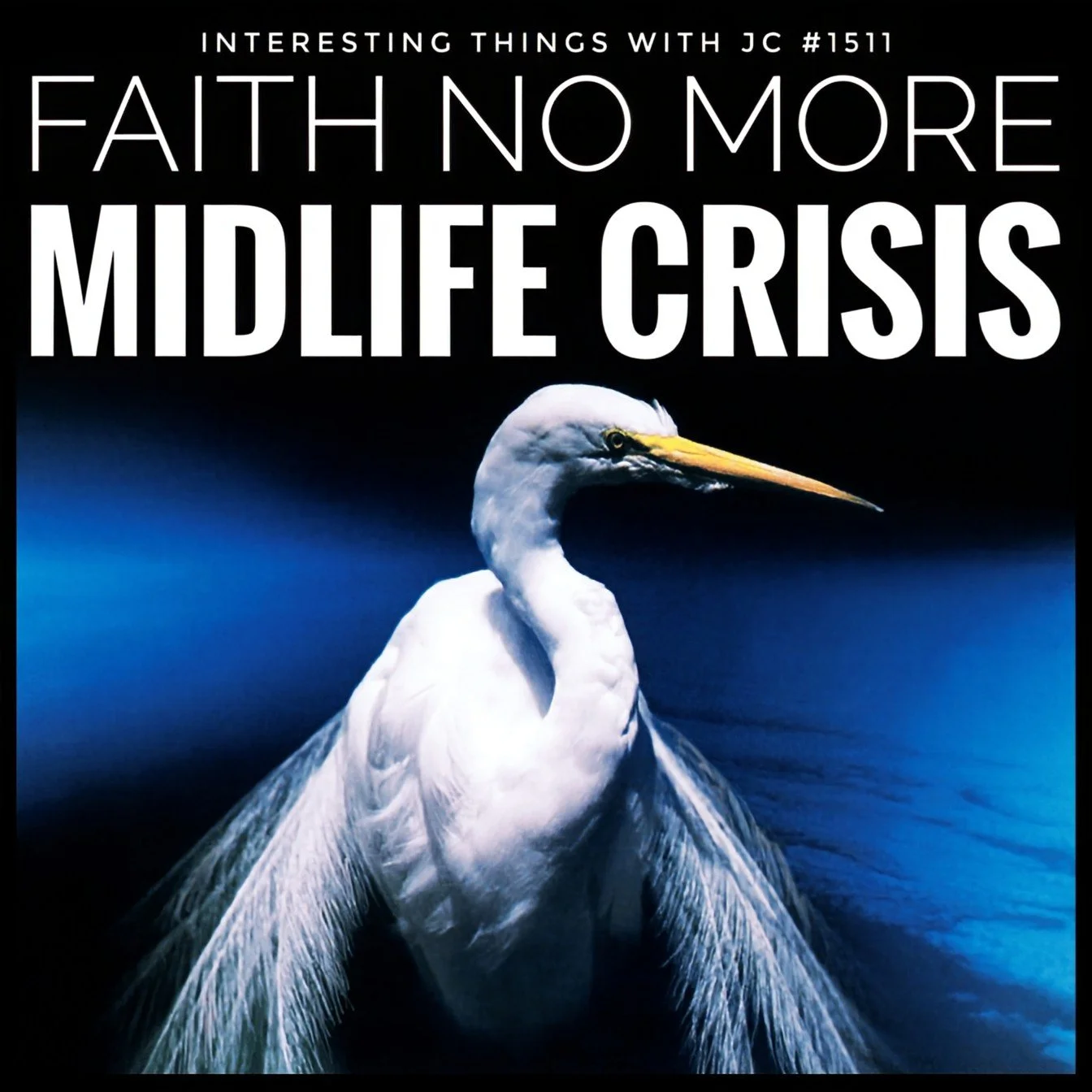
The image is a podcast cover for Interesting Things with JC, episode number 1511. The background is predominantly black, fading into deep blue tones that suggest nighttime water. Centered in the image is a white heron standing in shallow water. The bird faces slightly to the right, with its long yellow beak pointing forward. Its wings are partially extended downward, creating a wide, symmetrical shape that frames its body. The heron’s white feathers contrast sharply with the dark blue water and black background, giving the bird a calm but intense presence.
At the top of the image, white uppercase text reads “INTERESTING THINGS WITH JC #1511.” Below that, in much larger bold white letters, the title reads “FAITH NO MORE” and beneath it “MIDLIFE CRISIS.” The text is centered and clearly legible against the dark background. No people are present in the image. The overall visual tone is quiet, focused, and controlled.
Transcript
Interesting Things with JC #1511: “Faith No More – Midlife Crisis”
By the time “Midlife Crisis” reached radio in 1992, Faith No More wasn’t trying to prove they belonged anymore. They had already replaced a lead singer, broken through with “Epic,” and played stadium shows where a band either holds together or comes apart in public.
This song came after all of that.
Faith No More formed in San Francisco in the early 1980s and spent years scraping by. They changed names, changed singers, and kept missing traction. In 1988, they fired their frontman, Chuck Mosley, and took a gamble on a 20-year-old from Eureka, California named Mike Patton (MYKE PAT-in). The risk paid off fast. The Real Thing sold, “Epic” climbed the charts, and the band was suddenly everywhere.
What followed wasn’t relief. It was pressure.
They toured constantly, including opening stadium shows for Metallica and Guns N’ Roses. Those shows weren’t about comfort. They were about scale. About whether a band could step onto a stage built for tens of thousands and still sound like itself.
On July 25, 1992, that test came at Rich Stadium in Orchard Park, New York. More than 75,000 people were in the seats. Faith No More went on first, in daylight, in a place designed to expose weakness fast. When Mike Bordin’s kick drum hit and Billy Gould’s bass locked in behind it, the sound didn’t ease its way out. It hit all at once, like standing too close when a freight train comes through. You felt it in your chest before you had time to think. The crowd didn’t pull back. It moved forward.
I know, because I was there.
That experience mattered when they went back into the studio.
“Midlife Crisis” was released in May of 1992 as the lead single from Angel Dust. From the opening seconds, it makes no attempt to invite anyone in. The groove drops tight and controlled. Billy Gould’s bass and Mike Bordin’s drums sit back and hold steady. Roddy Bottum’s keyboards add tension without lifting the song. Jim Martin’s guitar stays clipped, almost restrained.
Mike Patton doesn’t reach for the listener. He doesn’t explode or explain. He sounds like someone who’s already made up his mind.
The title confused people. “Midlife Crisis” isn’t about age. Patton has said the song is about self-absorption, about people who confuse attention with substance. The lyrics aren’t confession. They’re aimed outward. They sound like something said after watching someone long enough to know exactly what drives them. It’s a song about people who build their identity out of attention, borrow confidence from others, and panic when that attention dries up. The “crisis” isn’t getting older. It’s realizing there’s not much underneath once the noise stops.
If “Epic” sounded restless, “Midlife Crisis” sounded settled. The band wasn’t asking to be liked anymore. They were deciding what they were willing to tolerate, and what they weren’t.
The song still found an audience.
“Midlife Crisis” reached number one on Billboard’s Modern Rock Tracks chart and broke into the top ten on the Mainstream Rock Tracks chart. Angel Dust entered the Billboard 200 and eventually went gold in the United States, selling more than 500,000 copies, with worldwide sales estimated at over two million. Faith No More didn’t repeat themselves, and people stayed with them anyway.
“Midlife Crisis” marked the point where Faith No More stopped looking back. They weren’t interested in replaying one successful moment or smoothing out the edges for comfort. They moved forward, played what they meant, and let the audience decide whether to come along.
These are interesting things, with JC.
Student Worksheet
Explain why “Midlife Crisis” is not literally about age.
Describe one musical choice that signals restraint rather than excess.
Compare the emotional tone of “Epic” and “Midlife Crisis.”
Creative prompt: Write four lines critiquing modern attention culture.
Teacher Guide
Estimated Time
45–60 minutes
Pre-Teaching Vocabulary Strategy
Preview terms using lyric excerpts and instrumental descriptions.
Anticipated Misconceptions
Students may assume the song reflects personal confession rather than critique.
Discussion Prompts
Why might success increase creative pressure?
How can restraint be more powerful than excess?
Differentiation Strategies
ESL: Provide lyric excerpts with guided annotations.
IEP: Offer audio-only analysis options.
Gifted: Compare with other post-success artistic pivots.
Extension Activities
Analyze another artist’s response to mainstream success.
Cross-Curricular Connections
Sociology: Identity and public image
Media Studies: Audience expectation cycles
Music Theory: Groove and tension
Quiz
Q1. What was the primary theme of “Midlife Crisis”?
A. Aging
B. Self-absorption
C. Romance
D. Fame envy
Answer: B
Q2. Which album introduced the song?
A. The Real Thing
B. King for a Day
C. Angel Dust
D. Introduce Yourself
Answer: C
Q3. What musical quality defines the song?
A. Speed
B. Chaos
C. Restraint
D. Improvisation
Answer: C
Q4. How did the band respond to industry pressure?
A. Repeated their sound
B. Quit touring
C. Changed direction
D. Reduced lineup
Answer: C
Q5. What chart did the song top?
A. Hot 100
B. Modern Rock Tracks
C. Billboard 200
D. Dance Club Songs
Answer: B
Assessment
Open-Ended Questions
Explain how “Midlife Crisis” represents a turning point for Faith No More.
Analyze how musical restraint supports the song’s message.
3–2–1 Rubric
3 = Accurate, complete, thoughtful
2 = Partial or missing detail
1 = Inaccurate or vague
Standards Alignment
CCSS.ELA-LITERACY.RI.9-10.2
Analyze central ideas in informational texts through music journalism.
CCSS.ELA-LITERACY.SL.9-10.1
Engage in collaborative discussion on artistic intent.
C3.D2.His.14.9-12
Analyze how cultural works reflect historical context.
ISTE 3a
Evaluate digital media for intent and impact.
UK National Curriculum – Music (Key Stage 4)
Understanding stylistic development and purpose in music.
IB MYP Arts
Analyzing artistic choices and audience response.
Show Notes
This episode explores how Faith No More confronted success by rejecting repetition and choosing artistic control. Through “Midlife Crisis,” the band critiques self-absorption and industry expectations, offering a case study in cultural resistance. In classrooms, this episode supports discussions on media literacy, authenticity, and how creative decisions reflect values under pressure. It remains relevant in an era defined by attention economics and public image.
This curriculum framework is based on the Reusable Prompt Curriculum Framework for Interesting Things with JC .
References
Patton’s stated meaning of “Midlife Crisis” creative control and manufactured emotion: Kalina, N. (2025). https://noahkalina.substack.com/p/newsletter-185-faith-no-mores-midlife
Faith No More’s rejection of repetition and commercial expectations on Angel Dust: Allen, J. (2017). https://thequietus.com/opinion-and-essays/anniversary/angel-dust-faith-no-more-review-anniversary/
Independent lyrical interpretation emphasizing invented emotion and self-absorption: JammingWave. (n.d.). https://jammingwave.com/why-i-like-the-song-midlife-crisis-by-faith-no-more-and-some-facts-about-it/
Critical analysis of artistic risk and cultural resistance on Angel Dust: McEver, M. (2022). https://www.popmatters.com/faith-no-more-angel-dust-atr30