1513: "What Makes Cheese Sharp?"
Interesting Things with JC #1513: "What Makes Cheese Sharp?" – You grab a slice thinking it’ll be mild, and it hits harder than expected. Let's find out why!
Curriculum - Episode Anchor
Episode Title: What Makes Cheese Sharp?
Episode Number: #1513
Host: JC
Audience: Grades 9–12, college intro, homeschool, lifelong learners
Subject Area: Biology, Food Science, Chemistry
Lesson Overview
This lesson uses everyday food experience to explain biochemical processes involved in cheese aging. Students explore how time, bacteria, enzymes, and chemical byproducts transform mild cheddar into sharp cheese, connecting microbiology and chemistry concepts to real-world sensory experience.
Learning Objectives
Students will be able to:
Define how aging affects the chemical composition of cheese
Explain the role of bacteria and enzymes in flavor development
Analyze why sharpness increases over time rather than being added
Compare mild, sharp, and extra-sharp cheddar based on aging processes
Key Vocabulary
Lactic Acid (lak-tik ASS-id) — A compound formed when bacteria convert lactose; responsible for tangy flavor in sharp cheese.
Lactose (LAK-tohs) — Milk sugar that bacteria consume during cheese aging.
Enzyme (EN-zym) — A protein that speeds up chemical reactions, including protein breakdown in cheese.
Amino Acid (uh-MEE-noh ASS-id) — Smaller molecules formed when proteins break down, contributing to flavor.
Glutamate (GLOO-tuh-mate) — An amino acid that adds savory depth to aged cheese.
Tyrosine (TIE-roh-seen) — An amino acid that can crystallize in aged cheese, creating crunchy bits.
Narrative Core
Open
The unexpected bite of sharp cheese surprises the listener and sparks curiosity about flavor.
Info
Cheddar cheese begins as a simple mixture of milk, cultures, rennet, and salt.
Details
As cheese ages, bacteria produce lactic acid and enzymes break down proteins, intensifying flavor and texture.
Reflection
Sharpness is a result of time, chemistry, and patience rather than added ingredients.
Closing
These are interesting things, with JC.
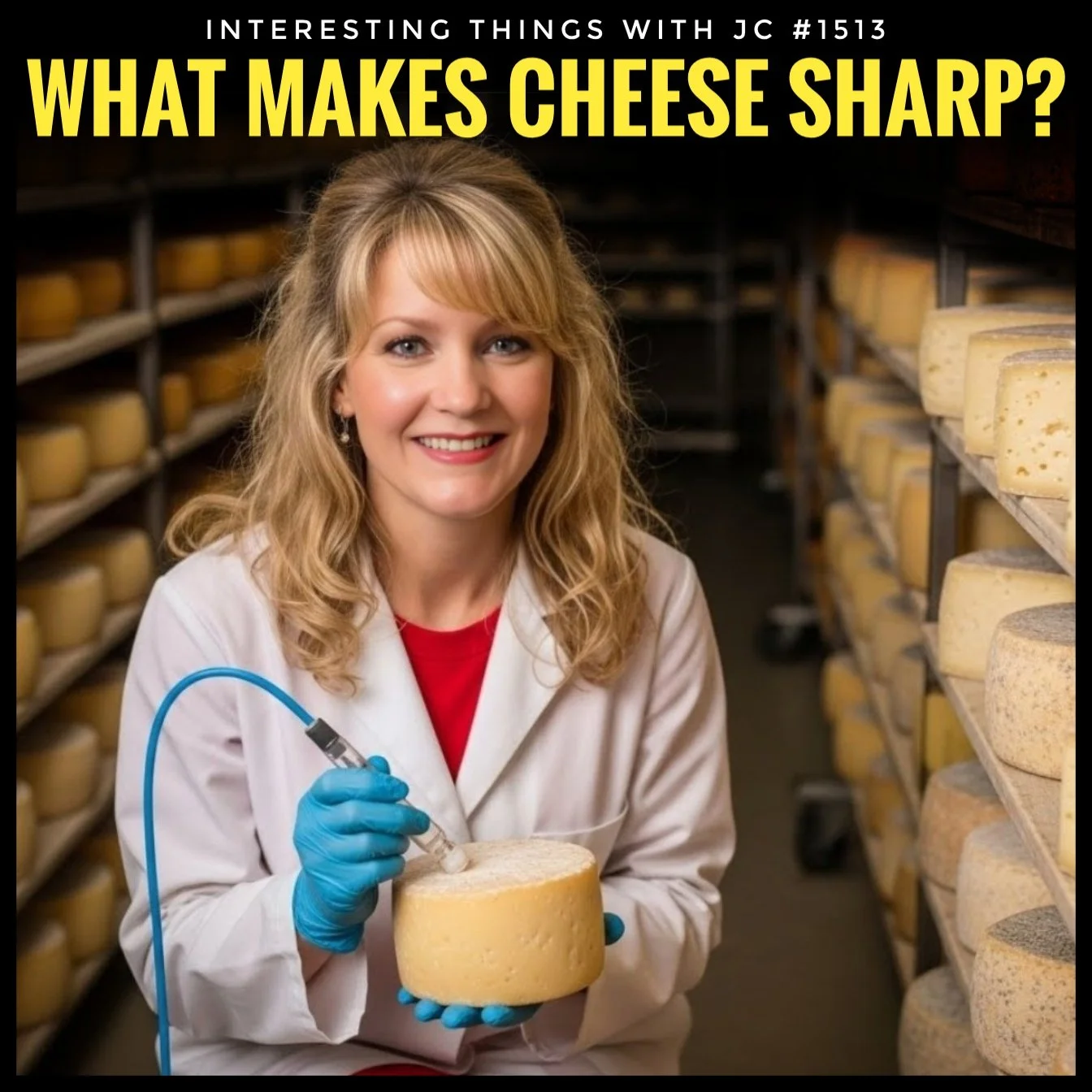
Promotional image for Interesting Things with JC #1513: “What Makes Cheese Sharp?” A beautiful and stunning woman wearing a white lab coat and blue protective gloves stands in a cheese aging room lined with shelves of round cheese wheels. She smiles warmly at the camera while holding a small wheel of cheese and inserting a sampling probe into its surface, suggesting scientific testing or quality inspection. Her blonde hair is softly styled, and her eyes are bright and expressive, conveying warmth, curiosity, and a quiet romantic charm that draws the viewer in. Her confident yet gentle expression reflects both expertise and care. Bold yellow text at the top reads, “WHAT MAKES CHEESE SHARP?” with the podcast title and episode number above it. The setting emphasizes craftsmanship, food science, and the aging process of cheese.
Transcript
Interesting Things with JC #1513: “What Makes Cheese Sharp?”
Most folks remember the first time sharp cheese surprised them. You take a bite thinking it’ll be mild and smooth, and instead it snaps back a little. Your mouth tightens up, and the flavor sticks around longer than you expected. That’s what people mean when they say a cheese is sharp.
And sharp isn’t something they add in later. It’s something that happens with time.
Cheddar starts out pretty simple. Milk, cultures, rennet, salt. Fresh cheddar is mild and just a touch sweet, because there’s still milk sugar in it and the proteins haven’t changed much yet. At that point, it’s easygoing. Nothing bold about it.
That changes once you let it sit.
As cheddar ages, the bacteria keep working, even though the cheese looks finished. Those bacteria eat the leftover lactose and turn it into lactic acid. That acid is what gives sharp cheese its tang. The longer the cheese ages, the more that acid builds up, and the sharper the bite gets.
Mild cheddar might age a few months. Sharp cheddar usually goes close to a year. Extra-sharp can sit a year and a half, two years, sometimes longer. Time isn’t just a number on the label. It’s doing real work inside the cheese.
While the acid brings the bite, time also breaks down the proteins. Enzymes slowly chop them into smaller pieces called amino acids. One of those, glutamate, adds a savory, nutty depth. That’s why sharp cheddar tastes fuller and more serious than mild cheese.
Then there are those little crunchy white bits you sometimes feel between your teeth. Those are crystals, usually tyrosine or calcium lactate. They form as moisture leaves the cheese over time. They’re natural, edible, and a good sign nobody rushed the process.
So sharp cheese isn’t spicy, and it isn’t bitter. It’s milk that’s been given enough time to toughen up.
And if you’re wondering what cheese is without a cracker… well, it’s just crackalackin!
These are interesting things, with JC.
Student Worksheet
Explain why sharpness increases as cheese ages.
Describe the role of bacteria in cheddar cheese flavor.
Why are crystals in aged cheese considered a good sign?
Compare mild and extra-sharp cheddar in terms of chemistry.
Teacher Guide
Estimated Time
30–45 minutes
Pre-Teaching Vocabulary Strategy
Use food examples to connect abstract chemistry terms to real experiences.
Anticipated Misconceptions
Sharp cheese is spicy
Flavor is added artificially after aging
Discussion Prompts
How does time act as an ingredient in food?
Why might people prefer stronger flavors as they age?
Differentiation Strategies
ESL: Visual diagrams of cheese aging
IEP: Sentence starters and guided notes
Gifted: Research other aged foods using similar processes
Extension Activities
Taste comparison lab using cheeses of different ages
Create a timeline model of cheddar aging
Cross-Curricular Connections
Chemistry: Acids and reactions
Biology: Bacterial metabolism
Health: Food processing and nutrition
Quiz
Q1. What causes the tangy taste in sharp cheese?
A. Salt
B. Lactic acid
C. Sugar
D. Fat
Answer: B
Q2. What do enzymes do during cheese aging?
A. Add flavoring
B. Stop bacteria
C. Break down proteins
D. Remove salt
Answer: C
Q3. What sugar do bacteria consume in cheese?
A. Glucose
B. Fructose
C. Lactose
D. Sucrose
Answer: C
Q4. What are crunchy crystals in aged cheese made of?
A. Mold
B. Sugar
C. Tyrosine or calcium lactate
D. Salt
Answer: C
Q5. What mainly determines whether cheddar is mild or sharp?
A. Color
B. Packaging
C. Time
D. Temperature
Answer: C
Assessment
Explain how bacteria and enzymes work together to create sharp cheese.
Describe why time is essential in changing cheese flavor.
3–2–1 Rubric
3 = Accurate, complete, thoughtful
2 = Partial or missing detail
1 = Inaccurate or vague
Standards Alignment
NGSS HS-LS1-7
Students explain how cellular processes release energy and produce byproducts like acids.
NGSS HS-LS2-3
Understanding interactions among organisms, including bacteria.
CCSS.ELA-LITERACY.RST.9-10.2
Determine central ideas of scientific texts.
CTE Food Science Standard
Understanding food processing and preservation methods.
UK National Curriculum Science KS4
Chemical changes and biological processes in food systems.
IB Biology SL
Enzyme activity and metabolism in applied contexts.
Show Notes
This episode explores why sharp cheese tastes the way it does, using cheddar as a case study in food science. Through simple storytelling, listeners learn how bacteria, enzymes, and time work together to transform milk into a bold, tangy food. In the classroom, this episode provides a relatable entry point into microbiology and chemistry, helping students see how invisible processes affect everyday experiences and why patience matters in both science and life.
References
Cabot Creamery. (2022, November 21). Cheese sharpness scale: What's the sharpest cheddar? https://cabotcreamery.com/blogs/cheese-culture/sharpness-scale
Renard's Cheese. (n.d.). A beginner's guide to aging cheese. https://www.renardscheese.com/blogs/lets-talk-cheese/a-beginners-guide-to-aging-cheese
The CheeseMaker. (n.d.). How does cheese aging work? https://www.thecheesemaker.com/blog/how-does-cheese-aging-work/
Agarwal, S., Costello, M., & Clark, S. (2005). Gas-flushed packaging contributes to calcium lactate crystals in Cheddar cheese. Journal of Dairy Science, 88(11), 3773–3783. ttps://doi.org/10.3168/jds.S0022-0302(05)73063-0 (Abstract available at: https://pubmed.ncbi.nlm.nih.gov/16230683/)
Tse, T. J., & Spagnuolo, P. A. (2023). Cheese aging and umami. In Search of Umami. https://medium.com/in-search-of-umami/cheese-aging-and-umami-2bf90213ab9d