1514: "Artificial Photosynthesis"
Interesting Things with JC #1514: "Artificial Photosynthesis" – Plants have always made food from sunlight. Now scientists are finding new ways to turn light into fuel with more power and purpose.
Curriculum - Episode Anchor
Episode Title: Artificial Photosynthesis
Episode Number: #1514
Host: JC
Audience: Grades 9–12, college intro, homeschool, lifelong learners
Subject Area: Chemistry, Environmental Science, Energy Engineering, Sustainable Technologies
Lesson Overview
Students will:
Define artificial photosynthesis and explain how it differs from natural photosynthesis.
Compare the efficiency of natural vs. artificial photosynthesis systems.
Analyze recent technological advancements and the challenges of scaling artificial photosynthesis.
Explain the potential societal and environmental impacts of synthetic fuel production from sunlight.
Key Vocabulary
Photosynthesis (foh-tuh-SIN-thuh-sis) — The process by which green plants use sunlight, water, and carbon dioxide to make food; plants convert solar energy into chemical energy.
Hydrogen Fuel (HY-druh-juhn FYOOL) — A clean energy source produced when water molecules are split during artificial photosynthesis.
Efficiency (ih-FISH-uhn-see) — A measure of how well energy or resources are converted into usable output; artificial systems surpass the ~1% efficiency of plants.
Catalyst (KAT-uh-list) — A substance that speeds up a chemical reaction without being consumed; crucial for artificial photosynthesis reactions.
Carbon Dioxide Reduction (KAR-buhn dye-OK-side ree-DUHK-shun) — A chemical process of turning CO₂ into useful fuels like methanol or methane using sunlight energy.
Narrative Core
Open – The episode opens with a poetic image of a cornfield in summer to introduce photosynthesis as a natural miracle.
Info – JC explains how plants capture solar energy, but notes their inefficiency, setting up the problem scientists want to solve.
Details – The episode describes how artificial photosynthesis mimics nature but with engineered systems that convert sunlight into usable fuels like hydrogen and methanol.
Reflection – JC frames the moment as analogous to the early days of flight—experimental but full of promise.
Closing – "These are interesting things, with JC."
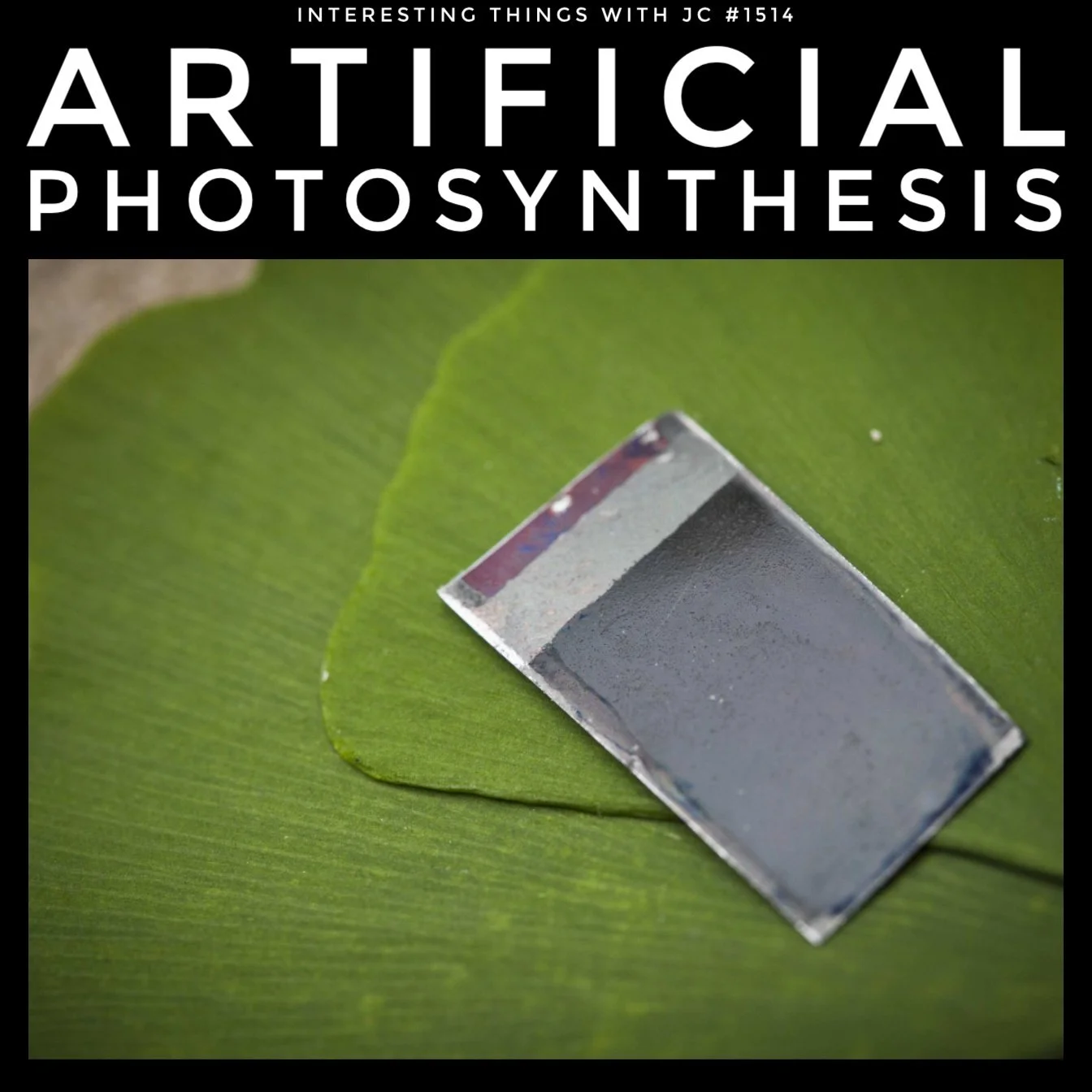
This promotional image for Interesting Things with JC episode #1514, titled "Artificial Photosynthesis," visually contrasts a sleek, human-made photosynthesis device with the natural leaf beneath it. The metallic panel, likely a prototype used in solar fuel research, symbolizes how modern science is mimicking and improving upon nature’s process of energy conversion. The juxtaposition highlights the central theme of the episode—transforming sunlight, water, and carbon dioxide into clean fuel using advanced technologies inspired by nature.
Transcript
Interesting Things with JC #1514: "Artificial Photosynthesis"
If you’ve ever watched a cornfield in July, you’ve seen one of the miracles of the world. Sunlight hits a leaf. Water comes up from the ground. Carbon dioxide drifts in from the air. And somehow, that plant turns all of it into stored energy. Food. Fuel for life.
For billions of years, nature’s been doing this on autopilot. But here’s the part most folks don’t realize. Plants aren’t very efficient at it. Even under ideal conditions, they only capture about one percent of the sunlight that hits them.
That simple fact led scientists to ask a bold question. What if we didn’t just copy photosynthesis, but built something that worked better?
Artificial photosynthesis is the attempt to do just that. Using sunlight to split water into hydrogen and oxygen, or to push carbon dioxide back into fuels like methane, methanol, or ethanol. Same basic ingredients as a leaf. Different outcome. Instead of sugar for a plant, you get fuel for people.
The chemistry itself is surprisingly straightforward. Light hits a special surface. Electrons start moving. Water breaks apart. Hydrogen bubbles off as a clean fuel. Carbon dioxide gets turned, step by careful step, into something useful again instead of waste.
Some systems look like solar panels dipped in water. Others use fine powders floating in tanks. One early design even looked like an artificial leaf, thin and flexible, sitting on water and producing hydrogen as long as the sun was out.
What’s changed recently is performance. By 2025, several systems are passing ten percent efficiency for turning sunlight into hydrogen. That number matters. It’s the point where engineers stop thinking in lab benches and start thinking in acres and factories.
There are still problems to solve. Materials wear out. Costs have to come down. Scaling up is never simple. But this no longer feels like a science fair experiment. It feels more like the early days of powered flight. Rough, imperfect, and clearly headed somewhere.
Nature figured out photosynthesis first. But humans are learning how to do it faster, cleaner, and on our own terms.
These are interesting things, with JC.
Student Worksheet
What are the main inputs and outputs of natural photosynthesis?
Why is natural photosynthesis considered inefficient by scientists?
Describe two methods used in artificial photosynthesis systems.
What is the significance of reaching 10% efficiency in artificial photosynthesis?
Imagine you are designing your own artificial leaf. What features would you include and why?
Teacher Guide
Estimated Time:
45–60 minutes
Pre-Teaching Vocabulary Strategy:
Use a Frayer Model for "Photosynthesis" and "Efficiency"
Show short video clips demonstrating natural and artificial photosynthesis
Anticipated Misconceptions:
Students may think all photosynthesis is inherently efficient
Confusion between solar panels and artificial photosynthesis systems
Discussion Prompts:
Could artificial photosynthesis replace fossil fuels?
How does the design of artificial systems reflect biomimicry?
What are the environmental benefits and trade-offs of synthetic fuels?
Differentiation Strategies:
ESL: Visual diagrams of photosynthesis processes
IEP: Sentence starters and graphic organizers
Gifted: Research real-world startup companies working on artificial photosynthesis
Extension Activities:
Design a prototype or sketch of an artificial photosynthesis device
Research a breakthrough in solar fuels and present it to the class
Cross-Curricular Connections:
Chemistry: Redox reactions and catalysis
Engineering: Renewable energy system design
Environmental Science: Carbon cycle, climate technology
Quiz
What is the main goal of artificial photosynthesis?
A. To grow plants faster
B. To produce fuel from sunlight
C. To increase crop yield
D. To reduce oxygen production
Answer: BNatural photosynthesis converts sunlight into:
A. Hydrogen
B. Electricity
C. Sugar
D. Oil
Answer: CWhich of the following is a byproduct of artificial water-splitting?
A. Methane
B. Oxygen
C. Nitrogen
D. Carbon monoxide
Answer: BOne design for artificial photosynthesis looks like:
A. A wind turbine
B. A solar-powered drone
C. A flexible leaf
D. A plastic tree
Answer: CWhy is 10% efficiency a key milestone for artificial photosynthesis?
A. It allows the system to power a city
B. It makes lab experiments more fun
C. It justifies commercial-scale deployment
D. It’s the same as plant efficiency
Answer: C
Assessment
Explain how artificial photosynthesis works, including the steps involved.
Compare natural and artificial photosynthesis in terms of energy efficiency and usefulness for humans.
Rubric (3–2–1)
3 = Accurate, complete, thoughtful
2 = Partial or missing detail
1 = Inaccurate or vague
Standards Alignment
NGSS (Next Generation Science Standards):
HS-PS3-3: Design, build, and refine a device that works within given constraints to convert one form of energy into another.
HS-ESS3-4: Evaluate or refine a technological solution that reduces impacts of human activities on natural systems.
CCSS (Common Core State Standards for Literacy in Science):
RST.11-12.2: Determine the central ideas or conclusions of a text; summarize complex concepts.
WHST.11-12.7: Conduct short research projects to answer a question.
CTE (Career and Technical Education – Engineering & Environmental Services):
ENEG05.01: Analyze sustainable energy systems and their applications.
International Equivalents:
UK A-Level Chemistry OCR A (Module 5.2.3): Redox and fuel cells — comparing artificial processes to biological ones.
IB DP Chemistry SL/HL (Topic 9.3): Electrochemical cells and renewable energy applications.
Cambridge IGCSE Environmental Management (Topic 3.2): Energy resources and sustainable solutions.
Show Notes
In Episode #1514 of Interesting Things with JC, listeners are introduced to the world of artificial photosynthesis—an emerging technology that mimics nature’s energy conversion methods but with greater efficiency and human benefit. JC explains how scientists are designing systems that can turn sunlight into hydrogen fuel and convert carbon dioxide into clean-burning fuels like methanol. From flexible artificial leaves to powdered chemical reactors, this episode takes students on a journey from chloroplasts to cutting-edge lab benches. With solar-to-fuel efficiency now crossing 10%, the dream of scalable, sustainable energy is moving closer to reality—making this a timely topic for science classrooms and curious minds alike.
References
Lewis, N. S., & Nocera, D. G. (2006). Powering the planet: Chemical challenges in solar energy utilization. Proceedings of the National Academy of Sciences, 103(43), 15729–15735. https://doi.org/10.1073/pnas.0603395103
Hansora, D., et al. (2025). Scalable and durable module-sized artificial leaf with a solar-to-hydrogen efficiency over 10%. https://pmc.ncbi.nlm.nih.gov/articles/PMC12056055/
Machín, A., et al. (2023). Artificial photosynthesis: Current advancements and future prospects. Biomimetics, 8(2), 298. https://pubmed.ncbi.nlm.nih.gov/37504186/#:~:text=Abstract,and%20utilization%2C%20and%20sustainable%20agriculture.
Rahman, A., et al. (2025). Advances in artificial photosynthesis: The role of chalcogenides and chalcogenide-based heterostructures. https://chemistry-europe.onlinelibrary.wiley.com/doi/10.1002/cptc.202400234#:~:text=Graphical%20Abstract,2
Takata, T., et al. (2024). Photocatalytic overall water splitting on Rh-doped SrTiO3 cocatalyst-loaded artificial leaves achieving solar-to-hydrogen efficiency exceeding 10%. https://www.frontiersin.org/journals/science/articles/10.3389/fsci.2024.1411644/full
Khan, B., Faheem, M. B., & He, J.-H. (2024). Unassisted photoelectrochemical CO2-to-liquid fuel splitting over 12% solar conversion efficiency. Nature Communications. https://www.nature.com/articles/s41467-024-51088-0