1515: "Brigitte Bardot"
Interesting Things with JC #1515: "Brigitte Bardot" – The goddess has left us at 91. Brigitte Bardot didn't chase stardom, she embodied it with ballet grace, barefoot sensuality in "And God Created Woman" and the courage to walk away untamed. This episode mourns the legend while celebrating the woman who redefined feminine freedom on her own terms.
Curriculum - Episode Anchor
Episode Title: Brigitte Bardot
Episode Number: #1515
Host: JC
Audience: Grades 9–12, college intro, homeschool, lifelong learners
Subject Area: History, Film Studies, Media Literacy, Gender Studies
Lesson Overview
Students will:
Define the significance of Brigitte Bardot’s influence on mid-20th century cinema and culture.
Compare Bardot’s portrayal of femininity in contrast with earlier female film archetypes.
Analyze the societal response to Bardot’s career choices, including her departure from acting.
Explain how Bardot’s life reflected broader shifts in media, gender norms, and personal autonomy in postwar Europe.
Key Vocabulary
Conservatoire (kon-ser-vah-TWAHR) — A prestigious French school of performing arts; Bardot studied ballet here as a child.
Marianne (mah-ree-ANN) — A national symbol of the French Republic, representing liberty and reason; Bardot was selected as a modern model.
And God Created Woman — The 1956 film that established Bardot as an international star and redefined female representation in cinema.
Jean-Luc Godard (zhahn-LOOK go-DAR) — Influential French filmmaker who cast Bardot in Le Mépris, a landmark of European art cinema.
La Madrague (lah mah-DRAG) — Bardot’s home in Saint-Tropez, which became a symbol of her private retreat and later her conservation work.
Narrative Core
Open — A poetic framing of Bardot’s presence: not someone who entered a room but changed its temperature, illustrating charisma beyond words.
Info — Childhood training, strict upbringing, and early exposure to performance arts grounded her in posture, balance, and self-awareness.
Details — Rise to fame via a 1949 Elle magazine cover, marriage to Roger Vadim, and the breakthrough role in And God Created Woman.
Reflection — Bardot’s rejection of Hollywood norms, her eventual withdrawal from cinema, and her transformation into an animal rights advocate.
Closing — “These are interesting things, with JC.”
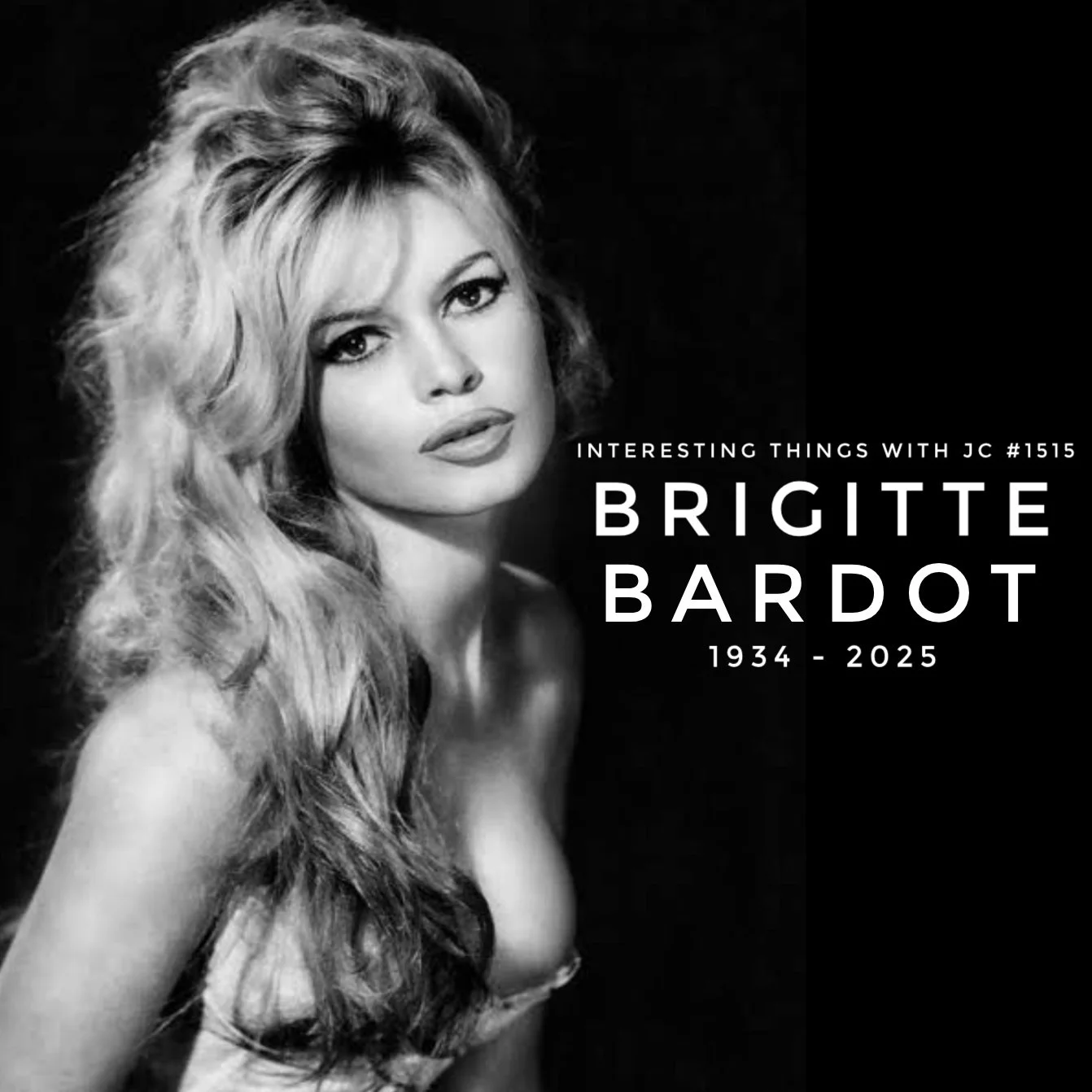
Black-and-white promotional portrait of Brigitte Bardot in her early career. She has long, voluminous blonde hair cascading over her shoulder and is wearing a strapless top. Her expression is calm and confident as she gazes slightly past the camera. On the right side of the image is a solid black panel with white text that reads: "Interesting Things with JC #1515 — Brigitte Bardot — 1934–2025."
Transcript
Interesting Things with JC #1515: “Brigitte Bardot”
There were certain women who didn’t just enter a room. They changed the temperature of it. They weren’t hunting for attention. They didn’t need to. People noticed them anyway, by the way they stood, by the way they looked back across the room. A woman comfortable being seen, and unafraid to return the look.
That was Brigitte Anne-Marie Bardot (bree-ZHEET bar-DO).
She was born on September 28, 1934, in Paris (PAIR-iss), France. She was raised in a strict household shaped by discipline and routine. At 7 years old, she entered the Conservatoire de Paris (kon-ser-vah-TWAHR duh PAIR-iss), where she trained in classical ballet under Russian choreographer Boris Knyazev (BOR-iss nee-AH-zev).
Ballet wasn’t about applause. It was about control. About posture. About balance. About learning how to stay composed when eyes are on you. Long before cameras followed her, she learned how to be seen with confidence. That kind of training defines you. It becomes part of who you are.
You could see it later on screen. She didn’t rush through scenes. She didn’t fidget or overplay moments. She stayed relaxed, grounded in her body, and the camera stayed with her.
At 15, a photograph changed her life. In 1949, she appeared on the cover of Elle magazine. The image was calm and direct. That photograph led to a screen test, and in 1952 she appeared in her first films, including Le Trou Normand and Manina, la fille sans voiles (mah-NEE-nah, la FEEL sahn VWAHL). These were modest roles, but they placed her in front of audiences. Manina, in particular, drew attention and made it clear she wasn’t just passing through.
That same year, at 18, she married director Roger Vadim (ROH-zhay vah-DEEM). The marriage coincided with her earliest rise and ended in 1957, as her public life expanded faster than her private one could keep pace.
The early years were busy and unglamorous. She worked constantly through the early 1950s, appearing in more than a dozen films that are largely forgotten today. Those years mattered. They taught her timing, restraint, and how to let a moment breathe instead of forcing it.
Then came 1956.
And God Created Woman, released in France as Et Dieu créa la femme (et DYUH kray-AH la FAM), was filmed in Saint-Tropez (san tro-PAY). The movie ran just over 95 minutes, but her presence in it changed what studios allowed women to be on screen.
After that film, female characters no longer had to be explained or managed in every scene. European cinema embraced something new. A woman could carry a moment, even a whole scene, simply by being there.
Fashion followed what audiences were responding to. Hair became more natural. Posture relaxed. Styling loosened. The body was no longer treated as something to be arranged or corrected, but something lived in.
In 1959, she married actor Jacques Charrier (zhahk shah-ree-AY). During that marriage, in 1960, she gave birth to her only child, a son named Nicolas (NEE-koh-LAH). Brigitte was candid throughout her life that motherhood did not come naturally to her, and the relationship remained distant. She never pretended otherwise. The marriage ended in 1962.
Her career didn’t coast after that. It deepened. In 1960, La Vérité (lah vay-ree-TAY) showed she could carry a serious dramatic role. In 1963, Jean-Luc Godard (zhahn-LOOK go-DAR) cast her in Le Mépris (luh may-PREE), placing her inside European art cinema that is still studied today. In 1965, Viva Maria (VEE-vah mah-REE-ah) made her an international box office success.
In 1966, she married German photographer and industrial heir Gunter Sachs (GOON-ter sahks). The marriage ended in 1969, another example of how difficult private life could be under constant public attention.
Hollywood noticed. She appeared in U.S.-backed productions like Shalako (shah-LAH-koh) in 1968, opposite Sean Connery. But she didn’t chase the system. She turned down long-term contracts and refused to relocate. She wanted control, not machinery.
One of her greatest honors came in the late 1960s, when she was chosen as Marianne (mah-ree-ANN), the national symbol of the French Republic.
Then came the decision that said more about her than any role ever could. In 1973, at 39 years old, Brigitte stopped acting. Completely. She said the work had become unbearable. Filming felt like being exposed, handled, and traded. She no longer recognized herself on screen, and the attention came at the cost of her peace. Acting no longer felt like creation. It felt like surrender.
She had already bought La Madrague (lah mah-DRAG) in Saint-Tropez in 1958. In 1986, she founded the Brigitte Bardot Foundation and devoted herself to animal protection, supporting shelters, rescues, and sterilization programs. In 1992, she married Bernard d’Ormale (ber-NAR dor-MAHL), and the marriage remained private and enduring until her death.
Brigitte Bardot died on December 28, 2025, at the age of 91, at her home in Saint-Tropez. She was survived by her son, Nicolas. Plans in France described a private funeral on January 7, 2026, at Notre-Dame-de-l’Assomption (NOH-truh DAHM duh la-SOOM-see-ON), with a public tribute expected in La Ponche (lah PONSH).
She was admired because she was beautiful, and because she understood exactly how to carry that beauty. She never apologized for it or treated it as something dangerous.
As she once said plainly and without regret, she gave her beauty and her youth to men. She understood admiration without surrendering herself. She was seen, and she remained her own.
With her, femininity wasn’t about pushing or posturing. It was about being comfortable, direct, and fully present. She proved a woman could be deeply desired without giving herself away. Free without hardening. Soft without breaking.
These are interesting things, with JC.
Student Worksheet
What training did Brigitte Bardot receive as a child that influenced her film presence?
Name two major films that marked turning points in Bardot’s career.
How did And God Created Woman change the way women were portrayed in cinema?
Why did Bardot decide to retire from acting at the age of 39?
In what ways did Bardot contribute to society after leaving the entertainment industry?
Teacher Guide
Estimated Time:
1–2 class periods (45–60 minutes each)
Pre-Teaching Vocabulary Strategy:
Introduce French terms and names using phonetic spelling and multimedia support (e.g., audio clips, maps of France).
Anticipated Misconceptions:
Students may assume Bardot was only a fashion figure or model, not a serious actress.
Students may not understand the cultural significance of Marianne or her rejection of Hollywood norms.
Discussion Prompts:
What does Bardot’s decision to leave acting say about fame and autonomy?
How did Bardot’s presence on screen differ from other actresses of her time?
In what ways did Bardot challenge or reinforce gender expectations in the 20th century?
Differentiation Strategies:
ESL: Use visuals of Bardot’s films and images from Elle magazine covers to aid comprehension.
IEP: Provide scaffolded questions with sentence starters.
Gifted: Invite students to analyze Bardot’s influence on modern celebrity culture.
Extension Activities:
Compare Bardot’s screen presence with Marilyn Monroe, Sophia Loren, or Audrey Hepburn.
Research the Brigitte Bardot Foundation’s animal protection initiatives.
Explore the representation of women in film before and after 1956.
Cross-Curricular Connections:
History: Post-WWII French society and cinema
Media Literacy: Image and branding of female celebrities
Ethics: The responsibility of fame and personal boundaries
Quiz
What was Brigitte Bardot's profession before becoming a film star?
A. Painter
B. Ballet dancer
C. Opera singer
D. Fashion designer
Answer: BWhich film is considered Bardot’s international breakout role?
A. La Vérité
B. Manina, la fille sans voiles
C. Et Dieu créa la femme (And God Created Woman)
D. Viva Maria
Answer: CWhy did Bardot retire from acting in 1973?
A. She wanted to raise her children
B. She lost interest in cinema
C. She felt acting had become unbearable and inauthentic
D. She was no longer being offered roles
Answer: CWhat cause did Bardot dedicate herself to after leaving film?
A. Education reform
B. Political activism
C. Animal protection
D. Fashion design
Answer: CWhat iconic French national symbol did Bardot embody in the 1960s?
A. The Eiffel Tower
B. Joan of Arc
C. Marianne
D. The Tricolor Flag
Answer: C
Assessment
In your own words, explain how Brigitte Bardot influenced film and public attitudes toward femininity during her era.
Reflect on Bardot’s decision to retire from the public eye. Do you think it was a form of empowerment? Why or why not?
3–2–1 Rubric:
3 = Accurate, complete, thoughtful
2 = Partial or missing detail
1 = Inaccurate or vague
Standards Alignment
Common Core – English Language Arts (Grades 9–12):
CCSS.ELA-LITERACY.RI.11-12.3 — Analyze a complex set of ideas or sequence of events and explain how they are developed.
CCSS.ELA-LITERACY.SL.11-12.1 — Initiate and participate effectively in a range of collaborative discussions.
C3 Framework for Social Studies:
D2.His.2.9-12 — Analyze change and continuity in historical eras.
D2.Civ.14.9-12 — Analyze historical examples of compromise and conflict management.
ISTE Standards for Students:
1.3 Knowledge Constructor — Evaluate the accuracy, perspective, credibility and relevance of information, media, data or other resources.
UK National Curriculum (History – Key Stage 4):
GCSE AQA History 8145 — Understanding the impact of cultural icons and the role of individuals in historical change.
Cambridge IGCSE (Media Studies 0413):
AO2: Media Language and Representation — Analyze how media representations convey values, attitudes and beliefs.
Show Notes
In this episode, JC explores the life and legacy of Brigitte Bardot—a woman who redefined femininity and cinematic presence in mid-20th century Europe. From her early ballet training to becoming an international icon, Bardot’s story touches on fame, artistic expression, and the cost of public attention. Her deliberate withdrawal from cinema and lifelong commitment to animal protection offer students a unique lens into personal autonomy and post-war media history. This episode provides critical insight into the evolution of gender roles in film and the enduring struggle for personal agency in the spotlight.
References:
Brigitte Bardot Foundation. (n.d.). Our Mission. https://fondationbrigittebardot.fr
The New York Times Staff. (2025, December 28). Brigitte Bardot, movie idol who renounced stardom, dies at 91. The New York Times. https://www.nytimes.com/2025/12/28/movies/brigitte-bardot-dead.html
BBC Staff. (2025, December 28). Brigitte Bardot: French cinema icon dies aged 91. BBC. https://www.bbc.com/news/articles/cly92pr8qryo
The Washington Post Staff. (2025, December 28). Brigitte Bardot, French femme fatale and cultural phenomenon, dies at 91. The Washington Post. https://www.washingtonpost.com/obituaries/2025/12/28/brigitte-bardot-dead/
de Beauvoir, S. (1959). Brigitte Bardot and the Lolita syndrome. Esquire. https://www.esquire.com/entertainment/movies/a14564/brigitte-bardot-lolita-syndrome/
Vincendeau, G. (n.d.). Brigitte Bardot. In BFI Screenonline. British Film Institute. https://www.screenonline.org.uk/people/id/456788/index.html