1516: "When New Year’s Eve Finally Changed Television"
Interesting Things with JC #1516: "When New Year’s Eve Finally Changed Television" – For decades, no scripted series dared to end on the noisiest night of the year. Then one show rewrote the rules, by making midnight the main character.
Curriculum - Episode Anchor
Episode Title: When New Year’s Eve Finally Changed Television
Episode Number: #1516
Host: JC
Audience: Grades 9–12, college intro, homeschool, lifelong learners
Subject Area: Media Studies, U.S. History, Communications, Cultural Studies
Lesson Overview
Learning Objectives:
By the end of this lesson, students will be able to:
Define how New Year’s Eve programming has traditionally functioned in American television culture.
Compare passive New Year’s Eve broadcasts to the narrative strategy used in Stranger Things.
Analyze the strategic media decision to schedule a series finale during a culturally synchronized moment.
Explain how collective viewing habits intersect with media innovation.
Key Vocabulary
Scripted Television (skrip-tid tel-uh-vizh-uhn) — Television shows that follow a pre-written script with planned plots, as opposed to live or unscripted events. Scripted television generally avoids airing major episodes on holidays like New Year’s Eve.
Finale (fih-nal-ee) — The final episode of a television series. The finale of Stranger Things made history by airing on New Year’s Eve.
Viewership (vyoo-er-ship) — The audience that watches a program. Tens of millions tuned in for the Stranger Things finale, making its viewership exceptionally high.
Synchrony (sing-kruh-nee) — The occurrence of events at the same time. New Year’s Eve provides a rare moment of global synchrony for media events.
Narrative Timing (nar-uh-tiv tahy-ming) — The deliberate alignment of story moments with real-world time or events. The narrative timing of a New Year’s Eve finale added emotional and symbolic weight.
Narrative Core
Open:
The episode opens by framing how, for most of television history, New Year’s Eve wasn’t meant for storytelling. It was background noise—never a plot point.Info:
JC provides statistical context: 20–25 million people watch the ball drop, and about one million gather in Times Square. The ratings are huge, but the content has historically lacked substance.Details:
The turning point is identified: Stranger Things broke decades of tradition by deliberately concluding its series on New Year’s Eve, reaching a massive synchronized audience.Reflection:
JC reflects on how this unique decision transformed a symbolic moment (midnight on New Year’s Eve) into a narrative climax—merging real time with fictional resolution.Closing:
"These are interesting things, with JC."
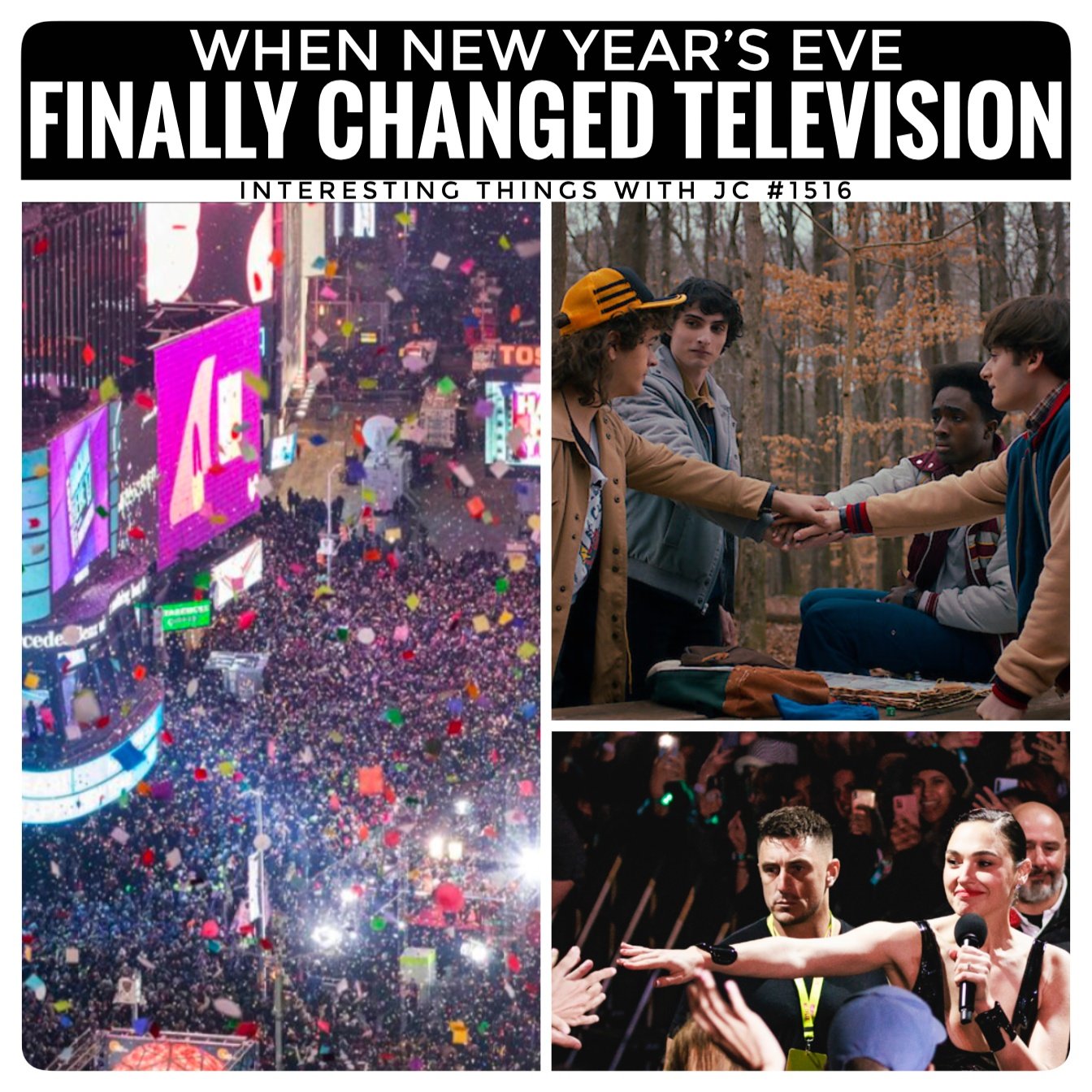
This promotional image for Interesting Things with JC #1516: "When New Year’s Eve Finally Changed Television" is a three-panel collage.
The left panel shows a wide overhead shot of Times Square during a New Year’s Eve celebration, filled with confetti, crowds, and glowing lights.
The top right panel features a scene from Stranger Things, where four teenage characters place their hands together in a pact, set against a wooded autumn backdrop.
The bottom right panel captures a celebrity in a glamorous black dress reaching into a crowd of fans at a live event, flanked by security.
Across the top, bold white and black header text reads: When New Year’s Eve Finally Changed Television. Subtitle below says: Interesting Things with JC #1516.
Transcript
Interesting Things with JC #1516: "When New Year’s Eve Finally Changed Television"
For most of television history, New Year’s Eve was never about storytelling. The TV was on, but it wasn’t the focus. People talked over it, wandered in and out of the room, and waited for the clock to do its job. December 31 belonged to countdowns, not conclusions.
Every year, roughly 20 to 25 million Americans watch the Times Square ball drop. Close to one million people gather in about 13 acres, roughly 0.05 square miles, or 0.13 square kilometers. The ratings are big, but the moment is brief. Everyone’s tuned in for midnight, not a plot.
That’s why scripted television avoided this night for decades. Networks didn’t risk finales when attention was split. And for more than 70 years, no major series ever chose December 31 or January 1 as an intentional ending point.
Then one show broke the pattern.
Stranger Things was the first major television series to deliberately end on New Year’s Eve. Netflix placed the finale right when the world was already watching together. Based on earlier seasons, estimates put opening-night reach in the tens of millions of households, with global cumulative viewership eventually climbing past 100 million viewers. Very few scripted finales in television history have ever reached that many people that quickly.
The final season stretched from Thanksgiving, through Christmas, and ended on New Year’s Eve. New Year’s Eve has always been about timing. The clock matters, and so does the moment it reaches zero. It’s one of the few nights when people everywhere are paying attention to the same second.
Television usually works around nights like that. This ending didn’t. It arrived to offer closure right as the new year began, and that timing was the point.
That’s how an intentional scheduling decision turns into entertainment history.
These are interesting things, with JC.
Student Worksheet
Why did scripted television historically avoid New Year’s Eve broadcasts for finales?
How many people typically gather in Times Square for New Year’s Eve?
What made the Stranger Things finale a unique event in TV history?
Define “narrative timing” using the example from the episode.
Write your own one-paragraph pitch for a show finale that aligns with a global or cultural event.
Teacher Guide
Estimated Time:
45–60 minutesPre-Teaching Vocabulary Strategy:
Use a word wall or vocabulary sketch notes for scripted television, finale, synchrony, and viewership.Anticipated Misconceptions:
Students may believe major series always air on holidays; clarify that holidays like New Year’s Eve were traditionally avoided for narrative programming.Discussion Prompts:
How does timing influence storytelling impact?
In what ways do real-world rituals (like New Year’s Eve) enhance fictional narratives?
Could this become a trend in digital streaming?
Differentiation Strategies:
ESL: Provide sentence frames and a bilingual glossary.
IEP: Offer audio replays and visual aids.
Gifted: Assign research on other shows that used historical events as narrative anchors.
Extension Activities:
Compare U.S. New Year’s Eve broadcasts with other countries’ traditions and televised rituals.
Create a timeline of how television finales have evolved with technology and cultural shifts.
Cross-Curricular Connections:
Sociology: Mass behavior and collective experience.
History: The role of broadcast in 20th and 21st century American culture.
Media Literacy: Analyze audience data and strategic timing in broadcasting.
Quiz
Q1. Why did television networks avoid airing finales on New Year’s Eve in the past?
A. It was too expensive
B. Audiences were too distracted
C. Censorship rules were stricter
D. Streaming services weren’t available
Answer: B
Q2. Approximately how many people watch the Times Square ball drop on TV each year?
A. 1–5 million
B. 10–15 million
C. 20–25 million
D. Over 100 million
Answer: C
Q3. What is unique about Stranger Things in the context of New Year’s Eve?
A. It started on January 1
B. It had the first unscripted finale
C. It ended intentionally on New Year’s Eve
D. It was a live broadcast
Answer: C
Q4. What is meant by “synchrony” in this episode?
A. Editing multiple TV shows at once
B. Watching alone at different times
C. Simultaneous global focus on the same moment
D. Switching between channels
Answer: C
Q5. What was one reason the Stranger Things finale was so impactful?
A. It aired during the Super Bowl
B. It premiered without any marketing
C. It aligned with a globally anticipated moment
D. It was broadcast only in the U.S.
Answer: C
Assessment
Why did Stranger Things choosing New Year’s Eve for its finale represent a shift in media strategy?
How can cultural moments like holidays be used to amplify storytelling?
Rubric (3–2–1):
3 = Accurate, complete, thoughtful
2 = Partial or missing detail
1 = Inaccurate or vague
Standards Alignment
Common Core ELA:
CCSS.ELA-LITERACY.RI.9-10.3 – Analyze how the author unfolds an analysis or series of ideas or events.
Students analyze the strategic planning behind the Stranger Things finale.CCSS.ELA-LITERACY.SL.11-12.1 – Initiate and participate effectively in a range of collaborative discussions.
Students engage in discussions on media strategy and cultural impact.
C3 (College, Career & Civic Life):
D2.Civ.10.9-12 – Analyze the impact of public policies and media decisions on society.
Connects with decisions in broadcasting and media influence.
ISTE:
ISTE Standard 1.3.a – Students plan and employ effective research strategies to locate information and evaluate the accuracy and validity of that information.
Students research viewership data and evaluate strategic media timing.
UK National Curriculum (English):
KS4 Reading: Understand and analyze how writers use language and structure to achieve effects.
Aligns with narrative timing in media scripts.
IB MYP Language & Literature:
Objective B: Organization – Analyze the effect of the creator’s choices on an audience.
Used to study how audience behavior influenced the Stranger Things finale strategy.
Show Notes
This episode explores a seemingly minor but historically significant shift in American media: the use of New Year’s Eve as a deliberate moment for storytelling rather than just celebration. JC explains how the final season of Stranger Things broke with 70 years of television tradition by aligning its final episode with the real-time countdown to a new year. Students and teachers will gain insight into how storytelling evolves alongside cultural rituals and technological possibilities. This topic is especially relevant in classrooms exploring media literacy, collective memory, and how audiences shape content decisions.
References:
Spangler, T. (2022). ‘Stranger Things’ Viewership Surpasses 1 Billion Hours Watched on Netflix. Variety. https://variety.com/2025/tv/news/stranger-things-stats-views-rewatched-scenes-1236615396/
Nielsen. (2023). New Year’s Eve TV Ratings: Year-End Review. https://variety.com/2023/tv/news/new-years-eve-2023-tv-ratings-dick-clarks-miley-cyrus-1235479454/
Netflix. (2016–present). Stranger things [TV series]. Netflix. https://www.netflix.com/title/80057281