Interesting Things with JC #1347: "Kola Superdeep Borehole" – They weren't looking for oil. Or hell. Just answers. What Soviet scientists found beneath the crust changed our view of Earth forever...and nearly broke their drill.
Curriculum - Episode Anchor
Episode Title: Kola Superdeep Borehole
Episode Number: #1347
Host: JC
Audience: Grades 9–12, college intro, homeschool, lifelong learners
Subject Area: Earth Science, Engineering, History of Science
Lesson Overview
Students will:
Define key geological and engineering terms related to deep-Earth drilling.
Compare different geological layers and the changes encountered during the Kola Borehole project.
Analyze how unexpected findings challenged prior scientific models of Earth’s crust.
Explain the technological and environmental challenges of extreme-depth drilling.
Key Vocabulary
Precambrian (pree-KAM-bree-uhn) — Refers to the earliest part of Earth's history, before multicellular life evolved. The Kola Borehole cut into Precambrian rock.
Metamorphic rock (meh-tuh-MOR-fik) — Rock altered by heat and pressure; fossils were found encased in this at great depths.
Ductile (DUHK-tl) — Describes material that deforms under stress without breaking. At extreme depths, granite became ductile.
Rotary drilling (ROH-tuh-ree DRIL-ing) — A method of drilling that uses a rotating drill bit; used to create the Kola Borehole.
Crustal hydrology (KRUS-tuhl hy-DRAH-luh-jee) — The study of water movement in Earth's crust; deep water discoveries at Kola altered this field.
Narrative Core (Based on the PSF – relabeled)
Open — A myth is busted: the drill to hell was not about demons, but about science seeking truth deep underground.
Info — In 1970, the Soviet Union began drilling into the Earth’s crust in the remote Kola Peninsula—not for oil or weapons, but pure science.
Details — Surprises like water trapped in rock, plankton fossils in metamorphic seams, and ductile granite challenged existing models.
Reflection — Despite technological advances, Earth’s complexity defied full understanding; even the deepest hole only scratched the surface.
Closing — These are interesting things, with JC.
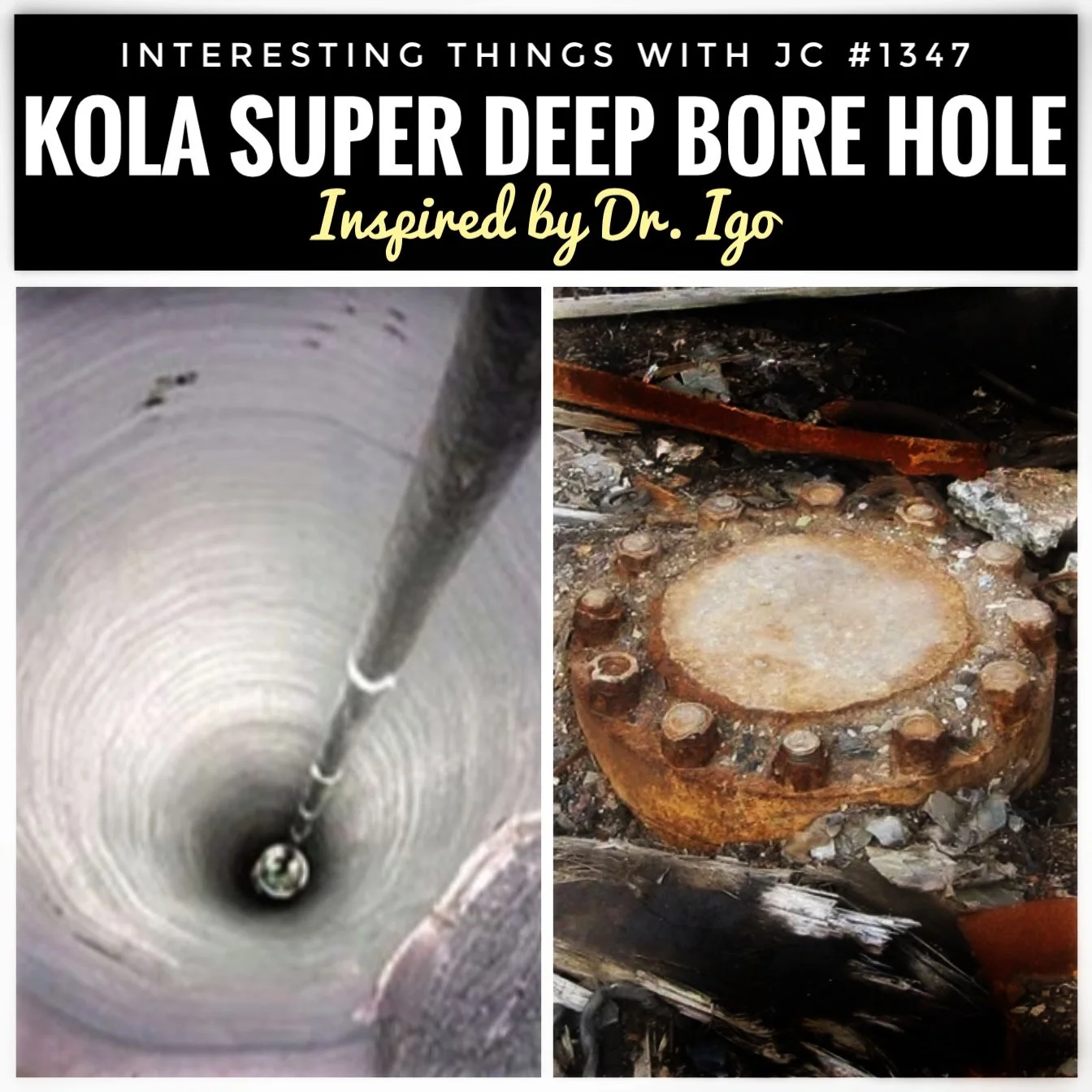
A two-part image: Left side shows a spiraling view down the Kola Superdeep Borehole with a drill shaft descending; right side shows a rusted steel cap sealing the abandoned site. Header text reads “Interesting Things with JC #1347 – Kola Super Deep Bore Hole – Inspired by Dr. Igo.”
Transcript
They weren’t trying to reach hell. That was a rumor. What Soviet scientists were actually trying to reach was the truth. And they believed the only way to reach it was downward.
In 1970, on a remote corner of the Kola Peninsula, near the Arctic mining town of Zapolyarny (zah-poh-LYAR-nee), the Soviet Union began drilling a hole straight into the Earth. It wasn’t for oil. It wasn’t for defense. It was science. The Kola Superdeep Borehole would become the deepest manmade point in history.
Earth’s continental crust runs about 25 to 30 miles thick (40 to 48 kilometers). But until then, the deepest humans had gone was about 5 miles (8 kilometers), in oil wells. The Soviets wanted to push past that, into the unknown. The plan was simple: drill until they couldn’t.
They used a method called rotary drilling, reinforced with custom-built bits made of heat-resistant alloys and shaft pipes engineered for vertical load. Progress was slow, less than 30 feet (9 meters) per day, but steady. This was not a commercial operation. No oil deadline. Just depth.
Then came the surprises.
Below 20,000 feet (6,096 meters), the drill cut into Precambrian rock, older than multicellular life. At 24,000 feet (7,315 meters), they discovered water trapped in rock fractures. It shouldn’t have been there. There was no known mechanism for water to migrate that deep. Yet it was real. Not an aquifer, but water locked inside crystalline grain boundaries. That shook long-standing models of crustal hydrology.
Farther down, they found microscopic plankton fossils encased in metamorphic rock, proof that parts of the crust had once been seafloor, then uplifted and buried over geologic time. Every core sample told a story of continental collision, heat, compression, and rebirth. It wasn’t just Earth’s depth on display. It was its autobiography.
But the deeper they drilled, the stranger things became.
Temperatures didn’t rise as expected. They soared. By the time they reached 35,000 feet (10,668 meters), the rock was 356°F (180°C). The drill was approaching its limit. Bits began to warp. Drilling fluid vaporized. And then, at the edge of reach, something worse.
The rock itself changed character. It didn’t behave like solid granite. It acted like plastic. At roughly 38,000 feet (11,582 meters), they encountered a layer of rock so hot and pressurized that it had begun to partially melt. Not lava, something stranger. A high-temperature, pressurized gel of ductile rock. Molten in consistency, dense in weight, and sticky.
The bits clogged. Lubricant systems failed. Every new shaft segment encountered deformation pressure. Rock was flowing into the hole, squeezing shut what had just been drilled. They tried new alloys, new strategies. But every meter cost more than the last hundred.
In 1989, the final depth was recorded: 40,230 feet (12,262 meters). That’s deeper than the height of Mount Everest turned upside down. No one has gone deeper since.
After the fall of the Soviet Union, the site lost funding. The last teams packed up and left. And in 1995, after funding collapsed, the site was shut down. A steel cap, about the size of a manhole cover, was welded over the opening. A 7.6-mile (12.2-kilometer) deep hole, the deepest ever drilled in human history, was sealed not with ceremony, but with rust.
And then came the myth.
A tabloid in Finland wrote a spoof story, claiming Soviet scientists had heard screams from hell at the bottom of the hole. It was fiction, picked up by a fringe religious newsletter in California and spread without verification. The story went viral, before that word even existed. Kola was called “the well to hell.”
In truth, it was something more profound: a moment when mankind hit the ceiling of its own ability.
The Kola Superdeep showed that the Earth is not a neat stack of layers. It’s complex, violent, and volatile beneath the crust. Rocks behave like liquid under heat. Seawater can hide miles below the surface. Fossils can be buried, melted, and reborn inside metamorphic seams.
And we’ve only seen the outer skin.
Even at 7.6 miles (12.2 kilometers) deep, the Kola borehole only pierced one-third of the continental crust, and less than one thousandth of Earth’s diameter. The inner Earth remains more mysterious to us than the Moon. Or Mars.
Today, the site is abandoned. The metal cap rusts in arctic wind. The buildings are gone. The science is mostly forgotten. But the lesson remains.
Beneath our feet is a world that doesn’t obey the rules we wrote for it. We reached as far as engineering allowed, and the Earth pushed back. Not with fire. Not with demons. But with complexity.
These are interesting things, with JC.
Student Worksheet
What was the scientific motivation behind drilling the Kola Superdeep Borehole?
Describe one surprising geological discovery made at a depth below 24,000 feet.
Why did the drill ultimately have to stop at 40,230 feet?
How did the tabloid myth about “the well to hell” originate and spread?
What broader lesson does JC suggest we learn from the Kola project?
Teacher Guide
Estimated Time: 2–3 class periods (45–60 minutes each)
Pre-Teaching Vocabulary Strategy:
Utilize visual concept maps and vocabulary journaling. Preview terms with context-rich sentence frames.
Anticipated Misconceptions:
That the Kola hole was abandoned due to danger, not funding or engineering limits.
Misunderstanding the difference between lava and ductile rock under pressure.
That myths about “hell” have a scientific basis.
Discussion Prompts:
How do scientific goals differ from commercial or political ones?
What does the Kola project teach us about the limits of science and technology?
How should we handle misinformation or myths in science?
Differentiation Strategies:
ESL: Provide translated summaries and visual media (e.g., videos of rotary drilling).
IEP: Allow verbal responses; offer extended time.
Gifted: Research parallel deep-earth exploration efforts globally and create comparative infographics.
Extension Activities:
Build a 3D model of Earth’s crust and mark drilling depth limits.
Debate: “Should we attempt a deeper borehole today?”
Write a speculative fiction story based on a scientific finding at depth.
Cross-Curricular Connections:
Physics: Heat transfer, pressure dynamics.
Chemistry: Mineral composition and metamorphic processes.
History: Cold War science projects.
Literature: Analyzing myth-making in modern media.
Quiz
Q1. What was the maximum depth of the Kola Superdeep Borehole?
A. 24,000 feet
B. 40,230 feet
C. 35,000 feet
D. 50,000 feet
Answer: B
Q2. What type of rock did the drill encounter that changed consistency at high temperatures?
A. Basalt
B. Limestone
C. Granite
D. Sandstone
Answer: C
Q3. Which of the following was not a reason the drilling stopped?
A. A volcanic eruption
B. Extreme heat and pressure
C. Bit deformation
D. Rock flow closing the hole
Answer: A
Q4. Which scientific field was most challenged by the discovery of water deep in rock?
A. Astronomy
B. Crustal hydrology
C. Paleontology
D. Oceanography
Answer: B
Q5. What myth emerged from the Kola project?
A. That it reached the Earth's core
B. That aliens were found underground
C. That screams from hell were recorded
D. That it caused earthquakes
Answer: C
Assessment
Describe how the Kola Superdeep Borehole contributed to our understanding of Earth’s crust.
Analyze the impact of myths and misinformation on public perception of science using the “well to hell” story as an example.
3–2–1 Rubric:
3 = Accurate, complete, thoughtful
2 = Partial or missing detail
1 = Inaccurate or vague
Standards Alignment
Next Generation Science Standards (NGSS)
HS-ESS2-1 — Develop a model to illustrate Earth's internal structure.
HS-ESS1-6 — Apply scientific reasoning and evidence from ancient Earth materials.
HS-ETS1-2 — Design solutions under constraints such as thermal, mechanical, and environmental conditions.
Common Core State Standards (CCSS)
CCSS.ELA-LITERACY.RST.11-12.3 — Analyze complex scientific texts describing experimental procedures.
CCSS.ELA-LITERACY.WHST.9-12.2 — Write informative texts that examine scientific topics.
C3 Framework for Social Studies
D2.His.1.9-12 — Evaluate how historical events inform scientific advancement.
D2.Civ.2.9-12 — Analyze the role of misinformation in shaping public debate.
International Equivalents
UK National Curriculum (KS4 Physics & Geography) — Earth structure; human impact on environment.
Cambridge IGCSE Geography 0460 — Plate tectonics and the structure of Earth.
IB MYP Science Criterion A — Knowing and understanding geoscience concepts and developments.
Show Notes
Episode #1347 of Interesting Things with JC delves into the Soviet Union’s Cold War-era scientific marvel: the Kola Superdeep Borehole. Far from being a portal to hell as tabloid myths suggested, the Kola Borehole was a profound exploration of Earth’s crust that challenged scientific assumptions about geology, heat flow, and subterranean water. JC walks listeners through the history, discoveries, and mysteries of the world’s deepest manmade point. In the classroom, this episode opens dialogue on scientific limits, Cold War research, and the human pursuit of knowledge beneath our feet.
References
Stierwalt, S. (2020, February 22). How deep is the deepest hole in the world? Scientific American. Retrieved July 16, 2025, from https://www.scientificamerican.com/article/how-deep-is-the-deepest-hole-in-the-world/
IFLScience. (2017, December). What’s at the bottom of the deepest hole on Earth? Retrieved July 16, 2025, from https://www.iflscience.com/whats-at-the-bottom-of-the-deepest-hole-on-earth-46757/
Orion Magazine. (2024, January 4). Inside the deepest artificial hole on Earth. Retrieved July 16, 2025, from https://orionmagazine.org/article/kola-borehole-russia-scientific-dig/