1346: "Napoleon's Rabbit Hunt Gone Wrong!"
Interesting Things with JC #1346: "Napoleon's Rabbit Hunt Gone Wrong!" – He defeated Europe’s armies...but not a swarm of bunnies. A celebration turned stampede reveals the absurdity hiding behind power.
Curriculum - Episode Anchor
Episode Title
"Napoleon's Rabbit Hunt Gone Wrong!"
Episode Number
1346
Host
JC
Audience
Grades 9–12, college intro, homeschool, lifelong learners
Subject Area
History, Historical Anecdotes, Critical Thinking
Lesson Overview
By the end of this lesson, students will be able to:
Define the historical context of the Treaties of Tilsit and the War of the Fourth Coalition.
Compare Napoleon’s military leadership with his role in the comedic hunting episode.
Analyze how historical anecdotes can reveal unexpected dimensions of powerful figures.
Explain how satire and irony can emerge from real historical events.
Key Vocabulary
Treaties of Tilsit (TREE-teez of TIL-sit) — Agreements signed in July 1807 between France, Russia, and Prussia that ended the War of the Fourth Coalition. Napoleon signed these accords to consolidate power across Europe.
Fourth Coalition (forth koh-uh-LISH-un) — A temporary military alliance formed by Prussia, Russia, Saxony, Sweden, and Britain to fight Napoleon between 1806–1807.
Berthier (bear-TYAY) — Napoleon's chief of staff, Alexandre Berthier, who arranged the infamous rabbit hunt.
Cavalry Charge (KAV-uhl-ree CHARJ) — A swift, mounted attack often used in warfare. Used metaphorically in the episode to describe the surge of rabbits.
Absurdity (ab-SURD-ih-tee) — The quality of being ridiculous or wildly unreasonable, a central theme in how the event is remembered.
Narrative Core (Based on the PSF – Renamed)
Open — The story hooks the listener with the unexpected contrast between a victorious Napoleon and a rabbit hunt.
Info — Background is provided: the Treaties of Tilsit, Napoleon’s dominance over Europe, and the celebratory hunt organized by Berthier.
Details — The event twists when thousands of tame rabbits, expecting food, swarm Napoleon and his officers.
Reflection — The broader meaning explores how even emperors are not exempt from nature’s unpredictability and human error.
Closing — “These are interesting things, with JC.”
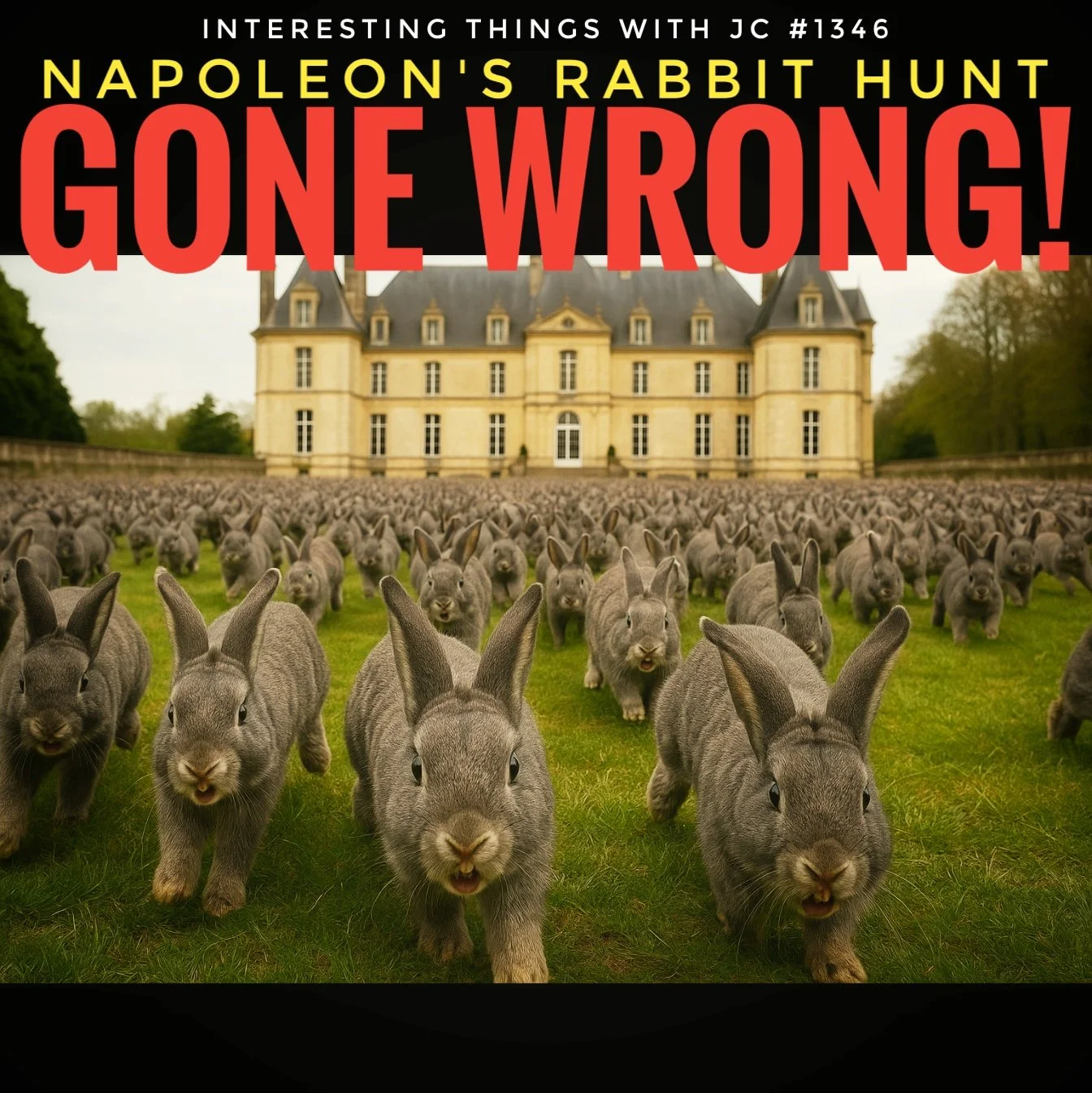
An overwhelming mass of 1000 grey rabbits surging forward across a grassy French chateau courtyard, charging directly at the camera with aggressive, hungry expressions. The bunnies are mid-motion, ears forward, eyes locked onto the viewer, teeth visible, fur rippling as they sprint directly toward us.
Transcript
In July 1807, just days after signing the Treaties of Tilsit, two accords that effectively ended the War of the Fourth Coalition, Napoleon Bonaparte was in high spirits. His forces had crushed the Prussians at Jena and the Russians at Friedland. France now stood unopposed across much of continental Europe. To celebrate the triumph, Napoleon requested a rabbit hunt. Not a symbolic gesture, he wanted sport. His chief of staff, Alexandre Berthier (bear-TYAY), arranged the event.
The plan seemed flawless. A luncheon was organized near the countryside outside Paris, with wine, silver service, and enough game to entertain a field of officers. As for the hunt itself, Berthier’s team gathered between 1,000 and 3,000 rabbits, about 900 to 2,700 pounds (408 to 1,225 kilograms) of animal mass. But instead of capturing wild hares, they bought tame ones from farmers, bred in pens and used to hand-feeding.
That detail proved critical.
Napoleon arrived with his guests expecting regal leisure. Guns were handed out. The cages were opened.
But the rabbits, recognizing the familiar coats and shoes of humans, not as threats but as meal tickets, began hopping forward.
Not a few. Hundreds. Then more.
The field turned gray with fur as the rabbits surged, not away, but toward the emperor. Officers laughed. At first. But when the animals climbed boots and nipped at gloves, the mood changed. Berthier tried to wave them off. Napoleon swatted with his riding crop. Nothing worked. One witness described it as “a cavalry charge, in miniature.”
The man who had stood firm at Austerlitz now retreated to his carriage under assault from a thousand rabbits. Some chased the retreating guests for several yards, or meters, unwilling to give up their expected treats.
It was over in minutes, but word spread fast.
This wasn't a strategic failure. It wasn’t a defeat. But it was a moment of unguarded comedy, one that followed him. Napoleon, the master tactician, undone not by a coalition of kings, but by a huddle of hungry hares.
What began as a celebration of victory became an unplanned lesson in humility. The story of Napoleon’s rabbit hunt reminds us that power, no matter how absolute, doesn’t exclude a man from absurdity. Even emperors can misjudge the instincts of the living things around them.
And sometimes, it’s not the cannon you fear, but the carrots you forget.
These are interesting things, with JC.
Student Worksheet
What historical event had just ended before Napoleon’s rabbit hunt took place?
How did Berthier’s choice of rabbits influence the outcome of the hunt?
In what way did the rabbit incident contrast with Napoleon’s image as a military leader?
Describe the symbolism or message conveyed by the rabbits’ unexpected behavior.
Write a short paragraph explaining how humor can be used to reveal truths in history.
Teacher Guide
Estimated Time
45–60 minutes (1 class period)
Pre-Teaching Vocabulary Strategy
Use a word wall or a matching activity to pre-teach key historical and narrative terms.
Anticipated Misconceptions
Students may think the story is fictional or exaggerated.
They may confuse wild and tame animal behavior.
Discussion Prompts
What can this story teach us about leadership?
How do small mistakes or overlooked details create historical irony?
Is this event relevant when evaluating a leader's legacy?
Differentiation Strategies
ESL — Provide illustrated vocabulary cards and allow oral responses.
IEP — Break transcript into chunks and use graphic organizers for cause/effect.
Gifted — Ask students to research and present another historical anecdote with unintended consequences.
Extension Activities
Write a mock newspaper article from 1807 reporting the rabbit incident.
Compare this story with other unexpected failures in history or politics.
Explore psychological concepts like expectation vs. reality in leadership.
Cross-Curricular Connections
Biology — Domestication and behavior of animals.
Literature — Use of irony and satire in historical storytelling.
Civics — The human dimensions of political leaders.
Quiz
Q1. What event was Napoleon celebrating during the rabbit hunt?
A. The signing of the Concordat
B. The end of the French Revolution
C. The Treaties of Tilsit
D. The formation of the First Coalition
Answer: C
Q2. Why did the rabbits run toward the humans instead of away?
A. They were trained attack animals
B. They were sick and confused
C. They were tame and used to being fed
D. They were attracted by music
Answer: C
Q3. What role did Alexandre Berthier play in the event?
A. He led the cavalry during battle
B. He cooked the luncheon meal
C. He organized the rabbit hunt
D. He was Napoleon’s political rival
Answer: C
Q4. How many rabbits were reportedly gathered for the hunt?
A. 100–300
B. 1,000–3,000
C. 5,000–10,000
D. 500
Answer: B
Q5. What tone best describes the episode's storytelling approach?
A. Tragic and solemn
B. Joyful and musical
C. Humorous and ironic
D. Scientific and factual
Answer: C
Assessment
In a short paragraph, explain how this story reflects a different side of Napoleon than traditional battlefield accounts.
How does the rabbit hunt illustrate the theme that even powerful figures can be vulnerable to small, unpredictable events?
3–2–1 Rubric
3 — Accurate, complete, thoughtful
2 — Partial or missing detail
1 — Inaccurate or vague
Standards Alignment
U.S. Common Core (CCSS)
CCSS.ELA-LITERACY.RH.9-10.3 — Analyze in detail a series of events described in a text.
CCSS.ELA-LITERACY.RH.11-12.6 — Evaluate authors’ differing points of view on the same historical event.
CCSS.ELA-LITERACY.WHST.9-10.2 — Write informative texts to examine and convey complex ideas.
C3 Framework for Social Studies
D2.His.1.9-12 — Evaluate how historical events were shaped by time and place.
D2.His.14.9-12 — Analyze how historical contexts influence perspectives.
International Equivalents
UK National Curriculum KS4 History — Understand historical significance and use historical evidence.
IB MYP Individuals and Societies Criterion B — Investigating historical events using sources.
Cambridge IGCSE History (0470) — Demonstrate understanding of historical concepts and perspectives.
Show Notes
In this episode of Interesting Things with JC, we explore a bizarre but true anecdote from Napoleon’s post-war celebrations in 1807. After his military victories and diplomatic success with the Treaties of Tilsit, Napoleon requested a rabbit hunt to commemorate the occasion. However, a decision to use tame rabbits backfired spectacularly as the animals swarmed him and his officers, mistaking the humans for feeders rather than threats. This moment of absurdity contrasts sharply with Napoleon’s image as a fierce military tactician and invites reflection on the unpredictability of history, the limits of control, and the role of irony in shaping public memory. This episode is rich in cross-disciplinary connections—from leadership and human psychology to narrative structure and historical symbolism—making it a valuable and engaging classroom resource.
References
Reilly, L. (2019). The time Napoleon was attacked by rabbits. Mental Floss. https://www.mentalfloss.com/article/51364/time-napoleon-was-attacked-rabbits
Tandeler, F. (2023, January 27). A brief moment of history: When Napoleon took on rabbits. Just History Posts. https://justhistoryposts.com/2023/01/27/a-brief-moment-of-history-when-napoleon-took-on-rabbits
White, F. (2014, September 12). Napoleon’s battle against rabbits. All About History. https://www.historyanswers.co.uk/people-politics/napoleons-battle-against-rabbits
History Defined. (n.d.). Napoleon versus the horde of “killer” bunny rabbits. https://www.historydefined.net/napoleon-versus-the-horde-of-killer-bunny-rabbits