1345: "Flash Floods"
Interesting Things with JC #1345: "Flash Floods" – A few hours of rain. A 30-foot wall of water. How does that happen, and how do you survive it? This is not just weather. It's terrain. It's physics. It's personal.
Curriculum - Episode Anchor
Episode Title: Flash Floods
Episode Number: #1345
Host: JC
Audience: Grades 9–12, college intro, homeschool, lifelong learners
Subject Area: Earth Science, Environmental Studies, Geography, Physics
Lesson Overview
Students will:
Define what a flash flood is and identify the physical and meteorological conditions that cause them.
Explain the relationship between terrain, rainfall, and runoff during flood events.
Analyze why flash floods are particularly dangerous and how rapidly they can develop.
Compare the physical forces of moving water at varying depths and speeds.
Key Vocabulary
Runoff (ˈrən-ˌȯf) — Rainwater that flows over the surface rather than being absorbed, especially common in rocky terrain.
Limestone (ˈlīm-ˌstōn) — A hard sedimentary rock that does not absorb water well, leading to higher runoff.
Flash Flood (ˈflash ˈfləd) — A sudden, violent flood after a heavy rain, often occurring in areas with poor drainage or steep terrain.
Hydraulic Pressure (hī-ˈdrȯ-lik ˈpre-shər) — The force exerted by water on surfaces; increases with speed and depth.
Turn Around, Don’t Drown — A public safety message emphasizing the danger of driving through floodwaters.
Narrative Core
Open: How does a few hours of rain create a 30-foot wall of water? The story begins with a dramatic question.
Info: Describes the unique terrain of Central Texas and how its geology contributes to runoff and rapid flooding.
Details: Highlights the science and math of water flow—how quickly water gathers, how much it weighs, and how forceful it can become.
Reflection: Emphasizes human vulnerability, the importance of flood awareness, and the deadly impact of underestimating water.
Closing: “These are interesting things, with JC.”
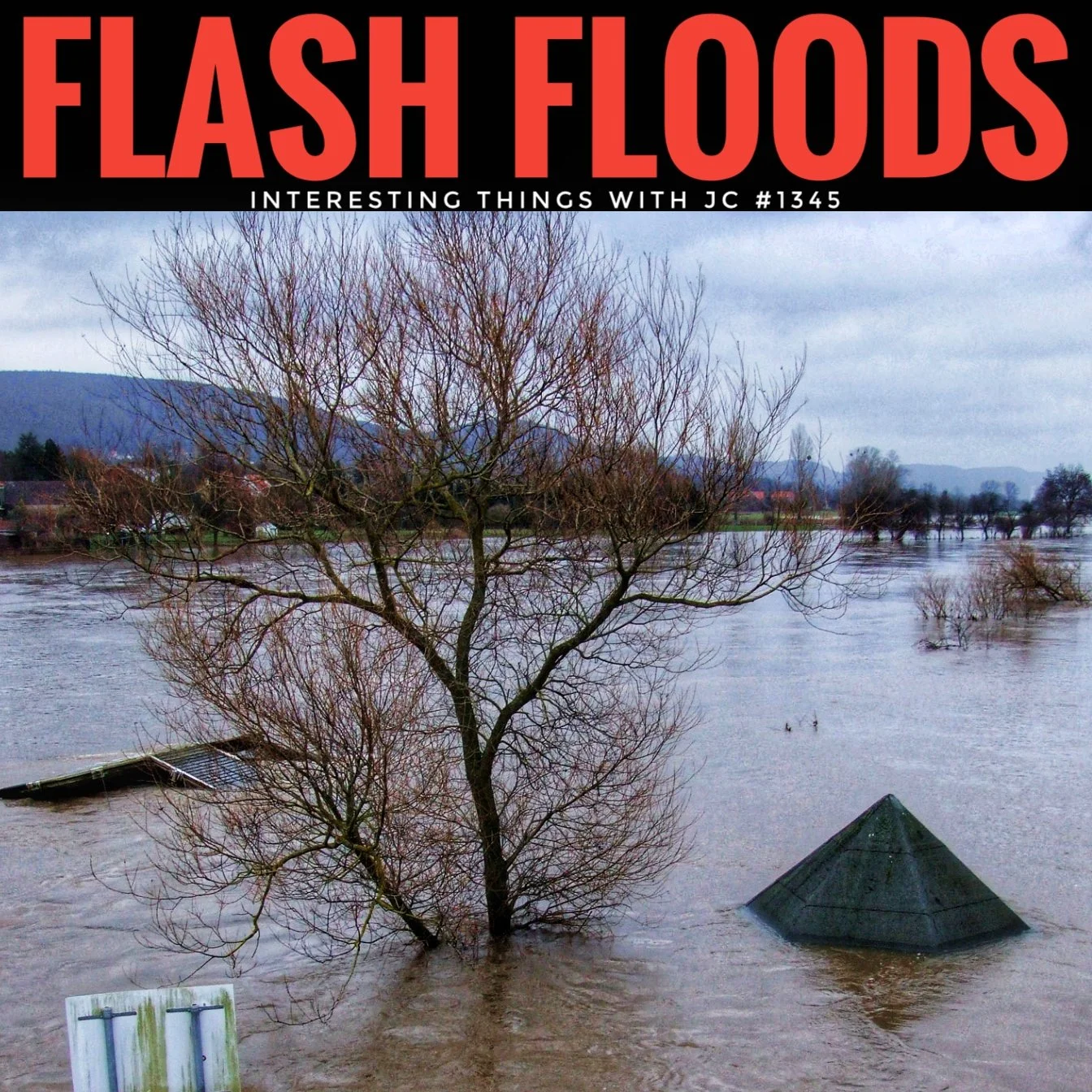
An example of high flood waters from flash floods
Transcript
It doesn’t seem like it should be possible.
How does a few hours of rain turn into a wall of water 30, even 40 feet high?
That’s the danger, and the reality, of a flash flood.
In July 2025, parts of Central Texas saw more than 20 inches of rain in just a few days. One camp in Kerr County got 6.5 inches in under three hours. But the real threat wasn’t just how much rain fell, it was where that water ended up.
The ground in Hill Country doesn’t absorb water well. It’s rock, not soil. Hard-packed, sun-baked limestone and clay don’t soak it in, they shed it. So the rain becomes runoff, and that runoff doesn’t spread, it funnels. It races downhill.
Even a single inch of rain falling on one square mile equals over 17 million gallons of water. Multiply that by 12 or 20 inches, across dozens of square miles, and you’re suddenly dealing with billions of gallons, all draining into tight, narrow channels.
And that runoff doesn’t trickle. It gathers, fast. In canyons, in creek beds, in places designed to move water downhill like a chute.
That’s how the Guadalupe River near Kerrville rose 30 feet in 45 minutes. Not gradually, violently. That wasn’t water creeping up a bank, that was a sudden surge, roaring through like a freight train.
And it doesn’t take much to become deadly.
Six inches of moving water can knock an adult off their feet.
Twelve inches will float most cars.
At two feet, even a full-size pickup can be pushed off the road.
That’s because water is heavy. A single cubic foot weighs over 62 pounds. When it’s moving fast, it hits hard.
At just 9 miles per hour, water can exert over 250 pounds of sideways pressure per square foot. That’s hundreds of pounds pressing against every part of your vehicle or your body. Doors buckle. Foundations shift. People don’t stand a chance.
Most flash flood deaths in the U.S., and there are about 88 each year, happen in vehicles. People underestimate what they’re facing. They misjudge the depth, or the speed, or they assume their car can power through. But it’s not about the car. It’s about the water.
And water always wins.
There’s another danger too, timing.
Flash floods don’t build over days. They erupt in minutes. Sometimes, the storm isn’t even overhead. A downpour miles away can send a wave of water straight into a town under blue skies. That’s what makes flash floods so deadly, you don’t always see them coming.
So when officials say, “Turn Around, Don’t Drown,” that’s not a slogan, it’s a fact. Two feet of water moving fast can hit with the force of a box truck. That’s not survivable.
This isn’t just weather.
It’s terrain.
It’s volume.
It’s physics.
And it moves faster than you think.
These are, interesting things, with JC.
Student Worksheet
What makes the terrain in Central Texas especially vulnerable to flash flooding?
Explain why a small amount of moving water (like six inches) can still be extremely dangerous.
How much water does one inch of rain on a square mile represent? What does this mean during a flood?
Describe why flash floods can occur even when it isn’t raining in your area.
Write a safety message or PSA to raise awareness about flash flood risks in your community.
Teacher Guide
Estimated Time:
45–60 minutes
Pre-Teaching Vocabulary Strategy:
Use visuals and diagrams to show runoff, terrain types, and floodwater forces. Provide real-world photos and data to contextualize terms.
Anticipated Misconceptions:
Students may believe floods only happen with long storms.
They might underestimate the power of shallow water.
They may not understand how terrain affects water movement.
Discussion Prompts:
Have you or someone you know ever experienced flooding? What happened?
Why might people choose to drive through floodwaters despite warnings?
How can terrain and urban development increase flood risks?
Differentiation Strategies:
ESL: Use labeled diagrams and dual-language glossaries.
IEP: Provide audio supports and allow visual models for pressure and runoff.
Gifted: Analyze historical flash floods and explore hydrologic modeling simulations.
Extension Activities:
Create a public awareness poster for “Turn Around, Don’t Drown.”
Calculate runoff volume using local rainfall and area data.
Explore how infrastructure can reduce flood damage (e.g., levees, culverts, flood zones).
Cross-Curricular Connections:
Physics: Forces, pressure, and water density.
Geography: Watershed modeling and landform impact.
Civics: Public safety systems and emergency response.
Environmental Science: Impact of soil types and climate patterns.
Quiz
Q1. What is the primary reason flash floods are common in Central Texas?
A. High humidity
B. Flat terrain
C. Rock-heavy ground that doesn’t absorb water
D. Frequent snowmelt
Answer: C
Q2. How much water is produced by one inch of rain on a square mile?
A. 1 million gallons
B. 5 million gallons
C. 17 million gallons
D. 50 million gallons
Answer: C
Q3. What does “Turn Around, Don’t Drown” emphasize?
A. Avoid hiking during storms
B. Don’t swim in rivers
C. Avoid driving through flooded roads
D. Evacuate when it rains
Answer: C
Q4. At what depth can moving water start to float most vehicles?
A. 3 inches
B. 6 inches
C. 12 inches
D. 24 inches
Answer: C
Q5. What force can moving water at 9 mph exert per square foot?
A. 100 lbs
B. 200 lbs
C. 250 lbs
D. 400 lbs
Answer: C
Assessment
Explain how terrain and rainfall intensity interact to cause flash floods. Use data from the episode to support your answer.
Analyze why flash floods can be more dangerous than other types of flooding. Include factors such as speed, pressure, and unpredictability.
3–2–1 Rubric:
3 = Accurate, complete, thoughtful
2 = Partial or missing detail
1 = Inaccurate or vague
Standards Alignment
NGSS (Next Generation Science Standards):
HS-ESS2-5: Plan and conduct an investigation of the properties of water and its effects on Earth materials and surface processes.
HS-ESS3-1: Construct an explanation based on evidence for how natural hazards affect human activity.
CCSS (Common Core State Standards – Literacy in Science):
RST.11-12.1: Cite specific textual evidence to support analysis of science and technical texts.
WHST.9-12.2: Write informative/explanatory texts to examine and convey complex ideas.
C3 Framework for Social Studies:
D2.Geo.7.9-12: Analyze the impact of physical and human geographic features on events and developments.
ISTE Standards for Students:
3a: Students plan and employ effective research strategies to locate information relevant to the question.
International Alignment:
UK National Curriculum (GCSE Geography):
AQA: 3.1.1.3 — Weather hazards in the UK, including the causes and effects of extreme weather such as floods.
IB MYP Sciences (Criterion A & D):
Criterion A: Knowing and Understanding — Identify scientific explanations of natural phenomena.
Criterion D: Reflecting on the Impacts of Science — Describe the ways science is applied and used to address real-world challenges.
Show Notes
This episode of Interesting Things with JC explores the terrifying science behind flash floods, focusing on recent real-world events in Central Texas. Students will discover how geology, terrain, and sudden rainfall interact to unleash deadly walls of water in minutes. JC uses vivid statistics, clear physics, and urgent storytelling to emphasize why flash floods are among the most dangerous natural events in the U.S. This topic is vital for classrooms because it ties directly into physical geography, environmental science, public safety, and the consequences of underestimating natural forces. Flash floods aren't just rare disasters—they are teachable moments in hydrology, decision-making, and survival.
References
Centers for Disease Control and Prevention. (2021). Floods. https://www.cdc.gov/nceh/features/flood-safety/index.html
FEMA. (2023). Turn Around Don't Drown®. https://www.weather.gov/safety/flood-turn-around-dont-drown
National Weather Service. (2025, July). Texas Flooding Event Summary – Guadalupe River Stage Data. https://water.weather.gov/ahps2/hydrograph.php?wfo=ewx&gage=krvt2
NOAA National Weather Service. (2024). Flood-related fatalities in the United States 1995–2023. https://www.weather.gov/hazstat/
U.S. Geological Survey. (2023). Water Science School – Runoff and the water cycle. https://www.usgs.gov/special-topic/water-science-school/science/runoff-and-water-cycle
U.S. Department of Transportation, Federal Highway Administration. (2001). Hydraulic Engineering Circular No. 17 (HEC-17): Highways in the River Environment. https://www.fhwa.dot.gov/engineering/hydraulics/pubs/01002.pdf
The Guardian. (2025, July 14). Monday briefing: The 'toxic cocktail' of climate denial, federal cuts and the Texas floods. https://www.theguardian.com/world/2025/jul/14/monday-briefing-the-toxic-cocktail-of-climate-denial-federal-cuts-and-the-texas-floods