Interesting Things with JC #1349: "Connie Francis" – She gave her voice to others, and sometimes to nations. From ghost-singer to Cold War subversive, her story was never just about fame. It was about survival.
Curriculum - Episode Anchor
Episode Title: Connie Francis
Episode Number: #1349
Host: JC
Audience: Grades 9–12, college intro, homeschool, lifelong learners
Subject Area: Music History, Media Literacy, U.S. Cultural History, Gender Studies
Lesson Overview
Students will:
Define the historical and cultural contributions of Connie Francis to music and entertainment.
Compare how Francis’s career reflects and diverges from the careers of later music icons like Elvis Presley or Taylor Swift.
Analyze the personal, technological, and political challenges she faced, including Cold War music censorship and artist rights.
Explain the significance of her legal and technological innovations in shaping modern music industry practices.
Key Vocabulary
Ghost-singing (/ɡoʊst ˈsɪŋɪŋ/) — Connie Francis provided vocals for actresses in films without credit.
Bones records (/boʊnz ˈrekərdz/) — Illicit recordings pressed onto discarded X-rays in the USSR, used to smuggle banned Western music.
Master recordings (/ˈmæstər rɪˈkɔrdɪŋz/) — Original studio recordings over which artists often lacked control, leading to legal battles.
Shortwave broadcasts (/ˈʃɔrtweɪv ˈbrɔdˌkæsts/) — Long-distance radio signals that carried Francis's music into Soviet-bloc countries.
Kevlar-lined gowns (/ˈkɛvlɑr laɪnd ɡaʊnz/) — Stagewear Francis had reinforced for safety after surviving assault, combining fashion with personal security.
Narrative Core
Open – “She had the kind of voice that didn’t just carry a melody—it carried people.” A striking hook that signals the impact and mystery of her legacy.
Info – Introduces Connie Francis’s early years, uncredited vocal work, and her rise in the music industry during a gender-restrictive era.
Details – Describes her breakthrough fan engagement model, Cold War cultural influence, Vietnam War performances, and legal challenges with MGM Records.
Reflection – Highlights her pioneering work in artist rights, her secret safety measures, and philanthropic contributions.
Closing – “These are interesting things, with JC.”
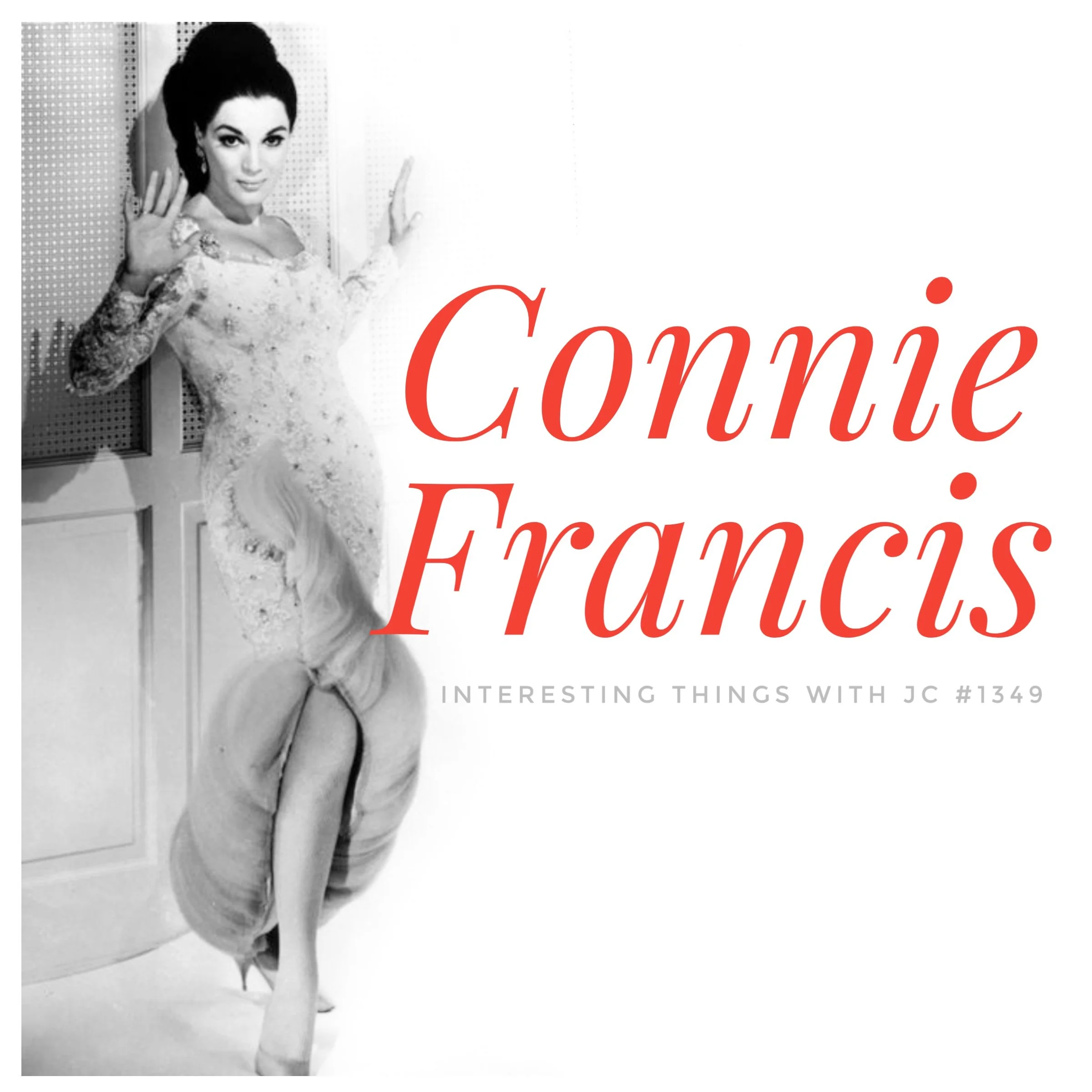
Black and white photo of Connie Francis in a glamorous 1960s evening gown, posing with her hands raised playfully against a wall. Overlay text reads ‘Connie Francis – Interesting Things with JC #1349’ in bold red and gray lettering
Transcript
She had the kind of voice that didn’t just carry a melody—it carried people. Across radios, war zones, soundstages, and borders that technically banned her. Yet behind the fame of “Where the Boys Are,” behind the perfect vowels and polished records, was a woman who never stopped engineering the unseen.
Connie Francis was born Concetta Rosa Maria Franconero in Newark, New Jersey, in 1937. By age 17, she was already ghost-singing for actresses in films—providing the vocals for Tuesday Weld in the 1956 movie Rock, Rock, Rock! while still finishing high school. Two years later, she dubbed the singing voice of Jayne Mansfield in The Sheriff of Fractured Jaw. Her name never appeared in the credits, but her voice played through theaters nationwide. At a time when image sold and vocal talent hid behind it, she was both essential and invisible.
For a moment, she thought chemistry might be her path. She enrolled at New York University with that exact major—she later admitted it “sounded smart.” But within months, she walked away to chase her first record deal. It was the right bet. By 1958, she had a #1 hit. By the early ’60s, her name topped charts in fifteen countries.
What most fans didn’t know was how personal her career stayed, even as it went global. She personally managed one of America’s earliest music fan clubs. She opened every letter. She wrote back. Her team launched a quarterly newsletter with behind-the-scenes notes, family recipes, and tour updates. This became a model—used later by Elvis Presley’s handlers, then the Beatles’ Apple Corps, and eventually, Taylor Swift’s modern fan operations. The template started in Connie’s kitchen.
And then came the borderless part of her career.
During the Cold War, her voice slipped past the Iron Curtain. Her German and Russian-language recordings were copied illegally onto acetate discs in East Germany, sometimes cut into discarded medical X-rays roughly 12 inches (30.5 centimeters) wide—a pirate medium known as “bones records.” Songs like “Die Liebe ist ein seltsames Spiel” (“Love is a Strange Game”—dee LEE-buh ist ayn ZELT-zahss SHPEEL) were heard by millions who never saw her face. Shortwave broadcasts carried her into homes from Poland to Siberia, even though Western music was officially banned.
But she also sang for those wearing boots and carrying rifles. Connie performed throughout the Vietnam War for U.S. troops. In 1968, during a volatile moment near Da Nang, rising tensions between two battalions were diffused when she took the stage and started singing “God Bless America.” Officers on the ground later testified that her voice prevented an outbreak of violence. For those soldiers, it wasn’t just a song—it was home. She was later awarded the Silver Medal of Merit by the Department of Defense—an honor rarely given to civilians.
Then came a quieter battle—against the very company that had made her a household name. In 1974, she sued MGM Records for control of her master recordings. She argued that contracts signed when she was underage were exploitative. It was a rare move at the time. She won partial rights—laying legal groundwork cited years later in high-profile disputes over artistic ownership. When Prince fought Warner Bros., and when George Michael took on Sony, lawyers pointed to Connie’s case as early precedent. She had planted the flag.
But not all of her adjustments were public.
After surviving a brutal assault that same year, she worked with designers to reconstruct her stagewear. Her gowns looked glamorous under the lights—but they were secretly reinforced with cut-proof lining made from nylon-kevlar fabric less than 1/8 inch (3.2 millimeters) thick. Hidden hooks were sewn into the sleeves, allowing the garment to tighten or detach instantly if grabbed. She never spoke of the design. But her security team knew. So did the seamstresses who called it “Hollywood armor.”
And she never stopped giving. In the late 1980s, she quietly funded autism research at a time when few celebrities would touch the subject. She did it under the name Concetta Enterprises. The recipient? A startup program at Rutgers University—now a leading center for sensory integration therapy.
She even planned the end. In the 1990s, she commissioned her own tombstone. It featured a granite musical staff with measures from her Italian-language hit, “Mama.” Below that, an inscription she wrote herself:
“She gave us music. She gave us strength. She gave us herself.”
And she nearly lived to see it installed. Connie Francis died on July 17, 2025, in Florida, at the age of 87. But she didn’t fade out. In her final year, a TikTok trend brought her 1962 B-side “Pretty Little Baby” back to the charts. Teenagers danced to her voice without knowing her name. But she heard it. Nurses say she requested that song each night in her hospital room. One of them quoted her last reaction to the trend: “They’ll think I’m a new artist again.”
She wasn’t just America’s Sweetheart. She was the sound of survival, ingenuity, and uncredited brilliance. A voice behind the curtain. A fighter behind the music. A woman who never stopped adapting—quietly inventing systems other stars would later copy.
These are interesting things, with JC.
Student Worksheet
What early career role did Connie Francis play in Hollywood without receiving credit?
Explain how Francis’s approach to fan engagement was innovative for her time.
Describe how “bones records” were used to share her music behind the Iron Curtain.
How did Connie Francis influence modern artist rights and legal battles in the music industry?
Create a design concept for a “Hollywood Armor” stage outfit based on Francis’s approach, explaining its purpose.
Teacher Guide
Estimated Time: 60–75 minutes
Pre-Teaching Vocabulary Strategy: Use historical photo prompts (bones records, stagewear) to spark inquiry-based learning before defining terms.
Anticipated Misconceptions:
Students may believe only modern artists control their music.
Some may assume fan engagement started in the internet era.
Discussion Prompts:
What does Connie Francis’s story teach us about innovation outside the spotlight?
How did geopolitical conflict shape musical expression in the Cold War?
What modern parallels exist between Francis’s legal battles and current artist rights debates?
Differentiation Strategies:
ESL: Provide translated vocabulary and closed captioning of podcast if available.
IEP: Use graphic organizers to track narrative elements and key facts.
Gifted: Assign comparative essays on artist rights using Francis and Prince or Taylor Swift.
Extension Activities:
Research Rutgers University’s current autism research and connect it back to Concetta Enterprises.
Create a short podcast or video documentary titled “Invisible Innovators” using Francis’s template.
Cross-Curricular Connections:
History: Cold War culture and censorship
Law: Intellectual property rights
Fashion Design: Stagewear safety innovation
Media Literacy: Viral trends and legacy artists
Quiz
What was Connie Francis’s birth name?
A. Rose Marie Franco
B. Concetta Rosa Maria Franconero
C. Maria Francesca Collins
D. Concetta Rosalie Ferrera
Answer: BIn which film did she provide vocals for Tuesday Weld?
A. Jailhouse Rock
B. Viva Las Vegas
C. Rock, Rock, Rock!
D. The Sheriff of Fractured Jaw
Answer: CWhat medium was used to create illegal “bones records”?
A. Old vinyl
B. Discarded newspapers
C. X-rays
D. Floppy disks
Answer: CWhat rare award did she receive from the Department of Defense?
A. Medal of Freedom
B. Silver Medal of Merit
C. Purple Heart
D. Congressional Music Award
Answer: BWhat 1962 song of hers saw a TikTok resurgence in her final year?
A. Where the Boys Are
B. Die Liebe ist ein seltsames Spiel
C. Pretty Little Baby
D. Mama
Answer: C
Assessment
Analyze how Connie Francis’s career reflects changes in gender expectations and professional autonomy from the 1950s to today.
Explain the cultural significance of her music crossing political boundaries during the Cold War.
3–2–1 Rubric
3 = Accurate, complete, thoughtful
2 = Partial or missing detail
1 = Inaccurate or vague
Standards Alignment
Common Core – ELA:
CCSS.ELA-LITERACY.RI.11-12.2 – Determine central ideas and summarize complex texts (applied through historical analysis of the episode).
CCSS.ELA-LITERACY.W.11-12.2 – Write informative/explanatory texts (used in worksheets and assessments).
C3 – Social Studies:
D2.His.5.9-12 – Analyze how historical context shapes individuals and events.
D2.His.14.9-12 – Analyze how cultural artifacts reflect values.
ISTE Standards:
ISTE 1.3.D – Students explore local and global issues and use collaborative technologies to work toward solutions (extended fan club model comparisons).
CTE: Arts, Media, and Entertainment Pathway:
AMDM 1.1 – Examine the evolution of media delivery and fan engagement across eras.
UK Equivalents:
AQA GCSE History: Paper 2/A: Modern America – Aligns with modules on Cold War and culture.
Edexcel GCSE Music: Area of Study 2 (Popular Music) – Understanding music in context, artist impact.
IB DP History: Prescribed Topic 12 (The Cold War) – Use of media in Cold War diplomacy.
Show Notes
This episode of Interesting Things with JC explores the remarkable, often-hidden legacy of Connie Francis. A pioneering voice in American pop culture, she wasn’t just a singer—she was a behind-the-scenes innovator in fan engagement, legal rights, Cold War media diffusion, and personal security design. Her influence spanned continents and decades, shaping how modern artists connect with fans and control their work. Through this deeply human story, learners can examine the power of music, the cost of invisibility, and the resilience behind a woman who never stopped adapting.
References
Edel, V. (2025, July 17). Connie Francis, 'Who's Sorry Now?' and 'Pretty Little Baby' singer, dies at 87. People. https://people.com/connie-francis-dead-age-87-8599290
Haworth, J. (2025, July 17). Connie Francis, ‘Pretty Little Baby’ singer, dies at 87. ABC News. https://abcnews.go.com/US/connie-francis-pretty-baby-singer-dies-87/story?id=123827214
Daly, N. (2017, May). Inside the covert world of bootleg X‑Ray records. National Geographic. https://www.nationalgeographic.com/magazine/article/explore-xray-records
Legacy News Staff. (2025, July 17). Connie Francis obituary (1937–2025). Legacy. https://www.legacy.com/us/obituaries/legacyremembers/connie-francis-obituary?pid=209401095