1359: "The Runit Dome"
Interesting Things with JC #1359: "The Runit Dome" – In the middle of the Pacific, a concrete dome holds the aftermath of 43 nuclear blasts. But it was never built to last. And the ocean is rising.
Curriculum - Episode Anchor
Episode Title: The Runit Dome
Episode Number: #1359
Host: JC
Audience: Grades 9–12, college intro, homeschool, lifelong learners
Subject Area: History, Environmental Science, Ethics, U.S. Foreign Policy
Lesson Overview
Students will:
Define the historical significance of the Runit Dome and nuclear testing at Enewetak Atoll.
Compare the environmental and political consequences of the Runit Dome with other nuclear test sites.
Analyze the implications of unsealed radioactive storage on coral and rising sea levels.
Explain the international legal ambiguity surrounding responsibility for radioactive waste.
Key Vocabulary
Runit Dome (ROO-nit dohm) — A concrete dome built over a nuclear waste crater on Runit Island; it holds radioactive debris from U.S. testing in the Marshall Islands.
Enewetak Atoll (eh-NEH-weh-tock a-TOLL) — A chain of 40 islands in the Marshall Islands, used by the U.S. for nuclear testing between 1948–1958.
Radioactive waste (ray-dee-oh-AK-tiv wayst) — Hazardous material that emits radiation; in this case, debris from nuclear tests.
Porous coral (POR-us KOR-uhl) — Coral with holes that allow water to pass through; a key concern under the dome, which lacks a bottom seal.
Climate stress (KLY-mit stres) — Environmental pressure caused by changing climate conditions, including sea-level rise that threatens the dome's integrity.
Narrative Core (Based on the PSF – relabeled)
Open – A remote island, a mysterious dome, and the hint of a lethal, invisible danger.
Info – U.S. nuclear testing history on Enewetak Atoll, including 43 explosions and cleanup measures taken.
Details – The dome was built directly on coral, unsealed, and is now under threat from rising seas. The radioactive waste is leaking, and no one claims full responsibility.
Reflection – The dome represents long-term consequences of policy decisions and the limits of human control over nature and time.
Closing – These are interesting things, with JC.
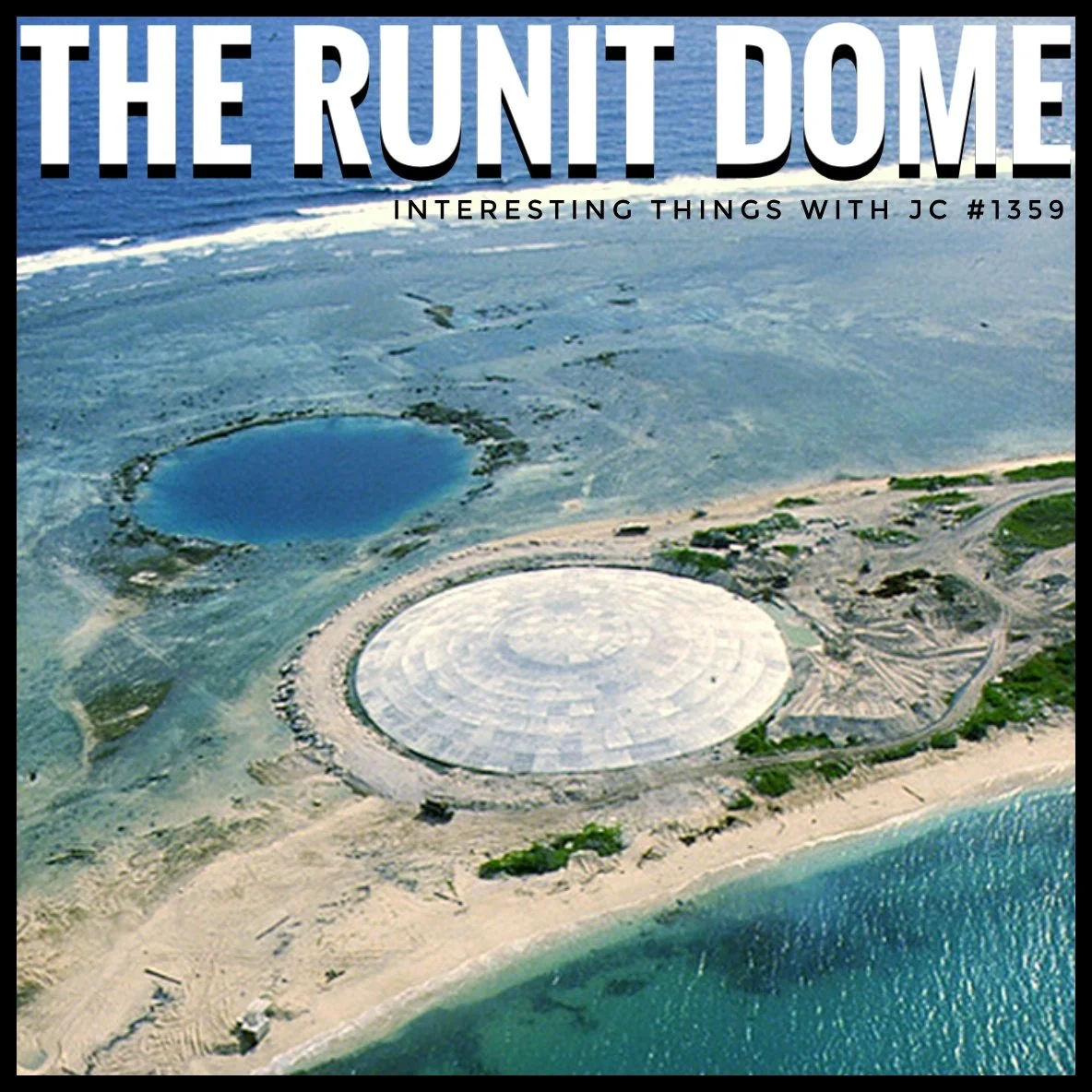
Aerial view of the Runit Dome, a large circular concrete structure on a small coral island surrounded by turquoise ocean. The dome is partially embedded in sand, with a dark water-filled crater visible nearby. The scene evokes isolation and environmental vulnerability.
Transcript
In the middle of the Pacific Ocean, on a small coral island that barely breaks the waterline, there sits a giant white dome. It looks like a science fiction relic—smooth, round, motionless—but underneath, it holds something very real. Something invisible. Something lethal.
The island is called Runit. It’s part of Enewetak Atoll (eh-NEH-weh-tock), spelled E-N-E-W-E-T-A-K. That’s a ring of 40 coral islands in the Marshall Islands chain, pronounced MAR-shull. Between 1948 and 1958, this remote atoll became one of the primary test sites for the United States’ nuclear weapons program. In total, 43 nuclear explosions were conducted on or near the atoll, including one with a yield of 500 kilotons—that's over 33 times the size of the Hiroshima (heer-oh-SHEE-mah) bomb.
But after the blasts, the real work began: cleanup. Tons of irradiated soil, equipment, and biological waste had to be dealt with. The solution—approved in 1977—was this: dig a 350-foot-wide (107-meter-wide) crater left by one of the test explosions, fill it with radioactive debris, and cap it with a dome of concrete 18 inches (45.7 centimeters) thick. The United States called it the Runit Dome. Locals began calling it “The Tomb.”
Here’s the part most people don’t know. That dome isn’t sealed to the bottom. There’s no lining. It sits directly on porous coral, inches above rising seawater. Over 111,000 cubic yards (85,000 cubic meters) of radioactive waste rest inside. The assumption in the 1970s was that this material would stay buried, inert, isolated.
Since construction finished in 1980, sea levels in the region have risen by about 7 inches (18 centimeters), and the rate is accelerating. During high tides and storms, seawater laps at the dome's edge—and sometimes seeps inside. The U.S. Department of Energy acknowledged in a 2013 report that groundwater beneath the dome is already radioactive. But the structure wasn’t built to last more than a few decades. It wasn’t designed for rising waters, it was designed for cost control.
And who owns it? That’s where things get even murkier. The United States managed the dome’s construction, but the Marshall Islands (MAR-shull) gained independence in 1986. The radioactive waste never left, but the legal responsibilities did. The U.S. maintains that the waste is now on Marshallese (mar-shuh-LEEZ) land. The Marshallese say they never had a choice—and now they live with the risk.
Runit Atoll isn’t populated. But Enewetak (eh-NEH-weh-tock) is. And many Marshallese who were relocated after the tests came back in the 1980s—only to find that fish were contaminated, plants grew strangely, and birth defects appeared at higher-than-normal rates. There was no public warning about what was buried under that dome, just a smooth concrete surface that kept its secrets below.
There’s no easy way to fix what’s inside the Runit Dome. Excavating it would risk exposing workers and the region to dangerous levels of radiation. Leaving it alone means letting time, water, and entropy do their work. No one is quite sure how long it will hold—or what will happen if it fails.
What we do know is this: the consequences of human choices don’t disappear when the headlines do. We built a monument not to progress, but to containment. And we left it vulnerable to the one thing no wall can hold back—time.
These are interesting things, with JC.
Student Worksheet
What was the original purpose of the Runit Dome?
How does the construction of the dome reflect the priorities of the U.S. government in the 1970s?
Describe two environmental risks posed by the dome's current condition.
Why is the dome not legally sealed from below, and what are the consequences?
If you were a scientist in charge of monitoring the dome, what would you prioritize and why?
Teacher Guide
Estimated Time
1–2 class periods (45–60 minutes each)
Pre-Teaching Vocabulary Strategy
Use a concept map to connect “radioactivity,” “containment,” and “coral atoll.” Preview pronunciation of key geographic and scientific terms.
Anticipated Misconceptions
Students may assume the dome is fully sealed or completely safe.
Some may think nuclear tests were isolated events without long-term consequences.
Discussion Prompts
Who should be responsible for environmental damage after geopolitical events?
What are the ethics of using isolated communities for large-scale testing?
Differentiation Strategies
ESL: Provide visuals and bilingual glossaries for scientific terms.
IEP: Break transcript into highlighted chunks with guiding questions.
Gifted: Research and present case comparisons (e.g., Chernobyl, Nevada Test Site).
Extension Activities
Investigate other Cold War-era environmental legacies.
Create a documentary-style podcast episode on “hidden” consequences of historical events.
Cross-Curricular Connections
Physics: Principles of radiation and half-life.
Sociology: Effects of displacement and environmental justice.
Government: Treaties and legal responsibilities in international law.
Quiz
Q1. What is stored beneath the Runit Dome?
A. Fossil fuels
B. Radioactive waste
C. Coral samples
D. Concrete debris
Answer: B
Q2. Where is the Runit Dome located?
A. Bikini Atoll
B. Enewetak Atoll
C. Guam
D. Palau
Answer: B
Q3. Why is the Runit Dome considered unstable?
A. It's built on sand dunes
B. It lacks a bottom seal and is vulnerable to rising seas
C. It was damaged by an earthquake
D. It contains flammable gases
Answer: B
Q4. Who currently claims legal ownership of the Runit Dome area?
A. Japan
B. United States
C. Marshall Islands
D. United Nations
Answer: C
Q5. What issue is caused by the porous coral beneath the dome?
A. It leads to erosion
B. It increases wind exposure
C. It allows radioactive material to leach into groundwater
D. It attracts marine wildlife
Answer: C
Assessment
In your own words, explain the main environmental and political issues raised by the existence of the Runit Dome.
Compare the situation at Runit Dome to another historical event where environmental responsibility was unclear or avoided.
3–2–1 Rubric:
3 = Accurate, complete, thoughtful
2 = Partial or missing detail
1 = Inaccurate or vague
Standards Alignment
U.S. Standards
CCSS.ELA-LITERACY.RI.11-12.1 – Cite strong textual evidence; students analyze direct content from JC’s narration.
NGSS ESS3.C – Human impacts on Earth systems; examines radioactive contamination and sea-level rise.
C3.D2.His.14.9-12 – Evaluate historical sources; ties into understanding U.S. and Marshallese claims.
ISTE 3a – Students plan and employ research strategies; use real data and government sources for further inquiry.
International Equivalents
UK AQA GCSE Geography 3.1.1.4 – Climate change impacts and human responses; relevant to Runit Dome.
IB DP Geography SL/HL (Core Unit: Changing Environments) – Coastal hazards, human vulnerability.
Cambridge IGCSE Environmental Management 0680 – Unit 3.4: Human influences on the environment; nuclear waste and pollution.
Show Notes
In this gripping episode, JC investigates the haunting legacy of the Runit Dome—a Cold War-era containment structure filled with radioactive waste and sitting precariously on a fragile coral island. This powerful story highlights a forgotten chapter of nuclear history, environmental miscalculation, and geopolitical responsibility. The episode provides a compelling entry point for teaching about long-term environmental consequences, the ethics of scientific testing, and the complex legal aftermath of global conflict. Through discussion, inquiry, and critical thinking, students can explore how decisions made decades ago still ripple through lives and ecosystems today.
References
U.S. Department of Energy. (2020). Report on the Status of the Runit Dome in the Marshall Islands (Report to Congress).
https://www.energy.gov/sites/prod/files/2020/06/f76/DOE-Runit-Dome-Report-to-Congress.pdfU.S. Department of Energy. (2022). 2022 Runit Dome Report to Congress – Comment Resolution Version.
https://www.energy.gov/sites/default/files/2022-11/EXEC-2022-000333%20-%202022%20Runit%20Dome%20Report%20to%20Congress%20-%20Comment%20Resolution-10-13-2022_Final_0.pdfGerrard, M. B. (2015). America’s Forgotten Nuclear Waste Dump in the Pacific. Columbia Law School, Sabin Center for Climate Change Law.
https://climate.law.columbia.edu/sites/default/files/content/docs/Michael%20Gerrard/Gerrard-2015-06-Americas-Forgotten-Nuclear-Waste-Dump-in-the-Pacific.pdfWoods Hole Oceanographic Institution. (2020). Putting the ‘nuclear coffin’ in perspective.
https://www.whoi.edu/oceanus/feature/putting-the-nuclear-coffin-in-perspective/The Guardian. (2015, July 3). This dome in the Pacific houses tons of radioactive waste—and it’s leaking.
https://www.theguardian.com/world/2015/jul/03/runit-dome-pacific-radioactive-waste