Interesting Things with JC #1367: "Loni Anderson" – She wasn’t supposed to be famous. She was supposed to be Leilani. But from St. Paul to syndication royalty, Loni Anderson rewrote the script...and the stereotype.
Curriculum - Episode Anchor
Episode Title: “Loni Anderson”
Episode Number: #1367
Host: JC
Audience: Grades 9–12, college intro, homeschool, lifelong learners
Subject Area: Media Studies, U.S. History, Performing Arts, Women's Studies
Lesson Overview
By the end of this lesson, students will be able to:
Define key terms related to television history, performance arts, and cultural influence.
Compare portrayals of female characters in 1970s–80s sitcoms with modern media representations.
Analyze how Loni Anderson challenged stereotypes in television through her portrayal of Jennifer Marlowe.
Explain how Loni Anderson used her platform for advocacy in health awareness and gender equity in media.
Key Vocabulary
Sitcom (SIT-kom) — A genre of comedy television show centered on a fixed set of characters. “WKRP in Cincinnati was a groundbreaking sitcom from the late 1970s.”
Syndication (sin-di-KAY-shun) — The practice of selling the rights to broadcast television programs beyond their original network. “WKRP became a cult hit in syndication after its initial cancellation.”
Representation (rep-ri-ZEN-tay-shun) — The portrayal of people, especially marginalized groups, in media. “Loni Anderson worked to improve representation of smart and independent women on television.”
Contract Negotiation (KON-trakt neh-GO-shee-AY-shun) — The process of agreeing on terms of employment, pay, or creative input. “Anderson made history by renegotiating her contract in 1980.”
COPD (Chronic Obstructive Pulmonary Disease) — A long-term lung condition often caused by smoking or exposure to harmful chemicals. “Loni Anderson became a spokesperson for COPD awareness after losing her parents.”
Narrative Core
Open: Loni Anderson was born in 1945 in Minnesota, almost named Leilani, a name with Hawaiian roots.
Info: Her early experiences in beauty pageants and theater sparked her love for performance and helped build confidence and stage presence.
Details: Her breakthrough role as Jennifer Marlowe in WKRP in Cincinnati redefined the “blonde secretary” trope and earned her critical acclaim. She became a pioneering woman in media by asserting creative control over her character and challenging network norms.
Reflection: Beyond acting, Loni Anderson’s legacy includes caregiving, advocacy for lung disease awareness, and reshaping the image of glamorous women on television as intelligent, empowered figures.
Closing: These are interesting things, with JC.
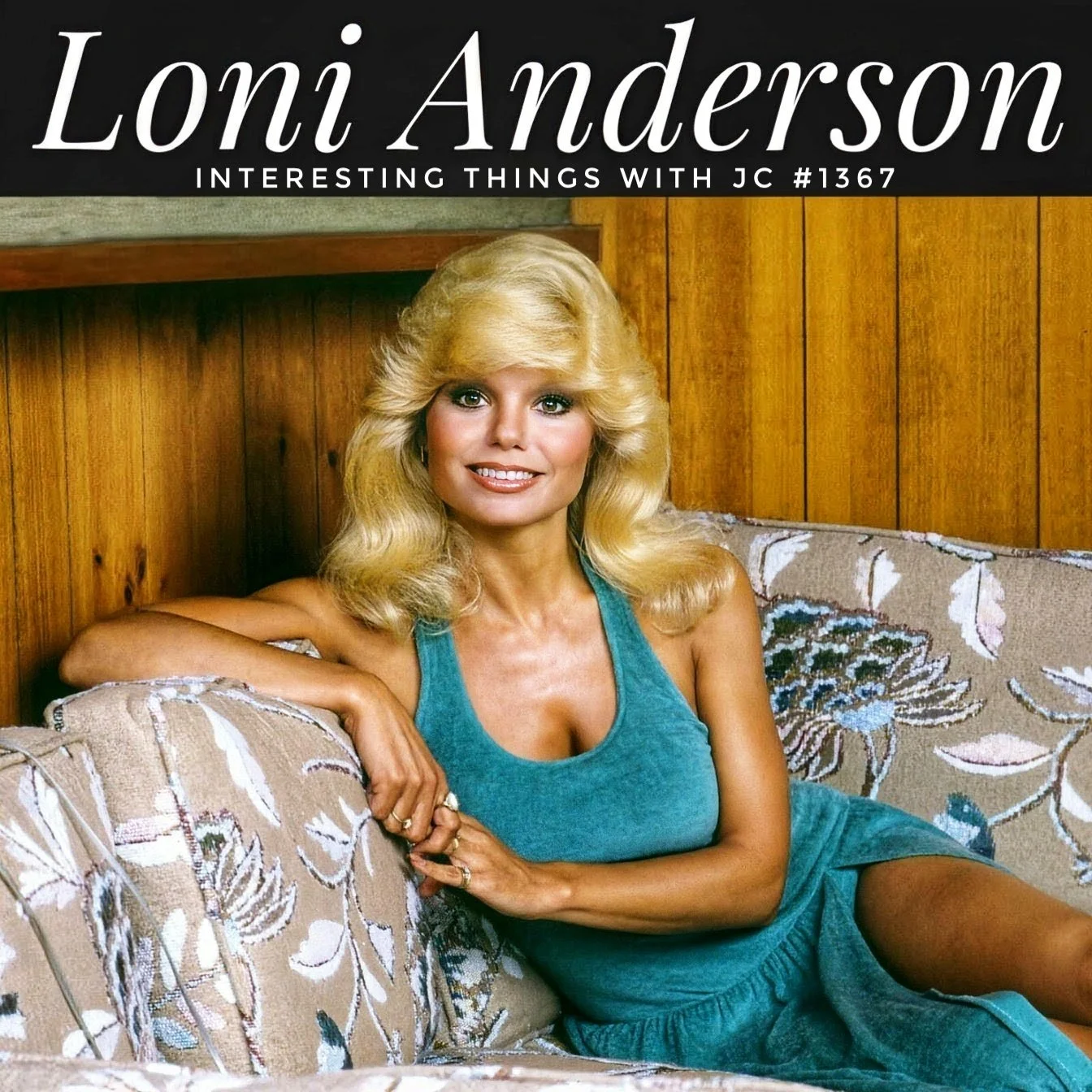
Loni Anderson, known for her striking beauty and glamorous presence, reclines gracefully on a vintage floral-patterned sofa in front of a wood-paneled wall. Her platinum blonde hair is styled in soft, voluminous waves, and she wears a teal halter-style dress that highlights her elegant figure. With a warm smile and confident posture, she embodies the sultry, sophisticated charm that made her a beloved television icon. Text above reads: “Loni Anderson – Interesting Things with JC #1367.”
Transcript
She was born Loni Kaye Anderson on August 5, 1945, in St. Paul, Minnesota.
Her dad, Klaydon Carl “Andy” Anderson, was an environmental chemist and a U.S. Air Force veteran. Her mom, Maxine, had once worked as a model before becoming a mother.
In her memoir, Loni wrote that her father almost named her Leilani (lay-LAH-nee), a Hawaiian name meaning “heavenly garland of flowers” or “royal child.” It was just after World War II, and Hawaii held a romantic pull for many Americans, especially veterans who had been stationed there. But he worried high school kids might twist the name into “Lay-Lani.” So Leilani became Loni... beautiful, simple, and easier to grow up with in Minnesota.
It’s been reported that she was voted Valentine Queen at Alexander Ramsey Senior High’s winter formal in 1963. She later attended the University of Minnesota to study art, paying her way through local beauty pageants. She earned titles like Miss Roseville, Miss Thermo-Jac Clothing, and was runner-up for Miss Minnesota. Those experiences taught her more than how to walk in heels... they gave her stagecraft, confidence, and the ability to hold a crowd.
She also acted in school plays and community theater, and the pull toward acting grew stronger. One day she decided this wasn’t just a hobby, it was a path. She packed her bags and headed west to Hollywood.
Her first screen role came in 1966, a small uncredited part in the Steve McQueen western Nevada Smith. For the next decade, she worked steadily, landing guest roles on shows like S.W.A.T., Barnaby Jones, Phyllis, Police Woman, and Three’s Company.
In the mid-1970s, she made a bold visual choice... platinum blonde hair. That changed how casting directors saw her and became part of her signature look.
In 1978, she landed the role that would make her a household name... Jennifer Marlowe on WKRP in Cincinnati. Loni refused to let Jennifer be a “dumb blonde,” pushing for her to be sharp, confident, and the smartest person in the room.
WKRP struggled in its early time slots, but by its second season reached number 22 in the Nielsen ratings. After its cancellation, it became a hit in syndication and influenced workplace comedies for years. In 2011, TV Guide ranked Jennifer Marlowe among the 50 Greatest TV Characters of All Time.
Loni’s work earned her two Emmy nominations and three Golden Globe nominations. Behind the scenes, she made history by renegotiating her contract in 1980 to secure not just better pay, but greater say over her character’s portrayal... rare for a woman on network television at the time.
The 1980s brought big changes. She co-starred with Burt Reynolds in Stroker Ace in 1983, and in 1988 they married and adopted a son, Quinton. Away from the cameras, she cared for Burt through a long illness when he was bedridden and dependent on heavy pain medication.
She continued to work... portraying Thelma Todd in White Hot, teaming with Lynda Carter in Partners in Crime, and appearing in Nurses, Empty Nest, Melrose Place, Sabrina the Teenage Witch, and So NoTORIous.
In 1999, after losing both parents to lung disease, she became a national spokesperson for COPD awareness. She worked with the American Lung Association and the National Lung Health Education Program for more than 20 years.
In 2008, she married Bob Flick from the folk group The Brothers Four, a man she had met decades earlier. Their marriage lasted until her passing.
Her final screen role came in 2023 in Ladies of the ’80s: A Divas Christmas, alongside Linda Gray, Morgan Fairchild, Donna Mills, and Nicollette Sheridan.
Loni Anderson died on August 3, 2025, in Los Angeles, just two days shy of her 80th birthday. Her funeral at Hollywood Forever Cemetery was private, and her family asked for donations to lung and cancer research in her name.
Friends and co-stars remembered her as gracious, funny, strong, and fiercely loyal. She will be remembered not only for Jennifer Marlowe, but as a woman who changed how glamorous women were portrayed on television, stood her ground for fair treatment, and used her platform to help others.
These are interesting things, with JC.
Student Worksheet
What role did Loni Anderson play on WKRP in Cincinnati, and how did she redefine that character?
How did her early life in Minnesota influence her later career in entertainment?
In what ways did Loni Anderson advocate for better representation of women in media?
What major health cause did she champion after personal losses?
Describe one way Loni Anderson made history in television behind the scenes.
Teacher Guide
Estimated Time: 60 minutes
Pre-Teaching Vocabulary Strategy:
Use context clues to define key terms before listening.
Create a Frayer Model for “representation” and “syndication.”
Anticipated Misconceptions:
Students may assume all television characters in the 1970s were written stereotypically.
They may think only modern actors advocate for social issues.
Discussion Prompts:
How did Loni Anderson’s career reflect changes in American television and gender roles?
What challenges might actresses have faced in the 1970s and 80s that still exist today?
Differentiation Strategies:
ESL: Provide audio transcript with vocabulary definitions in home language.
IEP: Offer visual timeline of Anderson’s career.
Gifted: Research another actress from the same era who challenged stereotypes.
Extension Activities:
Write a monologue from Jennifer Marlowe’s perspective in today’s media landscape.
Compare WKRP in Cincinnati to a modern workplace comedy like The Office or Superstore.
Cross-Curricular Connections:
History: Cold War and post-WWII America.
Health: Lung disease awareness and public health campaigns.
Performing Arts: Evolution of television acting roles.
Quiz
Q1. What was Loni Anderson's breakthrough role?
A. Thelma Todd
B. Sabrina
C. Jennifer Marlowe
D. Donna Mills
Answer: C
Q2. What television show helped make her famous?
A. Melrose Place
B. WKRP in Cincinnati
C. Empty Nest
D. S.W.A.T.
Answer: B
Q3. In what year did she renegotiate her television contract?
A. 1978
B. 1980
C. 1983
D. 1999
Answer: B
Q4. What was Loni Anderson's primary health advocacy focus?
A. Heart disease
B. Mental health
C. Lung disease / COPD
D. Breast cancer
Answer: C
Q5. What visual change helped redefine her casting in Hollywood?
A. Wardrobe
B. Red hair
C. Platinum blonde hair
D. Tattoos
Answer: C
Assessment
How did Loni Anderson’s portrayal of Jennifer Marlowe challenge gender stereotypes on television?
Describe how personal experiences in Loni Anderson’s life shaped her advocacy work.
3–2–1 Rubric:
3 = Accurate, complete, thoughtful
2 = Partial or missing detail
1 = Inaccurate or vague
Standards Alignment
Common Core ELA:
CCSS.ELA-LITERACY.RI.9-10.3 — Analyze how the author unfolds a series of ideas or events.
CCSS.ELA-LITERACY.W.11-12.2 — Write informative texts to examine and convey complex ideas.
CCSS.ELA-LITERACY.SL.9-10.1 — Initiate and participate effectively in collaborative discussions.
C3 Framework (Social Studies):
D2.His.2.9-12 — Analyze change and continuity in historical eras.
D2.Civ.14.9-12 — Analyze historical and contemporary means of changing societies.
ISTE Standards:
ISTE 1.3b — Evaluate the accuracy, perspective, and credibility of information and media.
ISTE 1.6d — Publish or present content that customizes the message for an intended audience.
UK National Curriculum (Key Stage 4 - English):
Reading comprehension and analysis — Examine how writers use language and structure to achieve effects.
Spoken English — Give short speeches and presentations, expressing own ideas and keeping to the point.
IB MYP Language and Literature:
Criterion A: Analyzing — Analyze the content, context, and language of media.
Criterion D: Using Language — Use appropriate language structures and styles for a specific audience.
Show Notes
This episode of Interesting Things with JC explores the life, career, and impact of Loni Anderson, a pioneering figure in American television best known for her role as Jennifer Marlowe in WKRP in Cincinnati. The narrative showcases her transformation from a small-town pageant winner to a nationally recognized actress and advocate for women's empowerment and public health. The episode encourages students to reflect on gender roles in media, the power of personal agency in shaping public narratives, and the ongoing need for representation and equity in entertainment. It offers a valuable case study in media literacy, cultural evolution, and the intersection of celebrity and advocacy.
References:
WKRP Archives. (2020, February 3). Loni Anderson as Jennifer Marlowe - WKRP in Cincinnati Highlights [Video]. YouTube. https://www.youtube.com/watch?v=AmdNziEacZQ
American Lung Association. (n.d.). COPD Awareness Month. https://www.lung.org/lung-health-diseases/lung-disease-lookup/copd/learn-about-copd/copd-awareness-month
Associated Press. (2025, August 3). Popular 1980s actor Loni Anderson of WKRP in Cincinnati has died. https://apnews.com/article/3614dc44dbad987f74fc4cd64bd3e7fc
Biography.com Editors. (2020, April 2). Loni Anderson Biography. A&E Television Networks. https://www.biography.com/actors/loni-anderson
People Magazine. (2025, August 4). Loni Anderson’s Family: All about the late actress’s 2 children and four marriages. https://people.com/all-about-loni-anderson-family-11784124/
The Washington Post. (2025, August 3). Loni Anderson, star of ‘WKRP in Cincinnati,’ dies at 79. https://www.washingtonpost.com/obituaries/2025/08/03/loni-anderson-dead/