1411: "Acoustic Shadows"
Interesting Things with JC #1411: "Acoustic Shadows" – Sound can vanish into silence, bending away like a ghost. From battlefields to oceans to medical scans, what you don’t hear can matter most.
Curriculum - Episode Anchor
Episode Title: Acoustic Shadows
Episode Number: 1411
Host: JC
Audience: Grades 9–12, college intro, homeschool, lifelong learners
Subject Area: Physics, History, Environmental Science, Acoustics, Military History
Lesson Overview
Students will:
Define what an acoustic shadow is and how it forms.
Compare examples of acoustic shadows across environments (e.g., battlefield, ocean, medical imaging).
Analyze how environmental factors affect sound wave propagation.
Explain real-world applications of acoustic shadow phenomena in science, medicine, and military strategy.
Key Vocabulary
Acoustic Shadow (/əˈkuːstɪk ˈʃædoʊ/) — A region where sound waves fail to propagate due to interference from environmental or material factors. In the Battle of Shiloh, soldiers stood in an acoustic shadow and couldn’t hear the combat nearby.
Sonar (/ˈsoʊnɑːr/) — A method using sound propagation to navigate, communicate, or detect objects underwater. Submarines used sonar to navigate and hide in shadow zones.
Ultrasound (/ˈʌltrəˌsaʊnd/) — High-frequency sound waves used especially in medical imaging. Doctors use ultrasound to detect growths by observing acoustic shadows inside the body.
Seismic Wave (/ˈsaɪzmɪk weɪv/) — A wave of energy that travels through the Earth, often due to earthquakes or artificial explosions. Geologists use seismic shadows to locate oil and gas reserves.
Wave Refraction (/reˈfrækʃən/) — The bending of waves when they pass through different media. Refraction affects how sound travels in various air or water layers, creating acoustic shadows.
Narrative Core
Open: A vivid Civil War anecdote introduces the mystery of silence in the middle of a brutal battle.
Info: Scientific explanation of how sound bends due to temperature, terrain, and wind, using relatable examples.
Details: Applications in medicine (ultrasound), naval warfare (sonar shadow zones), and geology (seismic shadows).
Reflection: Reveals the deeper truth: sound perception depends more on how waves bend than how loud they are.
Closing: "These are interesting things, with JC."
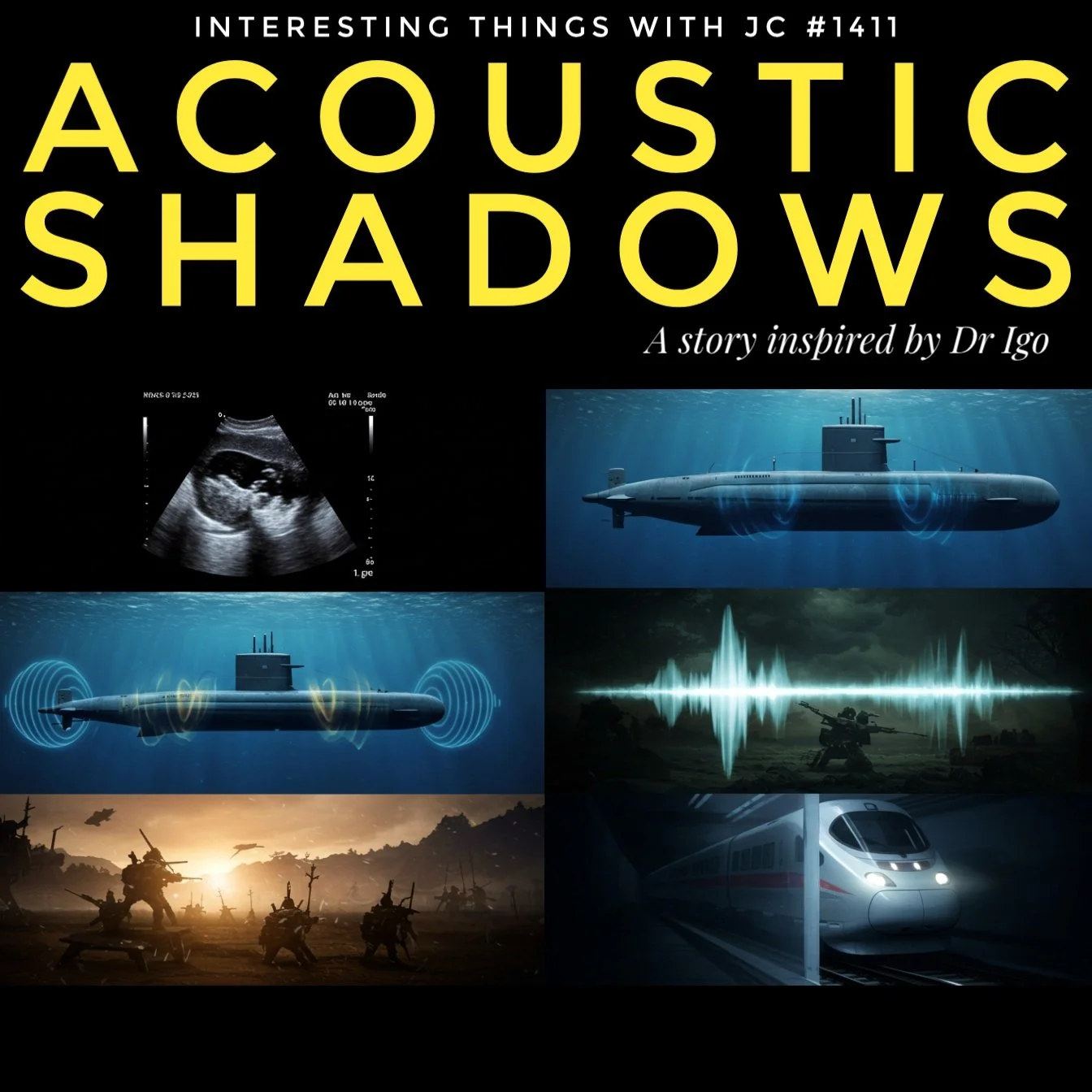
Podcast cover art for Interesting Things with JC #1411: Acoustic Shadows. The title is in bold yellow letters on a black background. Beneath it, six images illustrate the idea of sound shadows: an ultrasound scan, submarines emitting sonar waves underwater, sound wave graphics, Civil War soldiers in battle, and a high-speed train in a tunnel. Text below reads: “A story inspired by Dr Igo.”
Transcript
On April 6, 1862, Union soldiers stood near Shiloh Church in Tennessee. Just two miles—about 3 kilometers—away, one of the Civil War’s bloodiest battles was raging. Forty thousand Confederates slammed into sixty-two thousand Union troops. Cannons fired, rifles cracked—but the soldiers heard nothing. They thought the fight was over. In fact, they were standing inside an acoustic shadow.
Sound moves in waves, and those waves bend with the air. On cool mornings, warm air above cold ground bends them upward. Wind pushes them farther in one direction and cuts them off in another. Trees and hills break them apart. That’s why you’ll hear a train rolling by like it’s in the next room on one side of the tracks, but barely hear it on the other.
Medicine makes use of the same idea. Ultrasound sends sound at very high frequencies—millions of vibrations every second—into the body. Soft tissue lets those waves pass. Bone, stones, or tumors stop them cold. Behind that, the screen shows a dark band—an acoustic shadow. Doctors use those shadows to size up growths, find stones, or confirm what the eye can’t see.
The oceans follow the same rules. Warm water on top, cold below, with salt mixed in between, bends sonar beams. The sound curves away and leaves big shadow zones where sonar can’t reach. Submarines hide there. During the Cold War, patrols on both sides counted on those zones to slip by unseen.
You’ll find the pattern everywhere. Engineers design halls so voices don’t drop out in dead spots. Geologists follow seismic shadows to find oil and gas. Wolves and birds call with the wind, sending sound for miles—or losing it just over the next ridge.
Acoustic shadows prove sound is less about loudness and more about how waves bend, block, and travel. And what you don’t hear can matter most.
These are interesting things, with JC.
Student Worksheet
What environmental conditions can create an acoustic shadow?
How does an acoustic shadow apply in medical imaging like ultrasound?
Why were Union soldiers at Shiloh unable to hear the nearby battle?
What are some natural or engineered ways that acoustic shadows are managed or used?
Describe how sound behaves differently in the ocean compared to on land.
Teacher Guide
Estimated Time: 1–2 class periods (45–60 minutes each)
Pre-Teaching Vocabulary Strategy:
Use multimedia sound wave simulations (PhET, YouTube demos)
Define key terms through visuals (e.g., ultrasound images, sonar maps)
Anticipated Misconceptions:
"If something is loud enough, you’ll always hear it." (Refute via wave refraction.)
"Acoustic shadows are only in open spaces." (Counter with medical and geological examples.)
Confusing “shadow” with visual-only phenomena. (Clarify through cross-sensory comparisons.)
Discussion Prompts:
What would it feel like to be in an acoustic shadow during war?
How might knowledge of sound shadows change architectural design?
Can sound be used as camouflage?
Differentiation Strategies:
ESL: Use labeled diagrams and slow video playback of examples.
IEP: Chunk episode transcript into digestible sections and highlight key terms.
Gifted: Explore sonar cloaking and stealth technology in depth.
Extension Activities:
Create a model demonstrating sound wave refraction using heat lamps and different surfaces.
Research and present on how different animals use acoustic principles for hunting or evasion.
Write a short story based on a moment where an acoustic shadow changes history.
Cross-Curricular Connections:
Physics: Wave behavior, energy transfer
Environmental Science: Oceanic layers, wind patterns
History: Battle of Shiloh, Cold War tactics
Health Science: Ultrasound imaging and diagnostics
Quiz
Q1. What causes sound waves to bend and create acoustic shadows?
A. Magnetic fields
B. Temperature, wind, and terrain
C. Light diffraction
D. Earthquakes
Answer: B
Q2. Why were the Union soldiers at Shiloh confused?
A. They thought the Confederates surrendered
B. They couldn’t see the enemy
C. They were inside an acoustic shadow
D. They had no weapons
Answer: C
Q3. In medical imaging, what creates an acoustic shadow on a screen?
A. Water
B. Soft tissue
C. Bone or solid mass
D. Blood
Answer: C
Q4. How do submarines use acoustic shadows?
A. To attack enemy vessels
B. To repair sonar equipment
C. To hide from detection
D. To map underwater volcanoes
Answer: C
Q5. Which of the following is NOT an application of acoustic shadow principles?
A. Concert hall design
B. Earthquake monitoring
C. Sonar detection
D. Space travel
Answer: D
Assessment
Explain how the concept of acoustic shadows is used across at least three disciplines (e.g., medicine, military, architecture).
Describe a modern-day situation where understanding acoustic shadows could help save lives or improve technology.
3–2–1 Rubric:
3 = Accurate, complete, thoughtful
2 = Partial or missing detail
1 = Inaccurate or vague
Standards Alignment
NGSS:
HS-PS4-1 — Use mathematical representations to support a claim regarding relationships among frequency, wavelength, and speed of waves traveling in various media.
(Applies to wave refraction, sonar, ultrasound)HS-ESS3-6 — Use a computational representation to illustrate the relationships among Earth systems and how those relationships are being modified.
(Connects to sonar wave bending in ocean layers)
Common Core ELA:
CCSS.ELA-LITERACY.RST.9-10.2 — Determine the central ideas or conclusions of a text; trace the text’s explanation or depiction of a complex process.
(Analyzing acoustic shadow development across disciplines)CCSS.ELA-LITERACY.RST.11-12.4 — Determine the meaning of symbols, key terms, and domain-specific words in a science text.
*(Focus on vocabulary like “ultrasound,” “refraction,” “seismic”)
ISTE:
1.3 Knowledge Constructor — Students critically curate a variety of resources using digital tools to construct knowledge.
(Research-based extensions on sound and acoustics)
International Equivalents:
UK AQA Physics GCSE 4.6.1.3 — Sound waves and speed through different materials.
IB DP Physics (Topic 4) — Wave behavior and application, including reflection and refraction.
Cambridge IGCSE Physics 3.3 — Sound wave properties and behaviors, including echoes and reflection.
Show Notes
In this episode of Interesting Things with JC, the mysterious concept of "acoustic shadows" is explored through a compelling mix of history, physics, and real-world applications. From the Battle of Shiloh to Cold War submarines and ultrasound machines in hospitals, the episode illustrates how sound doesn’t always travel in predictable ways. Environmental factors like temperature, wind, terrain, and material density cause sound to bend or become blocked—leading to zones where noise simply disappears. For educators and students, this is a high-impact topic that blends science and history, and shows how an invisible phenomenon can influence everything from life-saving medical diagnoses to the outcomes of war.
References
Kinsler, L. E., Frey, A. R., Coppens, A. B., & Sanders, J. V. (2000). Fundamentals of Acoustics (4th ed.). Wiley.
https://www.wiley.com/en-us/Fundamentals+of+Acoustics%2C+4th+Edition-p-9780471847892National Park Service. (n.d.). The Battle of Shiloh. U.S. Department of the Interior.
https://www.nps.gov/shil/learn/historyculture/index.htmMayo Clinic. (n.d.). Ultrasound. https://www.mayoclinic.org/tests-procedures/ultrasound/about/pac-20395177
NOAA Ocean Exploration. (n.d.). Understanding Sound in the Ocean. National Oceanic and Atmospheric Administration. https://www.fisheries.noaa.gov/insight/understanding-sound-ocean
NOAA Ocean Exploration. (n.d.). SONAR. National Oceanic and Atmospheric Administration. https://oceanexplorer.noaa.gov/technology/sonar/