Interesting Things with JC #1395: "September 2nd - The Beginning and the End" – From the invasion of Poland to the peace aboard the USS Missouri, this episode traces the terrifying symmetry of a world at war, and what it left behind.
Curriculum - Episode Anchor
Episode Title:
September 2nd—The Beginning and the End
Episode Number:
#1395
Host:
JC
Audience:
Grades 9–12, college intro, homeschool, lifelong learners
Subject Area:
History, Political Science, International Relations, Civics, Global Studies
Lesson Overview
Students will:
Define key terms and historical moments from WWII through the Cold War to the present.
Compare the global alliances and power structures before, during, and after WWII.
Analyze the causes and effects of major turning points including Pearl Harbor, Stalingrad, and the Cold War.
Explain the long-term legacy of WWII on modern political tensions, including reflections on current geopolitical parallels.
Key Vocabulary
Blitzkrieg (/ˈblɪtskriːɡ/) — A military tactic used by Germany meaning “lightning war,” involving rapid and overwhelming attacks.
Stalingrad (/ˈstɑːlɪnɡræd/) — Site of a major WWII battle where Soviet forces halted and reversed the German advance in 1942–43.
Military–Industrial Complex (/ˈmɪlɪˌtɛri ɪnˈdʌstriəl ˈkɒmplɛks/) — A term from Eisenhower’s 1961 warning about the growing influence of defense industries on policy.
Cold War (/koʊld wɔːr/) — The ideological and geopolitical rivalry between the U.S. and the Soviet Union after WWII, without direct warfare.
Proxy War (/ˈprɒksi wɔːr/) — A conflict where two powers use third parties as substitutes for fighting each other directly, such as Korea or Vietnam.
Narrative Core
Open – The episode begins with September 2, 1939, the world on edge as Hitler invades Poland.
Info – A detailed chronology of key WWII events from the invasion of Poland to the surrender of Japan.
Details – Turning points like Operation Barbarossa, Stalingrad, and the development of the atomic bomb highlight the war’s escalation.
Reflection – Focus shifts to postwar global shifts, the Cold War, the arms race, and parallels with present-day global tensions.
Closing – Reminds listeners of the fragility of peace and the human cost of division, concluding with:
“These are interesting things, with JC.”
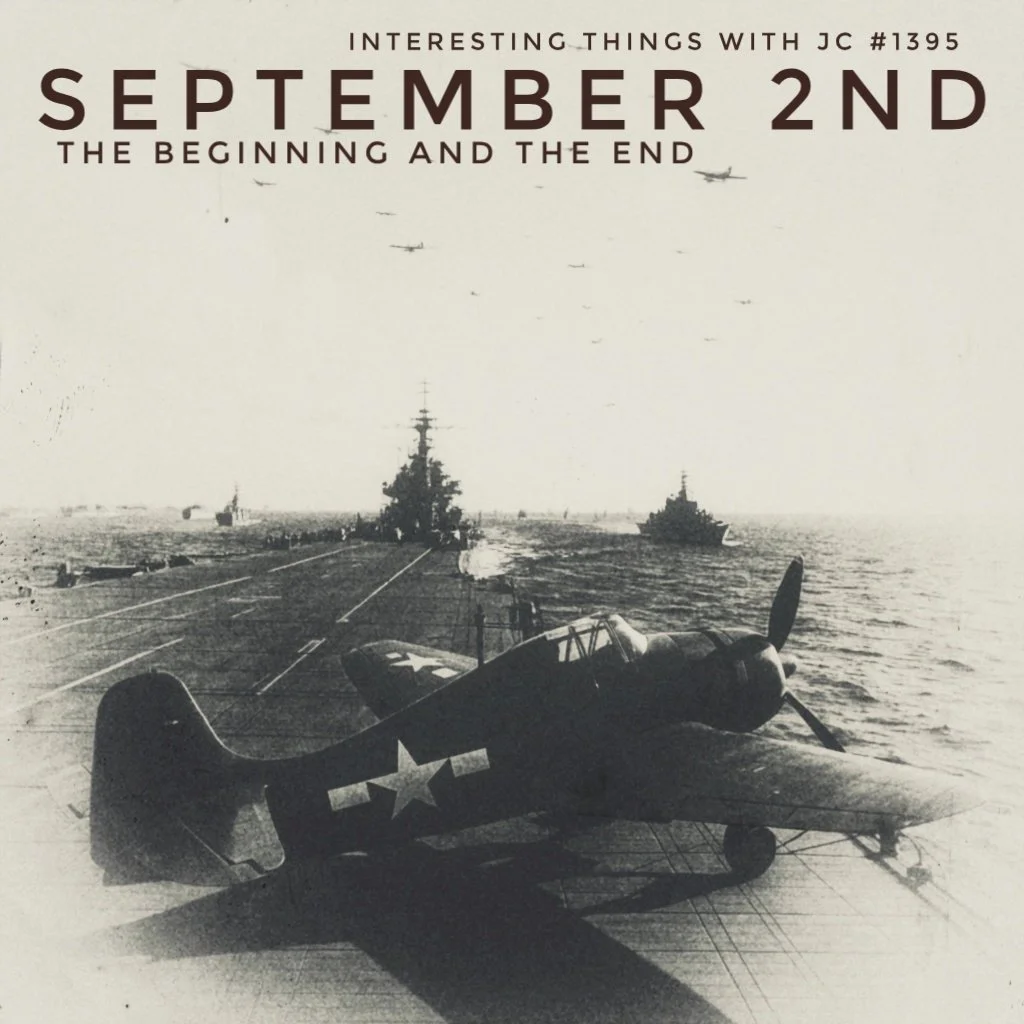
Podcast cover art for Interesting Things with JC #1395. A WWII aircraft carrier deck shows a U.S. fighter plane in the foreground, with the battleship USS Missouri and a fleet at sea under skies filled with planes. The title reads: “September 2nd — The Beginning and the End.”
Transcript
On September 2, 1939, the world was holding its breath. The day before, Germany had invaded Poland. Already, more than two hundred thousand German troops had crossed the border. Dive bombers screamed over towns, people fled on wagons and on foot, and in Warsaw, air raid sirens echoed through the streets. In London and Paris, leaders debated their final warning. Hitler had one chance to pull back. He didn’t. On September 3, Britain and France declared war.
That’s how the plunge into the Second World War began.
In less than a year, Denmark, Norway, Belgium, the Netherlands, and France all fell. By June 1940, France had been defeated in just six weeks. Britain stood alone, fighting for survival in the Battle of Britain. In the skies over southern England, the Royal Air Force held off wave after wave of German bombers.
Italy, under Mussolini, had jumped in on Germany’s side in June 1940. But their armies collapsed in Greece and North Africa, and by 1943 Mussolini was overthrown. He ended up executed by partisans in April 1945.
Germany’s biggest gamble came in June 1941, when Hitler invaded the Soviet Union. It was the largest land invasion in history. The Soviets took staggering losses—twenty-seven million people by war’s end—but they held. At Stalingrad in 1942 and 1943, the German army was surrounded and destroyed.
Meanwhile, across the Atlantic, the United States was pulled into the war after Pearl Harbor in December 1941. America’s factories went into overdrive. Tanks, planes, food, and supplies—seventeen million tons—were shipped to allies, including the Soviet Union. By June 6, 1944, American, British, and Canadian troops stormed the beaches of Normandy. Paris was liberated two months later.
By April 1945, Hitler was trapped in Berlin. On April 30, he shot himself in his bunker. Germany surrendered on May 8. In Europe, the war was over.
But in Asia, it wasn’t. The United States dropped atomic bombs on Hiroshima and Nagasaki, August 6 and 9, 1945. More than 200,000 people died in those two strikes. Japan surrendered. And on September 2, aboard the USS Missouri in Tokyo Bay, the papers were signed. In just 23 minutes, the deadliest war in history was officially done.
The cost? Seventy to eighty-five million lives. Cities flattened. Nations broken. Families torn apart.
And then came the rebuilding. Germany was divided into East and West. Berlin itself would be split by a wall. Britain, though victorious, was exhausted, and its empire unraveled—India gained independence in 1947, others followed. France rebuilt under Charles de Gaulle, determined never to be humiliated again. Italy became a republic, shaking off fascism.
The world order was rewritten. The United Nations was founded in October 1945. The U.S. dollar became the backbone of global finance. In 1949, NATO was created; in 1955, the Soviets answered with the Warsaw Pact. The wartime allies—the U.S. and the Soviet Union—were now rivals.
That rivalry defined the next half century. The Cold War. Nuclear weapons on both sides. Proxy wars in Korea, Vietnam, Afghanistan. The CIA and KGB working behind the scenes. Oil and money turned into weapons of influence. American presidents were judged on how they handled this new balance of terror—Truman with containment, Kennedy with Cuba, Reagan with confrontation.
At home, new social contracts were born. The GI Bill sent veterans to college. Highways spread suburbs across the country. The civil rights movement gained strength under the glare of a nation claiming to fight for freedom abroad. And through it all, the military–industrial complex—factories, labs, contractors—never shut down. Eisenhower warned of it in 1961, but it had already taken root during the war and kept growing.
But here’s the part that often gets overlooked. The United States and the Soviet Union had once stood together. There are monuments to it—the “Handshake at Torgau” in Germany, statues in Moscow, plaques in Washington and Alaska. For a short window of time, they fought shoulder-to-shoulder against fascism. Ordinary soldiers remembered it. Ordinary people wanted peace.
So why did it all break apart? Because after the common enemy was gone, what was left were two systems that couldn’t coexist—capitalism and communism. Add nuclear weapons, spheres of influence, and oil, and you had a recipe for rivalry. And of course, there were always those who profited from division—industries, power brokers, political players.
And here’s where it circles back to us. In recent years—around 2023—we saw echoes of old patterns. Wars in Ukraine and the Middle East deepened global divides. Tensions grew between the U.S. and China. Political polarization sharpened in many countries, with debates over history and activism fueling disagreements. NGOs and international groups took on larger roles in relief and advocacy, but their influence also raised questions about politics and power. And as all this unfolded, defense spending and arms sales surged worldwide—reminding us how conflict continues to feed the military–industrial machine.
The lesson is the same as it was in 1939, and again in 1945. Ordinary people everywhere—whether in America, Russia, Britain, France, Germany, Italy, or anywhere else—want peace, stability, and a future for their families. It’s the bad actors, then as now, who feed on chaos.
September 2, 1939—the plunge into catastrophe.
September 2, 1945—the step back from the brink.
And today, the reminder that unity is fragile, peace is precious, and history doesn’t repeat—it rhymes, unless we learn.
These are interesting things, with JC.
Student Worksheet
What were the immediate consequences of Germany’s invasion of Poland on September 1, 1939?
Why was the Battle of Stalingrad a turning point in WWII?
How did the Cold War differ from traditional warfare?
What does the phrase "military–industrial complex" mean, and who warned about it?
Identify one historical example from the podcast that reflects a modern global issue.
Teacher Guide
Estimated Time:
1–2 class periods (45–60 minutes each)
Pre-Teaching Vocabulary Strategy:
Use a visual word wall and concept-matching activities for terms like “Cold War,” “proxy war,” “NATO,” and “Marshall Plan.”
Anticipated Misconceptions:
Students may think the U.S. and USSR were always enemies.
Some may confuse WWII events with Cold War events due to overlapping themes.
Discussion Prompts:
How did the end of WWII set the stage for future conflicts?
Can peace between ideological rivals ever last? Why or why not?
What parallels do you see between 1939–1945 events and those mentioned in 2023?
Differentiation Strategies:
ESL: Use timelines and graphic organizers with multilingual glossaries.
IEP: Scaffold events with sentence frames and simplified cause-effect chains.
Gifted: Task students with evaluating the success or failure of post-WWII institutions like the UN or NATO.
Extension Activities:
Create a “Modern Versailles Treaty” role-play on preventing future wars.
Compare propaganda posters from WWII with modern media.
Cross-Curricular Connections:
Political Science: Explore the rise of NATO and the Warsaw Pact.
Ethics/Philosophy: Debate the morality of using atomic weapons.
Economics: Analyze the Marshall Plan and postwar economic recovery.
Quiz
Q1. What triggered Britain and France to declare war on Germany?
A. The bombing of London
B. The invasion of Poland
C. The fall of France
D. The Battle of Stalingrad
Answer: B
Q2. When did the United States officially enter WWII?
A. September 1, 1939
B. June 6, 1944
C. December 7, 1941
D. May 8, 1945
Answer: C
Q3. Which two cities were hit by atomic bombs in 1945?
A. Tokyo and Osaka
B. Berlin and Dresden
C. Hiroshima and Nagasaki
D. Seoul and Pyongyang
Answer: C
Q4. What organization was created in 1949 to counter Soviet influence?
A. League of Nations
B. Warsaw Pact
C. NATO
D. UN
Answer: C
Q5. What does the term “Cold War” refer to?
A. A war fought in winter
B. A war over cold climate zones
C. A period of tension without direct conflict
D. A battle between frozen economies
Answer: C
Assessment
Explain how the alliance between the U.S. and the Soviet Union shifted from cooperation to confrontation after WWII.
Describe one way in which the legacy of WWII continues to shape global politics today.
3–2–1 Rubric:
3 = Accurate, complete, thoughtful
2 = Partial or missing detail
1 = Inaccurate or vague
Standards Alignment
Common Core – History/Social Studies:
CCSS.ELA-LITERACY.RH.11-12.3 – Analyze a complex set of events and explain how they interact and develop over the course of the text.
CCSS.ELA-LITERACY.RH.11-12.9 – Integrate information from diverse sources to understand an issue or event.
C3 Framework – College, Career, and Civic Life (Social Studies):
D2.His.16.9-12 – Integrate evidence from multiple relevant historical sources and interpretations into a reasoned argument about the past.
D2.His.14.9-12 – Analyze multiple and complex causes and effects of events in the past.
CTE – Government and Public Administration Cluster:
GOVT.3.1 – Examine the foundations and purposes of the U.S. government within a global historical context.
IB – History (Diploma Programme):
IB DP History Paper 2: Authoritarian States – Analyze the impact of WWII on the rise and fall of fascist regimes and postwar international institutions.
Cambridge IGCSE History:
0470/22 (Depth Study: 20th Century) – Understand the causes, events, and consequences of major international conflicts (e.g., WWII and the Cold War).
World War II to Modern Day Timeline (1939–2025)
1939
September 1 – Germany invades Poland, WWII begins
September 3 – Britain and France declare war on Germany
1940
June 22 – France surrenders to Germany
July–October – Battle of Britain; RAF halts German air assault
1941
June 22 – Germany invades the Soviet Union (Operation Barbarossa)
December 7 – Japan attacks Pearl Harbor; U.S. enters WWII
1942–1943
August 23, 1942 – February 2, 1943 – Battle of Stalingrad; turning point on Eastern Front
1944
June 6 – D-Day; Allied invasion of Normandy
1945
April 28 – Mussolini executed by partisans in Italy
April 30 – Hitler commits suicide in Berlin
May 8 – Victory in Europe Day (VE Day); Germany surrenders
August 6 & 9 – Atomic bombs dropped on Hiroshima and Nagasaki
September 2 – Japan formally surrenders aboard USS Missouri; WWII ends
June 26 / October 24 – United Nations founded
1947
India gains independence from Britain; start of postwar decolonization
1948–1951
Marshall Plan provides ~$13 billion (≈$150B today) to rebuild Western Europe
1949
April 4 – NATO founded
August 29 – Soviet Union detonates first atomic bomb
October 1 – Mao Zedong proclaims the People’s Republic of China
1950–1953
Korean War; U.S. and UN forces vs. North Korea and China
1955
May 14 – Warsaw Pact established by Soviet Union and allies
1961
January – Eisenhower warns of the “military–industrial complex” in farewell address
August – Berlin Wall constructed, dividing East and West Berlin
1962
Cuban Missile Crisis brings the world to the brink of nuclear war
1964–1975
Vietnam War; major U.S. involvement
1973
Oil crisis highlights global dependence on Middle Eastern oil
1989
Fall of the Berlin Wall; Cold War begins to end
1991
Collapse of the Soviet Union; Cold War ends
2001
September 11 – Terrorist attacks on U.S.; War on Terror begins
2023
Global political divisions peak; Cold War–style tactics resurface through revisionism and activism
2025
80th anniversary of Japan’s surrender; reflection on WWII legacy and lessons
Show Notes
In this compelling episode of Interesting Things with JC, listeners are guided through the defining global events from the outbreak of WWII on September 1, 1939, to the Cold War aftermath and modern geopolitical tensions. Through gripping narration, JC connects seemingly distant events—Stalingrad, Pearl Harbor, Hiroshima—to present-day echoes of division and rivalry. This episode is an ideal resource for learners studying global history, political systems, international conflict, and postwar diplomacy. It offers timely reflection on the fragility of peace, the patterns of power, and the enduring hope of ordinary people across eras. Perfect for connecting classroom history to current global events.
References (APA Style)
Beevor, A. (2012). The Second World War. Little, Brown.
https://www.littlebrown.com/titles/antony-beevor/the-second-world-war/9780316023757/United Nations. (n.d.). History of the United Nations.
https://www.un.org/en/about-us/history-of-the-unUnited States Holocaust Memorial Museum. (n.d.). World War II key dates.
https://encyclopedia.ushmm.org/content/en/article/world-war-ii-key-datesU.S. National Archives. (n.d.). Japanese Instrument of Surrender, 1945.
https://www.archives.gov/college-park/highlights/japanese-surrenderNational Archives. (n.d.). Featured document: Japanese Instrument of Surrender.
https://www.archives.gov/exhibits/featured-documents/japanese-surrender-documentNaval History and Heritage Command. (n.d.). Formal Japanese surrender aboard USS Missouri. https://www.history.navy.mil/content/history/museums/nmusn/explore/photography/wwii/wwii-pacific/japanese-surrender/formal-surrender.html
USS Missouri Memorial Association. (n.d.). Surrender on the deck of the Missouri.
https://ussmissouri.org/history/history-2/surrender