1397: "What is a Florida Ounce?"
Interesting Things with JC #1397: "What is a Florida Ounce?" – “Fl oz” doesn’t stand for Florida. Once everyday knowledge, now a mystery hiding on labels and measuring cups...
Curriculum - Episode Anchor
Episode Title: What is a Florida Ounce?
Episode Number: 1397
Host: JC
Audience: Grades 9–12, college intro, homeschool, lifelong learners
Subject Area: History of Measurement, Mathematics, Language and Etymology, Consumer Education
Lesson Overview
Students will:
Define the meaning of a fluid ounce and distinguish it from other types of ounces.
Compare U.S. and British fluid ounces in terms of volume and usage.
Analyze historical reasons why fluid ounces became a standardized unit of measurement.
Explain how misconceptions like "Florida ounce" arise and why understanding measurement terminology is important.
Key Vocabulary
Fluid ounce (flood OWNS) — A unit of volume commonly used to measure liquids in the U.S. customary and British imperial systems. One U.S. fluid ounce is approximately 29.57 mL.
Ounce (owns) — A unit of weight in both the U.S. customary and British systems. One ounce (weight) does not equal one fluid ounce (volume).
Uncia (OON-kee-ah) — Latin for “one-twelfth,” the root word of “ounce,” historically used in Roman measurement.
Standardization (stan-dard-ih-ZAY-shun) — The process of developing and applying rules to ensure consistency in measurements across contexts.
Misconception (mis-kon-SEP-shun) — A mistaken belief or misunderstanding, such as interpreting "fl oz" as "Florida ounce."
Narrative Core
Open — A playful misconception: there’s no such thing as a “Florida Ounce.”
Info — “Fl oz” stands for fluid ounce, a measurement with centuries-old origins.
Details — The difference between weight and volume measurements, the historical role of the Latin "uncia," and the discrepancy between U.S. and British fluid ounces.
Reflection — As fewer people cook from scratch or use measuring cups, basic measurement literacy is fading, causing confusion over simple terms.
Closing — These are interesting things, with JC.
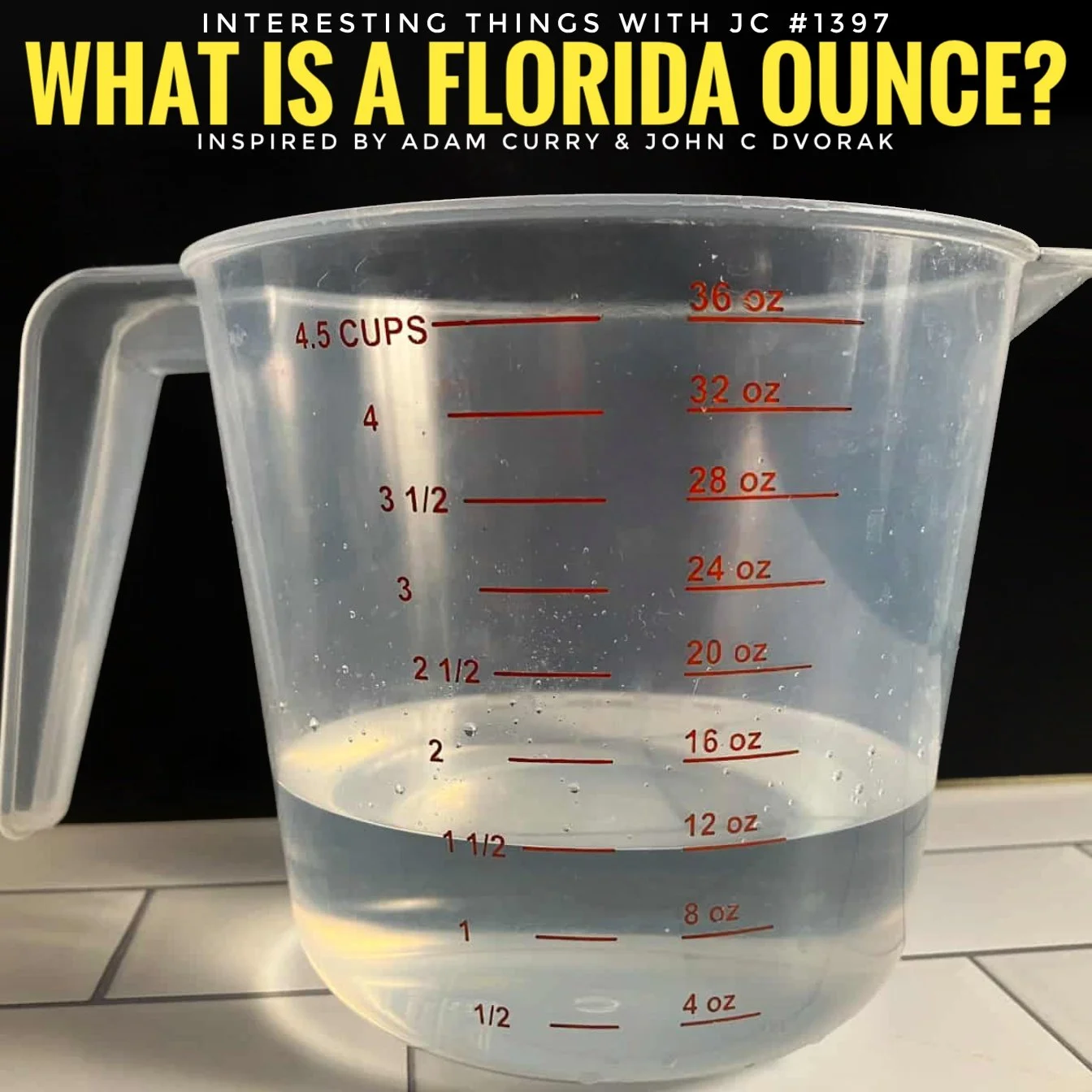
A clear plastic measuring cup marked in red with fluid ounce (oz) and cup measurements. Text above reads: "Interesting Things with JC #1397 — What Is a Florida Ounce? Inspired by Adam Curry & John C. Dvorak." The cup contains water up to the 16 oz (2 cup) mark. The image humorously highlights the misunderstanding of "fl oz" as “Florida ounce.”
Transcript
There’s no such thing as a Florida Ounce.
When you see “fl oz” on a soda can or measuring cup, it has nothing to do with the state of Florida. It’s short for “fluid ounce,” a way to measure liquid that’s been around for centuries.
An ounce of weight and a fluid ounce of volume aren’t the same. An ounce of sugar doesn’t match a fluid ounce of water. Cooks, brewers, and pharmacists depended on that difference to keep bread rising, beer balanced, and medicine safe.
The word ounce goes back to Rome. The Latin “uncia” (OON-kee-ah) meant one-twelfth of a pound. That idea carried into English trade, and by the 1800s, the fluid ounce became a fixed standard. “Fl oz” showed up on jugs, cups, and labels to keep everyone on the same page. In fact, early American recipe books from the 1800s warned readers not to confuse ounces by weight with fluid ounces, a mix-up that could ruin a cake.
Not long ago, every kid in America learned what “fl oz” meant. It was in school lessons, and reinforced at home when families cooked from scratch and measured carefully. Many remember those glass Pyrex measuring cups in the kitchen drawer, with “fl oz” printed right on the side. Today, with more ready-made meals and fewer home kitchens in daily use, that knowledge has slipped. Some folks see “fl oz” and think it means “Florida Ounce.”
Interestingly, in the United States, one fluid ounce is 1/128 of a gallon—about two tablespoons, or 29.57 milliliters. In Britain, their gallon is larger, so their fluid ounce is slightly smaller, about 28.41 milliliters. Same name, different measure.
So no, there’s no such thing as a Florida Ounce. It’s a fluid ounce—an old measure with deep roots, once a cornerstone of daily education, still keeping order in kitchens, stores, and pharmacies whether we notice it or not.
This episode was inspired by the No Agenda podcast featuring Adam Curry and John C. Dvorak. Thank you for spotlighting such an important topic.
These are interesting things, with JC.
Student Worksheet
What does “fl oz” stand for, and why is it sometimes misunderstood?
Compare a fluid ounce and a weight ounce. Why do they differ?
How did Roman measurements influence today’s measuring systems?
Why is it important to understand the difference between U.S. and British fluid ounces?
Describe a modern example where misunderstanding fluid ounces could cause a problem.
Teacher Guide
Estimated Time:
45–60 minutes
Pre-Teaching Vocabulary Strategy:
Use visual aids (e.g., measuring cups, kitchen scales) to demonstrate volume vs. weight.
Anticipated Misconceptions:
“Fl oz” refers to Florida
Fluid ounces and ounces are interchangeable
Measurement systems are the same across countries
Discussion Prompts:
How do measurement standards help us in everyday life?
Why do you think traditional measurement knowledge is fading?
Should measurement systems be globally standardized?
Differentiation Strategies:
ESL: Pair vocabulary with images and dual-language labels.
IEP: Use tactile tools for measuring (liquids vs. solids) with step-by-step instructions.
Gifted: Research historical measurement systems and compare to modern equivalents.
Extension Activities:
Create a mini-documentary or TikTok explaining “fl oz” to younger students.
Measure household items using both U.S. and metric systems and create conversion charts.
Cross-Curricular Connections:
Math: Volume and unit conversion
History: Roman influence on modern systems
Consumer Science: Label reading and cooking measurements
Language Arts: Etymology of measurement terms
Quiz
What does “fl oz” actually stand for?
A. Florida ounce
B. Fluid ounce
C. Flavored ounce
D. Foreign ounce
Answer: B
What is the Latin origin of the word “ounce”?
A. Octavius
B. Unica
C. Uncia
D. Ounculus
Answer: C
Why are fluid ounces and ounces by weight not equal?
A. One measures temperature, the other mass
B. One is metric, the other is imperial
C. They’re used in different countries
D. One measures volume, the other measures weight
Answer: D
How many milliliters are in a U.S. fluid ounce?
A. 10.24
B. 25.00
C. 29.57
D. 32.00
Answer: C
What is one reason fewer people understand “fl oz” today?
A. Schools teach different math now
B. People cook less at home
C. Fluid ounces are no longer used
D. Metric system replaced it in the U.S.
Answer: B
Assessment
Explain why it is important to distinguish between fluid ounces and weight ounces in recipes or medications.
Describe how the Latin root "uncia" influenced modern measurement systems.
3–2–1 Rubric
3 = Accurate, complete, thoughtful
2 = Partial or missing detail
1 = Inaccurate or vague
Standards Alignment
Common Core (CCSS.MATH.CONTENT.HSN.Q.A.1):
Use units as a way to understand problems and to guide the solution of multi-step problems.
Next Generation Science Standards (NGSS.PS1.A):
Structure and Properties of Matter — Recognizing that the mass and volume of substances relate to their physical properties.
C3 Framework (D2.Civ.14.9-12):
Analyze the impact of historical changes in systems on everyday life.
ISTE Standards (1.3 Knowledge Constructor):
Students critically curate sources of information using digital tools to construct knowledge.
UK National Curriculum (Maths: Measurement KS3):
Convert between different units of metric measure and understand and use approximate equivalences between metric and imperial units.
IB MYP Mathematics Criterion D (Applying Mathematics in Real-Life Contexts):
Solve real-life problems involving measurement and unit conversion.
Show Notes
This episode of Interesting Things with JC tackles a surprisingly common misconception: that “fl oz” stands for “Florida ounce.” In reality, it means “fluid ounce,” a centuries-old unit of liquid measurement with deep historical roots. JC traces its origin to ancient Rome’s uncia, explains the difference between ounces by volume and by weight, and explores why this distinction matters in everything from baking to pharmacy. The episode also reflects on a shift in domestic habits—as fewer people cook or measure ingredients by hand, terms like “fl oz” become easy to misread. This episode was inspired by Adam Curry and John C. Dvorak of the No Agenda Show podcast, whose insightful conversation spotlighted the confusion surrounding this abbreviation! This episode of Interesting Things with JC is a valuable resource for lessons in history, consumer education, and practical mathematics, reinforcing the importance of measurement literacy in everyday life.
References
NIST – General Tables of Units of Measurement (Handbook 44, 2024):
https://www.nist.gov/document/nist-hb-44-2024-appendix-c-general-tables-units-measurementNIST – Metric Kitchen: Cooking Measurement Equivalencies:
https://www.nist.gov/pml/owm/metric-kitchen-cooking-measurement-equivalenciesFood & Wine – A Brief History of Pyrex:
https://www.foodandwine.com/lifestyle/kitchen/history-of-pyrexCorning Museum of Glass – Pyrex Liquid Measuring Cup (1925):
https://pyrex.cmog.org/content/pyrex-liquid-measuring-cupFDA – How to Understand and Use the Nutrition Facts Label:
https://www.fda.gov/media/99069/downloadOnline Etymology Dictionary – “Ounce”:
https://www.etymonline.com/word/ounceUK Government – Weights and Measures Act 1985:
https://www.legislation.gov.uk/ukpga/1985/72No Agenda Show – Official Episode Archive:
https://www.noagendashow.net/