1399: "Giorgio Armani"
Interesting Things with JC #1399: "Giorgio Armani" – From wartime hardship to timeless elegance, He built an empire with restraint, grace, and conviction. His vision never wavered.
Curriculum - Episode Anchor
Episode Title: Giorgio Armani
Episode Number: #1399
Host: JC
Audience: Grades 9–12, college intro, homeschool, lifelong learners
Subject Area: History, Fashion Studies, Business Studies, Media Literacy, Ethics
Lesson Overview
Students will:
Define Giorgio Armani’s contributions to fashion, business, and culture.
Compare Armani’s business model with those of other fashion designers and entrepreneurs.
Analyze how Armani’s designs and values reflected cultural and historical moments.
Explain the broader impact of Armani’s ethical stances on the fashion industry.
Key Vocabulary
Couture (koo-TOOR) — High-end custom fashion design; Armani blurred the lines between couture and ready-to-wear.
Anorexia (an-uh-REK-see-uh) — An eating disorder marked by weight loss and food restriction; Armani’s response to a model’s anorexia-related death marked a turning point in fashion ethics.
Textile (TEK-style) — A type of cloth or woven fabric; Armani’s early work as a textile buyer informed his design sensibility.
Fragrance (FRAY-gruhns) — A perfume or scent product; Acqua di Giò became a global bestseller under the Armani brand.
Legacy (LEG-uh-see) — Something handed down from the past; Armani’s foundation and ethical decisions ensured the survival of his vision.
Narrative Core (Based on the PSF – Renamed Labels)
Open – The story opens with a young Giorgio Armani growing up amid WWII hardships and recovering from shrapnel wounds—an emotional and historic entry point.
Info – Armani’s unusual path from medicine to fashion, and his foundational work at La Rinascente, grounds his later success.
Details – Key moments include launching his brand in 1975, revolutionizing tailoring, breaking into Hollywood, and resisting corporate takeovers.
Reflection – Armani’s philanthropy, ethical standards, and commitment to independent control highlight a deeper legacy than fashion alone.
Closing – "These are interesting things, with JC."
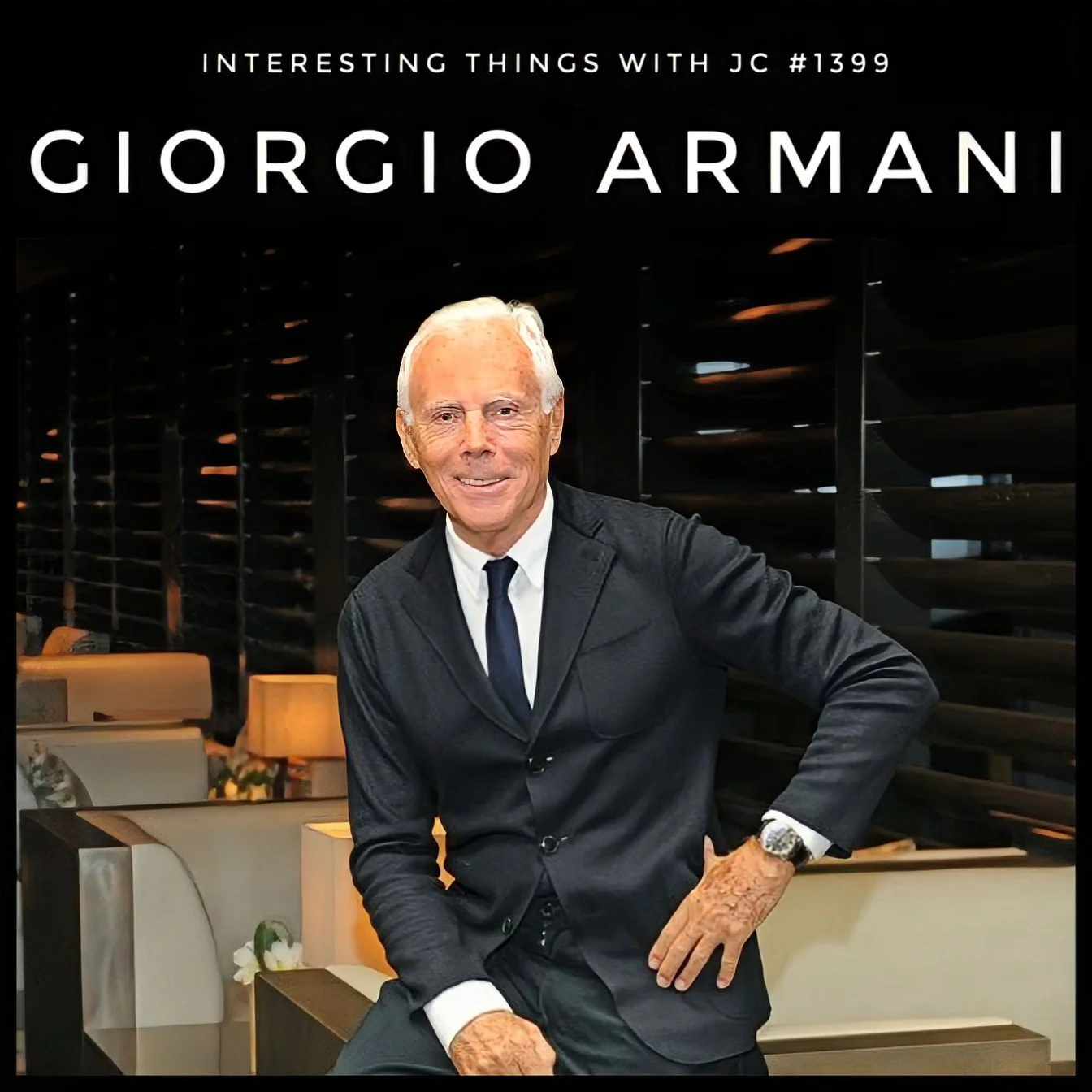
Portrait of Giorgio Armani, older gentleman with white hair, wearing a dark suit and tie, seated indoors with a warm background. Text above reads: ‘Interesting Things with JC #1399 – Giorgio Armani.’
Transcript
Giorgio Armani (JOR-jyo Ar-MAH-nee) was born in 1934 in Piacenza (Pee-ah-CHEN-zah), Italy, and grew up during World War II, when food and money were scarce and he was wounded by shrapnel as a boy.
He first studied medicine, served as a medic in the Italian army, and then turned toward fashion. His earliest work was as a window dresser and textile buyer at La Rinascente, Milan’s great department store—a job that gave him a feel for fabrics and how clothes should be seen. In 1975, with his partner Sergio Galeotti (SARE-jyo Gah-LOT-tee), he launched his own company. Armani’s jackets with soft shoulders and fluid trousers redefined tailoring. In 1980, Richard Gere wore Armani in American Gigolo, and the brand became a symbol of confidence from Hollywood to Wall Street.
Unlike many designers, Armani never sold out to a luxury group. He kept his company private, expanding it into more than 2,000 stores across 60 countries. By the early 2000s, annual sales topped $2 billion, doubling in the following decade. His fragrance line, led by Acqua di Giò (AH-kwah dee JO), became one of the world’s best-selling colognes, generating billions on its own. He also built hotels in Dubai and Milan, outfitted Italy’s Olympic athletes, and owned the Olimpia Milano basketball team. At his death, his fortune was estimated at $12 billion.
He also gave back. In the 1980s, he raised funds for AIDS research. In 2010, he launched “Acqua for Life,” a campaign that has provided millions of liters of safe drinking water across Africa, Asia, and South America. And in 2007, after a young model’s anorexia-related death, he became one of the first major designers to ban underweight models—a rare ethical stand in fashion.
Armani remained active in the business until his final days. In 2016, he established the Giorgio Armani Foundation to ensure the company’s independence beyond his lifetime.
Giorgio Armani died in Milan in September 2025 at age 91. He left behind a thriving company still under his control and a legacy best described in his own words: “Elegance is not about being noticed, it’s about being remembered.”
These are interesting things, with JC.
Student Worksheet
What early experiences influenced Armani’s understanding of fashion and design?
How did Armani’s work in Hollywood affect his brand’s global recognition?
Why is Armani’s decision to keep his company private significant?
What ethical actions did Armani take in the fashion industry?
Write a brief paragraph explaining how Armani’s life reflected resilience and innovation.
Teacher Guide
Estimated Time:
45–60 minutes
Pre-Teaching Vocabulary Strategy:
Introduce and define key terms with visual aids (e.g., photos of Armani suits, perfume ads). Discuss basic WWII context.
Anticipated Misconceptions:
Students may think all major designers work the same way or assume Armani was always wealthy.
Misunderstanding the global reach of fashion brands.
Discussion Prompts:
How does fashion reflect or shape culture?
What makes a business ethical?
Why might someone refuse to sell their company?
Differentiation Strategies:
ESL: Provide a visual timeline and glossary with phonetic cues.
IEP: Use guided notes or graphic organizers for the narrative sequence.
Gifted: Ask students to compare Armani’s legacy to another global entrepreneur.
Extension Activities:
Design a minimalist fashion sketch inspired by Armani’s aesthetic.
Research and present another Italian postwar innovator (e.g., Ferragamo, Fiat, Olivetti).
Write an obituary headline capturing Armani’s legacy in under 15 words.
Cross-Curricular Connections:
History: WWII Italy and its effects on citizens.
Economics: Private ownership vs. corporate acquisition.
Ethics: Body image in media and fashion.
Art/Design: The evolution of tailoring in menswear.
Quiz
Q1. Where was Giorgio Armani born?
A. Rome
B. Florence
C. Piacenza
D. Venice
Answer: C
Q2. What Hollywood film helped popularize Armani’s brand?
A. Scarface
B. American Gigolo
C. The Godfather
D. Wall Street
Answer: B
Q3. Which product line became one of the world’s best-selling colognes?
A. Armani Code
B. Armani Sport
C. Acqua di Giò
D. Armani Homme
Answer: C
Q4. In which year did Armani create a foundation to secure his company’s future?
A. 1999
B. 2007
C. 2010
D. 2016
Answer: D
Q5. What ethical stance did Armani take after a model’s death?
A. Boycotting fur
B. Banning underweight models
C. Refusing red carpet appearances
D. Cutting ad budgets
Answer: B
Assessment
How did Giorgio Armani change the global fashion industry?
What does Armani’s story teach us about perseverance and values?
3–2–1 Rubric:
3 = Accurate, complete, thoughtful
2 = Partial or missing detail
1 = Inaccurate or vague
Standards Alignment
U.S. Standards
CCSS.ELA-LITERACY.RI.9-10.3 – Analyze how the author unfolds a series of ideas or events.
Students examine Armani’s life path and business strategy.C3.D2.His.1.9-12 – Evaluate how historical events and contexts influenced individuals.
Explores how WWII and postwar Italy shaped Armani’s career.CTE.FA.FS.2.2 – Interpret the role of fashion in society and cultural expression.
Armani’s influence on culture through clothing and design.ISTE 1.6.b – Students create original works and responsibly repurpose digital resources.
Students create fashion sketches or obituary headlines.
International Standards
UK National Curriculum (History KS4) – Understand significant aspects of modern world history.
Includes WWII context and cultural recovery.IB MYP Individuals & Societies Criterion B: Investigating – Students use research skills to investigate.
Research Armani’s legacy and ethical impact.Cambridge IGCSE Business Studies (0450) 6.2 – Business structure: private vs. public ownership.
Armani's refusal to sell his company becomes a case study.
Show Notes
In this episode, JC explores the life and legacy of Giorgio Armani—one of the most influential figures in global fashion. Listeners learn how a young man from war-torn Italy transformed into a world-renowned designer, innovator, and businessman. Through tailoring that broke with tradition, ethical stands that reshaped industry standards, and a business model centered on independence and legacy, Armani’s story provides rich insights into design, entrepreneurship, resilience, and cultural change. This episode is especially relevant for classrooms discussing the intersections of history, economics, media, and ethics.
References
Reuters. (2025, September 4). Giorgio Armani, the ‘king’ of Italian fashion who revolutionised menswear. Retrieved from https://www.reuters.com/business/media-telecom/obituary-giorgio-armani-obituary-king-italian-fashion-who-revolutionised-2025-09-04/
Reuters. (2025, September 4). After Giorgio Armani, heirs and foundation to steer fashion empire. Retrieved from https://www.reuters.com/business/finance/after-giorgio-armani-heirs-foundation-steer-fashion-empire-2025-09-04/
GQ. (2025, September 5). How Giorgio Armani Transformed Tailoring. Retrieved from https://www.gq.com/story/how-giorgio-armani-transformed-tailoring
Vogue Business. (2025, September 5). Building an independent legacy brand: Lessons from Armani. Retrieved from https://www.voguebusiness.com/story/fashion/building-an-independent-legacy-brand-lessons-from-armani
Associated Press. (2025, September 5). Giorgio Armani leaves a legacy as 'the master of luxury ready-to-wear'. Retrieved from https://apnews.com/article/e4981a6e9ee0619251d71385bcdec230
Reuters. (2025, September 5). A lone red rose outside Armani as Milan mourns its 'king' of fashion. Retrieved from https://www.reuters.com/world/europe/lone-red-rose-outside-armani-milan-mourns-its-king-fashion-2025-09-05/
The Independent. (2025, September 5). Giorgio Armani's runway models demands revealed. Retrieved from https://www.independent.co.uk/news/giorgio-armani-dies-age-91-models-show-video-b2820190.html