Interesting Things with JC #1526: "Radio Swan" – A friendly radio voice drifted across the Caribbean, hiding a covert mission meant to shape a revolution. From pop music to coded signals, this is the story of how sound became a weapon.
Curriculum - Episode Anchor
Episode Title: Radio Swan
Episode Number: 1526
Host: JC
Audience: Grades 9–12, college intro, homeschool, lifelong learners
Subject Area
Cold War history, media literacy, communications technology, logistics and engineering support
Lesson Overview
3–4 measurable learning objectives:
Define: “Black radio” and psychological operations, and describe how Radio Swan fit Cold War strategy.
Compare: Overt broadcasting (publicly attributed) and covert/deniable broadcasting (unattributed/“black”) and identify how each shapes audience trust.
Analyze: How rapid construction logistics (materials, transport, towers, airstrip) enabled a strategic communications mission.
Explain: How cultural cues can function as signals, and evaluate evidence versus speculation when interpreting modern broadcasts.
Key Vocabulary
Radio transmission tower (RAY-dee-oh tranz-MISH-un TOW-er) — A tall structure that supports antennas so radio signals can broadcast farther; the Seabees built two 220-foot towers on Swan Island.
Shortwave (SHORT-wave) — Radio frequencies that can travel long distances by reflecting off the ionosphere; often used for international broadcasting and military networks.
Psychological warfare / PSYOP (SY-koh-LAH-jih-kul WAR-fair) — Communication strategies meant to influence attitudes and behavior; Radio Swan broadcast messaging intended to weaken confidence in Castro’s government.
Black radio operation (BLACK RAY-dee-oh op-uh-RAY-shun) — Covert broadcasting where the sponsor is hidden or misattributed; Radio Swan was associated with CIA cover arrangements.
Seabees (SEE-beez) — U.S. Navy construction units; Detachment Tango, NMCB 6 rapidly built the Swan Island site and got the station on the air May 17, 1960.
LST (EL-ess-TEE) — Landing Ship, Tank; a ship type used to move heavy equipment and supplies ashore, used to deliver the build-out materials.
Coded messages (KOH-did MES-ij-iz) — Phrases or signals embedded in broadcasts to communicate secretly; Radio Swan was documented as broadcasting coded material around the Bay of Pigs period.
Narrative Core
Open: An urgent 1960 order: build a radio station fast on a barely-mapped island, with no photos and minimal explanation—mystery plus speed creates immediate tension.
Info: Cold War pressures and Cuba’s 1959 revolution made radio a “quiet tool.” Swan Island’s isolation made it a plausible, deniable broadcast platform.
Details: Detachment Tango (NMCB 6) designed, shipped, and built the site rapidly—two 220-foot towers, camp, and airstrip—then Radio Swan went on air May 17, 1960.
Reflection: Radio can sound friendly while carrying strategic intent; interpreting signals (then and now) requires separating documented facts from rumor and understanding how trust is engineered.
Closing: These are interesting things, with JC.
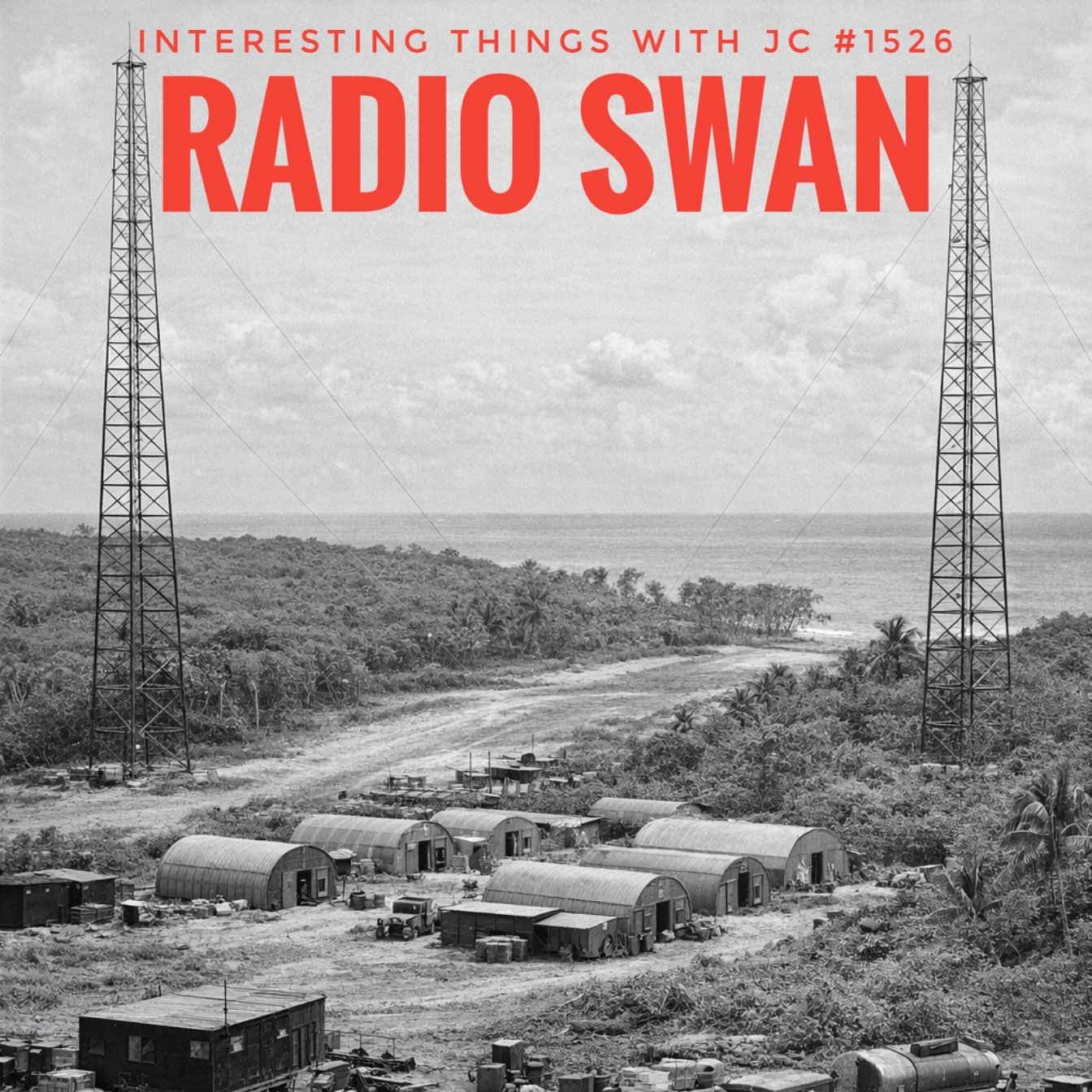
Black-and-white photo of a jungle island radio camp with Quonset huts and two tall transmission towers; red text reads “Radio Swan” and “Interesting Things with JC #1526.”
Transcript
Interesting Things with JC #1526: “Radio Swan”
It began as an urgent message in late March of 1960.
No photos. No reconnaissance reports. No real explanation.
Just a tasking order sent to Construction Battalion Atlantic. Build a radio station. Build it fast. Build it on Swan Island, a small, jungle-covered island in the Caribbean Sea north of Honduras. Today it’s called Isla Cisne. Back then, it was barely mapped.
Swan Island was only about 2 miles long, roughly 3.2 kilometers. Flat, humid, and isolated. But it sat just 180 miles, about 290 kilometers, from Cuba. Close enough that a powerful transmitter could reach Havana with ease. In the early days of the Cold War, that distance meant everything.
At the time, the Cuban Revolution had just reshaped the region. Fidel Castro had taken power in 1959. The Soviet Union was pressing closer to the Western Hemisphere. Washington was scrambling for leverage, and radio was one of the tools it could use without crossing a visible line.
Detachment Tango of Naval Mobile Construction Battalion Six was pulled off home deployment at Davisville, Rhode Island. One hundred thirty Seabees were told to build the site before continuing on to Bermuda. There was concern the mission might turn military, but details were scarce by design.
Using the Navy’s Advance Base Functional Component System, the entire project was designed in hours. Material lists were completed in under eight. Quonset huts. Power equipment. Furniture. Kitchen gear. Bedding. Even tableware. Most of it was already sitting in warehouses at Davisville. Within ten hours, trucks lined up at the gate. Within four days, two landing ship tanks were loaded and underway.
The first LST arrived at Swan Island about a week later.
The jungle was thick. There was only one narrow path across the island. With no aerial photos to rely on, the officer in charge made a Jeep reconnaissance to get a sense of scale and terrain. Locations were selected for two radio transmission towers, each 220 feet tall, about 67 meters. A landing strip was staked out. Priority went to the towers.
Unloading took two days and nights. While crews worked, clearing and construction began at the same time. When the towers were nearly complete, a CIA representative approached with a request. A black trailer had arrived on the second LST. It needed to be moved into position.
The next day, May 17, 1960, Radio Swan went on the air.
Signals were immediately received across the Caribbean. The station was strong, clear, and far-reaching. From a technical standpoint, the mission was an instant success. The CIA declared it operational. The camp and airstrip were finished in the weeks that followed. Equipment was backloaded. Detachment Tango sailed on to Bermuda, the job done without fanfare.
On July 7, 1960, the Chief of Naval Operations, Admiral Arleigh Burke, sent a letter of commendation. The project, he wrote, was of great importance to the United States. Its timely completion reflected great credit on the Navy.
At the time, few of the men involved knew why.
Radio Swan sounded like a commercial station. Music. Friendly voices. Light news. But it was a black radio operation, designed for psychological warfare. Between songs were messages aimed at weakening confidence in Castro’s government. Some broadcasts carried coded instructions intended for underground resistance groups inside Cuba.
As the Bay of Pigs invasion approached in April of 1961, Radio Swan’s role sharpened. Spanish-language messages increased. Carefully worded phrases served as signals. When the invasion failed and the headlines broke, the purpose of that rushed construction job a year earlier finally became clear.
Radio Swan later rebranded as Radio Americas and stayed on the air until 1968. When it shut down, the transmitters were dismantled and shipped to South Vietnam, where the same techniques were reused in another conflict.
The idea never went away.
Radio Swan was never about popularity. It was about timing, tone, and trust. A reminder that sometimes the most powerful tools do not look like weapons at all. Sometimes, they sound like music.
These are interesting things, with JC.
Student Worksheet
Using the transcript, list three construction or logistics details that made the Swan Island build unusually fast (people, systems, supplies, transport).
What makes a “black radio operation” different from a normal commercial station, even if the format sounds similar?
Identify two reasons radio was useful during the Cold War compared to visible military action.
Evidence check: The transcript gives a specific distance from Swan Island to Cuba. Find one credible source that gives a different distance or framing, and explain why distances can vary (reference points, measurement methods, “to Havana” vs “to Cuba”).
Teacher Guide
Estimated Time
50–70 minutes (or two 45-minute class periods)
Pre-Teaching Vocabulary Strategy
“Signal vs. noise” sort: give students vocabulary cards (shortwave, PSYOP, black radio, transmitter, coded message). Students sort into “technology,” “strategy,” and “evidence terms,” then justify placements with one sentence each.
Anticipated Misconceptions
“If it sounds commercial, it must be harmless.” (Discuss how format can build trust while content serves a strategic goal.)
“All mysterious broadcasts are doomsday triggers.” (Model evidence-based interpretation; note that UVB-76 is widely assessed as a military comms channel, and the signal is frequently hijacked by radio pirates.)
“One distance number is definitive.” (Teach geospatial precision: distance depends on endpoints—Havana vs. nearest Cuban coastline, etc.)
Discussion Prompts
What does it mean to “win trust” through media, and how did Radio Swan’s style support that?
Should governments use covert media to influence another country? Where is the line between information and manipulation?
Differentiation Strategies: ESL, IEP, gifted
ESL: Provide sentence frames (“A black radio operation is different because…”, “A coded message could be…”) and a bilingual glossary option.
IEP: Offer guided notes with a timeline template (1960 build → 1961 Bay of Pigs context → later rebrand).
Gifted: Source evaluation challenge—compare two sources describing Radio Swan’s purpose and identify which claims are directly evidenced versus inferred.
Extension Activities
Logistics simulation: Students plan a “rapid build” checklist for a remote communications outpost (power, shelter, towers, runway), then compare their plan to the Seabee account.
Media forensics: Students analyze how a friendly broadcast format can change persuasion outcomes (music, announcer tone, repetition, credibility cues).
Cross-Curricular Connections: (e.g., physics, sociology, ethics)
Physics/Engineering: antenna height, propagation, and why shortwave can travel far.
History/Government: Cold War information strategy and the Bay of Pigs planning context.
ELA/Media Literacy: rhetoric, tone, credibility, and audience analysis.
Ethics: persuasion vs. deception in public communication.
Framework reference
This curriculum output follows the “Reusable Curriculum Framework for Interesting Things with JC.”
Quiz
Q1. What was the construction unit tasked with building the Swan Island radio site?
A. U.S. Army Corps of Engineers
B. Naval Mobile Construction Battalion Six (Seabees), Detachment Tango
C. U.S. Coast Guard cutters
D. Royal Engineers
Answer: B
Q2. According to the Seabee account, Radio Swan went on the air on:
A. April 17, 1961
B. July 7, 1960
C. May 17, 1960
D. November 1961
Answer: C
Q3. “Black radio operation” most nearly means:
A. A station that only broadcasts at night
B. A station that uses encrypted FM signals
C. A covert station with hidden or misattributed sponsorship
D. A station that plays only classical music
Answer: C
Q4. Which document source notes the Swan Island station was completed and on the air with test signals by May 17?
A. A school textbook
B. U.S. State Department historical documents (FRUS)
C. A movie screenplay
D. A social media thread
Answer: B
Assessment
Using evidence from the episode and at least one external source, explain how Radio Swan’s “friendly” format could still function as psychological warfare. Include two specific techniques (tone, timing, repetition, credibility cues, coded phrases).
Choose one modern “signal interpretation” example. Write a short evidence memo: What is confirmed? What is plausible? What is speculation? What additional evidence would you need?
3–2–1 rubric:
3 = Accurate, complete, thoughtful
2 = Partial or missing detail
1 = Inaccurate or vague
Standards Alignment
Common Core State Standards (CCSS) – ELA/Literacy
CCSS.ELA-LITERACY.RH.9-10.1 — Cite specific textual evidence when analyzing historical sources (episode + documents on Radio Swan).
CCSS.ELA-LITERACY.RH.9-10.2 — Determine central ideas of a source; summarize how covert broadcasting supported Cold War aims.
CCSS.ELA-LITERACY.RH.11-12.7 — Integrate and evaluate multiple sources (Seabee account, FRUS, journalism) into a coherent understanding.
CCSS.ELA-LITERACY.SL.11-12.4 — Present findings clearly using evidence (debate: persuasion vs deception; evidence memos).
C3 Framework for Social Studies
D2.His.1.9-12 — Evaluate how historical events and developments were shaped by multiple factors (strategy, technology, logistics).
D2.His.4.9-12 — Analyze complex interactions in historical contexts (Cold War communications + Bay of Pigs planning environment).
D3.1.9-12 — Gather and evaluate sources, noting claims, credibility, and limitations (distance claims, attribution, speculation).
ISTE Standards for Students
1.3 Knowledge Constructor — Curate information from credible sources, compare claims, and document evidence.
1.6 Creative Communicator — Communicate complex ideas clearly (timeline + evidence memo).
1.7 Global Collaborator — Compare how different regions interpret media signals and historical symbolism (e.g., “Swan Lake” associations).
NGSS – Engineering Design (HS)
HS-ETS1-2 — Design a solution to a complex problem considering constraints (simulate rapid build logistics for a remote broadcast site).
HS-ETS1-3 — Evaluate solutions based on tradeoffs (speed vs secrecy vs sustainability in remote construction).
ACRL Framework for Information Literacy (College Intro)
Authority Is Constructed and Contextual — Distinguish firsthand accounts, government documents, and later commentary when weighing claims.
Information Creation as a Process — Analyze how broadcast “tone” and format are engineered to affect reception and trust.
International Equivalents (content-based, non-ideological)
UK National Curriculum (England) – History (KS3) — Historical enquiry: ask questions, use evidence, and understand interpretations through the Radio Swan case study.
AQA GCSE History (8145) AO2/AO3 — AO2 explain and analyze historical events; AO3 analyze and evaluate sources and interpretations (episode + documents).
Cambridge IGCSE History (0470) AO1/AO2 — Demonstrate knowledge/understanding and handle historical sources (evidence memo + source comparison).
IB DP History — Source evaluation, perspectives, and analysis of historical causation and consequence (information strategy and deniable operations).
Show Notes
Radio Swan began as a rapid, secretive construction mission in spring 1960: Navy Seabees from NMCB 6 were ordered to build a remote broadcast facility, towers, camp and an airstrip, on Swan Island (Isla Cisne) with minimal site intelligence, then successfully brought the station on the air by May 17, 1960. What sounded like a friendly, commercial-style station was tied to covert influence efforts aimed at Castro’s Cuba, including documented periods of coded messaging and intensive broadcasts tied to the Bay of Pigs planning environment.
In the classroom, this episode is a clean case study in how engineering, logistics, and communications intersect with history: students can trace how fast design and supply systems enabled strategic reach, and how media formats can be engineered for trust. It also supports modern media literacy: the episode’s “swan” motif connects to how symbols can become signals (for example, the long-standing association of “Swan Lake” with moments of Soviet/Russian political disruption), while emphasizing the difference between confirmed evidence and speculation when interpreting broadcast anomalies.
References
U.S. Navy Seabee Museum / Navy Live. (n.d.). Radio Swan: Seabees part of Cold War history. https://seabeemagazine.navylive.dodlive.mil/News/Article/2609949/radio-swan-seabees-part-of-cold-war-history/
U.S. Department of State, Office of the Historian. (n.d.). Foreign Relations of the United States (FRUS): Survey of the Cuban operation (document excerpt). https://history.state.gov/historicaldocuments/frus1961-63v10-12mSupp/d273a
TIME. (1971, December 6). Honduras: Swans, spooks and boobies. https://time.com/archive/6815217/honduras-swans-spooks-and-boobies/
Berg, J. (n.d.). Radio Swan and Radio Americas: A DX saga (PDF). Radio Heritage Foundation. https://www.radioheritage.com/otsw/Stations/Radio_Swan_and_Radio_Americas--A_DX_Saga.pdf
Radio Free Europe/Radio Liberty. (2020, June 3). Barbara: The original voice of RFE. https://about.rferl.org/article/barbara-the-original-voice-of-rfe/