Interesting Things with JC #1525: "The Trial of Joan of Arc" – She had no lawyer. She couldn’t read. But she faced over 130 men and answered every question. Her words would outlive her fire.
Curriculum - Episode Anchor
Episode Title: The Trial of Joan of Arc
Episode Number: 1525
Host: JC
Audience: Grades 9–12, college intro, homeschool, lifelong learners
Subject Area: World History (Late Medieval Europe), Civics/Law (legal procedure), Religious Studies (historical theology), Media Literacy (primary sources)
Lesson Overview
By 1431, Joan of Arc’s military and political impact made her trial a high-stakes contest over legitimacy during the Hundred Years’ War. Students analyze how legal process, power, and primary-source records shaped outcomes—and how later review changed the official verdict. (The trial in Rouen ran from January 9 to May 30, 1431.)
3–4 measurable learning objectives using action verbs:
Define key terms related to medieval church courts (e.g., heresy, recantation, canon law) and apply them to Joan’s case.
Analyze how political incentives can influence legal proceedings, using evidence from the episode and a primary-source excerpt.
Explain how Joan’s answers and the court’s questioning strategies reveal the logic of “trap questions” in adversarial settings.
Compare the 1431 condemnation with the 1450s rehabilitation process as examples of how institutions reassess past decisions.
Key Vocabulary
Heresy (HAIR-uh-see) — Beliefs judged to be against official church teaching; Joan was tried and condemned for heresy in a church-run court setting.
Canon law (KAN-un law) — The church’s legal system; the episode notes that Joan was held in military custody rather than church custody, raising procedural concerns.
Recant (rih-KANT) — To take back a statement or belief; Joan was pressured to recant, then was treated as a “relapse” when she returned to earlier claims.
Abjuration (ab-juh-RAY-shun) — A formal renunciation of beliefs; the episode describes an abjuration event used to reduce Joan’s sentence.
Inquisitor (in-KWIZ-ih-ter) — An official involved in investigating heresy; church legal machinery and theological questioning shaped the proceedings.
Legitimacy (luh-JIT-uh-muh-see) — The accepted right to rule; the episode ties Joan’s visions to the political legitimacy of Charles VII.
Primary source (PRY-mair-ee sors) — Firsthand evidence (like transcripts); Joan’s trial records are studied as unusually detailed medieval legal documentation.
Narrative Core
Open: A teenage prisoner faces a room of powerful scholars and church officials without counsel, yet her recorded words endure for centuries.
Info: England and France are locked in the Hundred Years’ War; Joan’s role in Charles VII’s coronation turns her into a political threat. The presiding bishop, Pierre Cauchon, is aligned with English interests.
Details: The court’s questioning tries to force contradictions; Joan’s careful answers resist “trap” logic. Charges narrow, clothing becomes central, and a coerced recantation sets up the “relapse” pathway to execution.
Reflection: The story highlights how legal outcomes can hinge on procedure, power, and interpretation—and why later institutions revisit contested judgments.
Closing: These are interesting things, with JC.
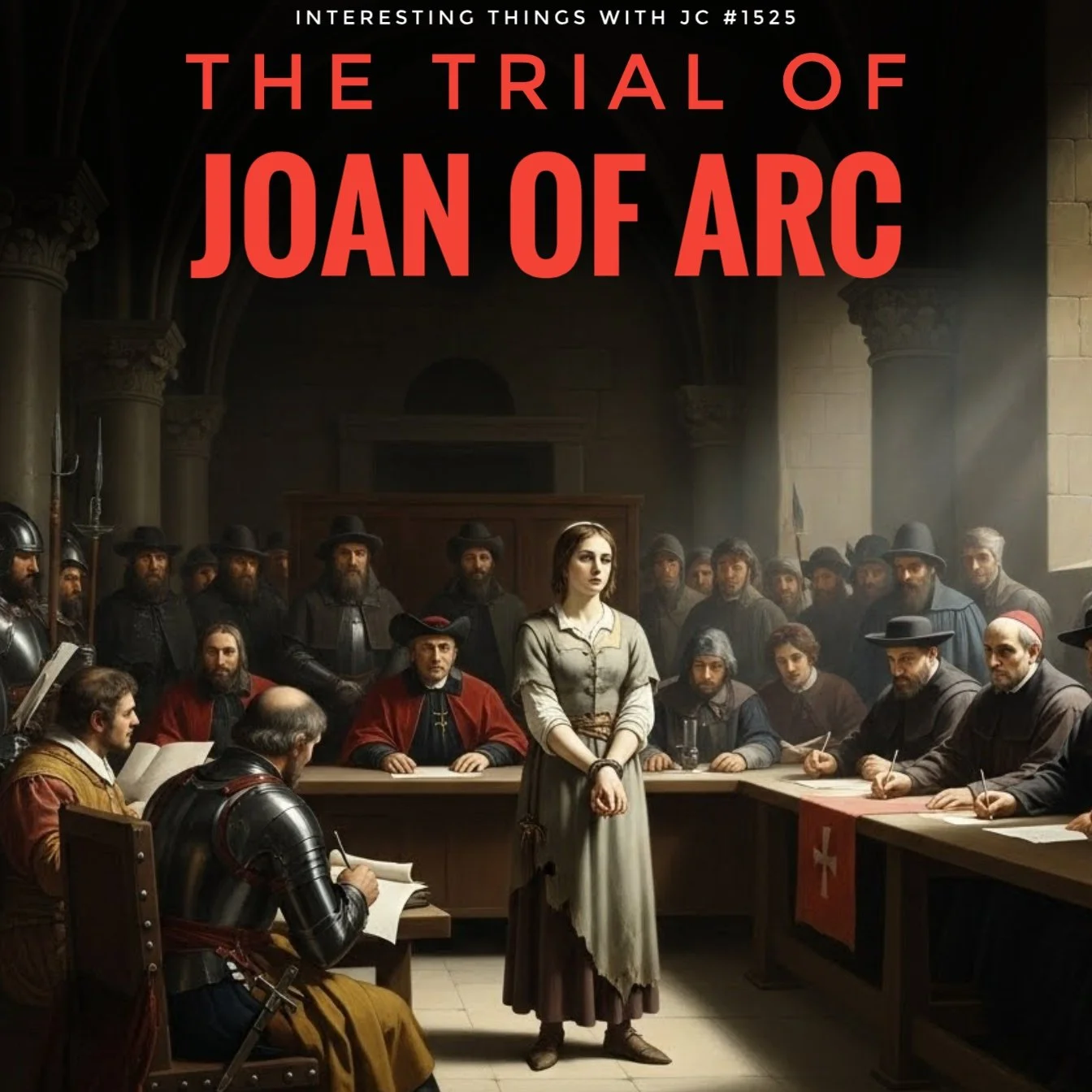
Square artwork with a dim, cathedral-like courtroom. Top text reads “INTERESTING THINGS WITH JC #1525,” and large red text reads “THE TRIAL OF JOAN OF ARC.” Joan stands centered with bound hands, facing forward, surrounded by seated and standing medieval officials at long tables, some writing. Light from the upper right highlights her while the background stays shadowed.
Transcript
Interesting Things with JC #1525: "The Trial of Joan of Arc"
In the winter of 1431, in the city of Rouen, France, under English occupation, a nineteen-year-old prisoner stood before more than a hundred church officials and scholars. She had no lawyer. She couldn’t read or write. But her words, taken down in nearly 800 pages of trial records, would be remembered for centuries.
Joan of Arc had become a problem. Not because she led troops into battle, but because she had helped crown a king. Just a year earlier, she escorted Charles VII to Reims and stood beside him as he was anointed the legitimate ruler of France. That act alone had changed the course of the war. If her visions came from God, then so did Charles’s reign. But if they came from demons, England could still claim the throne.
The trial began on January 9. The lead judge was Pierre Cauchon, a French bishop who owed his position to the English. He was joined by Jean Le Maistre, the vice-inquisitor. Over 130 men were involved in the proceedings, many of them trained at the University of Paris, the top theological school of the time.
Before Joan even entered the courtroom, court officers traveled to her hometown of Domrémy, near the Meuse River. They questioned people who had known her since childhood. They found no evidence of blasphemy or crime. She was described as honest, devout, and modest.
In February, the interrogations began. Joan faced both public hearings and private questioning in her prison cell. She was being held in a military prison under English guard, not in church custody as required by canon law. Still, she answered every question clearly. Her responses frustrated her accusers, who were hoping she’d trip herself up.
At one point they asked if she believed she was in God’s grace. It was a trap. Church doctrine said no one could be certain of such a thing. Saying yes would mean pride. Saying no would imply guilt. Joan answered, “If I am not, may God put me there. If I am, may He keep me there.” The court couldn’t find fault with that.
The charges against her originally totaled seventy. By spring, they were narrowed to twelve. These included her claim that she had received visions from saints, her refusal to submit fully to the Church’s authority, and her habit of wearing men’s clothing.
Joan testified that she had been guided by the voices of St. Michael, St. Catherine, and St. Margaret since she was thirteen. She said they had instructed her to lift the siege of Orléans and to lead Charles to his coronation.
Her wearing of men’s armor and clothing became a key focus. The court cited Deuteronomy 22:5, which forbids a woman from wearing a man’s garments. Joan explained she wore them on the battlefield and again in prison, where she feared being attacked by her male guards. The explanation didn’t matter. The outcome was already taking shape.
On May 24, in front of a crowd outside the Church of Saint-Ouen, Joan was threatened with immediate execution. A scaffold had been built. Surrounded by officials and clerics, she was pressed to recant. Under pressure and fearing the fire, she signed a statement, likely without understanding all its contents, and agreed to wear women’s clothing. Her sentence was reduced to life in prison.
Less than a week later, she was found back in men’s clothing. She told the court her dress had been taken away. She also said the voices had returned and told her she had sinned by recanting. The judges called it a relapse into heresy. And under Church law at the time, relapse meant death.
On the morning of May 30, 1431, Joan was led to the marketplace of Rouen. She was tied to a tall wooden stake surrounded by wood and straw. A Dominican friar named Isambart de la Pierre stayed near her, offering comfort as the execution began. Witnesses said she called out the name of Jesus again and again. She was nineteen years old.
Her body was burned twice more, just to make sure nothing remained. Her ashes were dumped in the Seine River.
Twenty-five years later, in 1456, the Church reopened her case. Pope Callixtus III ordered a full review. Over one hundred witnesses were called. The new panel found that Joan’s trial had been politically driven, legally flawed, and theologically unsound. The original verdict was declared null and void.
In 1920, she was declared a saint by Pope Benedict XV. She is now the patron saint of France, and her trial transcript remains one of the most detailed legal records from the Middle Ages.
She never claimed to be important. She never asked for fame. She believed she was following the will of God, and she stayed faithful to that belief until the fire took her.
These are interesting things, with JC.
Student Worksheet
What made Joan of Arc “a problem” for the English claim to the French throne, according to the episode?
Explain why the question about being “in God’s grace” was a trap. How did Joan answer it, and why was it effective?
List two major charges narrowed into the final set described in the episode. What evidence did the court emphasize?
Why did Joan say she wore men’s clothing while imprisoned? How did the court treat that explanation?
Creative prompt: Write a 1-page “primary source reflection” as if you are a scribe in Rouen in 1431. What do you observe about the courtroom strategy and tone?
Teacher Guide
Estimated Time
45–60 minutes (one class period) or 90 minutes (with document analysis extension)
Pre-Teaching Vocabulary Strategy
“Frayer Model Sprint” (10 minutes): students complete 3 boxes (definition, example, non-example) for heresy, recant, canon law.
Quick oral rehearsal: students use each word in a sentence tied to the episode.
Anticipated Misconceptions
“Medieval trials were all the same.” (Clarify differences between secular vs. ecclesiastical jurisdiction and procedure.)
“A transcript guarantees fairness.” (A record can be detailed yet still reflect coercion, constraints, or bias.)
“Religious questions were only about faith.” (In this case, theology is bound tightly to politics and legitimacy.)
Discussion Prompts
Which details suggest the court was searching for a predetermined outcome? Cite moments from the transcript/episode.
Is a “trap question” always unethical? When might it be legitimate, and when is it coercive?
How does the existence of a long record shape what later generations can argue about the case?
Differentiation Strategies: ESL, IEP, gifted
ESL: provide a two-column glossary (term / simple definition) + sentence stems (“The court focused on ___ because ___.”).
IEP: chunk the episode into 4 segments; after each, answer one guided question with a partner.
Gifted: compare Joan’s recorded responses to modern legal rights concepts (counsel, venue, custody) using evidence-based argumentation.
Extension Activities
Primary-source excerpt analysis: use a short passage from a reputable translation of the trial record and annotate for question type (open, leading, trap, forced choice).
“Appeals Court Brief” simulation: students write a one-page argument for why a verdict should be upheld or overturned, citing procedure and evidence.
Cross-Curricular Connections:
English/Language Arts: rhetoric under pressure; analyzing how answers are structured to avoid false choices.
Civics/Law: legal procedure, due process concepts, and how institutions correct past rulings.
Theology/Religious Studies (historical): how doctrine and authority are invoked in legal contexts.
Media Literacy: how narrative framing influences modern memory of historical figures.
(Framework source used: )
Quiz
Q1. Where did Joan of Arc’s 1431 trial take place?
A. Paris
B. Rouen
C. Orléans
D. Reims
Answer: B
Q2. According to the episode, why did Joan’s role in Charles VII’s coronation matter politically?
A. It proved the English had no army
B. It threatened the legitimacy of English claims to rule France
C. It ended the Hundred Years’ War immediately
D. It made Joan the queen
Answer: B
Q3. What was the purpose of the “Are you in God’s grace?” question as described?
A. To compliment Joan
B. To test her reading ability
C. To trap her into an answer that could be called prideful or guilty
D. To decide her prison food
Answer: C
Q4. Which issue became a major focus late in the trial?
A. Joan’s tax records
B. Joan’s men’s clothing
C. Joan’s ability to write Latin
D. Joan’s ownership of land
Answer: B
Q5. What happened in 1456 according to the episode?
A. Joan was captured
B. The English crowned Charles VII
C. The Church reviewed the case and declared the original verdict invalid
D. The trial began
Answer: C
Assessment
Open-ended question 1: Using evidence from the episode, explain two ways political power shaped the legal process in Joan’s trial.
Open-ended question 2: Evaluate Joan’s response to the “God’s grace” trap question. What makes it a strong answer, and what does it reveal about the court’s strategy?
3–2–1 rubric:
3 = Accurate, complete, thoughtful (uses specific episode evidence; explains cause/effect; clear reasoning)
2 = Partial or missing detail (some accurate points but limited evidence or unclear explanation)
1 = Inaccurate or vague (minimal evidence; misunderstandings of events or concepts)
Standards Alignment
Common Core State Standards (CCSS) – ELA/Literacy (Grades 9–12)
CCSS.RH.9-10.1 — Cite specific textual evidence to support analysis of primary/secondary sources (episode details + document excerpts).
CCSS.RH.9-10.2 — Determine central ideas and summarize key information accurately (trial timeline, charges, outcomes).
CCSS.RH.11-12.6 — Evaluate authors’ differing points of view on the same historical event (condemnation vs. rehabilitation narratives).
CCSS.WHST.9-10.1 — Write arguments focused on discipline-specific content (appeals brief / verdict evaluation).
CCSS.SL.11-12.1 — Initiate and participate effectively in collaborative discussions (structured debate on procedure and power).
C3 Framework for Social Studies State Standards
D2.His.1.9-12 — Evaluate how historical events and developments were shaped by unique circumstances of time and place (Rouen under English occupation).
D2.His.4.9-12 — Analyze complex interactions within societies (religion, law, war, legitimacy).
D2.His.14.9-12 — Analyze multiple and complex causes and effects of events (why the trial’s outcome mattered politically).
D3.1.9-12 — Gather relevant information from multiple sources while using the origin and credibility to guide selection (trial record translations, scholarly summaries).
D4.1.9-12 — Construct arguments using precise claims and evidence (legal/procedural critique writing).
ISTE Standards (Students)
ISTE 3 (Knowledge Constructor) — Evaluate sources and curate information (compare translations, reputable references, avoid unreliable retellings).
ISTE 6 (Creative Communicator) — Communicate complex ideas clearly using appropriate platforms (mock brief, annotated excerpt, reflection writing).
ISTE 7 (Global Collaborator) — Work with others to examine issues from multiple perspectives (role-based trial simulation and debrief).
UDL Guidelines (internationally used accessibility framework)
UDL 1.2 — Offer alternatives for auditory information (provide written excerpt/summary supports alongside audio).
UDL 5.2 — Use multiple tools for composition (graphic organizers, sentence frames, structured outlines).
UDL 8.3 — Foster collaboration and community (pair/share, role assignments, discussion norms).
International Equivalents (content-based)
England GCSE History (AQA/Edexcel/OCR – Skills Alignment) — Use and evaluate sources; explain causation and consequence; construct supported historical interpretations (trial procedure and political context).
Cambridge IGCSE History (0470) — Demonstrate source evaluation and structured explanation of historical events (evidence-based claims about bias and process).
IB DP History — Analyze and evaluate sources and perspectives; construct analytical essays using evidence (condemnation vs. rehabilitation comparison).
Show Notes
Episode #1525 follows the 1431 trial of Joan of Arc in Rouen, framing it as a collision of law, theology, and wartime politics. The narrative emphasizes how Joan’s role in affirming Charles VII’s legitimacy raised the stakes of determining whether her “voices” were divine or deceptive, and how courtroom strategy, including trap questions and procedural pressure, shaped the outcome. In classroom settings, this episode supports close reading, sourcing, and argument writing: students can practice distinguishing claims from evidence, identifying potential bias, and evaluating how institutions justify decisions. It also invites careful discussion about how primary-source records preserve voices under constraint, and why later reviews (like the 1450s rehabilitation process) matter for historical interpretation. Key historical anchors (trial dates, major figures, later canonization) are supported by standard reference works and official church documentation.
References
Encyclopaedia Britannica. (n.d.). Saint Joan of Arc: Capture, trial, and execution. Encyclopaedia Britannica. https://www.britannica.com/biography/Saint-Joan-of-Arc/Capture-trial-and-execution
Encyclopaedia Britannica. (n.d.). Pierre Cauchon. Encyclopaedia Britannica. https://www.britannica.com/biography/Pierre-Cauchon
Benedict XV. (1920, May 16). Divina disponente (Litterae Decretales). The Holy See. https://www.vatican.va/content/benedict-xv/la/bulls/documents/hf_ben-xv_bulls_19200516_divina-disponente.html
University of California, Santa Barbara, Department of History. (n.d.). The Trial of Joan of Arc (PDF). https://www.history.ucsb.edu/wp-content/uploads/Trial-of-Joan-of-Arc.pdf
Fordham University. (n.d.). Medieval Sourcebook: The Trial of Joan of Arc (translation and documents). https://sourcebooks.web.fordham.edu/basis/joanofarc-trial.asp