1524: "Ratification of the 11th Amendment (1798)"
Interesting Things with JC #1524: "Ratification of the 11th Amendment (1798)" – A guy from South Carolina sued Georgia and nearly blew up the Constitution. What came next? A fast-track amendment that pulled federal courts back in line.
Curriculum - Episode Anchor
Episode Title: Ratification of the 11th Amendment (1798)
Episode Number: 1524
Host: JC
Audience: Grades 9–12, college intro, homeschool, lifelong learners
Subject Area: U.S. History, Civics, Constitutional Law
Lesson Overview
By the early 1790s, the new Constitution was still being tested—especially in the federal courts. This episode explains how the Supreme Court’s decision in Chisholm v. Georgia (1793) triggered swift political backlash and led to the Eleventh Amendment, narrowing federal judicial power over lawsuits against states. It also traces how later rulings expanded “state sovereign immunity” beyond the amendment’s original text.
3–4 measurable learning objectives using action verbs:
Define “state sovereign immunity” and describe why it mattered to early U.S. states after independence.
Explain the Supreme Court’s holding in Chisholm v. Georgia (1793) and why states reacted strongly.
Analyze how the Eleventh Amendment changed federal court jurisdiction over certain suits against states.
Compare the Eleventh Amendment’s text with later interpretations (for example, Hans v. Louisiana) to see how constitutional meaning can expand through case law.
Key Vocabulary
Sovereign (SAH-vuh-rin) — A government with independent authority; in the episode, states argued they could not be sued without consent.
Jurisdiction (joor-is-DIK-shun) — A court’s legal power to hear a case; the dispute centered on whether federal courts had power over suits against states.
Article III (AR-ti-kul three) — The Constitution’s judicial article; the Court read its language to allow certain suits involving states.
Ratification (rat-uh-fih-KAY-shun) — The state approval process for constitutional amendments; the Eleventh Amendment reached the required threshold in 1795.
State sovereign immunity (SOH-vuh-rin ih-MYOO-nuh-tee) — The doctrine that states are generally protected from being sued without consent; later cases broadened it beyond the amendment’s text.
Amendment (uh-MEND-muhnt) — A formal change to the Constitution; the Eleventh Amendment narrowed federal judicial power in specific cases.
Narrative Core
Open – The young U.S. Constitution is “unsettled law,” and states fear being dragged into federal court like private defendants.
Info – Chisholm v. Georgia (1793) arises from unpaid Revolutionary War-era claims; Georgia refuses to appear, asserting sovereignty.
Details – The Supreme Court rules 4–1 that federal judicial power reaches the dispute; Georgia threatens harsh punishment for enforcing the judgment; Congress proposes an amendment that becomes the Eleventh.
Reflection – A targeted “fix” becomes a long-lasting constitutional doctrine as later courts broaden state immunity (including Hans v. Louisiana).
Closing – These are interesting things, with JC.
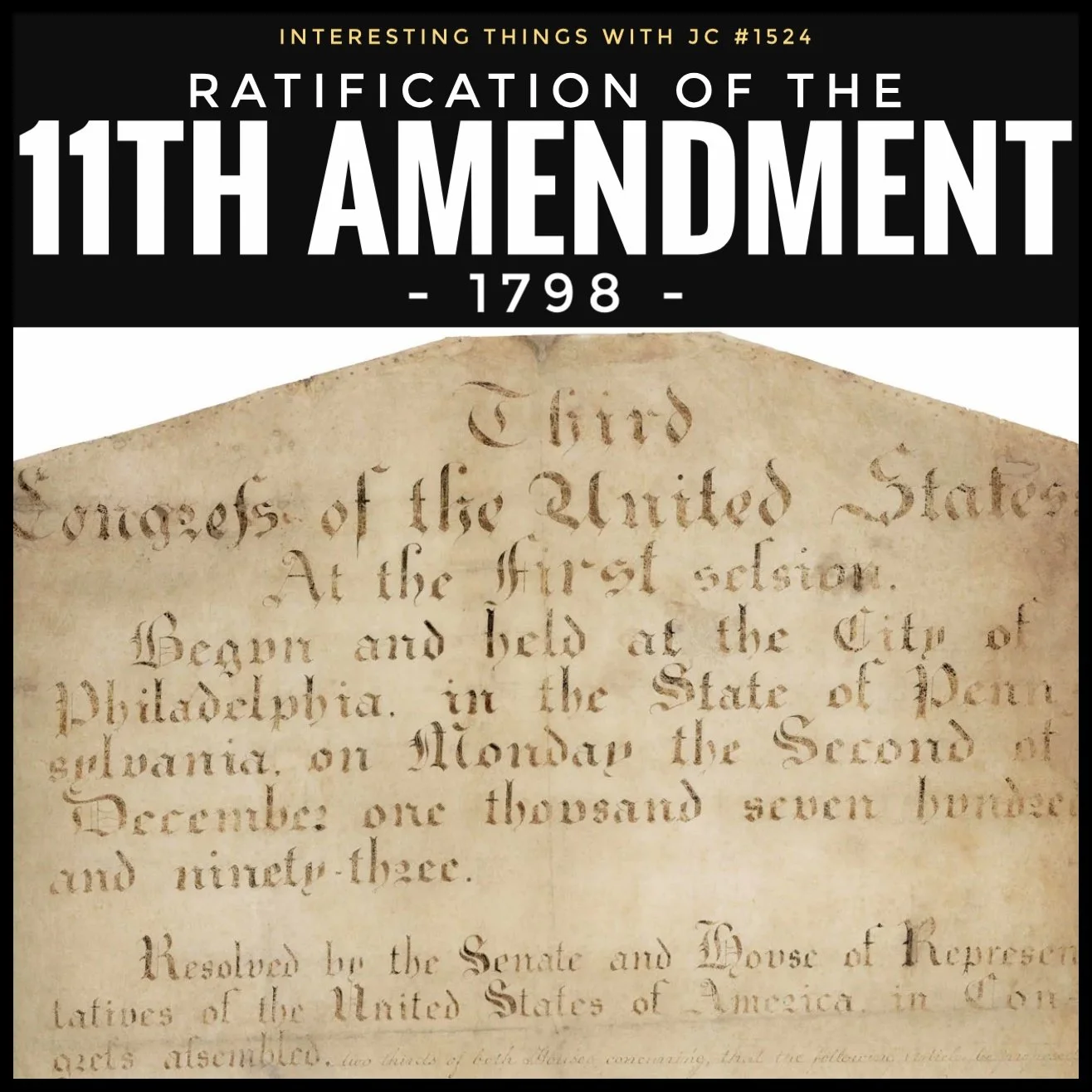
Black title banner reading “Interesting Things with JC #1524 — Ratification of the 11th Amendment — 1798” above a parchment-style image showing an early U.S. congressional document with faded handwritten text from the late 1700s.
Transcript
Interesting Things with JC #1524: "Ratification of the 11th Amendment (1798)"
In the early years of the United States, the Constitution was still unsettled law. The nation was new, the federal courts were untested, and the states guarded their independence closely. What unsettled them most was the possibility that a distant federal tribunal could summon a sovereign state and place it on trial like a private individual.
That fear became real in 1793 with a lawsuit called Chisholm v. Georgia. A South Carolina merchant named Alexander Chisholm (CHIZ-um) sued the State of Georgia (JOR-juh) in federal court. Chisholm sought payment for supplies delivered during the Revolutionary War, which had ended only ten years earlier in 1783. Georgia refused to appear, arguing that a sovereign state could not be sued without its consent.
The Supreme Court ruled otherwise. By a four-to-one vote, the justices held that Article III of the Constitution granted federal courts authority over disputes between states and citizens of other states. The language was read plainly, without accommodation for political consequence. To many state leaders, the ruling crossed a line. War debts were widespread, financial records were uneven, and states feared a wave of lawsuits that could empty their treasuries. Georgia responded with defiance, passing a statute that threatened the death penalty for anyone attempting to enforce the Court’s judgment within the state.
Congress acted quickly. In March of 1794, Senator Caleb Strong of Massachusetts (mass-uh-CHOO-sits) introduced a constitutional amendment designed to reverse the decision. The wording was direct. It declared that federal judicial power would not extend to lawsuits against a state brought by citizens of another state or by foreign subjects.
Ratification followed at a rapid pace. By February 7, 1795, twelve of the fifteen states had approved the amendment, meeting the constitutional threshold. Administrative delays, however, postponed its formal recognition. It was not until January 8, 1798, that President John Adams notified Congress that the amendment was officially part of the Constitution. The Supreme Court soon dismissed all pending suits against states from its docket.
The Eleventh Amendment became the first constitutional amendment adopted after the Bill of Rights. It was intended as a correction, restoring limits the states believed had been removed by judicial interpretation. Federal courts remained, but their reach was narrowed where state sovereignty was concerned.
Its meaning did not remain confined to its original text. In 1890, the Supreme Court ruled that states were also immune from lawsuits brought by their own citizens in federal court. What began as a narrow response to a single case grew into a broad doctrine known as state sovereign immunity. Today, states may still be sued if they consent, or if Congress clearly authorizes such actions under specific constitutional powers, including those tied to the Fourteenth Amendment.
A single lawsuit, brought by one creditor against one state, reshaped the balance between federal authority and state independence. The Eleventh Amendment stands as a reminder that the Constitution was designed not only to create national power, but to limit it where the states believed their sovereignty was at stake.
These are interesting things, with JC.
Student Worksheet
Answer in 2–4 sentences each.
Why did Georgia refuse to appear in federal court in Chisholm v. Georgia? What principle was Georgia defending?
What did the Supreme Court decide in Chisholm v. Georgia, and why did that decision alarm many states?
How did the Eleventh Amendment change what federal courts could do in certain lawsuits against states?
The episode says the Eleventh Amendment’s meaning expanded over time. What is one example of later expansion, and why does that matter?
Creative prompt: Write a short “headline + lead paragraph” (3–5 sentences) that a 1790s newspaper might print to explain the amendment to ordinary readers.
Teacher Guide
Estimated Time
45–60 minutes (or two 30-minute blocks)
Pre-Teaching Vocabulary Strategy
Quick-sort: Give students 6 vocabulary cards (sovereign, jurisdiction, ratification, Article III, immunity, amendment).
Students place each card under: “Court concept,” “Constitution concept,” or “Government power concept,” then justify choices aloud.
Anticipated Misconceptions
“The Eleventh Amendment means states can never be sued.” (Clarify: it limits specific categories; consent and certain constitutional pathways matter.)
“John Adams ‘passed’ the amendment.” (Clarify: states ratify; Adams sent an official message announcing adoption.)
“Chisholm was only about politics, not legal text.” (Clarify: the decision turned on a reading of Article III jurisdiction.)
Discussion Prompts
Should courts read constitutional language “plainly” even if the political consequences are severe? Why or why not?
What does this episode suggest about the relationship between courts and amendments (interpretation vs. correction)?
If you were a state leader in 1793, what would you fear most: debt claims, loss of sovereignty, or federal overreach? Defend your choice with episode evidence.
Differentiation Strategies: ESL, IEP, gifted
ESL: Provide sentence frames (“Georgia argued that… because…” “The amendment changed jurisdiction by…”) and a mini-glossary with simpler synonyms.
IEP: Offer a graphic organizer: “Case → Reaction → Amendment → Long-term impact” with partially filled blanks.
Gifted: Challenge students to compare the Eleventh Amendment’s text to the broader doctrine described later and argue whether that expansion is persuasive (use evidence).
Extension Activities
Primary-source practice: Read a short excerpt of the Eleventh Amendment text and paraphrase it into modern English (two versions: “student-friendly” and “legal-precise”).
Mini-moot court: Two teams argue whether a hypothetical lawsuit fits within the Eleventh Amendment’s limits, using only the amendment’s wording.
Timeline build: 1793 (Chisholm), 1794 (Congress passes), 1795 (ratified threshold), 1798 (official announcement), 1890 (Hans).
Cross-Curricular Connections: (e.g., physics, sociology, ethics)
ELA: Argument writing—claims, evidence, counterclaim about federal vs. state power.
Mathematics: Simple data reasoning—why “12 of 15 states” meets the 3/4 threshold (and how the threshold would change as new states join).
Government/Economics: War debts and fiscal risk as drivers of constitutional change.
Quiz
Q1. What sparked the push for the Eleventh Amendment?
A. A treaty dispute with France
B. A Supreme Court case allowing a private citizen to sue a state
C. A state’s attempt to leave the Union
D. A presidential veto of a court bill
Answer: B
Q2. In Chisholm v. Georgia, Georgia’s main argument was that:
A. Federal courts did not exist yet
B. A state could not be sued without its consent
C. The Supreme Court had too many justices
D. The Revolutionary War never created debts
Answer: B
Q3. What does the Eleventh Amendment’s text restrict?
A. All federal criminal trials
B. Federal courts hearing certain suits against a state by out-of-state or foreign plaintiffs
C. Congress’s power to pass taxes
D. The President’s power to appoint judges
Answer: B
Q4. According to the episode, when did President John Adams notify Congress that the Eleventh Amendment could be treated as part of the Constitution?
A. 1791
B. 1793
C. 1798
D. 1803
Answer: C
Q5. What later Supreme Court decision is commonly associated with expanding immunity to suits brought by a state’s own citizens?
A. Marbury v. Madison
B. Hans v. Louisiana
C. Brown v. Board of Education
D. Dred Scott v. Sandford
Answer: B
Assessment
Open-ended prompts (answer in a well-organized paragraph):
Explain how one Supreme Court decision led to a constitutional amendment. Include: the case, the reaction, and the amendment’s purpose.
The episode argues the Eleventh Amendment’s impact grew beyond its original wording. Explain how that happened and what it shows about constitutional interpretation over time.
3–2–1 rubric (for each response):
3 = Accurate, complete, thoughtful (clear chain: event → reasoning → effect; correct terms used)
2 = Partial or missing detail (mostly correct, but thin explanation or unclear linkages)
1 = Inaccurate or vague (major factual errors or little connection to the episode)
Standards Alignment
Common Core State Standards (Literacy in History/Social Studies)
CCSS.ELA-LITERACY.RH.11-12.1 — Cite specific textual evidence from the episode to support analysis of Chisholm, state reactions, and the amendment’s purpose.
CCSS.ELA-LITERACY.RH.11-12.2 — Determine central ideas (federal jurisdiction vs. state sovereignty) and summarize accurately.
CCSS.ELA-LITERACY.RH.11-12.6 — Evaluate how a legal/political viewpoint (state sovereignty) shapes responses to court decisions.
CCSS.ELA-LITERACY.WHST.11-12.1 — Write arguments about whether constitutional meaning should remain tied to text or can expand through precedent.
C3 Framework for Social Studies State Standards
D2.Civ.1.9-12 — Distinguish the powers and responsibilities of courts and states within a constitutional system.
D2.Civ.4.9-12 — Explain how constitutional rights and limits are interpreted through institutions (courts, Congress, amendment process).
D2.Civ.12.9-12 — Analyze how public policies and government actions (constitutional amendments) respond to disputes and perceived overreach.
D2.His.14.9-12 — Analyze multiple and complex causes and effects (a lawsuit leading to an amendment and long-term doctrine).
ISTE Standards (Students)
ISTE 1.3d (Knowledge Constructor) — Students gather information from reliable sources to build a short timeline of legal change (1793–1890).
ISTE 1.6b (Creative Communicator) — Students communicate complex ideas clearly (newspaper “lead paragraph” or mini-argument).
ISTE 1.7b (Global Collaborator) — Students compare how different systems handle government immunity concepts (optional extension discussion, evidence-based).
International Equivalencies
UK National Curriculum (KS4/GCSE – Citizenship/History, constitutional principles) — Understanding how law, courts, and government structures limit power; applying case-based reasoning to civic questions.
IB DP (History/Government-related civics skills: constitutional change and interpretation) — Analyze how political systems respond to legal conflicts; trace continuity and change through institutions and key events.
Show Notes
This episode follows a single early Supreme Court lawsuit, Chisholm v. Georgia (1793), and shows how it triggered a fast constitutional response: the Eleventh Amendment. Students see the practical fears behind constitutional change (war debts, state treasuries, and sovereignty concerns) and how the amendment narrowed federal judicial power over certain suits against states. The episode also previews a crucial idea for modern civics: constitutional meaning is shaped not only by text and ratification, but also by later court interpretations, including expansions of state sovereign immunity. This matters today because questions about when states can be sued; by whom, and in what courts continue to influence how federalism works in real life.
References
Federal Judicial Center. (n.d.). Chisholm v. Georgia (1793). https://www.fjc.gov/history/cases/cases-that-shaped-the-federal-courts/chisholm-v-georgia
National Archives. (n.d.). The Constitution: Amendments 11–27 (Amendment XI dates and text). https://www.archives.gov/founding-docs/amendments-11-27
Oyez. (n.d.). Chisholm v. Georgia (2 U.S. 419) (case summary). https://www.oyez.org/cases/1789-1850/2us419
U.S. Congress, Constitution Annotated. (n.d.). Early Amendments (Eleventh and Twelfth Amendments) (official announcement delay; Jan. 8, 1798). https://constitution.congress.gov/browse/essay/intro.6-3/ALDE_00000136/
The American Presidency Project. (1798, January 8). Special Message (re: Eleventh Amendment adoption). https://www.presidency.ucsb.edu/documents/special-message-3304
Justia U.S. Supreme Court. (1890). Hans v. Louisiana, 134 U.S. 1 (state immunity extended to suits by a state’s own citizens). https://supreme.justia.com/cases/federal/us/134/1/