Interesting Things with JC #1523: "Manganese" – It hides in nuts and leafy greens, works inside your bones and brain, and shapes desire itself. This unsung mineral is doing more than you think.
Curriculum - Episode Anchor
Episode Title: Manganese
Episode Number: #1523
Host: JC
Audience: Grades 9–12, college intro, homeschool, lifelong learners
Subject Area: Biology, Chemistry, Health Science, History of Science
Lesson Overview
Students will:
Define the role of manganese in human biology and nutrition.
Compare manganese with other essential minerals like calcium, iron, and magnesium.
Analyze the discovery and historical uses of manganese, including its role in ancient glassmaking.
Explain the biological mechanisms through which manganese influences hormone regulation and bone health.
Key Vocabulary
Manganese (ˈmaŋ-gə-ˌnēz) — A trace mineral that supports bone health, hormone regulation, and enzyme function.
Pyrolusite (ˈpī-rə-ˌlü-ˌsīt) — A mineral form of manganese dioxide; used historically in glassmaking and in the isolation of manganese metal.
Enzyme (ˈen-ˌzīm) — A protein that speeds up chemical reactions in the body; manganese helps certain enzymes function properly.
Dopamine (ˈdō-pə-ˌmēn) — A neurotransmitter associated with pleasure, motivation, and desire; its production is supported by manganese.
Antioxidant (ˌan-tē-ˈäk-sə-dənt) — A substance that protects cells from damage by free radicals; manganese contributes to this cellular defense system.
Narrative Core
Open – The episode introduces manganese by comparing it to more well-known nutrients like calcium and iron, setting the stage for a deeper dive into its overlooked importance.
Info – The story begins in 1774 with Johan Gottlieb Gahn’s isolation of manganese from pyrolusite, linking the element’s ancient use in glassmaking to its scientific discovery.
Details – The episode outlines manganese’s roles in energy metabolism, collagen production, bone health, hormone balance, and dopamine production—emphasizing its quiet but essential functions.
Reflection – Manganese, though needed in only trace amounts, plays an outsized role in maintaining health and hormone balance, connecting nutrition to both body and brain function.
Closing – "These are interesting things, with JC."
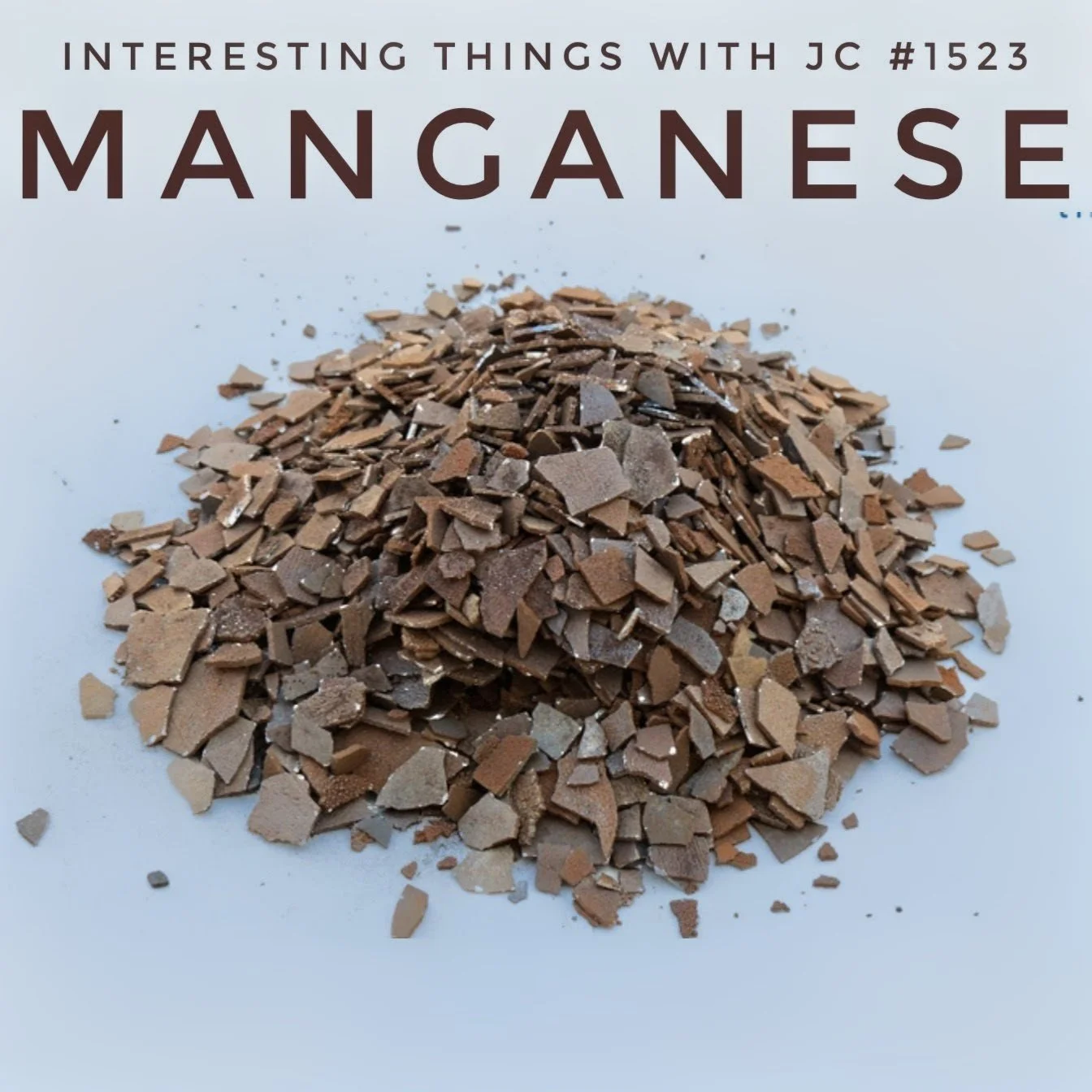
A high-resolution image shows a mound of manganese flakes in various shades of brown and metallic gray, resting on a light blue surface. The flakes are jagged and irregular, suggesting a brittle texture. At the top of the image, bold text reads: "Interesting Things with JC #1523: Manganese."
Transcript
Interesting Things with JC #1523: "Manganese"
Most of us know the big names in nutrition. Calcium. Iron. Potassium. They get the spotlight. But there are other minerals working in the background every day, keeping the system running without much credit. Manganese is one of them.
The story of manganese starts in 1774. A Swedish chemist named Johan Gottlieb Gahn was heating a black mineral called pyrolusite, pronounced pie-roh-loo-site. When he combined it with carbon and applied heat, he isolated a new metal. That metal was manganese. At the time, pyrolusite was already useful. Ancient glassmakers had used it for centuries to remove unwanted color from glass. What no one knew back then was that this same metal would turn out to be essential to human life.
Today, we know the body needs manganese in very small amounts. For adult men, about 2.3 milligrams per day. For women, about 1.8 milligrams. That’s less than the weight of a grain of rice. But that tiny amount carries a lot of responsibility.
Manganese helps enzymes do their jobs. It plays a role in turning food into usable energy. It helps build and maintain strong bones. It supports wound healing and helps the body make collagen, the protein that keeps skin flexible and joints working smoothly. It’s also part of the body’s antioxidant defenses, helping protect cells from everyday damage.
Where things get especially interesting is hormone regulation.
Manganese supports the systems that control sex hormones. In women, it helps regulate estrogen, which influences everything from menstrual cycles to fertility and libido. In men, it supports testosterone production, which affects sex drive, muscle mass, and sperm health. Balanced manganese levels help keep those systems steady rather than swinging too far in either direction.
There’s also a brain connection. Manganese helps the body produce dopamine, a neurotransmitter tied to motivation, pleasure, and sexual desire. That means this mineral doesn’t just support physical function. It also plays a role in how desire itself is wired.
Beyond hormones, manganese works closely with calcium and magnesium to keep bones dense and resilient. Long-term deficiency can weaken bone structure and interfere with normal metabolism. On the other end, too much manganese, usually from environmental or industrial exposure rather than food, can damage the nervous system. Like many things in biology, balance matters.
Most people get enough manganese without trying. Nuts, whole grains, leafy greens, beans, and even pineapple provide it naturally. It’s not flashy. It doesn’t come in trendy supplements. It just shows up, does its job, and moves on.
From an eighteenth-century chemistry experiment to the inner workings of your bones, brain, and hormones, manganese is proof that small things often carry the biggest workload. The next time you eat a handful of nuts or a bowl of greens, remember there’s more going on than you can see.
These are interesting things, with JC.
Student Worksheet
Who first isolated manganese, and what mineral was used in the process?
List three biological functions that manganese supports in the human body.
Explain how manganese influences hormone production in both men and women.
Why is manganese considered part of the body’s antioxidant defense system?
Provide examples of foods that are natural sources of manganese.
Teacher Guide
Estimated Time
45–60 minutes (1 class period)
Pre-Teaching Vocabulary Strategy
Use visual aids or a word wall for key terms like “enzyme,” “dopamine,” and “pyrolusite.”
Conduct a quick comparison chart of essential minerals (Ca, Fe, Mg, Mn).
Anticipated Misconceptions
Students may confuse manganese with magnesium due to similar names.
Students may believe more manganese is always better; clarify that excess can be harmful.
Discussion Prompts
Why might some essential nutrients be less well-known despite their importance?
How does the discovery of an element influence our understanding of health over time?
Should nutrition education focus more on trace minerals like manganese?
Differentiation Strategies
ESL: Provide sentence frames for answering questions.
IEP: Offer audio replay of the episode and visual guides for mineral functions.
Gifted: Encourage research into the environmental impacts of manganese mining.
Extension Activities
Create a health infographic about the role of trace minerals.
Investigate other "quiet" nutrients that play crucial roles in the body.
Cross-Curricular Connections
Chemistry: Periodic table and elemental properties.
History of Science: 18th-century European chemistry.
Health Science: Nutritional needs and deficiencies.
Psychology: Dopamine's role in brain function and motivation.
Quiz
Q1. What mineral did Johan Gottlieb Gahn use to isolate manganese?
A. Hematite
B. Pyrolusite
C. Magnetite
D. Bauxite
Answer: B
Q2. Manganese helps the body produce which neurotransmitter?
A. Serotonin
B. GABA
C. Dopamine
D. Adrenaline
Answer: C
Q3. What daily amount of manganese is recommended for adult women?
A. 5.2 milligrams
B. 3.0 milligrams
C. 2.3 milligrams
D. 1.8 milligrams
Answer: D
Q4. What is one function manganese serves in the human body?
A. DNA replication
B. Oxygen transport
C. Bone formation
D. Vision improvement
Answer: C
Q5. What is a potential effect of too much manganese?
A. Anemia
B. Nerve damage
C. Brittle nails
D. Hair loss
Answer: B
Assessment
Describe how manganese helps regulate hormone levels and identify specific hormones it affects in men and women.
Explain why balance is important when it comes to manganese intake, including what can happen if levels are too high or too low.
3–2–1 Rubric
3 = Accurate, complete, thoughtful
2 = Partial or missing detail
1 = Inaccurate or vague
Standards Alignment
NGSS (Next Generation Science Standards)
HS-LS1-3 — Plan and conduct an investigation to provide evidence that feedback mechanisms maintain homeostasis.
Linked to manganese’s role in hormone regulation and antioxidant defense.
HS-LS1-2 — Develop and use a model to illustrate the hierarchical organization of interacting systems.
Connected to manganese’s support of enzymes, bones, and the nervous system.
Common Core State Standards – ELA
CCSS.ELA-LITERACY.RST.9-10.2 — Determine the central ideas of a text and provide an accurate summary.
CCSS.ELA-LITERACY.RI.11-12.4 — Determine the meaning of words and phrases as they are used in a text.
ISTE Standards for Students
1.1 Empowered Learner — Students understand the fundamental concepts of technology operations.
Applied through exploration of historical scientific methods and nutritional science.
International Standards Alignment
UK National Curriculum (Chemistry, KS4)
Chemistry: Elements and the periodic table — Understand the properties and uses of transition metals like manganese.
IB MYP Sciences
Criterion A: Knowing and understanding — Explain scientific knowledge through historical and biological case studies.
Cambridge IGCSE Combined Science
B7.1 Biological Molecules — Describe the role of minerals and vitamins in health and nutrition.
Show Notes
In this episode of Interesting Things with JC, the spotlight turns to manganese, a little-known but crucial trace mineral. JC walks listeners through its discovery in 1774 by Johan Gottlieb Gahn, its historical use in glassmaking, and its current role in human biology. Students will learn how manganese supports enzyme activity, hormone regulation, dopamine production, and bone development, all in trace amounts smaller than a grain of rice. This episode bridges chemistry and health science, showing how essential nutrients operate quietly behind the scenes. It's ideal for classroom discussions about metabolism, micronutrients, and the historical evolution of scientific knowledge.
References
Institute of Medicine. (2001). Dietary Reference Intakes for Vitamin A, Vitamin K, Arsenic, Boron, Chromium, Copper, Iodine, Iron, Manganese, Molybdenum, Nickel, Silicon, Vanadium, and Zinc. https://www.ncbi.nlm.nih.gov/books/NBK222310/
National Institutes of Health. (2022). Manganese Fact Sheet for Health Professionals. https://ods.od.nih.gov/factsheets/Manganese-HealthProfessional/
Royal Society of Chemistry. (n.d.). Manganese Element Facts. https://www.rsc.org/periodic-table/element/25/manganese